
Earlier this year, we launched ServiceNow Futures, a future-forward team of futurists, innovation officers, and futures engineers inside ServiceNow. Our mission is simple, but urgent: help leaders see further and act sooner.

As part of that work, we translate emerging signals, market shifts, and technology trends into actionable insights for the C-suite. Our research, thinking, and customer-facing work become executive frameworks, reports, webinars, and workshops — practical tools to help business and technology leaders make better decisions today for a world that does not fully exist yet.
Today, I’m proud to share the release of my latest ServiceNow Futures Report, “AI Cultures and Agentic Darwinism: Why Survival of the Fittest Starts With a Leadership Mindshift.” It is available to download immediately, with no email gate and no paywall. The other news is that it was developed with advisory from my old friend and former Altimeter colleague, now General Partner at Blitzscaling Ventures, Jeremiah Owyang. 🙌
I wanted to share it here with this community because the report explores something I believe every leader needs to confront now: AI transformation is not just a technology strategy. It is a cultural one.
The companies that will thrive in an era of AI Darwinism will not simply be the ones that deploy the most AI tools, launch the most pilots, or chase the biggest productivity targets. That’s becoming status quo. They will be the organizations with the leadership capacity, cultural readiness, and operating imagination to evolve.
So, let’s dive in.

The question we sought to answer is among the companies navigating AI, what kind of culture was taking shape as these companies navigated their AI journey.
We explored four AI cultures, each with four different survival odds. Technically, Jeremiah’s research identified five cultures. In this report, we explored the following…
AI Followers
AI Forward
AI First
AI Native
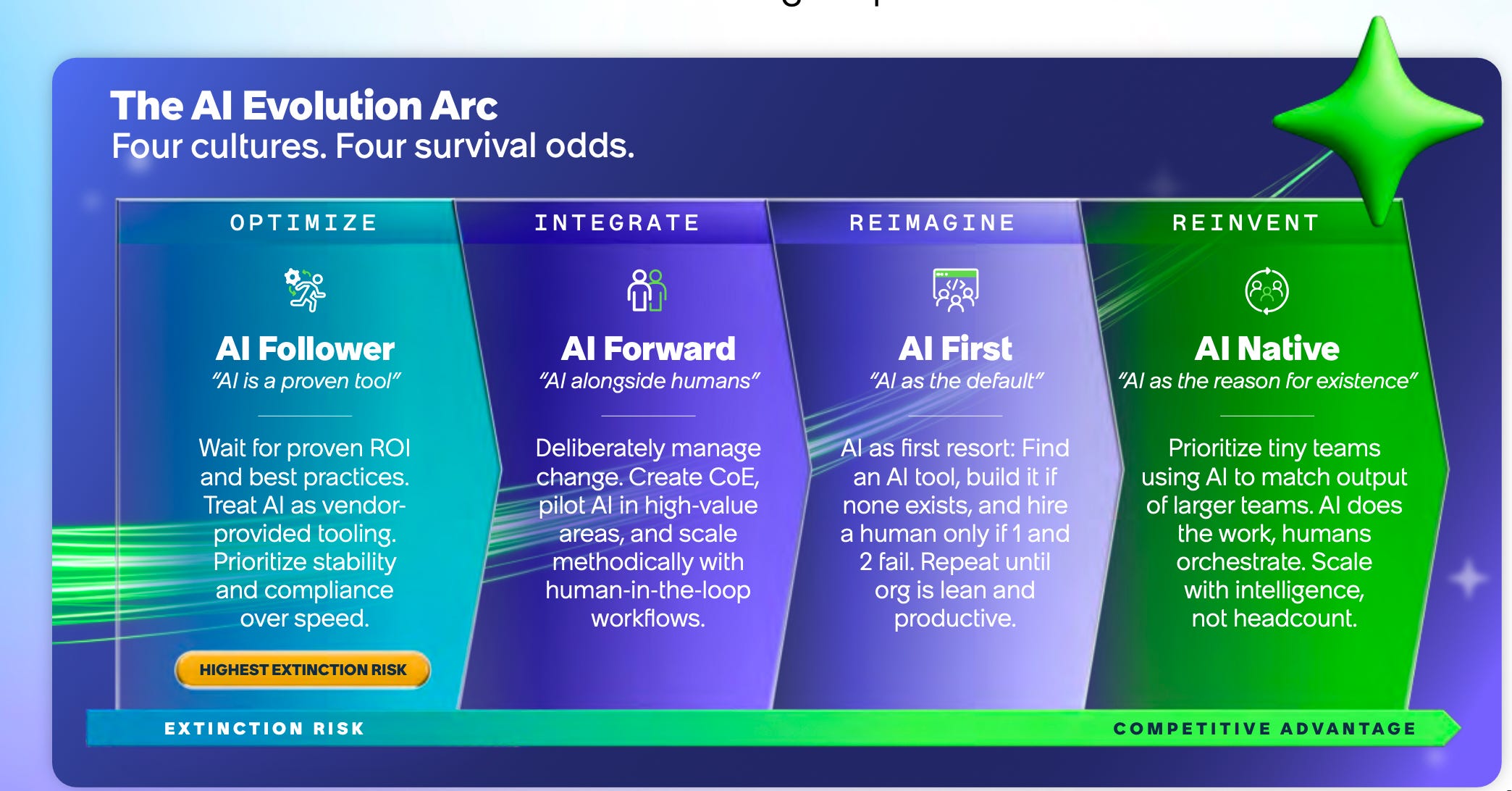
AI Followers wait. They look for proven ROI, best practices, vendor maturity, regulatory comfort, and consensus before moving with conviction. They value stability and compliance. There is wisdom in caution, but in a world moving this quickly, waiting can become a strategy for falling behind. Followers use AI to optimize what already exists. They are trying to play the old game better.
AI Forward organizations move deliberately. They integrate AI alongside people and often emphasize augmentation to bring employees into the journey. They create centers of excellence, pilot high-value use cases, scale what works, and design human-in-the-loop workflows. Forward cultures understand that AI transformation is not a technology rollout. It is a change in behavior, belief, and operating rhythm.
AI First companies invert the default. Instead of asking, “Who should do this work?” they ask, “Can AI do this first?” The operating assumption changes. AI becomes the first resort, not the afterthought. Humans do not disappear. They move up the value chain toward judgment, creativity, empathy, trust, exception handling, and orchestration.
AI Native companies are built, or rebuilt, with AI at the core. For startups, AI is not a feature. It is the foundation. They scale with intelligence, not headcount. Tiny teams can produce the output of much larger organizations because AI performs operational work and humans orchestrate outcomes. But AI Native is not only a startup phenomenon. Established companies can also rethink functions, workflows, and business models from first principles by asking, “If we started over today with AI at the center, what would this become?”
These cultures are not merely labels. They are a reflection in the AI mirror.
Where are you really?
And where are your competitors, customers, employees, and AI-native challengers going?
Once leaders can answer honestly, they can evolve intentionally.
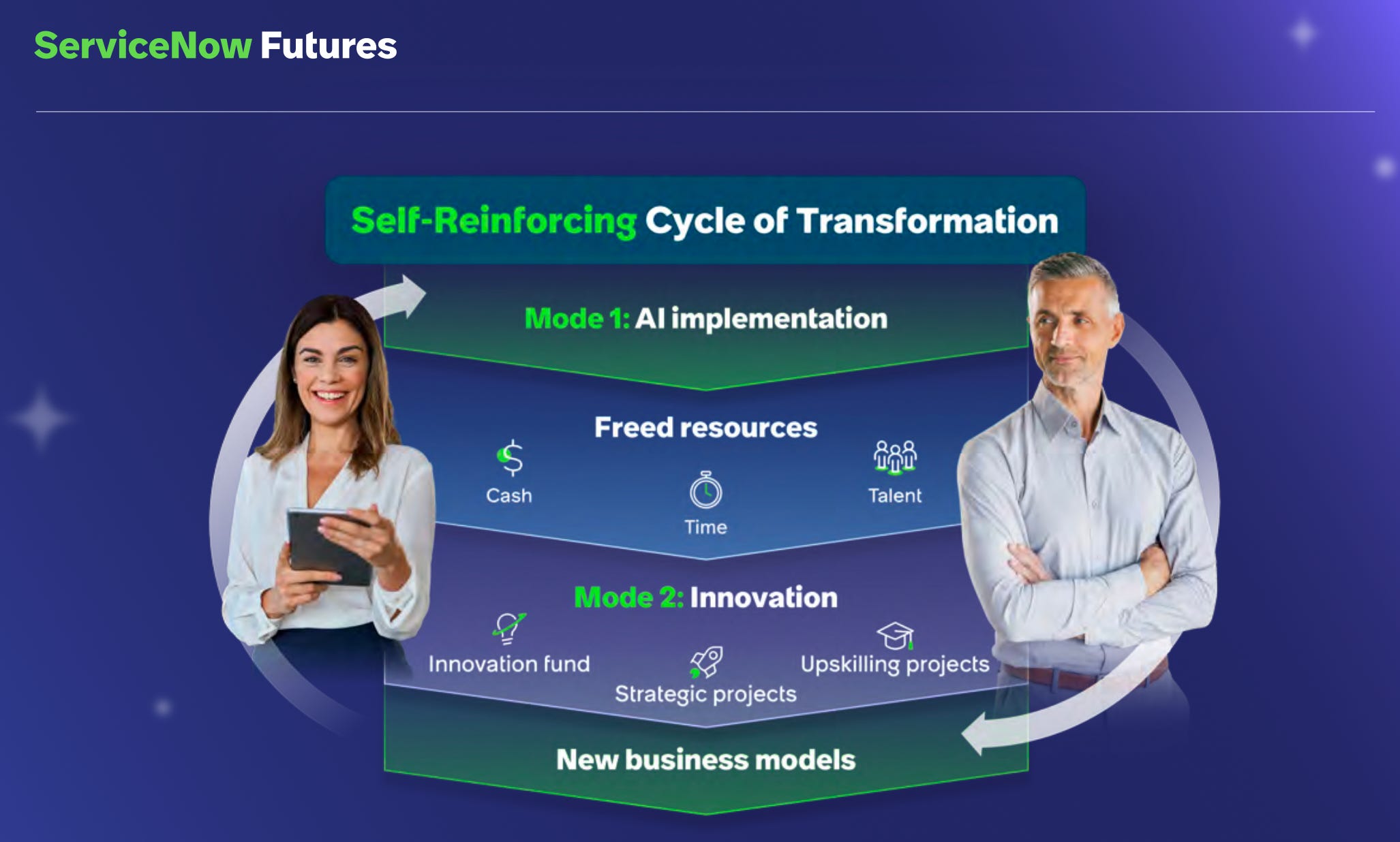
In the report, we introduce a bimodal strategy for doing so. Mode 1 is optimized AI. It improves existing workflows, reduces manual work, lowers costs, accelerates cycle times, and creates visible wins. This matters because credibility matters. CFOs need proof. Employees need momentum. Leaders need confidence.
Mode 1 is not the destination. It is rooted in meaningful progress.
Mode 2 is innovative AI. It uses the capacity created by optimization to explore new products, services, experiences, revenue streams, and business models. This is where AI stops being a productivity story and becomes a growth story.
The magic is in the cycle. Mode 1 frees resources: cash, time, and talent. Those resources should not disappear into more meetings, messages, and dashboards. They must be deliberately reinvested into Mode 2. Savings become fuel. Efficiency becomes capacity. Capacity becomes reinvention. Reinvention creates advantage. Advantage invites further investment.
That is how evolution compounds.
The AI Evolution Arc maps the journey from Optimize to Integrate to Reimagine to Reinvent. Or, culturally, from AI Follower to AI Forward to AI First to AI Native.
This progression is not guaranteed. Organizations can get stuck optimizing indefinitely. They can celebrate productivity while competitors redefine the market. They can become more efficient at work that matters less.
Darwin taught us that adaptation determines survival.
In the era of AI Darwinism, adaptation is now a leadership choice.
Please read the report. 🙏
No posts
Comments
Nothing yet. Say the first thing.
Sign in to join the conversation.