
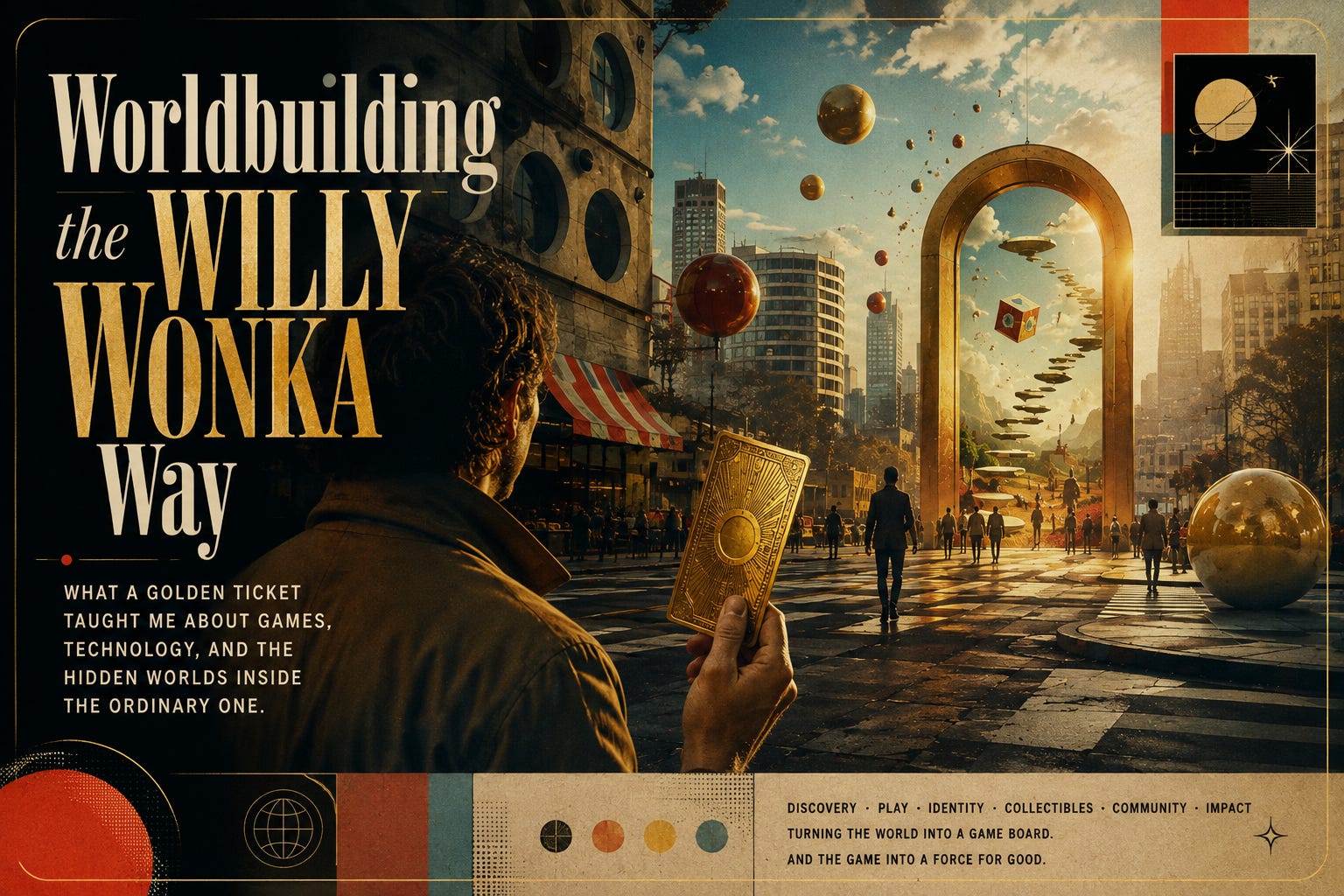
I must have been seven or eight when I first saw Willy Wonka & the Chocolate Factory. I don’t remember where I saw it. I do remember wanting the ticket.
Wonka’s factory was the sort of place a child could become obsessed with. Everyone knew it was there. Strange and wonderful things came out of it, but almost nobody went in, and nobody seemed to know what happened behind those enormous gates.
Then came the Golden Ticket.
Hidden somewhere inside an ordinary chocolate bar was a tiny piece of gold that could get you through those gates and into the impossible place on the other side.
I remember what that idea did to my imagination.
Suddenly the corner store in my neighborhood wasn’t quite the same place. A chocolate bar was no longer just something you ate. Now I wondered about the world behind it. Where did it come from? How was it made? What might be happening somewhere beyond the wrapper that I couldn’t see?
Wonka made ordinary things feel like they might have another world hiding behind them.
There was already a long tradition of putting something extra inside an ordinary product. Cracker Jack famously put prizes in its boxes. But Dahl made the prize a doorway. The Golden Ticket didn’t give you another thing. It gave you access to an entire world.
Collectors know this feeling. When you open a pack of trading cards or a blind box, you already know you’re getting something you want. But there’s another possibility hiding inside: the rare card, the secret figure, the chaser. You don’t know if you’ll get it, and that uncertainty turns opening the package into an event.
The Golden Ticket may be one of the purest versions of that mechanic. Charlie wasn’t buying a lottery ticket. He was buying chocolate. The chocolate had value either way, but hidden inside was the possibility of something extraordinary.
That possibility changed the meaning of the chocolate bar, and for a while, the whole world around it.
Looking back, I think that was my first encounter with something I’ve spent much of my career trying to create: worldbuilding.
What interested me about worldbuilding was never just creating fictional places. It was what happened when a story changed the way you saw the place you were already standing in. A familiar street could suddenly hold a mystery. You might walk somewhere you’d walked a hundred times and start looking for something you had never noticed before.
I didn’t have language for that way of thinking when I was eight. Decades later, I started building it, using whatever technology was available to bring that hidden layer to life.
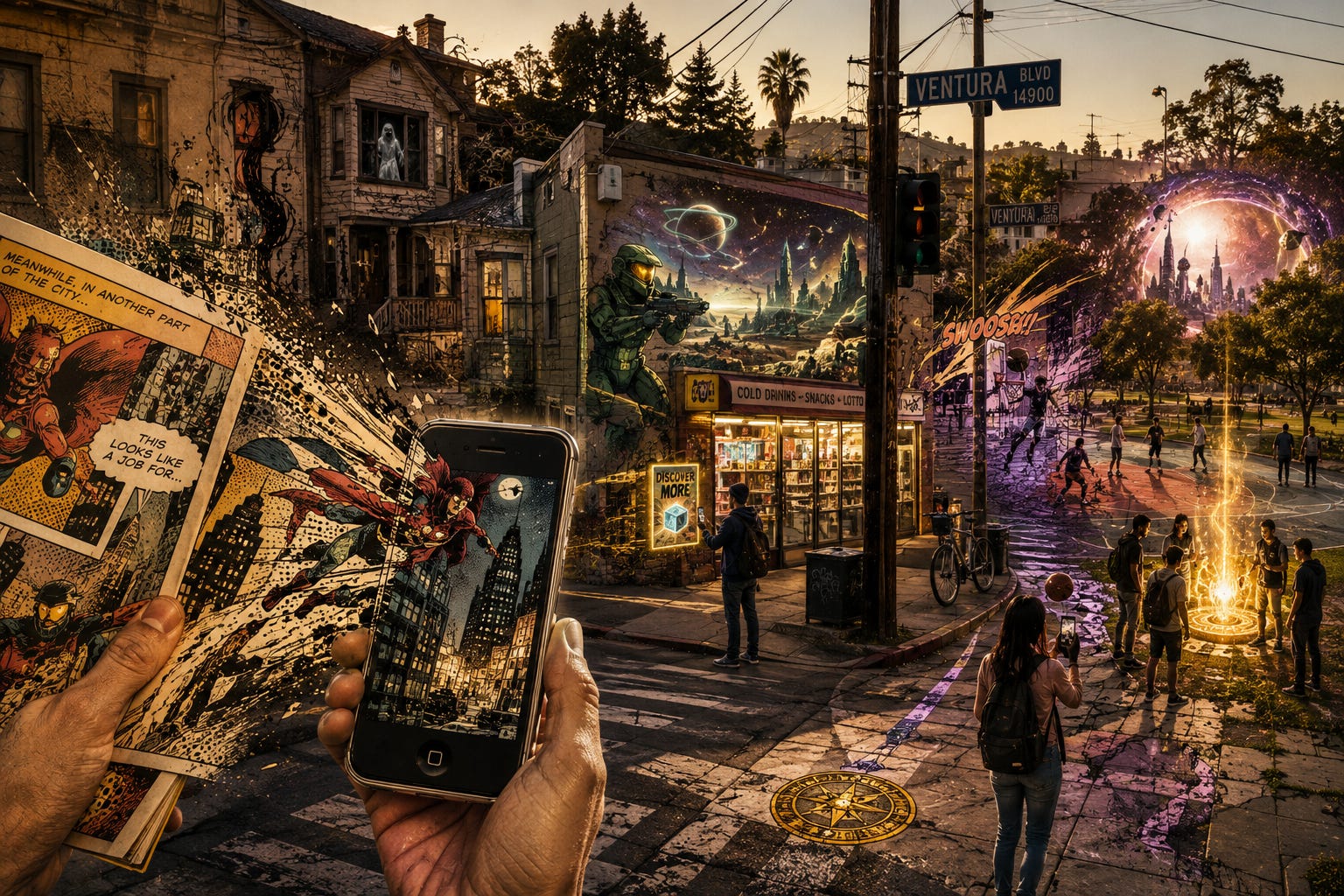
When I founded Ogmento as a new kind of mobile gaming company, I didn’t think of the phone as a screen where the game took place. The game was happening in the world around you. The phone was the looking glass that let you see it.
We called what we were doing location-based gaming because where you stood actually mattered. We called it augmented reality gaming because we could place digital things into the physical environment around you. Those were useful descriptions of the technology, but I always thought we were building something larger.
We haunted people’s actual surroundings with Paranormal Activity, letting the fiction escape the screen and show up where you lived. With Halo, a 7-Eleven or a product on the shelf could become part of the game. With the NBA, real neighborhoods and cities became part of a larger digital experience and competition.
What fascinated me was what happened when the boundaries between the story and ordinary life started to disappear. A store could become part of the story. A product could unlock something you couldn’t otherwise access. Where you were could determine what happened next. The physical world was no longer just the backdrop for the game. It was becoming part of the game itself.
Once the world could respond to where you were and what you did, you weren’t simply consuming the story anymore. You were participating in it.
I kept coming back to one idea:
How do we turn the world itself into a game board?
We turned every 7-Eleven into a destination for a Halo experience. Go inside, interact with Mtn Dew or Doritos, and you could unlock power-ups, shields and other rewards. We even offered a rare code that could be entered into the Halo console game to unlock an exclusive helmet.
To our players, those Pepsi products contained something invisible that only they knew how to find. An everyday physical product had become a beacon for game content, and offered its own version of a Golden Ticket.
The product was still the same product. But to the player, there was now another world hiding inside it.
Entertainment was finally escaping the metal brick in your pocket and beginning to inhabit the world around you.
Years later, Pokémon GO made that idea obvious at enormous scale.
Today, in 2026, connecting a physical place or product to digital content is familiar territory. Scan something, visit somewhere, unlock something. What interests me now is that these experiences can begin to remember us.
AI can understand context, respond in real time and increasingly recognize where someone is in a journey. The same store, product or street can reveal something different because of what you’ve already done and what you’re trying to do next.
That changes the design problem.
We’re no longer limited to triggering isolated moments. We can build experiences where participation accumulates, actions have consequences and the world responds over time.
Game designers have understood this for decades. Player state, progression and feedback are what turn a series of interactions into a journey. Now those principles can move out into the physical world.
For brands, that opens up a different kind of relationship with customers. Instead of measuring only whether someone scanned, clicked or visited, we can ask whether they came back, progressed and became more deeply involved.
Which brings me back to Wonka.
The clever part of the Golden Ticket was that Wonka’s world began before anyone entered the factory. Once those tickets were hidden, the ordinary world became part of the game.
Dahl understood something fundamental about attention. Hide something rare among ordinary things and we start looking at the ordinary more carefully.
Wonka’s factory was full of technology, but nobody remembers the machinery. We remember what it felt like to enter.
That’s the part of worldbuilding I think we sometimes lose when we become enamored with the tools. I’ve worked through several generations of them now, from mobile and location to AR, spatial computing and AI. Each has given us new ways to reveal another layer of possibility inside the world we already inhabit.
But the question that interests me now has changed.
If we really can turn the world into a game board, what kind of game should we build?
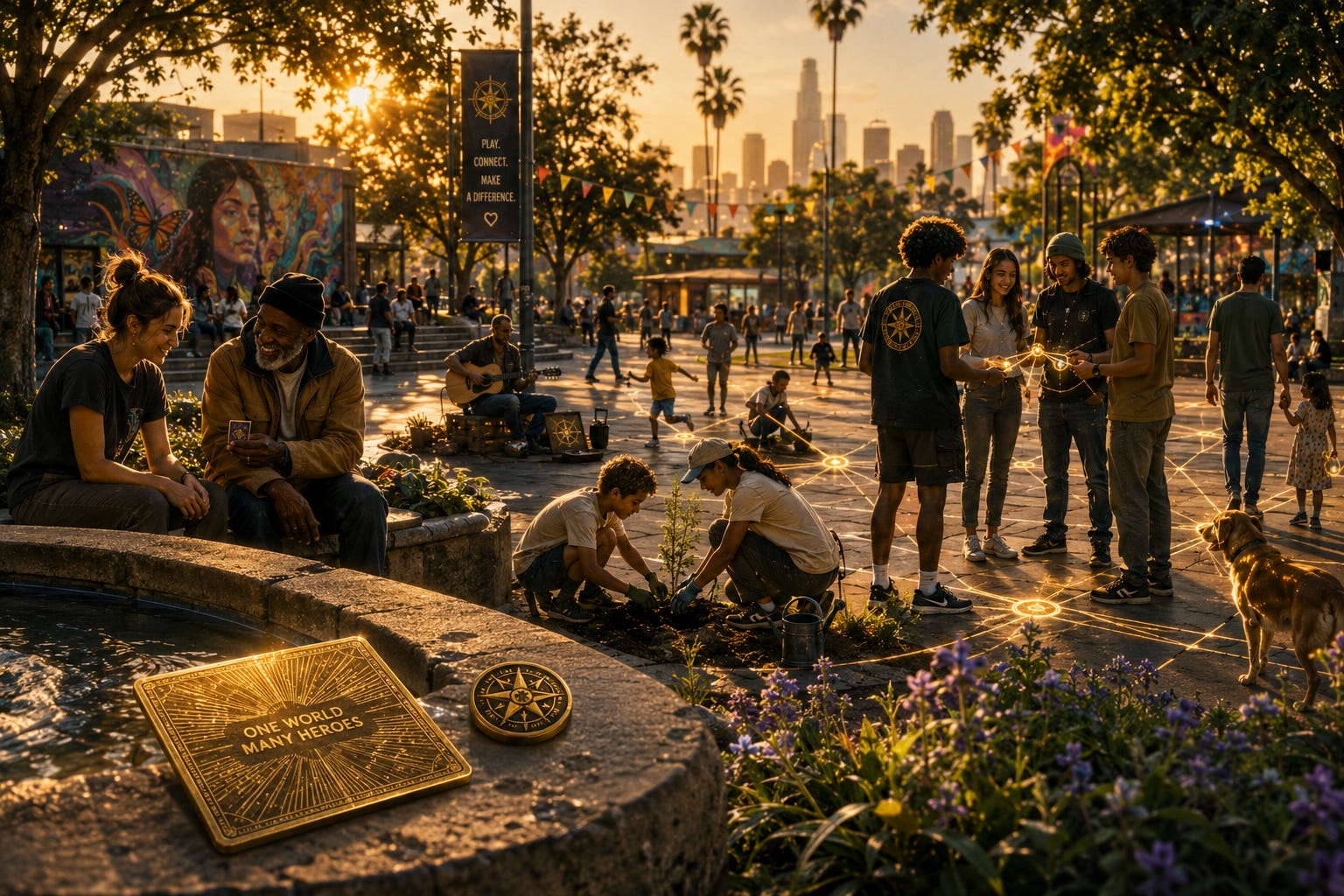
These systems are becoming much better at understanding where we are, what we’ve done and what motivates us. That makes them powerful tools for influencing behavior. I want to use that understanding to help people participate more deeply in the world around them.
I’m working on something now that pulls together threads I’ve carried for most of my career, around games, identity, real-world participation and the idea that play can change how we see ourselves and what we believe we’re capable of.
There are some extraordinary people building adjacent pieces of this future too. For the first time in a while, I have that feeling I used to get when a new medium was becoming possible.
One last thing about Willy Wonka that I’ve come to appreciate more and more. Charlie enters the factory as a kid with very little power over his circumstances. He leaves having been entrusted with the whole thing. Somewhere along the way, he discovers that his choices inside this strange world actually matter.
The best games and imagined worlds can do something similar. They give us a place to make choices, test ourselves and discover something about who we might become. Sometimes we carry a little of that person back into ordinary life.
I’ve been chasing some version of this since I first saw Charlie tear open that wrapper. I wanted the Golden Ticket because I thought it would open the door to somewhere magical. More than fifty years later, I understand the idea differently.
The real magic is what the journey can unlock in us.
There are hidden worlds inside the ordinary one. Now we get to decide what they’re for.
I’m Brian Selzer. I’ve spent my career building at the edges of games, technology, entertainment and human behavior, from Marvel and the early days of mobile and AR to what’s emerging now with AI and spatial computing.
Resonant Signal explores how we design experiences that people actually want to enter, trust and remember. I'm interested in technology that disappears into the experience rather than announcing itself.
If that resonates, subscribe. And if you’re building something ambitious in this space and think we should work together, reach out.
No posts
Comments
Nothing yet. Say the first thing.
Sign in to join the conversation.