
As far as I can tell, Ms. Rachel cares about one thing. Children. She is not a politician or a theologian, but her passion has dragged her into both political and theological controversy. This says a lot more about our politics and theologies than it says about Ms. Rachel.
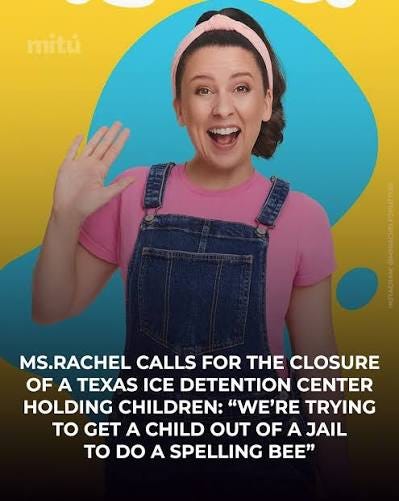
How do we evaluate political or economic success? Mainstream publications ask if the economy is doing well, and measure numbers like GDP or the Dow Jones Industrial Average.
Ms. Rachel doesn’t seem to care about those things. Instead she asks, how are the children? Are they learning, fed, and flourishing? Are they living and breathing? If so, that may mean we are on the right track, and if not, we should rethink everything. This sounds obvious as I write it, but the reality is that the world is not currently structured to operate this way. In fact, if you start with the flourishing of children as your starting point as a foundational priority, you will quickly become radicalized. You will see how anti-life most of the political systems we take for granted really are.
Ms. Rachel’s fundamental belief in the priority of children’s lives has placed her on the front lines of multiple human rights issues. For example, she’s been called a radical for her ceaseless advocacy for the children of Gaza. She won’t shut up about it. She tweets and posts and goes on any program that will have her to speak a very simple truth that makes people very uncomfortable: we must stop killing children. We must not remain silent as the killing of children continues. We must not elect politicians who will fund the ongoing killing of children. And if we can’t agree on this, we have a serious problem.

Ms. Rachel advocates for queer lives for the same reason: many queer people are children, and queer children are one of our most vulnerable populations. Queer teens are more likely to be homeless, assaulted, and impoverished than other kids. An estimated 40% of homeless youth identify as LGBTQ+, several times their share of the youth population overall.1 Sit with that. Many of them ended up homeless after being evicted by their conservative Christian parents. Thrown into the street like human garbage. One of the most unsafe places for a queer child is a “good Christian home.”
I have never heard Ms. Rachel describe herself as a political progressive, but her belief in the right of children to live, taken to its conclusion, puts her firmly on the political left. One of the reasons I’m a leftist is that I believe we should start with the premise of the value of human lives—of the right of every person to food, water, safe housing, medical treatment, community, and care—and build a world from there. I do not believe those things should be earned. They are not privileges, but rights. These are things that people deserve, because people matter. But if you can’t get there with me, if you find yourself plagued by the “what abouts”—”but what about drug addicts, what about mooches and welfare queens, what about people who take advantage of the system?”—well, then perhaps you could accept an even more basic claim: the fundamental value of children’s lives. That every child has a right to food, water, safe housing, medical treatment, community, and care. And build a world from there. Because even if you think that some adults have made bad choices, what could a child have done to become undeserving of such things?
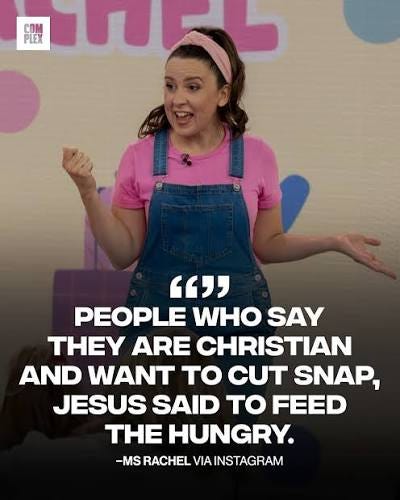
Our world is not organized for the flourishing of children—we received a stark reminder of this on the other side of the COVID pandemic. In 2020, the shutdown received an unprecedented response. Our country, usually quite austere in regard to a social safety net, sent out an expanded child allowance to every child and their parents. For one year, our tax dollars actually went to children—and the results were astounding. Child poverty fell from 9.7% in 2020 to 5.2% in 2021, its lowest recorded level ever.2 We cut child poverty in half, from the simple act of sending money to the children who needed it. Despite conservative fears that handouts for the undeserving poor would cripple us as a nation, the economy responded very well to this. There was no downside—just healthier, happier, better-fed kids. But in 2022, Congress let the expanded Child Tax Credit lapse. The poverty rate for children leapt back up, more than doubling from its historic low to 12.4 percent, erasing all of the record gains made against child poverty over the previous two years.
We are without excuse. We know what could cut child poverty, so we just need to get honest with ourselves: getting children out of poverty is not our priority. And to take that out of the realm of the conceptual, here’s what that means. Children who grow up below the poverty line complete two fewer years of schooling and, as adults, are more than twice as likely to report poor overall health, be obese, or experience psychological distress.3 We all feel this tragedy. The cost of child poverty to the US economy is over $1 trillion per year.4 We will pay for it either way—but our country chooses to pay for it in ruined lives, rather than rent support or groceries for kids.
It is not only my politics that have this premise at the center, but my faith as well. Like Ms. Rachel, Jesus had radical ideas about children that challenged his social world.
When he said, “Let the children come to me; do not hinder them, for to such belongs the kingdom of God” (Mark 10:14), he spoke this into a world where children had no status, power, or rights. They were treated like property, not people. One of the truly great effects of the global spread of Christianity is that the dignity of children has become an accepted, commonplace belief. This was not always the case. But despite living in a culture that generally believes platitudes like “children are the future,” we don’t often act like it.
If Christian theology kept the flourishing of children at the forefront, then when it came to affirming queer people, the data on what leads to the flourishing of children would be more essential to the debate than arguing over the original meaning of proof-texts that condemn homosexuality.5
Ms. Rachel may not call herself a theologian, but going by how Jesus talks about God, she may have a better handle on the divine than many pastors:
“Whoever welcomes one of these little children in my name welcomes me; and whoever welcomes me does not welcome me but the one who sent me.” (Mark 9:37)
We do not love God most by holding to the most rigid and literal interpretations of Scripture. We love God most when we love what God delights in. I believe this means building a world that treats every single human being as worthy, valuable, and divine. But even if you can’t get there—what if we just started with the children?
Chapin Hall at the University of Chicago, Missed Opportunities: LGBTQ Youth Homelessness in America (Voices of Youth Count, 2018).
National Academies of Sciences, Engineering, and Medicine, A Roadmap to Reducing Child Poverty (2019), ch. 3: compared with children in families above twice the poverty line, children below the poverty line completed two fewer years of schooling and, as adults, were more than twice as likely to report poor overall health or high psychological distress. https://www.ncbi.nlm.nih.gov/books/NBK547371/
The Trevor Project, 2024/2025 U.S. National Survey on the Mental Health of LGBTQ+ Young People: LGBTQ+ young people with access to affirming spaces and accepting communities report significantly lower rates of attempting suicide. The organization’s central finding across seven years of surveys is that elevated suicide risk is driven by mistreatment, stigma, and discrimination — not by LGBTQ+ identity itself. https://www.thetrevorproject.org/survey-2024/
No posts
Comments
Nothing yet. Say the first thing.
Sign in to join the conversation.