
This November, the richest government in the history of the world will not be sending out any food assistance to its most vulnerable citizens. What kind of “Christian Nation” withholds food from 16 million children who rely on these benefits for their basic nutrition?
This wholly preventable tragedy has revealed something more rotten than government gridlock and incompetence: the cruelty of the conservative MAGA movement, including the white evangelicals that make up their base.
beloved, with Brian Recker is a reader-supported publication. To receive new posts and support my work, consider becoming a free or paid subscriber.
While many evangelical leaders have been silent in the face of this crisis, others have celebrated the lapse in benefits as the end of “handouts.”
SNAP, or food stamps as they are commonly called, has been denigrated by conservatives for decades. People who use them are often stereotyped as lazy or as leeches on taxpayers. Their favorite proof text? “If anyone is not willing to work, let him not eat” (2 Thessalonians 3:10).

But people are entitled to food. Food is a human right, and everyone deserves to eat—regardless of employment status or work ethic. And there are deeply biblical reasons to believe this.
The Only Condition is Hunger
Setting that misunderstood proof text aside, the broader witness of Scripture consistently commands us to feed the hungry. There are roughly fifty direct commands to feed hungry people, in addition to hundreds about caring for the poor.
James 2:15–16 – “If a brother or sister is without food and one of you says, ‘Go in peace,’ but does not supply their bodily needs, what good is that?”
James does not mention a work requirement. The absence of food—and the presence of need—makes someone deserving of care, independent of economic contribution.
Isaiah 58:6–10 – “Is not this the fast that I choose… to share your bread with the hungry?”
Proverbs 22:9 – “Those who are generous are blessed, for they share their bread with the poor.”
Matthew 25:35–40 – “For I was hungry and you gave me food.”
Over and over, the only requirement for giving food to someone is hunger. Hungry people deserve food simply because of their humanity.

What Do People Deserve?
Many of us received a version of the gospel that said people were fundamentally undeserving. I was told that because I was born in sin, I was worthy of punishment. If I died in my natural state, all I deserved was death and hell. Any kindness or comfort I experienced short of God’s wrath was considered grace. What I “merited” was torment.
What do you believe people fundamentally deserve?
I believe this question lies at the center of our spirituality, and explains much of evangelicalism’s cruelty. Do people fundamentally deserve hell, or do they deserve love?
I believe people deserve to have their basic needs met.
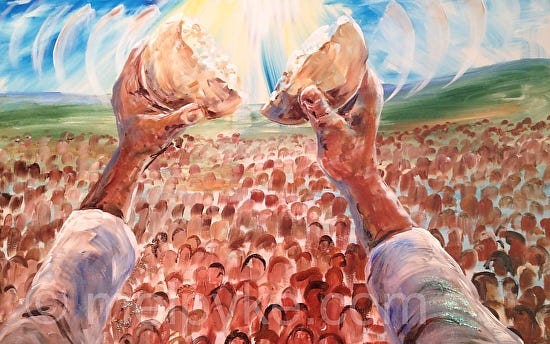
Jesus fed the hungry without requirements and taught us to pray for “our daily bread.” He also prayed that God would “forgive our debts, as we forgive our debtors.”
Centuries of over-spiritualized interpretation from theologians who knew neither hunger pangs nor debt slavery have hidden how Jesus’ prayer addressed the two deepest social realities of his world: hunger and debt. For the working poor, the next meal was not guaranteed, and many lived in perpetual debt to wealthy landowners.
Jesus’ prayer pointed to a world where everyone had enough bread and debts were forgiven.
Many of us inherited a punitive Christianity that insists every debt be fully paid. But the prayer is not that debts would be paid—it’s that they’d be forgiven, completely cancelled.
This goes completely against the conservative mindset of what people “deserve.” Loan cancellation? Not fair! Food handouts? Freeloaders! But in the world of the Kingdom, people deserve food and forgiveness, for free.
Isaiah 55:1 –
“Come, everyone who thirsts, come to the waters;
and he who has no money, come, buy and eat!
Come, buy wine and milk without money and without price.”
The point of this invitation is that it’s unearned—not because we are unworthy, but because we already are worthy, simply by virtue of being image-bearers of God. Our dignity is innate; it cannot be earned or deserved.
The Kingdom of God vs A Punitive Empire
When you see this truth, it changes how you show up in the world. The Kingdom of God is not a place, and it’s certainly not where we go when we die. It happens when we acknowledge this inner worth, and treat every person as the child of God that they truly are in the deepest part of themselves.
This recognition is a paradigm shift, and it’s a fundamentally different way of calling people into change. Are people punished into change—or loved into change?
Many conservatives have long sought to defund food stamps because they believe hunger is good for the poor—it will motivate them to pull themselves up by their bootstraps. But this punitive outlook is both cruel and ineffective.
Hungry people don’t work harder—they commit more crimes, and understandably so. They are often so burdened by survival that they can’t contribute meaningfully to society. When people’s basic needs are met, they show up as better citizens.
Punishment does not call out the best in people. If we want people to flourish, we must treat them with dignity, regardless of what we believe they “deserve.”
The wisest spiritual leaders have always known the poor are not undeserving but deserving of care. This is how the early church father St. Basil the Great spoke of what we owe one another:
“The bread which you hold back belongs to the hungry; the coat you guard in your locked storage-chests belongs to the naked; the footwear mouldering in your closet belongs to those without shoes. The silver you keep hidden belongs to the one in need. Thus, however many are those whom you could have provided for, so many are those whom you wrong.”
— St. Basil the Great

Do you agree with St. Basil? Do you believe that the excess food in a wealthy society belongs to the hungry—that we owe it to them, that it is their right?
If you believe they have to earn it, where does that belief come from? This punitiveness is nowhere in the ministry of Jesus, who freely fed the hungry and told his disciples that when they hosted a banquet, they should “invite the poor, the crippled, the lame, the blind,” precisely those who “cannot repay you” (Luke 14:13–14).
Any talk of “deserving” versus “undeserving” poor is foreign to the message of Jesus—to be human is to be deserving.
Weaponizing Paul
A few thoughts on this popular proof-text:
For even when we were with you, we gave you this rule: “The one who is unwilling to work shall not eat.” We hear that some among you are idle and disruptive. They are not busy; they are busybodies. - 2 Thess 3:10-11
First of all, this verse is in the context of the early church, a community where believers shared wealth and met material needs. In this Kingdom world, “No one claimed that any of their possessions was their own, but they shared everything they had” (Acts 4:32).
However, Paul is addressing some who are unwilling to contribute to this greater whole. In fact, an increasing number of scholars believe that the “idle busybodies” Paul is addressing are not the poor, but wealthy patrons. In Roman cities, elites lived off rent and others’ labor. Manual work was for slaves and the poor.
Paul calls them to a new mindset: outside the church, exploiting labor might be normal, but those hierarchies don’t exist in the Kingdom. Here, we are equals and carry one another.
So Paul does not seem to be saying, “Poor people shouldn’t eat if they can’t work.” He’s likely aying, “Wealthy freeloaders who scorn work and live off others violate the Gospel.”
The Real Freeloaders
Rolling out this proof text now is especially egregious because most people on food stamps cannot be accused of laziness.
Most on food stamps should not be working at all: children (≈ 44 percent of SNAP recipients), the elderly (≈ 10 percent), or the disabled (≈ 11 percent). Of those who can work, most do—often full-time, and yet they can still barely afford groceries because they do not receive a living wage!
Corporations like Walmart and Amazon have millions of employees on food stamps. Companies with soaring profits pay starvation wages, and taxpayers cover the gap. That is the real robbery, not the aid we give the poor.
Food stamps are not handouts to poor workers—they are handouts to greedy corporations and billionaires like Jeff Bezos, who is worth hundreds of billions, while many working for him need government assistance. St. Basil would like a word.
Paul never rebuked the poor. He was constantly speaking up for them. His call was for mutual responsibility: for each of us to let go of superiority and take our place among our brothers and sisters in one connected family. This, too, was Jesus’ vision.
Jesus declared the Kingdom of God, and when he ascended, the early church put his vision into practice—a society of mutuality, where everyone had enough and no one was seen as undeserving.
This is how the Kingdom comes: when we see that people deserve care and compassion because they are worthy of it. And so are you.
So speak up to protect SNAP, and in the meantime, support local food banks like this one. And may we build a world where everyone matters and belongs—not by the measure of economic contribution, but simply because of our shared humanity.
This is how the Kingdom comes.
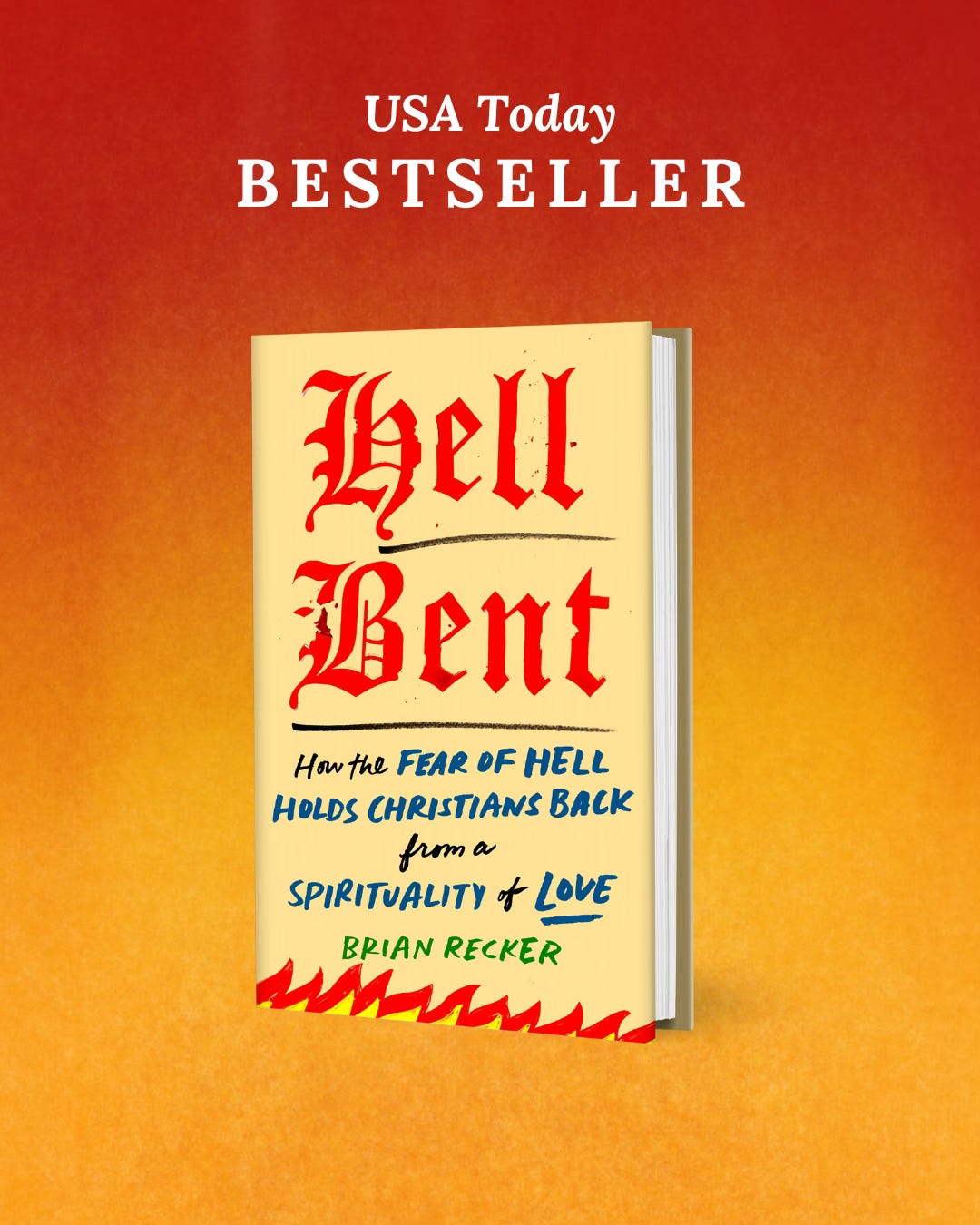
If this reflection resonated with you, you will probably appreciate how I explore these themes in my new book, Hell Bent: How the Fear of Hell Holds Christians Back from a Spirituality of Love.
It’s about reclaiming the Spirituality of Jesus, which was a way of love for the sake of this world, not escaping to the next. The Gospel is so much better than many of us were taught.
beloved, with Brian Recker is a reader-supported publication. To receive new posts and support my work, consider becoming a free or paid subscriber.
Comments
Nothing yet. Say the first thing.
Sign in to join the conversation.