
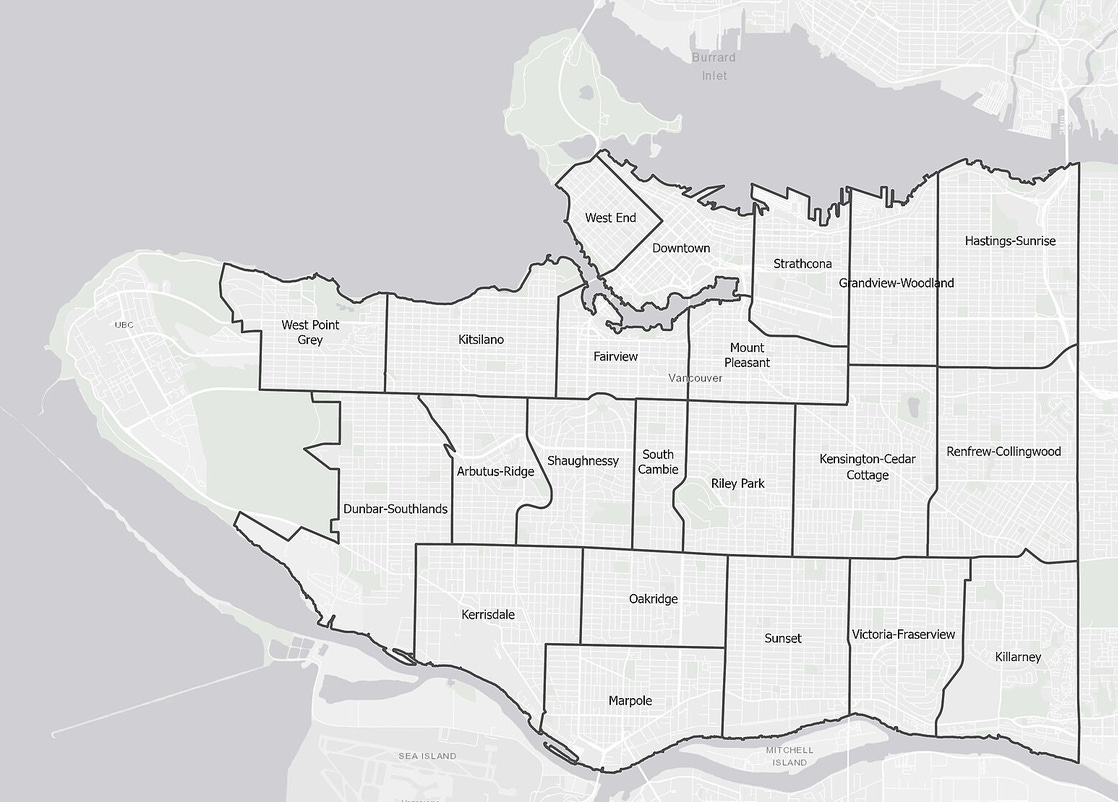
Vancouver’s 22 neighbourhoods—still in Wikipedia, just not in the Vancouver ODP
“So, Pops, what did in the Villages Plan in the end?” asked my son. We were enjoying coffee at the 16th & MacDonald Starbucks, ground zero for what would have been one of the city’s 17 neighbourhoods.
“There were many contributors to its failure,” I answered, “but a few stand out for me: Its presentation to citizens was so poor that many folks rightly concluded that their opinions did not matter; the location of the Villages made little or no sense to most citizens; residents were outraged when they discovered that hundreds of folks had lost control of their properties; and it became evident that city staff did not care one whit about the city’s existing 22 neighbourhoods. That’s just a few reasons it failed to launch.”
“I get the first two items,” my son answered. “But I’d like a bit more about the other two. What do you mean about folks losing control of their properties?”
“Buried in the 300+ page Villages Plan referral report to Council—that’s what’s at the Public Hearing and what Council bases its decisions on—was the fact that 600+ property owners in the core centres of each Village would no longer be able to do anything on their properties except 4-6 storey residential buildings with continuous ground level commercial.”
He looked puzzled. “What about additions and renovations? A laneway home? A secondary suite? A duplex?”
“No, no, no and no”, I answered. “It was clear that these 600+ lots would be ‘sterilized,’ meaning an owner without development savvy could do nothing except await a developer who would buy their property—probably at a discount because of the sterilization—and redevelop. They’d have no ability to, say, add a family room out the back to accommodate a growing family, or a laneway home or secondary suite as a mortgage helper. At the Public Hearing I pointed out that the requirement for continuous ground level commercial/retail translated into five continuous miles of new development to sell or lease in a city where some existing neighbourhood shopping areas are struggling due to already-sterilized locations (think the Safeway site on West 10th Avenue) as well as other factors such as high property taxes. So redevelopment would only occur at the rate at which commercial development became feasible.”
Again he looked puzzled. “Didn’t city planning staff consider this sterilization effect?”
I laughed. “Two staff comments were telling. One was that these 600+ lots were “only” 4% of the total of about 13,000 lots within the Villages. Tell that to the locked-in families. The second was that when staff tried an optional commercial frontage approach along Cambie, the result was one small coffee shop only between King Edward and 41st Avenue. To avoid a recurrence, sterilizing 600+ lots seemed a logical approach to them—just not to the hundreds of families affected, many of whom had accepted noisier but more affordable homes as the price of living in Vancouver.”
“So what’s your take away from all this? What might it mean for the October elections?”
“The opposition to this proposal was widespread, covering most of the city’s neighbourhoods. Citizens are finally coming to understand that city staff and their political masters would like to erase the city’s 22 neighbourhoods, just as the Vancouver Official Development Plan (ODP) has.”
His eyebrows knit, so I added: “The Vancouver ODP has ZERO mentions of the city’s 22 neighbourhoods, instead focusing on seven village “types” which the Villages Plan fixed on the map with no reference to neighbourhoods.”
I continued. “For the first time in the five years I’ve been writing City Conversations, folks from all across the city are recognizing that the current Council and staff care nothing about the 22 unique neighbourhoods that anchor the city. Hundreds spoke against the Villages, thousands wrote against them.”
“What does this all mean for the upcoming elections in October?” he asked.
“Political parties that think the entire city is one single entity to play with as they wish may discover citizens disagree. Those who want to create a war between renters and owners forget the thousands of owners who rent suites and laneways—the creators and beneficiaries of gentle density. This time around I hope that residents will look carefully at each party’s policies—some policy cupboards remain empty at this late date—and look for who has the knowledge, experience and courage to govern a city for all neighbourhoods and all citizens.”
He smiled, gave me his trademarked hug, then cycled off to meet friends who, with him, will decide what they will inherit and go forth with.
CODA
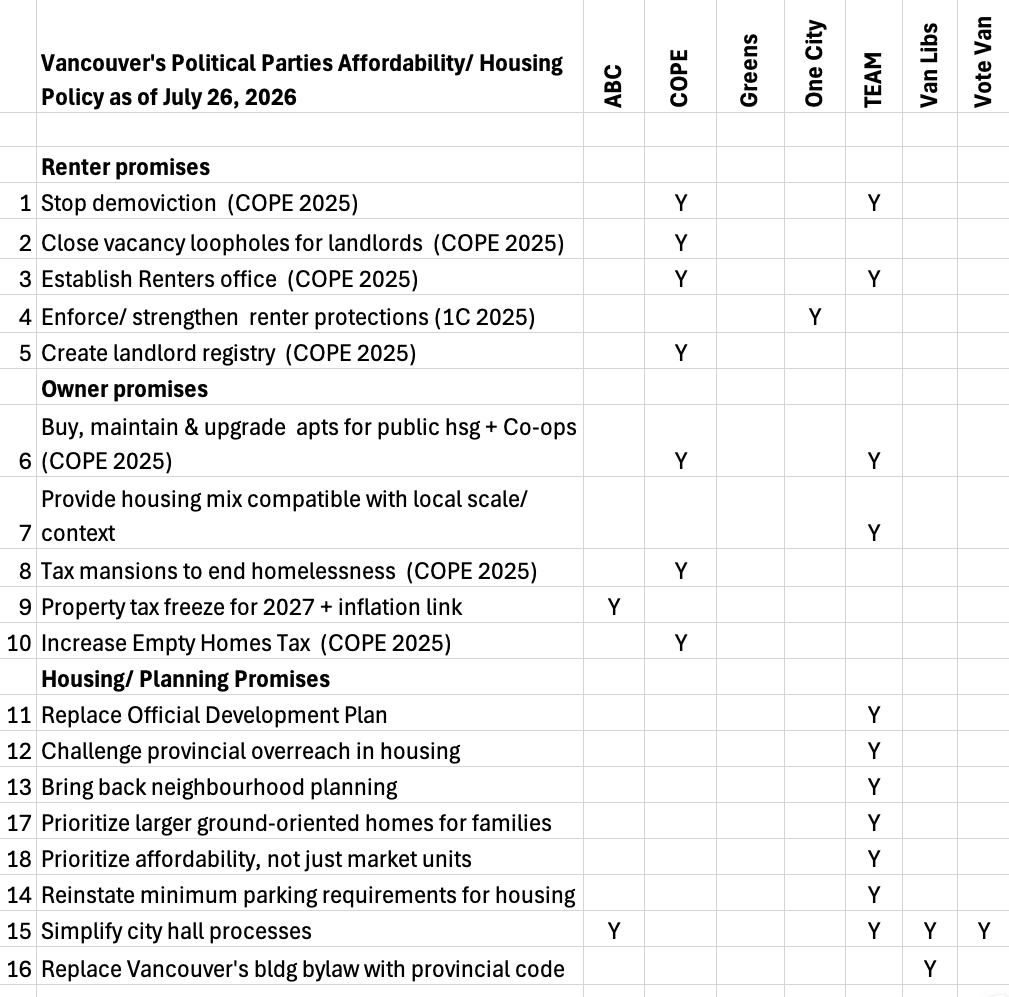
In my last City Conversation I said I would update my listing of each political party’s housing and affordability policies each time I published a CC. The only party that has updated its policy listings is TEAM, including some new renter, owner and city-wide policies:
This post is just over 700 words. If you appreciated this post, please share to your social media and consider becoming a free subscriber to City Conversations at
Brian Palmquist writes in the ancestral lands of the Musqueam people. He is a Vancouver-based architect, building envelope and building code consultant and LEED Accredited Professional (the first green building system). He is semi-retired, still teaching, writing and consulting a bit, but not beholden to any client or city hall. City Conversations mix real discussion with research and observations based on a 50-year career including the planning, design and construction of almost every type and scale of project. He is the author of the Amazon best seller and AIBC Construction Administration course text, “An Architect’s Guide to Construction.” A glutton for punishment, he is threatening to write a book about how we can Embrace, Enhance and Evolve the places where we love to live. Some of its content may appear above.
Comments
Nothing yet. Say the first thing.
Sign in to join the conversation.