
The first Black professor my wife, Katie, ever had was Dr. LaNail R. Plummer.
At the time, Katie was in her first semester of a demanding graduate program in Clinical Mental Health Counseling at Johns Hopkins University. She was managing teenage daughters, a full course load, and a husband who was finally learning what it meant to be an active parent. And all while she was commuting back and forth from our home in the Washington D.C. metro to Baltimore several times a week.
I was pacing in the attic working on my doctoral dissertation when Katie called me:
Katie: I just met the most amazing woman, and you have to talk to her.
Me: So class went well?
Katie: It was beautiful. She’s my Human Development and Counseling professor, and she also created and teaches an entrepreneurship course for counselors.
Me: That’s incredible. I don’t think I’ve ever even heard of a class like that.
Katie: Probably not. I think it’s one of the only ones in the country. You’re going to love her.
A few weeks later, Dr. Plummer and I met over Zoom. She had kindly responded to a request for support on my research and made me feel like I was the most important call of her day. There’s a grounded energy about Dr. Plummer: steady, generous, fully present.
Conversations with her draw you in and fill you up.
A few years later, I met her in person for the first time when she joined a panel I moderated at Harvard Business School on entrepreneurial women in health care. Alongside Regina Herzlinger and two other remarkable founders, Dr. Plummer shared her journey with warmth and precision, weaving personal experience with professional wisdom.
See: Dr. LaNail R. Plummer and me at the Entrepreneurial Women in Health Care Panel
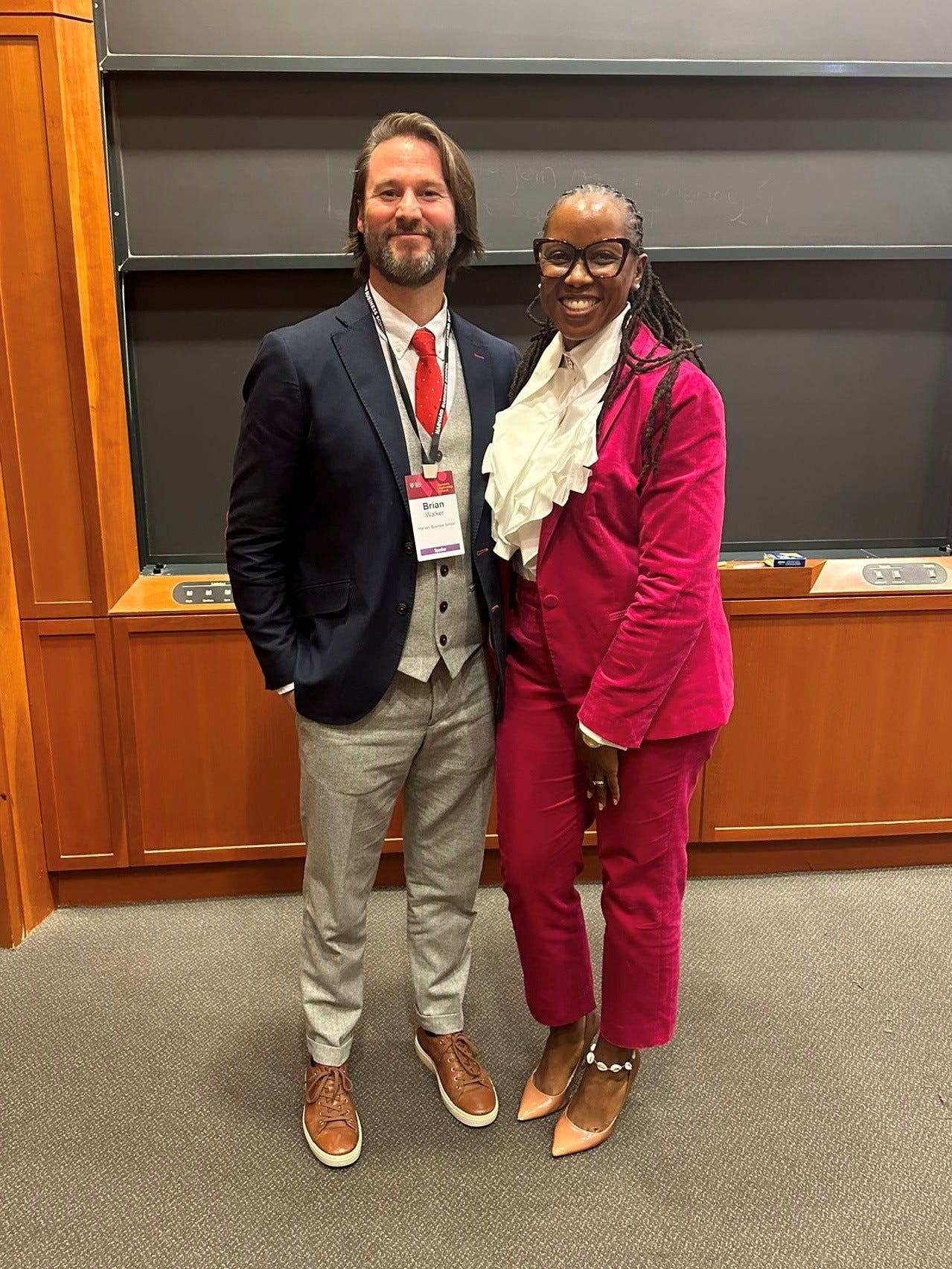
Her father—a U.S. Army officer—taught her to never bring a problem to someone without a solution.
In middle school in San Bernardino, LaNail watched her classmates return late after morning break. The teachers were frustrated: tardy slips piled up, and the hallways buzzed with excuses. The problem was clear—students were rushing off campus to grab a snack and didn’t have time to return before the bell—but frustrations were getting in the way of solutions.
LaNail approached the principal with a plan: arrange a delivery service to bring snacks to campus, with a small fee built into the price to cover the service. There were some wide eyes from the administrative staff and some initial pushback, but LaNail kept coming back with more answers and more support.
The service started in 1990 and is still operating today.
A few years later, she found herself living overseas, stationed with her father at the U.S. Army base in Yongsan, Seoul. Thousands of miles from home, the isolation weighed on LaNail and many of the children, especially the families of deployed soldiers.
Within a few months of her arrival, she found herself in the base commander’s office, pitching a pen-pal program that would link students in Korea with children of deployed military families around the world.
The program launched in 1993 and continues today.
She moved back to the States after graduation, completed a Bachelor of Arts in Administration of Justice at Howard University, and then joined the Army herself. LaNail progressed through the ranks—focusing on supporting enlisted soldiers and assisting families of deployed troops—while also earning her master’s in counseling and later her doctorate in counselor education.
After serving in the military for almost a decade, she transitioned into civilian life and began working in schools and community-based settings around the Washington, D.C. area. Soon, a pattern emerged: many Black and LGBTQ+ individuals were missing meaningful access to mental health care. Therapists lacked cultural fluency. Systems were rigid and impersonal.
When she proposed a new model of care—one driven by cultural competence and community empowerment—she heard the familiar rejections from venture capitalists and banks: too narrow, too experimental, not scalable.
But she pressed ahead, offering free workshops in schools and then in community centers. Resources were thin and some efforts stumbled. Buy-in was uneven, and trust took time to build.
Despite the challenges, momentum grew.
Community referrals followed, families asked for support, and her services spread by word of mouth. That emerging network laid the foundation for what would become Onyx Therapy Group, a practice rooted in the belief that culturally competent mental health care is foundational for quality care.
When the pandemic surfaced long-standing inequities, Onyx was already positioned to serve. Under Dr. Plummer’s leadership, the practice helped clients, schools, and organizations navigate trauma, change, and loss. From its first Washington, D.C. office the group expanded into a national practice partnering with education systems, non-profits, and corporate clients.
See: Dr. LaNail R. Plummer speaking at Harvard Business School with Regina Herzlinger (left) and Priyanka Agarwal (right)

Over the past year, Onyx Therapy Group has expanded internationally, beginning with new partnerships and services in South Africa. It’s demanding work—building programs across continents while continuing to lead a thriving U.S.-based practice.
She also became the Department Chair of the Counseling Program at Trinity Washington University, where she continues to educate and mentor the next generation of mental health professionals.
Amid all of that, she scheduled pockets of time to slow down, reflect, and write. Her forthcoming book, The Essential Guide for Counseling Black Women (available for preorder here), gathers decades of clinical insight and lived experience into one powerful resource for therapists seeking to understand and support Black women with cultural depth and respect.
The book explores the realities that often bring Black women to therapy—identity, friendship, emotion, freedom, work, and legacy—while equipping clinicians to meet them with empathy and skill. Each chapter offers therapist tips, reflective questions, and exercises designed to help both client and counselor move toward healing together.
It’s a book for counselors who want to better understand how to serve their clients with greater awareness and compassion.
It’s a book for Black women seeking to improve their mental health and claim space for rest and renewal.
And it’s a book for everyone who wants to better understand their community and their friends. As Trevor Noah said in his final dialogue on the Daily Show: “I always tell people, if you truly want to learn about America, talk to black women…If you truly want to know what to do or how to do it, or maybe the best way, or the most equitable way, talk to black women.”
Creating. Meaning. Everywhere.
Thanks for reading about Dr. LaNail R. Plummer and Onyx Therapy Group.
This winter I’m teaching in Boston and traveling around the world to meet with people who are creating meaningful change in their communities.
About 2–3 times a month, I’ll share reflections on what I’m learning—stories from the road, insights from my work with entrepreneurs and leaders, and thoughts on how we create meaning through what we build.
If that resonates, I’d love for you to follow along.
Comments
Nothing yet. Say the first thing.
Sign in to join the conversation.