
I’m sitting in the Frankfurt Airport, about to head to Boston for the third time in the last twenty days. The fall is always the busiest stretch of my teaching schedule—case discussions, panels, and preparation for an entrepreneurship field course that pull me across time zones and campuses. I typically take a train to Munich or Vienna and then catch a non-stop to Boston, but I love going through Frankfurt when I have the chance.
This airport holds a story that I’ve carried all my life and connects me to one of my favorite people of all time: my grandmother, Joyce.
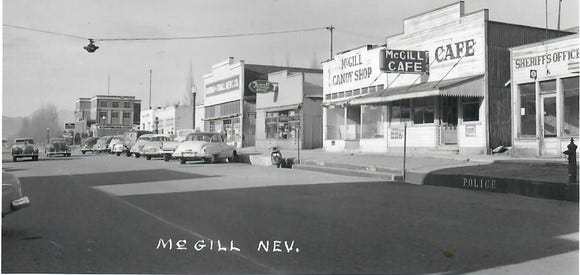
She was born in McGill, Nevada, in 1934—one of seven children in a mining town tucked into the mountains. Her parents raised their large family in a place of scarcity and grit. She and my grandfather, Royce, met when they were twelve and were inseparable from that moment on.
See: McGill, Nevada
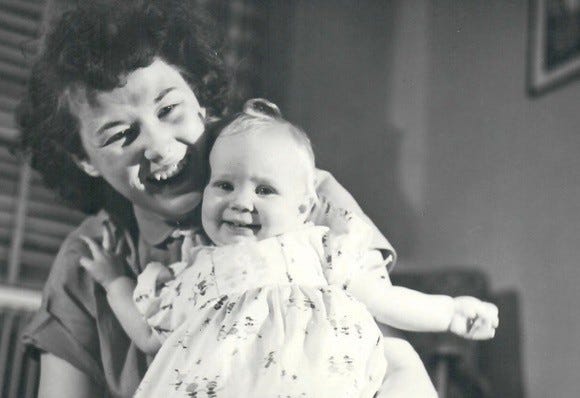
After graduating from high school, they married young and were soon whisked away to Japan after my grandfather joined the Air Force and began training as a fighter pilot. While stationed there amid the tensions of the early Cold War, Joyce had her first daughter—my mother—and raised her far from home, learning to build community and find her place wherever she was planted.
See: Joyce and my mother in Japan
From Japan, their journey took them back to the States, where Joyce welcomed another daughter, my aunt. But soon thereafter, in 1961, my grandfather was reassigned to Hahn Air Base, one of many U.S. installations in West Germany meant to project strength and deter Soviet aggression.
In 1961, Berlin had just been divided by a hundred-mile-long wall, and there was static everywhere: missiles pointed across borders, nuclear drills in schools, and American fighters stationed across Europe, ready to scramble at a moment’s notice. Given the environment, the military curtailed family travel and dependent passage to Germany was restricted because of security risks.
Joyce never took much to people telling her what she could and couldn’t do. She began the process of moving to Germany with the ordinary steps many would take: applications, letters, paperwork.
But the ordinary steps stalled. The chain of command slowed. Channels clogged. She soon realized that waiting alone would not be enough. Nobody else was going to solve her problem. If she couldn’t find a way, she would have to make one.
Joyce started making calls. She found allies, built momentum, and in time she appealed to a U.S. Senator from Nevada to intervene. She navigated the inertia of military and diplomatic systems that were never designed for a woman in her position to push them, and she did it with the same steady resolve she carried her whole life.
She was no-nonsense, fiercely capable, and had little patience for anyone who confused caution with competence.
When approval finally came, she boarded a plane with two children on her own, crossing oceans and borders, flying toward a country that was a spark away from conflict.
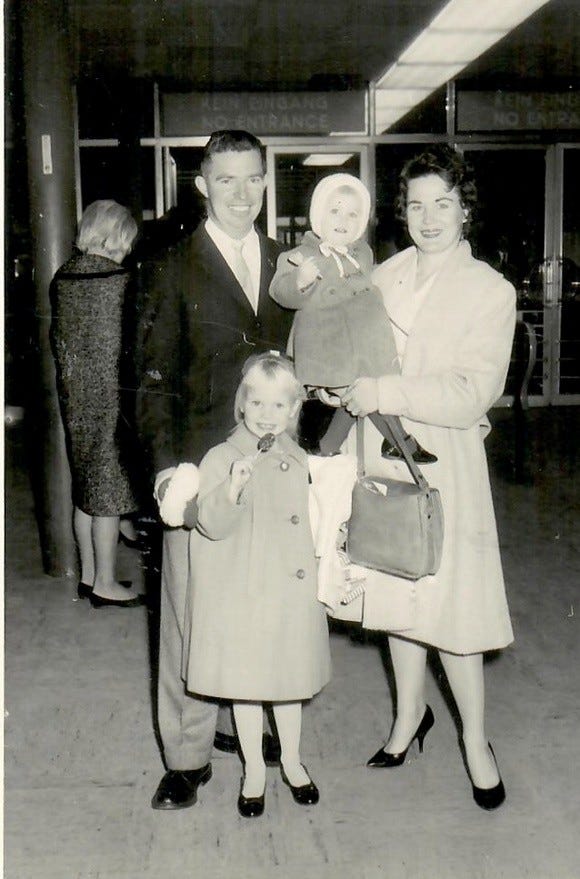
When they landed in Frankfurt, my mother—then six—spotted her father in uniform and dropped everything. She sprinted through customs, ducked through passport control, and dodged security—with the guards shouting and clamoring after her. She jumped into his outstretched arms, laid her head on his neck, and listened as he tried to calm the startled officers.
See: Joyce and her family reunited at the Frankfurt Airport, 1961.
Joyce was entrepreneurial long before that word became fashionable. She refused to accept the world as it was and took responsibility for changing what she could—whether that meant creating solutions from scratch to bring her family together, building community wherever the Air Force sent her, or solving problems others preferred to ignore.
She came from nothing and still created meaning out of every season of her life. Joyce knew that what she did mattered, and she would never let anybody convince her otherwise.
So here I am, in Frankfurt Airport, thinking about one of the most kind, supportive, and powerful people I’ve ever met. She passed away ten years ago this December, and I’m grateful that the pain of missing her is still part of my life.
That her name continues on with my daughter’s.
That her stories are still told.
Creating. Meaning. Everywhere.
Thanks for reading about my grandmother, Joyce.
This fall I’m teaching in Boston and traveling around the world to meet with people who are creating meaningful change in their communities.
About 3–4 times a month, I’ll share reflections on what I’m learning—stories from the road, insights from my work with entrepreneurs and leaders, and thoughts on how we create meaning through what we build.
If that resonates, I’d love for you to follow along.
Comments
Nothing yet. Say the first thing.
Sign in to join the conversation.