
One of the biggest events on the summer basketball calendar for 2026 wrapped up last week in Istanbul: the FIBA U17 World Cup. A loaded United States team — led by Duke commit and tournament MVP Joaquim Boumtje-Boumtje — blitzed the competition. Going 7-0 with an average margin of victory of nearly 49 points per game, Team USA defeated Serbia to claim its eighth straight championship in the event.
The tournament featured a stacked field of both American and international prospects, serving as yet another signal of just how loaded the 2028 NBA Draft is shaping up to be. While the 2027 class projects to be a touch underwhelming, though there will clearly be talent to find, the 2028 cycle projects as a much deeper class, headlined by several prospects with franchise-altering potential.
Thanks for reading Split The Action! Subscribe for free to receive new posts and support my work.
A new draft lottery format set to roll out next year, and it’ll be crucial for rebuilding and retooling franchises to wisely manage their 2028 draft assets. It’s still early, but the 2029 class projects strongly as well. Regardless, 2028 is a class that teams should want to be heavily invested in, positioning themselves with as much draft capital and as many improved lottery odds as possible.
With that in mind, let’s take a look at several prospects who stood out at the FIBA U17 World Cup, hailing from both Team USA and a deep international pool of players.
Joaquim Boumtje-Boumtje (USA)
Beckham Black (USA)
CJ Rosser (USA)
Jordan Page (USA)
Cayden Daughtry (USA)
NaVorro Bowman Jr. (USA)
Nikola Kusturica (Serbia)
Nathan Soliman (France)
Omer Kutluay (Türkiye)
United States
Joaquim Boumtje-Boumtje, Forward/Center
Back in May, I wrote a deep-dive scouting report on Joaquim Boumtje-Boumtje (so please check that out if you haven’t already). Since the end of his season with Barcelona, JBB has continued to travel the world, dominate his competition and add new pieces to his toolkit.
En route to a team title and the event’s MVP award, JBB enjoyed a smashing success in his debut with Team USA. He averaged 19.6 points, 10.9 rebounds, 2.0 assists (9.9 percent assist rate), 2.1 blocks and 1.7 steals per game — all in only 22.8 minutes per contest. His efficiency was on full display as Boumtje-Boumtje put together monster shooting numbers from all over the floor (64 2P%, 53.1 3P% and 88 FT%) while leading the tournament in PER (38.2).
With Team USA running its offense through JBB, the 7-footer scored using a variety of different half-court tactics. He produced from both sides of the pick-and-roll (as a ball-handler and a screen-setter), on spot-ups, designed post-ups, face-up isolations and in 5-out initiation. This included stretches with him operating as the team’s lone center, though he also played significant minutes next to traditional bigs like Erick Dampier Jr.
Boumtje-Boumtje showcased impressive contact absorption on his drives. Instead of going into the bump and flinging a wild shot at the rim to fish for a foul, JBB played with exceptional force and balance. He drove through defenders.
On this possession against Serbia, Boumtje-Boumtje flows into a late pick-and-roll with Dampier, drawing a switch against Petar Bjelica, a talented young big man in KK Mega’s system. JBB leverages the threat of his off-dribble 3-pointer with a subtle right-handed hang dribble that throws Bjelica off balance. That slight lean from the defender is all the space Boumtje-Boumtje needs to get downhill and play through the bump. A weak-side helper rotates over, but JBB explodes upward for a strong finish at the rim.
Whether he’s running off screens or handling in space, opposing bigs tasked with guarding Boumtje-Boumtje must be wary of his 3-ball. JBB is a quick-trigger shooter with deep, effortless range, and that puts enormous pressure on those defenders.
Here, Team USA comes out in a Horns set against Australia, featuring an entry pass to JBB at the elbow while Dampier ducks in for a hi-lo feed. Instead of making the pass, JBB opts to call his own number, hitting a smooth step-back 3-pointer from NBA range.
At the World Cup, JBB posted an outstanding true shooting percentage of 73.7 percent, a remarkable number given his usage and versatile shot selection. When opponents respect his 3-ball, Boumtje-Boumtje excels at rocking and rolling downhill as a slasher.
As Team USA initiates its secondary offense, JBB brings the ball up the floor and catches Australia’s center in a cross-match. The moment the opposing 5 takes a step toward him and puts his hand up, Boumtje-Boumtje is gone. Utilizing another sharp hesitation dribble, JBB gets all the way to the rim, throwing down a dunk over power forward Riak Akhuar (13), who posted an impressive 7.7 percent block rate of his own during the tournament.
The Americans ran a significant amount of 5-out offense through JBB, frequently stationing him at the top of the key in “Delay” sets or in the pinch post. On this play, he showcases 5-out facilitation by delivering a beautiful, off-handed pass on a designed backdoor cut to Beckham Black (12)
When opponents press up or send a second defender in his direction, Boumtje-Boumtje can pick coverages apart with timely passes.
He is a high-level processor with the ball, displaying a comprehensive view of the floor for a 7-footer who just turned 17. JBB pairs this elite vision with the ability to fit the ball into tight windows with touch and accuracy.
Matched up against Cameroon, the United States goes to its “Delay” series with 45-cut action: NaVorro Bowman Jr. (4) cuts through the lane off the right wing, followed immediately by Asa Montgomery (5), a nasty cutter, doing the same off the left wing.
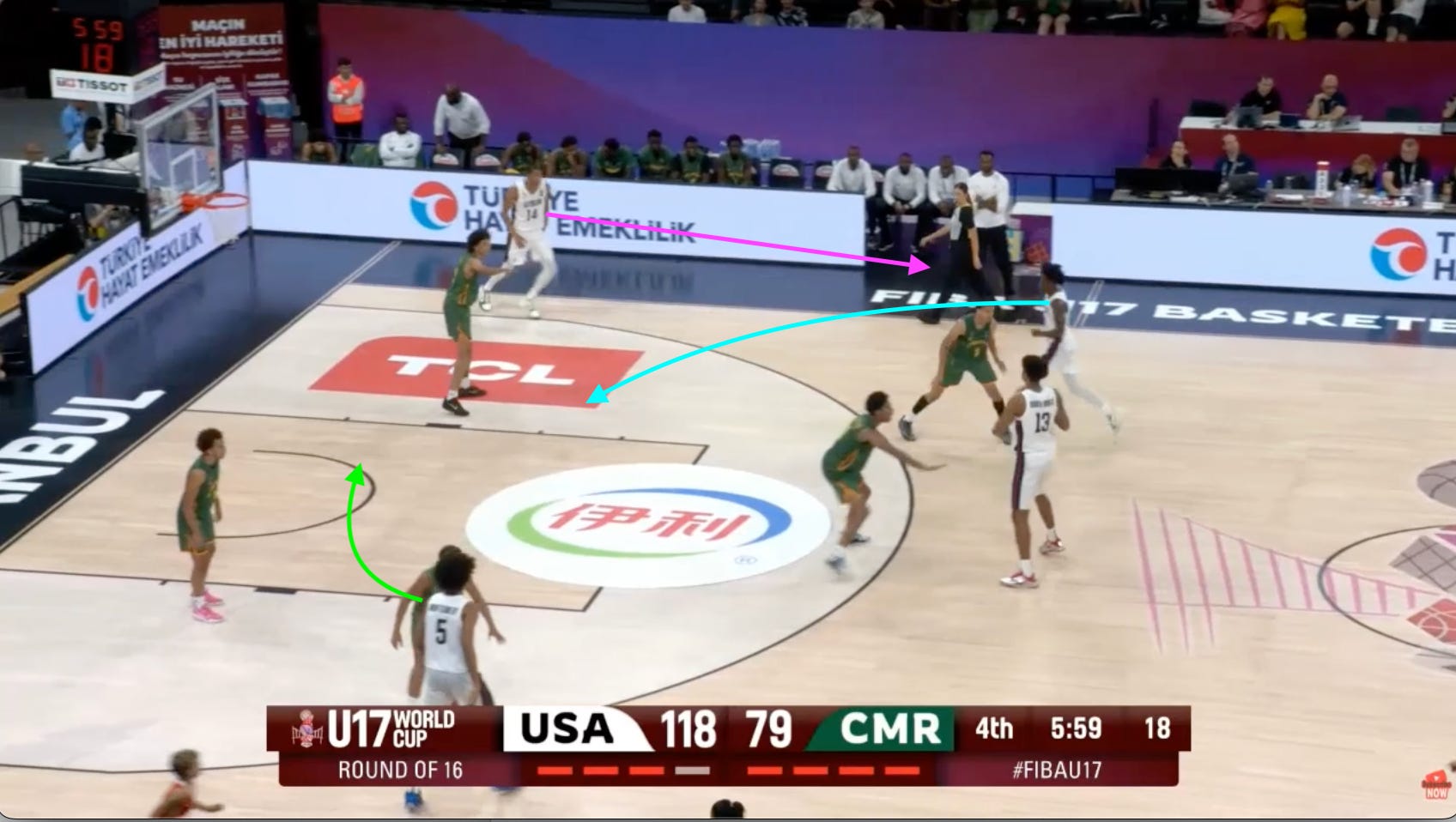
Boumtje-Boumtje looks right, but quickly spins back to his left and hits Montgomery cutting down the seam. He delivers a perfect pass that floats right into the blind spot of the chase defender.
An added benefit of JBB’s feel for the game is his scoring versatility: he simply doesn’t have to force things. Boumtje-Boumtje excels at letting the game come to him, but he can also hustle his way into unscripted points: put-backs, random cuts and transition run-outs.
According to my own charting data from the tournament, JBB registered five dunks in seven games that came as a direct result of his own steals.
His advanced defensive metrics were equally spectacular: a 36.3 percent defensive rebound rate (which led the tournament by a wide margin), 9.1 percent block rate, and 3.4 percent steal rate.
While JBB doesn’t possess elite foot speed, he plays with exceptional instincts and anticipation. At his size, that spatial awareness allows him to generate a high volume of defensive events.
Beckham Black, Point Guard
While Boumtje-Boumtje dominated the frontcourt, 6-foot-3 Beckham Black made a strong claim as the top guard in the tournament. Black is young and athletic, yet he plays an incredibly refined game. There’s a maturity to his approach; between dazzling moments of creativity and elite off-dribble shooting, he effortlessly runs the show for an offense, transitioning from secondary breaks into half-court flow to set teammates up.
He remains in total control of the offense at all times, thanks to an advanced understanding of tempo and spacing. There’s a distinct unselfishness to his game, too. In his 144 minutes of action, Black dished out 58 assists (8.3 per game) against only nine turnovers (11.4 percent TOV rate), yielding a stellar 6.44-to-1 assist-to-turnover ratio and a 41.9 percent assist rate. Black racked up a high volume of these dimes in transition, hitting ahead or throwing lobs to JBB, Jordan Page and CJ Rosser.
He also found consistent success pushing early offense, identifying teammates like Montgomery for high-percentage looks before the defense could fully set.
Playing off a live dribble, Black can read multiple lines of defense and manipulate windows with layered passes, hitting open teammates ahead of defensive rotations. He excels at moving defenders with his eyes and ball fakes, subtly looking off opponents to create the openings he wants.
Running offense against Italy, Black and Boumtje-Boumtje initiate a drag screen along the left wing. Italy hedges the action, putting two on the ball against Black. This leaves just one help defender to handle JBB on the roll and Bowman relocating to the left corner. Black perfectly leverages this 2-on-1 scenario, staring down Bowman in the corner and selling a pass fake in his direction.
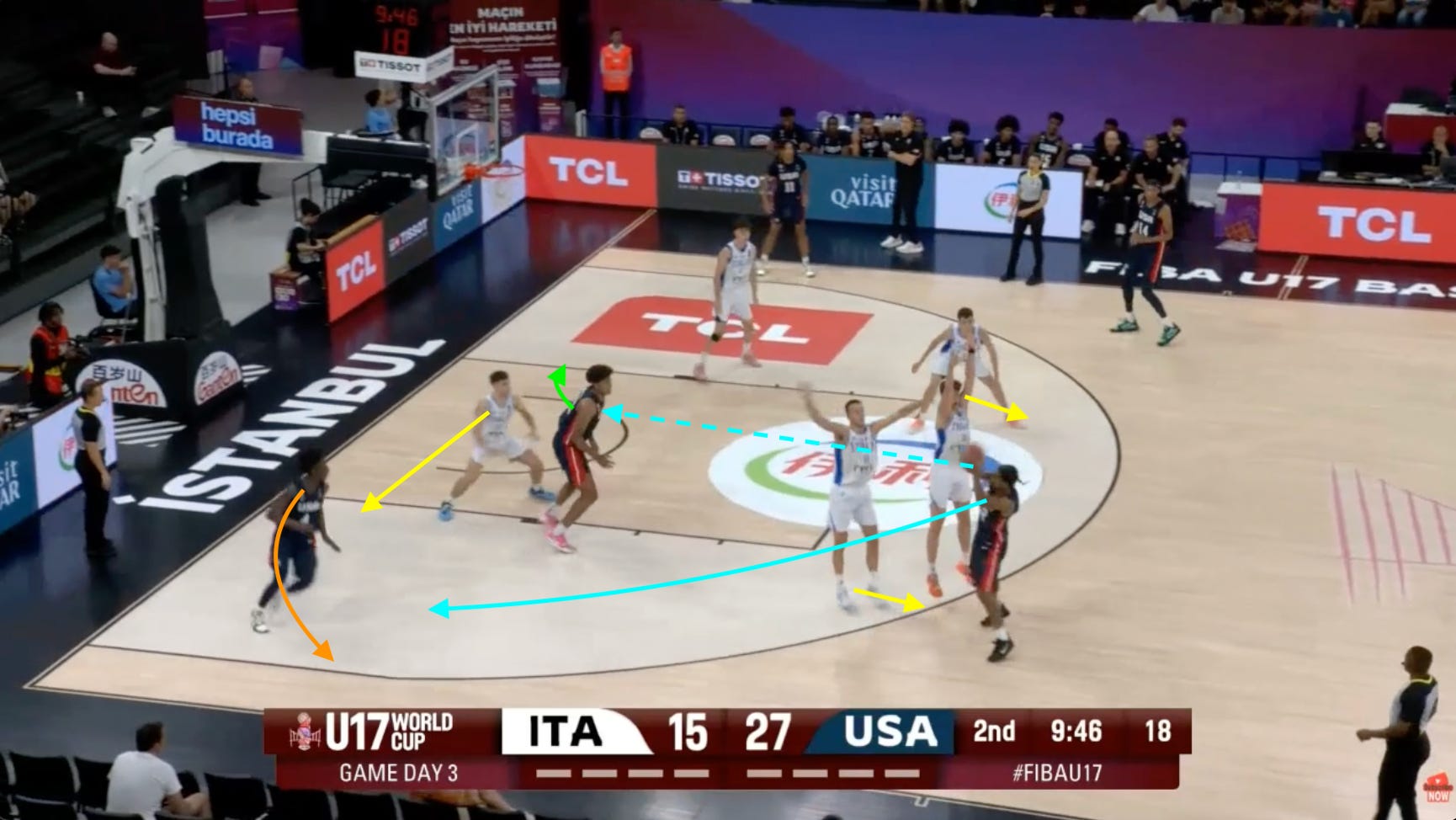
This gets the low-man defender to leap out toward Bowman, leaving JBB wide open in the paint. Black puts the ball right on the money to Boumtje-Boumtje, leading him perfectly toward the rim for an easy dunk.
The chemistry between Black and JBB was another highlight of the tournament, especially in transition and in the pick-and-roll. Black made life easy for all of his teammates, including Dampier, who feasted on rim runs alongside his star point guard.
Early in the second half of a blowout win against Japan, Black and Dampier engage in a pick-and-roll in the middle third of the floor. Japan’s defense attempts a hard hedge on the screen, but Black counters by rejecting the pick with a nifty left-handed in-and-out dribble. This opens up a clean lane for Dampier, and Black delivers a precise pocket pass that hits the big man in stride for an easy layup — well before the hedging defender can recover back.
Black isn’t just a pick-and-roll merchant. He doesn’t require a ball screen to beat defenders and touch the paint. His mix of sudden burst, strength/contact absorption and crafty handles allows him to get downhill and collapse opposing defenses.
During 2026 FIBA World Cup play, Black posted a stellar 60.8% effective field goal percentage, including 62.2 percent on 2-point attempts and 39.3 percent from 3-point range — with just over 43 percent of his total field goal attempts coming from beyond the arc.
If Black sees drop coverage, he can comfortably let it fly from deep or probe into the paint to access his runner or float game, flashing soft mid-range touch. Alternatively, if a defense switches a ball screen involving Black, that switch had better be crisp; if there’s an inch of daylight, Black will let it fly.
This is special stuff. Black looks like the definitive PG1 for the 2028 draft class. While he’s a truly standout offensive talent, Black can also create havoc on the defensive end. Not only did he post an elite assist-to-turnover ratio, but he also maintained a steal-to-turnover ratio better than 2-to-1, racking up 21 steals to just nine turnovers.
His elite feel for the game translates directly to his defense, allowing him to play with excellent anticipation. He breaks on passes before the action has fully developed without having to constantly gamble. Some of his most impressive steals, however, occurred when on-ball players tried to pass over his head. Black uses his length and quick hands to rise up, deflect the ball and secure the possession for himself.
These types of steals happened repeatedly throughout the tournament and almost always lead to easy transition buckets in the other direction.
CJ Rosser, Wing
As a member of Team USA, CJ Rosser played some of his best basketball to date, averaging 16.4 points and 3.7 rebounds in just 19.3 minutes per game. Rosser shot 51.3 percent from the floor, including 60.9 percent on 2-point attempts and a solid 11-of-30 (36.7 3P%) from deep.
Two of the primary ways the 6-foot-10 forward stood out were his flashes as a team defender, particularly in weak-side rim protection, and his usage in pindown actions on offense
Rosser possesses the reaction time, stride length and wingspan to cover serious ground defensively, making him an absolute terror around the basket for opposing drivers and cutters.
Take this defensive possession against Italy, which starts out a bit choppy for Team USA. Rosser is stationed on the right side of the floor when an errant Italian pass drags both JBB and Mason Collins (7) to the far corner. Out of the scramble, Mattia Ruggeri (8) emerges with what looks like a clear line to the basket. Rosser, however, has other ideas. Despite starting a foot outside the opposite side of the lane, Rosser takes two explosive steps and beats Ruggeri to the apex for a spectacular swat.
The block from Rosser triggers a fast break, resulting in Bowman finding Collins for a wing 3.
Australia runs a back-screen action for Luke Paul (7) on this possession, and Jordan Page (8) gets tripped by the screener while trying to stay attached. As Paul breaks free from Page, a clear lane to the rim appears to open up. Rosser, again, reads the development perfectly; he rotates over from the right corner and erases what would’ve been an easy layup.
Rosser’s length and hands can also turn him into a deflections machine and quick-reach steals artist.
This is one of my favorite defensive possessions for Team USA from the entire tournament. Page starts out at the point of attack before a Serbia pick-and-roll triggers a switch: Dampier jumps out to the ball, while Page “veer-back” switches to take away the roller. By the time Nikola Kusturica (25) shakes up the left wing to receive the pass, USA’s defense is completely set. With no immediate rotation to exploit, Kusturica attempts to drive and overpower Rosser. Rosser handles the bump perfectly, staying vertical before sticking his hands in the cookie jar for a clean strip — one of just 12 turnovers Kusturica committed in Istanbul.
Within the flow of the half-court offense, Rosser found a high volume of efficient looks shooting off the catch and cutting away from the ball. Team USA also put him in pindown actions, which is notable for a player of his size and length. It’s an effective way to get him to his spots both from beyond the arc and in the mid-range; Rosser can curl off a screen with a defender trailing behind and rise seamlessly into his motion without worrying about a heavy contest.
Rosser may never be a big-time separation/space creator, but that’s fine for his game. He simply shoots over the top.
In these actions, Rosser makes quality, score-first reads off down screens, knowing when to fade or curl hard. If a trailing defender closes out aggressively, Rosser can attack their feet on a catch-and-go drive to slash toward the rim, leveraging his length to chew up space instantly.
For example, Rosser fades this inverted down screen from Black in early offense. When his defender jumps out to run him off the 3-point line, Rosser counters with a quick first step toward the baseline, followed by a two-dribble attack for a powerful dunk.
Jordan Page, Wing
Not everyone gets to be a featured player on Team USA. Regardless of competition level — whether it’s Devin Booker with the senior national team or Arkansas guard Jordan Smith at the U19 World Cup last summer — certain players, who are stars on their respective teams outside the national system, must be willing to accept and excel in a scale down role. The sacrifices are often worth their weight in gold (medals).
Jordan Page, a product of Raleigh, North Carolina’s Broughton High School, hit these notes perfectly in Istanbul: defend hard, run the floor whenever there’s daylight and cut purposefully in the half-court. With JBB (24.4 percent usage rate), Black (20.1 percent usage) and Rosser (26.4 percent usage) at the controls on offense, Page tailored his game to the system and the unique talents of his teammates.
At 6-foot-5 with long arms, a sturdy base, fast hands and quick lateral movements, Page can be a demon defending at the point of attack.
Team USA’s pick-and-roll defense isn’t always the most crisp in these competitions, as the team leans on its collective length and athleticism to cover gaps and erase mistakes. However, Page had positive moments of screening navigation, both on and off the ball, including possessions against top opposing perimeter scorers.
On this baseline-under play, Australia runs staggered down screens for Paul (7), its star guard. Page turns into Paul’s shadow and blows up the action, gliding over the top of both screens and being in position to get a steal. That turnover creates a transition opportunity, with a streaking JBB punctuating things off a feed from Page: a southpaw-to-southpaw connection.
In 96 minutes of action, Team USA outscored opponents by 149 points with Page on the floor. He posted a 17 percent usage rate on offense, shot 75.9 percent on 2-point attempts and didn’t a free throw attempt. Page will do the dirty work, too, including setting hard screens that free up teammates for efficient looks at the basket.
Here, Page sets a good “Rip” screen to create an opening for Dampier, who slams home a lob from Black.
Despite playing an off-ball role, Page attempted just four 3-pointers in his six games (1-of-4 3PA), which is something to monitor longterm. Will he be able to reliably stick spot-up jumpers? Can he create his own shot? The answers to those questions will come sooner rather than later, but for the World Cup, he countered the lack of a 3-ball with constant motion and heady off-ball activity.
As Black engages in drag ball screen action with Rosser, Page is stationed in the right, strong-side corner. Black gets into his bag and gets by his defender. Page could continue to spot-up in the corner for a kick-out, but when his defender digs at Black’s handle, he’s already in motion, cutting along the baseline for a layup, courtesy of Black.
Playing off movement was a real strength of Page’s in the tournament, constantly working a step ahead of his defender. He even showcased a little “stampede cut” to make himself a moving target in catch-and-go opportunities.
Black and JBB run pick-and-roll on the left side of the floor against Cameroon, with Page in the strong-side corner. As Black attacks the drop coverage and JBB rolls, Cameroon’s defense collapses: Black takes the two defenders involved in the screening action, while JBB’s rim run pulls a defender off Page in the corner. When this happens, Page comes off the corner and starts cutting toward the basket; he’s inside the arc and on the move when Black kicks it to him. This is the stampede cut.
When his defender turns and looks to close out on the ball, Page is already driving downhill into the paint, which creates another rotation and pulls in help defenders, opening Boumtje-Boumtje for a lay-down pass at the rim. This is how you build advantage in a half-court offense and connect actions as a secondary playmaker.
Moreover, Page impacts winning at both ends of the floor. He’ll make the extra pass to a corner shooter, set hard screens or crash the offensive glass.
On this first quarter possession against Australia, USA runs its “Horns Down” action: feeding Dampier in the right slot and running wide pindown action for Rosser, cutting out of the weak-side corner. As Rosser curls and gets into his gather around the nail, Page doesn’t remain stationary in the corner; he cuts baseline toward the rim, sliding behind his defender.
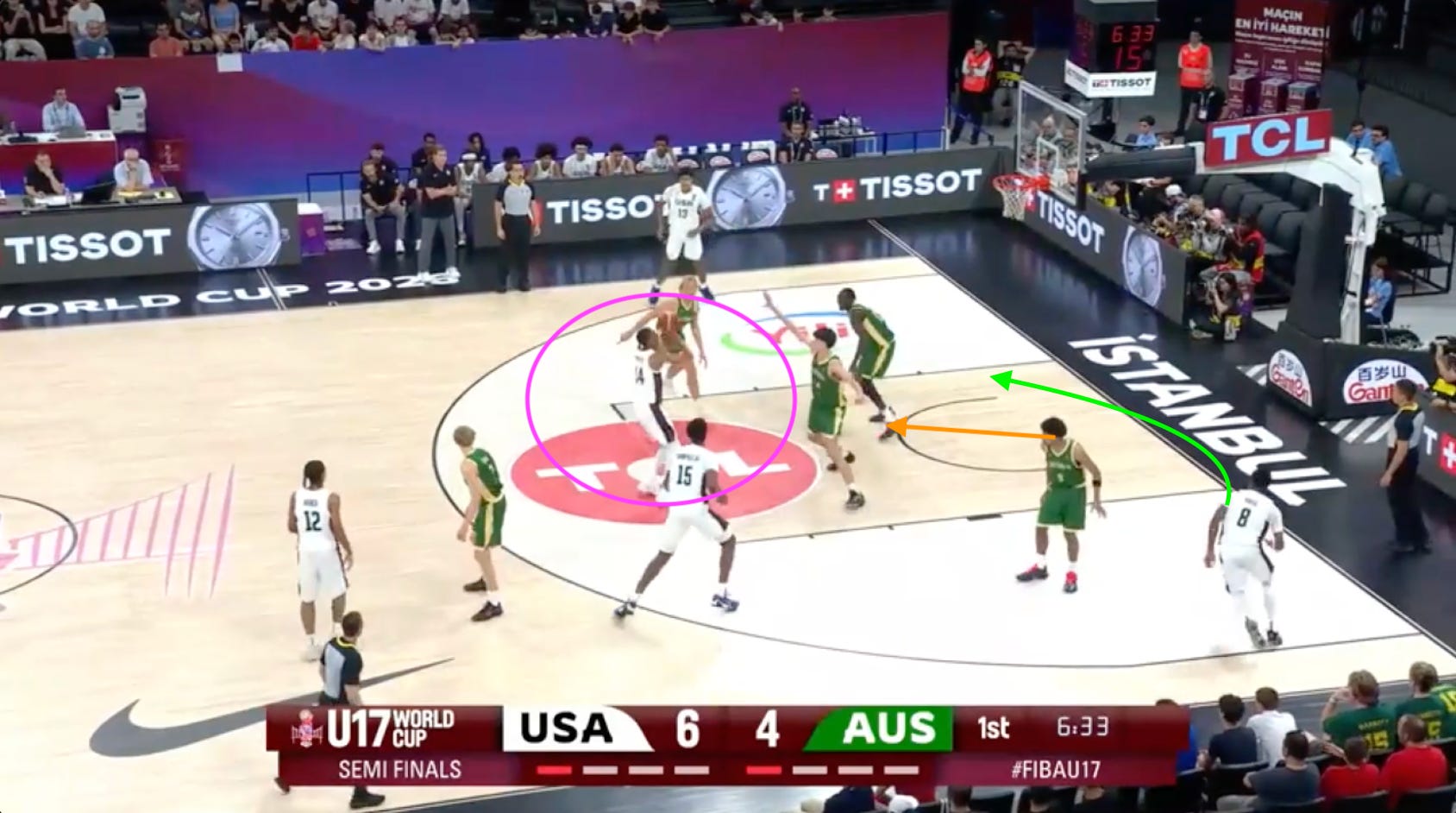
Rosser’s jumper misses and two Australians are in great position to grab the defensive board; however, Page busts in and taps out a contested rebound right back to his teammate. Rosser collects the loose ball and drains the jumper, but this doesn’t happen without Page’s hustle.
Cayden Daughtry, PG
Black wasn’t the only standout lead ball handler on the roster, though: Cayden Daughtry continued his strong 2026 campaign with outstanding production at the World Cup. In just under 18 minutes per game, Daughtry averaged 11.7 points, 4.7 assists and 4.0 free throw attempts, while shooting 66.7 percent on 2s, 45 percent on 3s and 82.1 percent from the line, translating to a true shooting rate of 72.8 percent.
The 6-foot Daughtry is smaller, but he’s as durable driver, one who can play through the bump. Beyond his toughness and physicality, Daughtry is a patient playmaker with excellent body control. He’s tough to contain as Daughtry can mix speeds and change directions at the drop of a time.
Here against Italy, Daughtry receives a pass in the middle of the floor, hits his defender with a little stutter rip move and drives by (through contact) for a layup.
This is what that change of pace can create: opportunities to get downhill into tight spaces.
Daughtry and JBB run empty-side two-man game late in the shot clock against Serbia. The defense has the action bottled up, but with under five seconds left on the clock, Daughtry launches into action: a snappy between-the-legs crossover dribble. Instead of dribbling sideways along the perimeter, Daughtry is now going north-south, straight to the rim, for a finish, despite a physical contest from the 6-foot-8 Kusturica.
His patience and purpose with the basketball are notable. As things speed up and the court is cluttered with defenders and off-ball movement, Daughtry can slow the chaos down and get to his spots. There’s an intentionality to these movements that’s rather encouraging. He’s in control, and he’s looking to bend coverages and create openings for teammates.
Xavier Young (10) sets a flat ball screen at mid-court for Daughtry on this possession against Italy. Daughtry dribbles middle and then snakes back to the empty side, driving away from a help defender digging at the ball. A shooter of Daughtry’s caliber could look to let it fly with this much space, or skip it to Collins in the weak-side corner — a pass Daughtry can make. Instead, Daughtry takes his time driving down, pulls the screener defender in his direction, forcing a switch. Young has inside leverage on the guard defender and a clear line to the rim.
While Daughtry can operate like a pure point, he’s also a heady off-ball mover with strong connective tendencies. Daughtry will cut and relocate without the ball, looking to build advantage by making the extra pass.
This transition possession flows into a give-and-go between Daughtry and Collins. When the ball cycles back to Daughtry, he catches it in the middle of the floor, with Australia’s defense scrambling to match up. Daughtry doesn’t force the issue, though. He waits a beat, lets the seas part and hits a streaking Montgomery for another dunk.
This feel as a quick decision-maker and off-ball player served him well on Team USA, as he played a lot of minutes with Bowman, who can commands some on-ball usage, too.
Bowman launches this possession running pick-and-roll with Young. As Bowman drives middle, Daughtry shakes up from the right corner to the wing. Australia’s defense is in good position, but Daughtry is still able to drive by Paul and crack the paint, which pulls in help defenders and creates a cut opportunity for Montgomery, who feasted playing off Daughtry.
Montgomery shot 86.7 percent on 2-point attempts (26-of-30 2PA). According to my charting data from the tournament, Daughtry assisted Montgomery 10 times, the most of any player on the roster, including nine finishes at the rim.
NaVorro Bowman, Jr., Combo Guard
Similar to Daughtry, Bowman scaled his game perfectly for the United States, vacillating between on-ball facilitation and off-ball connective playmaking. Bowman shot 71.7 percent on 2-point attempts and dished out 25 assists to 12 turnovers.
As a creator, Bowman has a nice first step and plays with plenty of burst. The 6-foot-2 guard can drive in either direction and win races to the rim, even against set defenses.
Bowman pairs that speed well with good wiggle and changes of direction. Even in the middle of a drive, Bowman can shift from a straight line into slippery changes of his direction. The ability to break this stuff out on the fly speaks to his athleticism and ingenuity as a driver.
In the open floor, Bowman’s handle can really take over, too. He’ll leave defenders grabbing at the air as he floats and glides around them with pace. Bowman is looking to score when he drives, but he can really pass, too, including hit-aheads and lobs in transition.
International
Nikola Kusturica, Serbia, Wing
While going through Barcelona film early this spring to watch Boumtje-Boumtje and UNC-bound Sayon Keita, I was able to catch a lot of Nikola Kusturica. He popped off the screen as a super creative wing who played with bravado, took chances as a playmaker and could basically do everything on both ends of the floor.
Kusturica is already the youngest player to ever debut for Barcelona’s senior team, and he’s now one of the top prospects in the college hoops landscape; however, the World Cup offered another context for the 6-foot-8 wing: Kusturica as the unquestioned leader of Serbia. Kusturica didn’t disappoint, and if not for a ridiculous effort from JBB, Kusturica would’ve been the best player at the event.
Over the course of a week, Kusturica put together a monster two-way performance, one that went beyond the stats, which were impressive in their own right: he was relentless. Even from afar, while watching on my laptop in North Carolina, his effort level jumped out. Kusturica is super competitive and a leader; package that with his blend of skills and frame, and there’s unlimited potential, especially once he bulks up.
Kusturica recorded 16 steals and 12 blocks in 191 minutes, translating to a steal rate of 4.1 percent and a 5.8 rebound block rate.
During the championship game against the United States, Kusturica went at his former teammate, JBB, on both ends: battling in the post in a clash of titans and attacking him on switches when he had the ball on offense.
His potential as a slasher is special. Despite being pretty lanky, Kusturica has enough bend and craft with his handle to get into tight spaces. After this ball-screen split against New Zealand, Kusturica is able to take one more dribble, gather and glide to the rim for a dazzling finish.
Kusturica’s balance and stride length allow him to cover ground as a driver, whether it’s the half court or the open floor. Again, there’s a real funkiness to his game. He just plays and moves in his own ways. In the game of basketball, you want outlier talents like that: those who differentiate themselves.
As Serbia pushes the ball at New Zealand, Kusturica receives this pass on the move, but he’s still able to pick up his dribble from outside the arc, Euro-step down all the way down the lane and then finish through contact with his left hand.
Kusturica is skinny, but he can already dish out some punishment as a driver. When he gets stronger and adds muscle, he’ll be able to withstand more contact while maintaining his balance.
With a need for Kusturica to be assertive as a scorer for Serbia, the young wing was also able to showcase some of his nuttier shooting abilities. Kusturica has deep range on his 3-ball, and he can hit off the dribble and off platform.
There’s a team-first scalability to his game as well. He dialed up his usage as the situation demanded, but he doesn’t have to force much. Kusturica is a smart mover and cutter, plus his determination as a finisher makes him an excellent target away from the ball.
Because he’s so good at doing the secondary creation work, you can play this guy next to anyone and he’s going to click. Kusturica brings a super malleable skill set to the table.
Kusturica is one of the best connective passers among all prospects, too. He maps the floor well and has a real sense of angles and geometry, which turns him into snappy decision-maker on quick reads.
Serbia even used Kusturica as a screener and roving mismatch piece in its short roll game.
The ability to play both sides of the pick-and-roll, including some bully-bal is encouraging and highlights the type of offensive weapon Kusturica could become in leverage situations as he progresses.
Nathan Soliman, France, Forward
One of the more versatile player and scorers in the World Cup was France forward Nathan Soliman. The 6-foot-9 Soliman led France in scoring (17.6 points per game), rebounds (7.0 per game), blocks (1.6 per game) and steals (1.1), while posting a usage rate of 24.9 percent and an impressive effective shooting clip of 65.1 percent (42.3 3P%).
Soliman was excellent in the opener against Team USA’s stacked front line, scoring 18 points on efficient 6-of-7 shooting from the field (5-of-6 FTA) and collecting four stocks: two steals and two blocks, including a doozy against CJ Rosser. The United States runs 5-out Zoom action for Rosser, with Soliman switching off and then switching back onto the ball. As Rosser drives left, he tries to finish with his inside hand and Soliman is there waiting to pin the shot on the backboard.
The sample size is small, but over this stretch, Soliman posted a 5.9 percent block rate and a 3.2 percent steal rate — both strong indicators that reinforce the disruptive nature of his defensive game.
While he isn’t a twitchy athlete or highly explosive with the ball, Soliman is an industrious creator with a reliable midrange scoring stroke. Balancing power and grace, he thrives when receiving touches in the mid-post or pinch post areas, where he can isolate and operate with a mix of face-up moves and Barkley-style backdown drives.
In the USA matchup, Soliman hit a collection of tough shots against active, athletic wing defenders like Rosser and AJ Williams.
Here, Soliman receives an inverted ball screen and forces a switch against Williams. With the left side cleared out, Soliman chisels his way toward the elbow before pirouetting to drain a difficult fadeaway jumper.
Of course, these types of tough mid-range attempts are ideally treated as fallback looks: bail-out options when the offense stalls. However, Soliman isn’t just a late-clock isolation player. He brings some genuine downhill driving pop to his game as well.
One of the best features of Soliman’s creation profile is his functional deceptiveness with the ball. When initiating the offense, he’s a natural fit to run inverted pick-and-rolls, leveraging smaller guards as screeners to hunt mismatches or create advantage situations if the defense decides to put two on the ball.
This exact archetype — a fluid, primary-initiating big — also makes Soliman highly effective keeping the ball on fake dribble-handoffs. These DHO keepers trigger defensive miscommunications and freeze defenders, and Soliman is always ready to pounce on the opening.
If and when the defense collapses on those looks, Soliman, who posted an assist rate of 19.4 percent over his seven World Cup games, can look for kick-outs or cutters.
Ultimately, this is the optimal projection for Soliman: a big wing who can score from multiple levels, provide floor spacing and serve as a versatile mismatch weapon in both early offense and late-clock situations.
Soliman may never be an apex creator; in fact, he may be better suited for a tertiary role. Down the line, though, an offense could run actions through Soliman or use use as a screener or spacer to help distort matchups and make life easier for other ball handlers. You won’t be able to hide non-defenders on his bully-ball game.
Omer Kutluay, Türkiye, Point Guard
While Black and Daughtry may have asserted themselves as the premier point guards at the event, Türkiye’s Omer Kutluay — a product of the Real Madrid pipeline — certainly made his case as a potent offensive engine. With the attack flowing entirely through him, Kutluay posted monster numbers: a 33.3 percent usage rate and a 49.3 percent assist rate against a mere 12.2 percent turnover rate (63 assists to 24 turnovers).
Some defenses, like the gap-heavy approach of Serbia caused some issues, Kutluay played with aggression as opponents tilted coverages to stop him at all costs, averaging 28.4 points on 20.9 field goal attempts per game while shooting 35.7 percent from deep and 47.8 percent inside the arc.
France threw everything at Kutluay in the quarterfinals, but he simply continued to hit massive shot after massive shot. He possesses serious pull-up range paired with matching confidence; even with a second defender contesting his space, Kutluay can routinely bury deep jumpers with accuracy.
Kutluay features a wicked crossover and plenty of functional twitch; he can weave through defenders like cones or expertly split a hard hedge downhill. Once he gets into the paint, Kutluay unpacks an extensive bag of below-the-rim finishing counters, or he can leverage his gravity to make quick, daring reads as a playmaker.
The threat of his pull-up or step-back 3-ball is a powerful tool for unlock his dribble-drive game. He’ll lull defenders into thinking he’s ready to pop an off-dribble 3-point and then blow by them for downhill paint finishes.
Stay turned for more scouting and 2026 offseason coverage throughout the Summer and Fall!
Thanks for reading Split The Action! Subscribe for free to receive new posts and support my work.
Comments
Nothing yet. Say the first thing.
Sign in to join the conversation.