
Two companies. Two opposite reputations.
One is the patron saint of value investing. It sits on roughly $382 billion in cash. It has not paid a dividend in almost 60 years. Its P/E is about 14.
The other is the poster child of growth. Its revenue grew 85% last year. It is worth close to $5 trillion. Its P/E is about 31.
Here is the part that should stop you.
The value icon, Berkshire Hathaway, pays its shareholders nothing. The growth icon, Nvidia, just started sending shareholders a check.
The textbook says it should be the other way around.
That is the first lesson. The growth-versus-value labels are useful. They are also messier than any chart makes them look.
I think most beginners get talked into picking a team too early. Growth or value. Pick one, defend it forever. That is a mistake. So before you pledge allegiance to either camp, let me walk you through what the two approaches actually mean, using the two companies above.
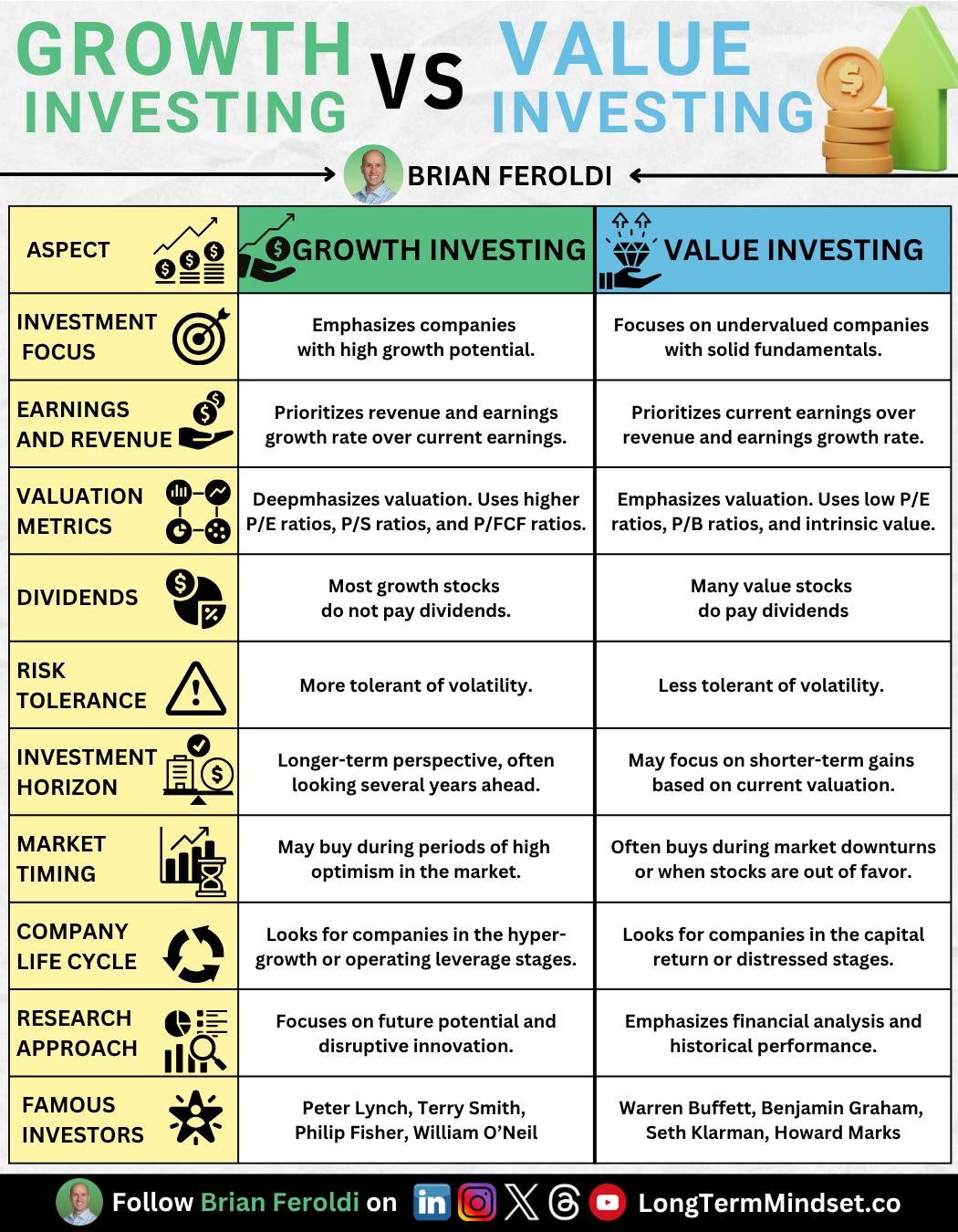
Value investing starts with one question. What is this business worth right now, and can I buy it for less than that?
A value investor wants a gap between price and worth. Buy a dollar for 70 cents. That gap is what Benjamin Graham called the margin of safety. Buffett built Berkshire on it. Seth Klarman and Howard Marks preach it.
Value investors lean on metrics that measure today: a low price-to-earnings ratio, a low price-to-book ratio, a conservative estimate of intrinsic value. They tend to buy when a stock is hated, beaten down, or boring. Less tolerant of wild price swings. Often happy to collect a dividend while they wait.
Growth investing starts somewhere else. What will this business be worth later, and is today’s price reasonable compared to that future?
A growth investor will pay a higher multiple today if the growth is real and durable. Peter Lynch made his name this way. So did Philip Fisher. They care more about the size of the runway than about this quarter’s earnings.
Growth investors accept higher P/E ratios, higher price-to-sales ratios, and a lot more volatility. They are buying the next decade, not the next dividend. Most of the time, there is no dividend at all, because the company would rather reinvest every dollar back into the business.
Two doors. Same house. Now let’s see what each one looks like in real numbers.
Berkshire Hathaway trades around 14 times earnings. Its price-to-book ratio sits near 1.4. Both are below where the stock has traded for most of the last decade.
It pays no dividend. None. Buffett has always argued he can reinvest a retained dollar better than you can, so he keeps it.
And it is sitting on about $382 billion in cash. That is not a typo. Berkshire has more spare cash than the entire market value of most companies on Earth.
On paper, this is the value investor’s dream. Cheap multiple. Fortress balance sheet. Decades of proof.
NVIDIA trades around 31 times trailing earnings. That is more than double Berkshire’s multiple.
Its revenue grew 85% over the past year, driven by demand for the chips behind the AI buildout. Return on invested capital is north of 100%, which is almost unheard of at this scale.
For years, it paid a token dividend of one cent a share per quarter. This spring it raised that to 25 cents. The yield is still tiny, around half a percent. The message is the same one growth companies always send: we would rather pour the money back into the business than hand it to you.
On paper, this is the growth investor’s dream. Explosive top line. Elite returns on capital. A market that cannot get enough.
Here is where I want you to slow down, because the labels can fool you.
A low P/E is not a synonym for safe.
Berkshire is cheap for reasons. Buffett stepped down as CEO at the end of 2025. Greg Abel runs it now. The company is so large that compounding at its old pace may be impossible. That $382 billion in cash is a sign Buffett could not find enough things worth buying, and cash earns far less than a great business does. For the “value” case to pay off, Abel has to deploy that mountain of cash into something that grows. If he cannot, you own a cheap stock that stays cheap.
A high P/E is not a synonym for expensive.
NVIDIA looks pricey at 31 times earnings. But if earnings keep climbing, the forward multiple drops to around 20, which is not crazy for a business growing this fast. For the “growth” case to pay off, AI spending has to keep accelerating for years. If that spending slows, you are no longer paying 31 times growing earnings. You are paying 31 times falling earnings. That math gets ugly fast.
This is the whole game. The label tells you the strategy. It does not tell you whether the investment is any good. A bad value stock is still a bad investment. A great growth stock bought at an insane price is still a way to lose money.
Buffett settled this argument back in 1992. He wrote that “growth and value investing are joined at the hip.”
He is right. Growth is not the opposite of value. Growth is one of the inputs you use to figure out what a business is worth. A company growing 85% a year is worth more, per dollar of today’s earnings, than one growing 2% a year. That is not a contradiction. That is just arithmetic.
So stop asking whether you are a growth investor or a value investor. Ask the better question instead.
What is this business worth, and am I paying more or less than that?
Berkshire and Nvidia are both trying to answer that question. They just start from different ends of it.
Wishing you investing success, Brian
No posts
Comments
Nothing yet. Say the first thing.
Sign in to join the conversation.