
For years, I read financial statements one at a time.
I would open the income statement. Check if the company made a profit. Nod. Move on.
The balance sheet and the cash flow statement felt like extra credit. I mostly skipped them.
That was a mistake, and it took me too long to fix.
The three statements are not three separate reports. They are three camera angles on the same business. One camera points at profit. One points at what the company owns and owes. One points at where the cash actually went.
Same company. Same year. Three views.
Here is the part that changed how I invest. The three angles are wired together. A number on one statement shows up on another. Once you can see the wiring, the statements stop feeling like homework and start telling you a story.
Meta makes that wiring easy to see.
Two true numbers
In 2025, Meta reported $60.5 billion in net income.
That same year, Meta’s operations generated $115.8 billion in cash.
Both numbers are correct. Neither is a typo.
A $55 billion gap sits between “profit” and “cash.” That gap is the entire reason you read more than one statement. If you only looked at net income, you would badly understand how much money this business actually throws off.
The statements explain the gap. You just have to follow the numbers from one to the next.
A quick refresher
We have covered each statement on its own. Here is the one-line version of each, using Meta’s 2025 numbers.
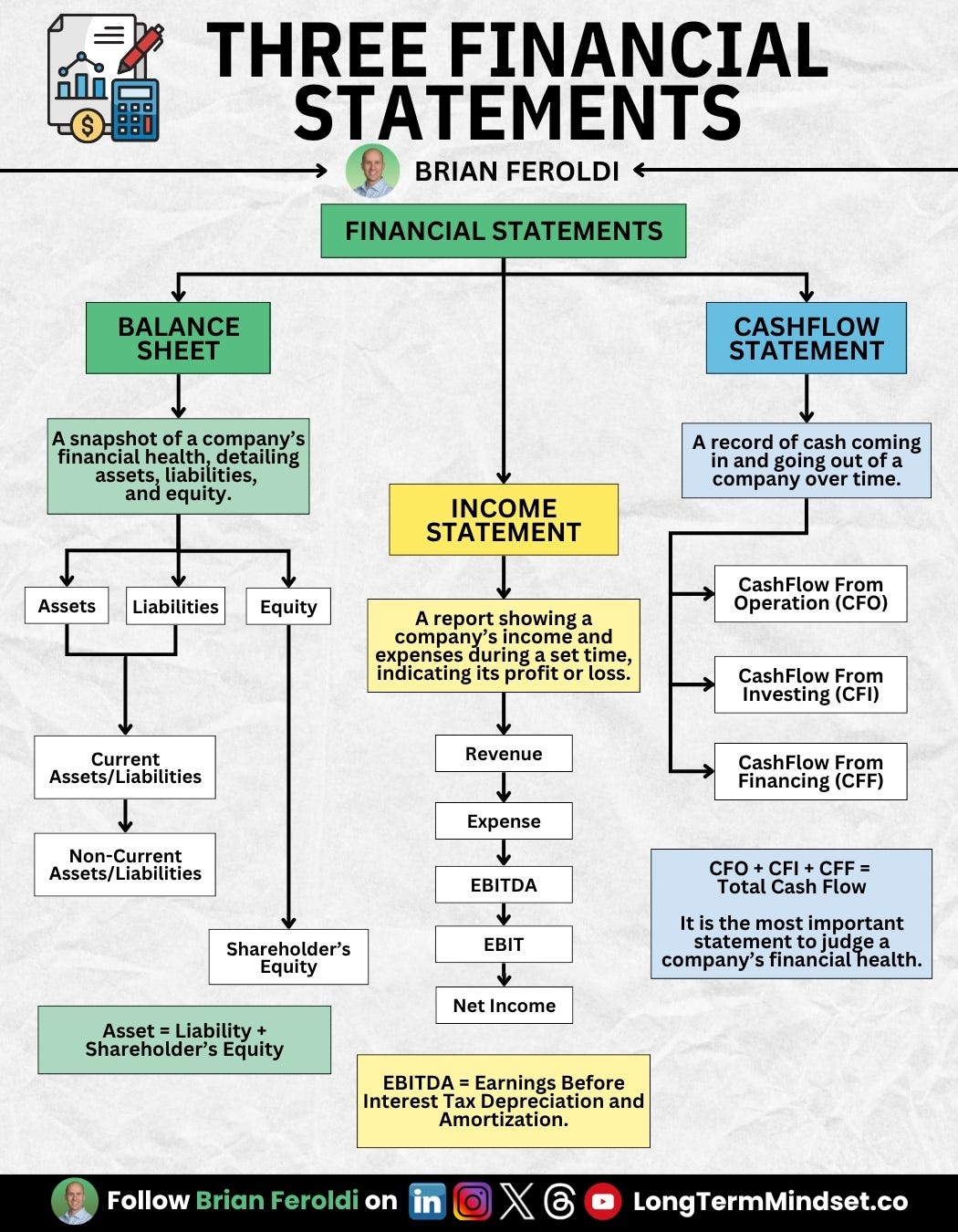
The income statement shows profit over a period. Meta took in nearly $201 billion in revenue, subtracted every cost, and was left with $60.5 billion in net income.
The balance sheet is a snapshot on a single day. On December 31, 2025, Meta owned $366 billion in assets, owed $149 billion in liabilities, and the $217 billion left over belonged to shareholders.
The cash flow statement tracks actual cash in and out over a period. In 2025, operations brought in $115.8 billion of it.
Three angles. Now watch how they connect.
You just followed one number through Meta's three statements. That is most of what reading financial statements actually is, and it gets easier every time you do it.
I send one short lesson like this every Saturday. Plain English, real companies, free.
Connection 1: Net income is the handoff
Net income is the last line of the income statement. It is also the first line of the cash flow statement.
That is not a coincidence. The cash flow statement starts with the $60.5 billion in profit and then adjusts it to figure out how much real cash came in.
Net income shows up in a second place too. It flows into shareholders’ equity on the balance sheet, into a bucket called retained earnings. Every dollar of profit a company keeps gets added to what shareholders own.
So one number, net income, touches all three statements. It ends the income statement, opens the cash flow statement, and grows the balance sheet.
Connection 2: Some expenses cost profit but not cash
This is where that $55 billion gap starts to make sense.
Meta recorded $18.6 billion of depreciation and amortization in 2025. That is a real expense. It lowered net income by $18.6 billion.
But no cash left the building for it this year. Depreciation is the accountant’s way of spreading the cost of something Meta already bought, like a building or a server, over the years it gets used.
So on the cash flow statement, that $18.6 billion gets added right back. The profit said the money was spent. The cash never moved.
Stock-based compensation works the same way. Meta paid employees $20.4 billion in stock in 2025. It counts as an expense, so it lowers profit. No cash goes out the door, so it gets added back too.
Add those two back, plus a few other adjustments, and you can see how $60.5 billion of profit becomes $115.8 billion of operating cash. The income statement and the cash flow statement are looking at the same business. They just count differently.
Connection 3: Cash ends up on the balance sheet
The cash flow statement does not stop at operations.
It then shows what Meta did with that cash. In 2025, the company poured about $70 billion into property and equipment, mostly data centers and servers. It spent $26.3 billion buying back its own stock and $5.3 billion on dividends.
After all the cash comes in and goes out, the statement lands on one number: how much cash Meta had at the end of the year.
That number is not stuck on the cash flow statement. It walks straight over to the top of the balance sheet. Meta ended 2025 with $35.9 billion in cash and equivalents, and that is exactly the figure sitting in the asset column.
The cash flow statement explains the movement. The balance sheet records the result.
Why the balance sheet always balances
One more piece ties it all together.
A balance sheet has to balance. Always. The formula never breaks:
Assets = Liabilities + Shareholders’ Equity
For Meta in 2025, that is $366 billion in assets, $149 billion in liabilities, and $217 billion in equity. Add the last two and you get $366 billion. It balances to the dollar, every single quarter, for every public company.
That is not magic. It is the whole accounting system enforcing one rule: everything a company owns was paid for either by money it owes or by money its owners put in and left in.
What this is worth to you
When I read one statement alone, I get a slice of the business. Net income alone hid the fact that Meta generates almost twice its profit in cash. Cash flow alone would not tell me what the company owns or owes. The balance sheet alone says nothing about whether this year was good or bad.
Read together, they corroborate each other. Profit flows into cash. Cash flows onto the balance sheet. The balance sheet has to balance. When those connections hold, the numbers are telling a consistent story. When they do not hold, that is your first clue something is off.
Here is the one thing to try this week. Pull up a company you own. Find net income on the income statement. Then find it again at the top of the cash flow statement. Then find retained earnings on the balance sheet.
One number, three places. Once you spot it, you cannot unsee how the statements talk to each other.
Wishing you investing success,
Brian
Comments
Nothing yet. Say the first thing.
Sign in to join the conversation.