
WELCOME to #TheatreClique — my emphatically intermittent newsletter dedicated to encouraging you to click out to some of the most interesting, intriguing & noteworthy writing about drama, theatre & performance (at least, so says me)…
This installment of #TheatreClique clicks out to pieces that consider one of the nation’s first dramatists, remember one of Philadelphia’s most influential theatre artists, and narrate the messy dramatic history of live performance on this continent. Plus, a quick bit of commentary about my experience of recent productions, including The Loved Ones, Girl Interrupted, The Family Dog, and Barefoot in the Park. And for this week’s opener, I lift a video folks usually share this at the start of June. But I always think of it as the only memorable thing to emerge from the 1995 television broadcast, A Capitol Fourth. (I promise I vividly remember actually watching this air live on PBS that year and can attest to my delight in rediscovering, some years later, actual video documentation of what I worried might have been a delusion: Leslie Uggams’s performance of “Honking the Bejeepers.”) Here’s the clip and its hilarious backstory — and check out the crowds gathered so sensibly in our nation’s capitol that year…and if clicking the embedded image below routes to an error message, try clicking here.
EDITOR’S NOTE: whenever possible, whenever linking to paywalled pieces, I try to “gift” the article to #TheatreClique readers. In other words, clicking out to articles in the New York Times, Washington Post, Philadelphia Inquirer, The Atlantic, and Wall Street Journal should neither present hassle nor burn through your current allotment of free views. Here’s hoping more outlets — hello LATimes! hi NewYorkMagazine! yo NewYorker!— adopt similar technologies for subscribers soon... (I do however acknowledge that, for many linked items, some kind of sign-in/registration is required for “free” access.) That said, should you encounter any obstacles to access for linked materials that are particular persistent, perplexing or annoying, please do alert me by replying to this message so that I can try to adjust accordingly.
Wherein I highlight a handful of the most click-worthy links I’ve encountered in the last few…
at The New York Times, historian/writer Kathleen Duval (with illustrations by Tim McDonagh) profiles Mercy Otis Warren, who — in the 1770s — published a series of plays that animated understandings of “the struggle against Britain as a fight against tyranny”;
at Hyperallergic, arts writer/editor Aruna D’Souza surveys some of the visual artists who have re-represented the Statue of Liberty “as a tool to argue for a fuller vision of American freedom”;
at Hammer & Hope, culture writer/editor Clover Hope talks to director Zhailon Levingston about how “Cats on Broadway now is as much a war cry as it is a joy bomb…. We’re celebrating the people who have always made something from the scraps colliding with a generation of people who are continuing the historical promise to never settle”;
at Café Europa, freelance theatre writer/critic Natasha Tripney excavates how the play White Rabbit, Red Rabbit began as an experiment that became an international phenomenon;
The New York Times’s Helen Shaw remembers Philadelphia-legend Dito van Reigersberg (1972-2026) through his work as an actor, drag artist and co-founder of Pig Iron Theater Company as well as his “talent for blending zaniness with romantic yearning”;
and THIS WEEK’S MUST-READ…
at American Theatre, theatre writer/historian Charlotte Canning reminds us — with great erudition — that, on the US’s 250th birthday, “we should be able to look to our nation’s stages, as we always have, for signs of where our country has been—and where it is going.”
Wherein I highlight noteworthy current or soon upcoming opportunities for remote theatregoing.
Pig Iron Theatre’s 2026 Season ~ Franklin’s Key & Poor Judge
“To cap off our 30th anniversary season, Pig Iron is excited to share professional recordings of our award-winning 2026 stage productions: Franklin’s Key and Poor Judge.”
streaming on-demand from 7/6-19 • $35ea/$60bundle
Wherein I offer capsule commentaries on what I liked best (or found most compelling) about the shows I’ve recently engaged... A full accounting of my 2026 theatregoing can be found HERE.
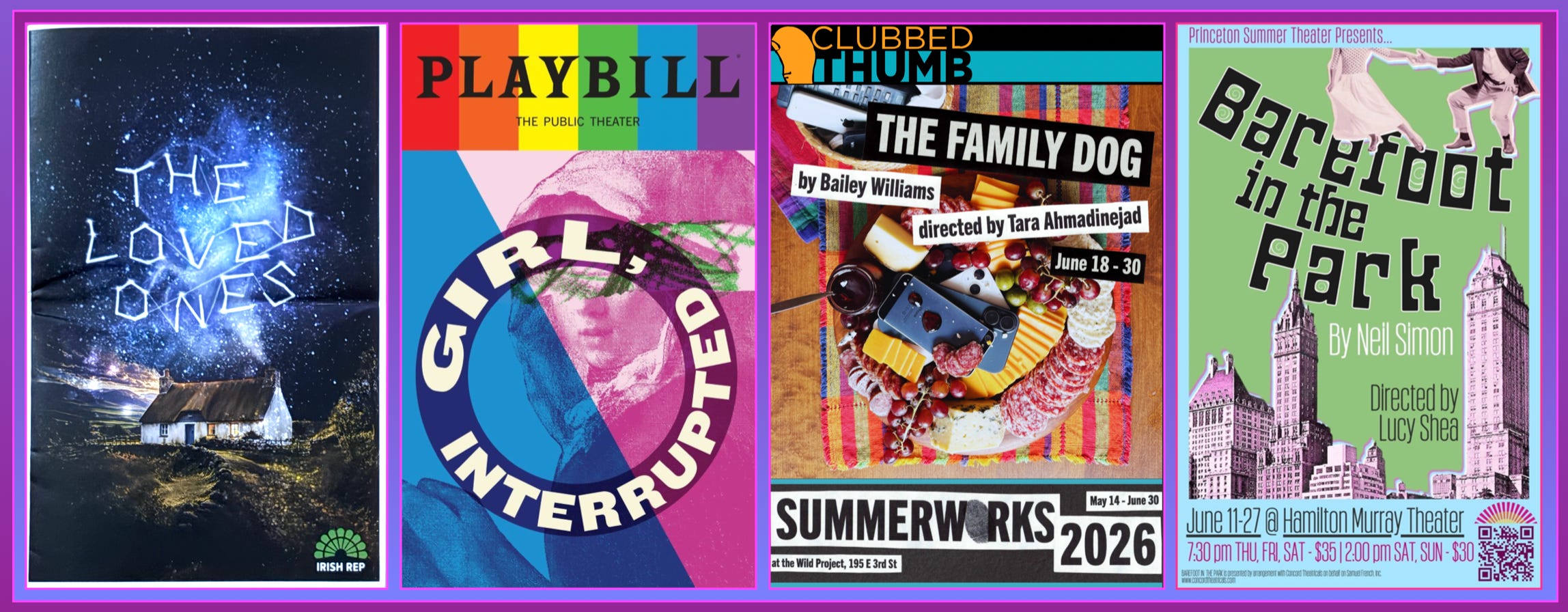
Written by Erica Murray • Directed by Nicola Murphy Dubey • NYC : Off-Broadway • Irish Rep (Greenburger) • June 2026..
It’s all too easy, especially in the theatre, to think we have everything we need to know about a character based solely our first impressions of them. Erica Murray’s stealthily effective script for The Loved Ones is especially adept in its use of such “first impressions” as a dramatic device. Consider Murray’s dramatis personae: Nell (a luminous Maryann Plunkett) is the isolated, exhausted, prickly-but-kind proprietor of a cozy Airbnb in some remote corner of County Clare. Gabby (the achingly vulnerable Alana Raquel Bowers) is the pregnant college student who arrives — unannounced — at Nell’s doorstep, seemingly anticipating that everything will just work out. Orla (Clare O’Malley, a raging caged animal in upmarket corporate drag) is pulled tighter than her slick ponytail and is, clearly, disinclined to suffer fools. And then of course there’s Cheryl-Ann (the defiantly cheerful Donna Lynne Champlin) — that boundary-free gregarious American tourist, dedicated bird-watcher, and Harry-Potter-adult who is happy to remind you that she will be leaving a review. Within minutes, with this swirl of surprise arrivals and mistaken bookings and disrupted plans, The Loved Ones sets us up to think we know what’s going to happen. But the accomplishment of Murray’s play — one amplified by the acute precision of Nicola Murphy Dubey’s direction — is that each of these characters becomes more complicated (and more human) with each passing moment. Quiet surprises and simple twists avert pat narrative convention, which allows the play to breathe in unexpected and utterly captivating ways. And as these women sit alongside their flickering ghosts of grief, they begin — thanks to each other — to confront the imminent reality of their necessarily uncertain futures. The Loved Ones is as captivating as it is moving, elevated by consistently excellent performances and stealthily clever sound and scenic design. Plunkett is (as per usual) extraordinary, as is the formidably gifted Bowers. But matching them are Champlin, who serves a cascading delight of a performance, and O’Malley who holds the always thrumming heart of the play with acuity and grace. A quiet, funny gem of a production.
See also:
TheatreMania’s Rachel Graham celebrates how The Loved Ones “charms with wit, warmth, and unexpected turns” and makes “appealing theater out of mediating on questions instead of answering them”;
at New York Notebook, veteran theatre writer/critic Sandy MacDonald praises The Loved Ones as a “marvel of unshowy complexity” featuring “four supremely gifted performers navigating the emotional maze set out for them.”
Book by Martyna Majok, with Songs by Aimee Mann • Directed by Jo Bonney • NYC : Off-Broadway • The Public (Martinson) • June 2026.
I’ve observed some sincere hand-wringing (mostly over on theatre tiktok) as to whether Martyna Majok’s adaptation of Susanna Kaysen memoir Girl, Interrupted is actually a musical, even though it’s billed as a play with music. I’m alert to what The New York Times’s Helen Shaw describes as the “chronological confusion” stirred by the source material — an early 1990s bestseller that became a generational touchstone of sorts, as well as a semi-iconic late 1990s film featuring a full cohort of rising stars, even though the material is ostensibly about the late 1960s. (I confess to never reading the book and not even remembering seeing the movie, even though I apparently wrote about the film back in my StinkyLulu days.) But, yes, this staging of Girl, Interrupted does operate as a bit of a blur — of genre, of tone, of chronology, of character — but that might be exactly why I responded so viscerally to it. Perhaps because Aimee Mann’s music is so, well, Aimee Mann… and perhaps because Mann’s songs operate more as interpolations within Majok’s script (rather than, say, a fully “integrated” musical theatre score), this adaptation of Girl, Interrupted does feel a bit fragmented, a bit jumbled, even a bit incoherent — which serves the material in perhaps unexpected ways. (At The New York Times, theatre writer/critic Elisabeth Vincentelli gives context to Girl, Interrupted’s peripatetic journey to the stage — which might explain some the show’s herkyjerkyness. Or not.) But, yes, I was utterly and consistently engaged by Girl, Interrupted as a richly textured work of music theatre that uses Mann’s distinctive melodies to drop us deep into often paradoxical registers of character-driven emotion. Holding the brittle center of Girl, Interrupted’s kaleidoscope of searing vignettes is Juliana Canfield, in an understated, eerie but somehow electrifying thrum of a performance. Canfield’s Susanna is our guide through (and our only known survivor of) the harrowing halls of this institution dedicated to confining women — at the behest of men (doctors, fathers, husbands) — for their own good. Susanna’s fellow “patients” are a captivating lot (the rebel, the anorexic/bulimic, the lesbian, the disfigured accident survivor, the kind friendly one suffering a severe and unpredictable mood disorder) for whom greater acceptance and better treatments might be available in just a few years. But early on, Majok includes snippets of these institutionalized girls watching television reports from “the outside” — news of protests, love-ins, and death counts from Vietnam — presumably to anchor our awareness that Girl, Interrupted narrates the period from 1967-69. The device also activated — at least for me — a palpable sense of melancholic dread, underscoring that — if 1 of every 10 US soldiers sent to Vietnam were wounded or killed — the odds of survival for these institutionalized girls were far far worse. And in this Girl, Interrupted, we experience that devastation, as nearly all of these girls become casualties in an unspoken and unspeakable war against their full, complicated, flawed humanity. Amplifying this tragedy, Majok and director Jo Bonney chart this steady cycle of loss incrementally by having each character join a gallery along the rear rotunda of the haunting, panopticon-styled scenic design by dots. Ultimately, I found Girl, Interrupted an uneasy but richly textured provocation that, like the Vermeer painting used as a framing device in it, challenges us to ask what everyday violences, violations, and vulnerabilities are we in/capable of seeing right now.
See also:
OutInNewJersey’s Allen Neuner highlights how Girl, Interrupted offers a “harrowing look back at institutionalized medical sexism”;
at ExeuntNYC’s Loren Noveck highlights how each of Girl, Interrupted’s “patients is her own tragedy–her own life, interrupted–and it’s Mann’s songs that really make us feel it.”
Written by Bailey Williams • Directed by Tara Ahmadinejad • NYC : Off-Broadway • ClubbedThumb (The Wild Project) • June 2026.
Not too long ago, I encountered a bit of axiomatic wisdom that went something like this: “For children, loving a dog teaches lessons about death; for adults, loving a dog helps to confront the realities of aging.” Although presented as a commonplace saying, the framing was new to me and, as someone who shares a domicile with an adorable but demanding elder dog, it’s one I’ve been pondering ever since. It also came to mind as I reflected one Bailey Williams’s wildly funny, incisively acerbic yet unstintingly warm play, The Family Dog, which rounded out this years installment of ClubbedThumb’s Summerworks. The Family Dog offers a portrait of an all-too-typical upper middle class white family of self-possessed strivers right about when the twenty-something kids fail to launch as expected and when what had briefly been an empty nest has begun to fill again. The Family Dog also toys with our pleasures (and suspicions) of the all-too-familial dramedy with a giant couch at center stage. But the surprise of Williams’s play is that, under the astute direction of Tara Ahmadinejad, The Family Dog feels — quoting David Cote here — “a tiny bit like if Our Town had an old, sickly canine as the Stage Manager.” (In the role of this wise yet avuncular dog is the extraordinary Bruce McKenzie, somehow totally convincing as a dog and also as the voice of — well — what is dog spelled backwards? Kinda that, but in a totally chill, old dog kinda way.) And as much as the play hovers around the ever-impending death of this impossibly old dog, The Family Dog seems to me to be even more interested in how this group of adult children are confronting — in themselves and their family — the fearsome realities of aging. All the frailties and the failures, the infirmities and the infelicities, the deceptions and denials that punctuate the life-hinge between “figuring it out” and “really should have it together by now.” Featuring expertly funny and vividly felt performances from the likes of Jennifer Van Dyck (as a mother who’s need for love and control has her completely unmoored) and Ethan Dubin (as the blowhard big brother recently crashlanded in the family basement), standouts among an exhilaratingly strong ensemble. A brisk wonder of a play that has me hoping for future chances to spend time with this amazing dog… and the family that loves him so, of course… but, yeah, mostly that dog.
See also:
at The Village Star-Revue, theatre critic/dramaturg Mark Dundas Woods talks to Bailey Williams about how her “personal if not quite autobiographical play” made it to page and then the stage;
at Engaging with Melodrama, dramaturg/administrator Susana Kuhn hails The Family Dog as “nothing short of miraculous.”
Written by Neil Simon • Directed by Lucy Shea • Princeton, NJ • Princeton Summer Theater (Hamilton Murray) • June 2026.
When I was coming up as a wee theatrebaby, Neil Simon seemed to be — oh — pretty much everywhere. In scene study classes. At speech tournaments. On college, high school, and community theatre stages. And, of course, all over the large and small screen. But somewhere along the way, Simon’s late twentieth century ubiquity somehow dissolved, seemingly altogether, as the century turned. Indeed, I suspect there are several generations of currently striving theatrefolk who likely only vaguely know that there even was such a thing as a Neil Simon. (At least beyond his being the namesake of the current Broadway home of MJ: The Musical.) So when I learned that Princeton Summer Theatre was kicking their 2026 season off with a staging of one Simon’s simplest and most crowd-pleasing comedies, I couldn’t help but wonder how the cultural and historical specificity of Simon’s play might play today. I should not have been surprised but PST’s Barefoot in the Park totally worked. Though lighter than I might have expected when it came to big laughs (especially from the near capacity audience comprised mostly of folks older than me), director Lucy Shea’s strategy to anchor the piece in Corie’s emotional perspective had the unexpected effect of having this Barefoot be the most human (and humane) approach to the play that I’ve seen. This humanity extended to the full ensemble (reminding me of what I so love about Mildred Natwick’s performance in the film.) So not only did PST’s production re/introduce me of the sturdy-yet-supple comedic architecture of this particular play but, perhaps more surprising, Shea’s staging also reminded me of the sincere humanity embedded within Barefoot and, indeed, throughout Neil Simon’s formidable ouevre.1
See also:
TAPintoPrinceton highlights how “A Pleasant Surprise” At Princeton Summer Theater “Evolves into a Delight”;
at Town Topics, theatre writer/critic Douglas Sanborn III praises PST’s Barefoot for making “the play’s world vivid and entertaining, offering audiences a fun start to its season.”
TRANSPARENCY DISCLOSURES for #260703: Charlotte Canning is a friend and professional colleague. I have served on the board of Clubbed Thumb for most of this decade. I attended The Loved Ones as a guest of the production and at no direct expense to myself.
With only the very occasional exception, I do not include in this newsletter extended commentary on works presented on the Princeton campus by current (or even recently graduated) Princeton students. Even so, I do want to embrace the opportunity to highlight the work being done by this rising cohort of theatremakers and also to document, even if only briefly, the relevance of their work to my general theatregoing flow.
Comments
Nothing yet. Say the first thing.
Sign in to join the conversation.