
WELCOME to #TheatreClique — my emphatically intermittent newsletter dedicated to encouraging you to click out to some of the most interesting, intriguing & noteworthy writing about drama, theatre & performance (at least, so says me)…
This installment of #TheatreClique clicks out to pieces that reflect on 30 years of ClubbedThumb, that insist on potency of artistic autonomy, and that apply the principles of recovery to the challenges of working within the contemporary American theatre. Plus a #NowFundThis challenge to support Climate Sing, “an ongoing project committed to bringing people together through passionate, joyful songs that lift up the current, urgent need to deepen our relationship to our planet.” And my commentary on some recent productions, including Titans, The America Play, The White Whale Journal, and Animal Wisdom. But for this week’s opener, I lift director/writer/producer Kristin Marting’s remarkable interview with arts leader Maria Striar about her three decades of work as the founding artistic director of ClubbedThumb… and if clicking the embedded image below routes to an error message, try clicking here.
EDITOR’S NOTE: whenever possible, whenever linking to paywalled pieces, I try to “gift” the article to #TheatreClique readers. In other words, clicking out to articles in the New York Times, Washington Post, Philadelphia Inquirer, Atlantic, and Wall Street Journal should neither present hassle nor burn through your current allotment of free views. Here’s hoping more outlets — hello LATimes! hi NewYorkMagazine! yo NewYorker!— adopt similar technologies for subscribers soon...
Wherein I highlight a handful of the most click-worthy links I’ve encountered in the last few…
#TC’s MUST READ for this week: at Theater Is Hard, playwright/theatremaker Sara Farrington — generatively, provocatively, smartly — applies the principles of Al-Anon to the state of our contemporary American theater (especially as bleakly/aptly distilled by Isaac Butler’s recent analysis in American Theatre);
at The New York Review of Books, novelist/essayist Zadie Smith ponders the question of artistic autonomy and whether and why artists should go on making things in times like these;
KJZZ’s Lauren Gilger profiles playwright/educator and 2026 Guggenheim Fellow Elaine Romero about how her 120+ plays map how “the only way out of any kind of political quagmire is the truth of humanity”;
at the Folger Shakespeare Library Blog, actor/author Austin Tichenor surveys the past, present, and future of “actors exploring Shakespeare alone onstage”;
at AramcoWorld, freelance arts/culture journalist Indlieb Farazi Saber reports on the UK company Muslim Panto, which adapts the UK’s beloved “panto” tradition by transforming familiar fairy tales through the integration of MENASA cultural traditions (and culturally appropriate humor) with original panto shows like Snow Brown and Her Seven Chachay;
at Grub Street, actor/writer Constantine Rousouli narrates how he eats/rests/exercises/heals to get through five days (and seven shows) of Titanique;
and, at BoyCulture, independent culture writer Matt Rettemund reports on how he “went from being a guy with zero expectations to one with zero reservations” about Heated Rivalry: The Unauthorized Musical Parody.
Wherein I highlight noteworthy current or soon upcoming opportunities for remote theatregoing.
The Alcove at the Lucille Lortel’s War Painting
“Our performance is survival” In this dark comedy-drama by Caridad Svich — nominated for the 2026 Susan Smith Blackburn Prize — a wealthy couple invites their erstwhile friend over for an evening. An innocent affair turns savage, as Western civilization itself is dismantled. What wars do we harbor in the name of art?
streams on-demand through 6/17 • free, with required registration
Wherein I offer capsule commentaries on what I liked best (or found most compelling) about the shows I’ve recently engaged... A full accounting of my 2026 theatregoing can be found HERE.
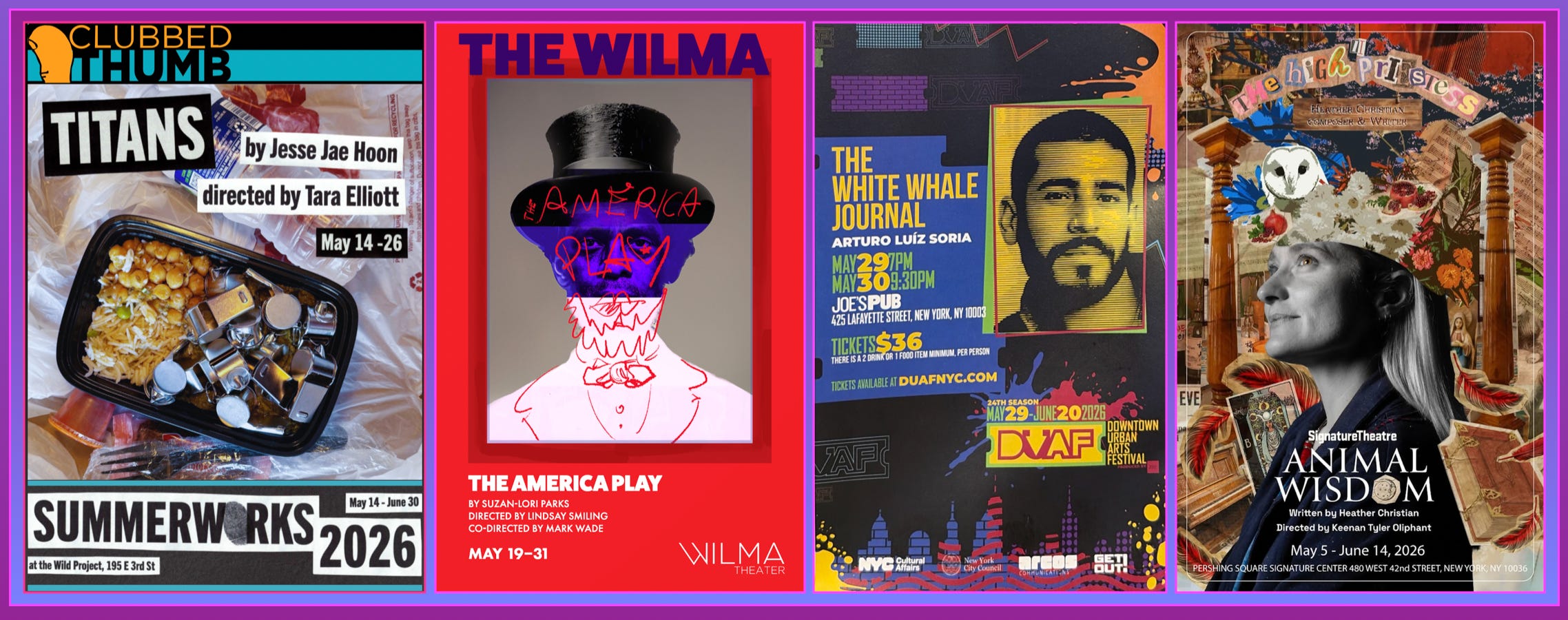
Written by Jesse Jae Hoon • Directed by Tara Elliott • NYC : Off-Broadway • Clubbed Thumb’s Summerworks @ TheWildProject • May 2026.
“Funny. Strange. Provocative.” That’s been the distinctive artistic mission/mandate of Clubbed Thumb for three decades. And as the first offering in this year’s Summerworks, Jesse Jae Hoon’s emphatically topical Titans — which depicts one unspecified community’s response to the escalation of ICE raids — is follows this triple-imperative with a distinctively urgent verve. The play begins with the (strange) surreality of a world in which people are being disappeared — from their workplaces, from their classrooms, from their vehicles — which provides the narrative context for an unlikely cohort of (funny) characters who, over the course of the play, become a community methodically teaching themselves — and us — how to resist (provocative). Director Tara Elliott’s brightly choreographic staging activates the world shared by these characters with deft precision, while also (and always) subtly underscoring that these incredibly skilled actors were also people gathered in a tiny theatre in the East Village. Jae Hoon’s and Elliott’s deftly integrate Brechtian basics, like the ensemble watching and laughing at the scenes they weren’t in, or the didactic moments of direct address as one or another actor stepped out of the action to offer practical how-to instruction, or scenic designer Raphael Mishler’s use of supertitles to cue location. Together, these gestures built a theatrical world in which the typical theatrical divides — between the audience and the stage, between actor and community-member, between action and inaction — became more porous (and more charged) than usual, thereby amplifying a distinctive sense of urgency. Indeed, Titans threaded the particular needle of political conscience plus funny/strange/provocative in a way I haven’t experienced at ClubbedThumb since Summerworks 2017 (the one that introduced Heidi Schreck’s What the Constitution Means to Me to an astonished (and activated) audience). (And a big ole yay to the whole dazzling ensemble, with especial shoutouts to Julia Brothers, Ben Langhorst, and Layan Elwazani for making me swoon at the balance of humanity and hilarity served.)
See also:
at The New York Times, writer/critic Elisabeth Vincentelli considers Titans as “American civic as a counterbalance to American gothic” and as an example of the ways “Summerworks endures [as] a small light, but it shines bright;”
at Engaging with Melodrama, dramaturg/teaching-artist Susana Kuhn praises Titans as “a beautifully crafted wake-up call” to “the terrifying twists and turns of our current lives, where, unfortunately, we must be brave.”
Written by Suzan-Lori Parks • Directed by Lindsay Smiling, with Mark Wade • Philadelphia • Wilma Theater • May 2026.
Suzan-Lori Park’s adventurously theatrical rumination on the question of USAmerican history probably arrives as a potent provocation anytime it is staged any where. But in 2026? In Philadelphia? In this political economy? The Wilma’s staging deftly evokes the play’s interest in history’s myriad sedimentations with a characteristically elaborate scenic design and deft deployment of ensemble. In the play’s more exuberant (and forthright) first act, Lindsay Smiling — the play’s director and Wilma’s newly appointed Artistic Director — embodies the “foundling father” with vivid presience, evoking the variously grand “American” traditions of hucksterism, patriotism, and nostalgic erasure. In the play’s trickier second act, the production’s decision to approach Parks’s linguistic abstractions with inquisitivness — as if the many repetitions were questions that might discover emotional resolution rather than eruptive utterances that linger in the air as aroma or as dust — renders the play’s signal ellipticality as individualized frustrations rather than as comment on history’s casually recursive cruelties. And I’m not sure whether it was the nearly Meisnerian-mode of the second act, or Smiling’s shift from actor to director at intermission, but the delicate frisson tethering the play’s first and second acts seemed lost in the great (w)hole of the piece. Even so, it’s always a remarkable experience to sit within the worlds scripted by Suzan-Lori Parks — especially those emerging in the first surges of her remarkable career — and this was no exception.
See also:
Broad Street Review’s Josh Herren praises The America Play as a “wonderfully realized production of a rare work by an American master”;
Burd Reviews’s Frank Burd reflects on The America Play as “a most unique philosophical look at life as we think we know it.”
Written by Arturo Luíz Soria, from the words of Dustyn Kurt Gobler • Directed by Danilo Gambini • NYC : Off-Broadway • Downtown Urban Arts Festival @ Joe’s Pub • May 2026.
With The White Whale Journal, actor/playwright Arturo Luíz Soria undertakes an impossibly difficult (and at times shockingly intimate) task: to speak the words found in his beloved brother’s journals as a way to not only to honor his brother’s life but also his decision to end it. The boldness of Soria’s dramaturgical instinct is cued by the piece’s title — itself both a metaphorical invocation of the inherent futility of some (possibly self-destructive) pursuits and a literal reference to the one journal that Soria’s brother said explained why he did what he did but which he destroyed out of caring concern for the loved ones he would leave behind. And the piece — a montage seemingly crafted entirely from Soria’s brother’s words — serves, thanks to the dexterity of Soria’s dramaturgical instincts and his extraordinary capacity as an actor, as a subtle rebuke to our narrative habits around the lived reality of suicidality. Not unlike César Alvarez’s Elementary Spacetime Show, Arturo Luíz Soria’s The White Whale Journal offers a forthrightly humane challenge to reassess how we choose to comprehend the necessarily complex constellation of thoughts, feelings and choices that comprise suicidality. Developed in collaboration with director Danilo Gambini, Soria utilizes an array of technical tools — live film, photographic filters, microphones, sound mixing — in tandem with archival objects, including physical photographs, the actual journals, and a child’s board book. Toggling such authenticity (the “actual” objects) with conspicuous mediation (the various technical tools) allows Soria to both resist and refract the kind of declamatory register that so often defines the truth claims of the auto/biographical solo show. And even when presented amidst the less than hospitable ambience (and tech capacity) of Joe’s Pub, what Soria offers instead is far more compelling: an intimate but necessarily imperfect portrait of how one beautiful man’s love for life collided with his need to leave it. Notably, Soria’s dramaturgical deployment of his skills as an actor — particularly how his capacity as an oral interpreter allows the words in the journals to linger in the air for our reflection and contemplation without his inflections determining their meaning — anchors this piece in haunting and unexpected ways. Additionally, as he toggles between the various lenses and filters of different cameras, Soria’s actorly instinct for understanding his angles also allows us to see how any one man — and this man in particular — is (and was) always already holding multiple selves in constant, dynamic tension. A potent achievement from a remarkably gifted writer/performer.
See also:
The Digital Journal’s Markos Papadatos talks to playwright/actor Arturo Luíz Soria about his hopes that The White Whale Journal might help audiences “to reflect a bit on those they’ve lost and find empathy for those around them who might be struggling at this moment.”
Words & Music by Heather Christian • Directed by Keenan Tyler Oliphant • NYC : Off-Broadway • Signature Theatre (Linney) • May 2026.
This was not my first experience with Heather Christian’s Animal Wisdom. Way back in 2021, having been truly captivated by Theatre in Quarantine’s production of Christian’s I Am Sending You the Sacred Face, I was thrilled to encounter more Heather Christian through the filmed version of Animal Wisdom, as presented by ACT and Woolly Mammoth. I recall being more fascinated than engaged by the filmed version of Animal Wisdom, while also being mildly, if abstractly, confused by the piece: was it a musical autobiography? an ancestral bestiary? a new kind of theatrical concert? I wasn’t sure. Nor was I at all sure that, five years later, I would find this staging any less confounding. Which might explain why I was so utterly unprepared to be so wholly blown away by Keenan Tyler Oliphant’s production. This Animal Wisdom is still an ancestral autobiography/bestiary, in which Christian — here, via the character “H” (portrayed at the performance I saw by “alternate” Emma Duncan) — details how she experiences and understands the world the way she does because she talks to ghosts. Or communes with spirits. Or whatever. (To hear Christian talk more about how her particular attunement to the spirit world inflects her art and creativity, check out this episode of Woo Woo with Rachel Dratch.) But whatever it is that Animal Wisdom is — and it is a lot — I think Christian has it right in her “composer’s note” when she explains that these songs don’t tell stories or illuminate character but rather function “as active channels to communicate with spirits we are conjuring.” For indeed, Animal Wisdom is a theatrical conjuring — of energy, of spirit, of community, of compassion, of healing, of release — through the collaborative envoicing of (spiritual) songs. And, thanks to the meticulously open-hearted clarity of Oliphant’s production (supported by the astute scenic design by Emmie Finckel and exhilarating lighting of Masha Tsimring), this iteration of Animal Wisdom immediately started plucking at strings of emotion, experience, memory, and wonder residing deep within me so, that by the time we get to the really intense stuff in the third section, my whole bodymindspirit was thrumming along as if I was part of the ensemble. Indeed, in one shadowy shocking surprise of a moment, the song and the staging so vividly mirrored some of my own — deeply private, mostly unarticulated — experiences that I actually said out loud: “oh she gets it.” (Thankfully the sound was so enveloping I doubt my outburst could be heard by anyone other than me.) A remarkable piece… and an extraordinary experience… and one I’m already looking forward to experiencing again in a few weeks. Wowza.
See also:
ExeuntNYC’s Catherine Sawoski reviews Animal Wisdom as “a performance that defies genre to reach for the sacred”;
Writer/critic Helen Shaw takes over the New York Times Theatre Update newsletter “to talk about a remounting of the 2017 folk-blues song cycle Animal Wisdom, written by our doyenne of the secular-sacred, Heather Christian.”
Wherein I spotlight a notable current or ongoing fundraising campaign…
For very contribution made by a #TheatreCliquer to the annual fundraising campaign for CLIMATE SING — “an ongoing project committed to bringing people together through passionate, joyful songs that lift up the current, urgent need to deepen our relationship to our planet” — over the next two weeks, I will add an extra $5 to my “in honor of #TheatreClique readers” pledged donation of $75.
Be sure to let me know you donated somehow. Just take a screenshot of your confirmation receipt and email it to me OR text me OR tag me somehow OR whatever… Contribute ANY amount and I’ll add another $5 to my #TheatreClique donation on June 15. C’mon, #TheatreCliquers, make me give until it hurts… so good… for this worthwhile cause!
Comments
Nothing yet. Say the first thing.
Sign in to join the conversation.