
WELCOME to #TheatreClique — my emphatically intermittent newsletter dedicated to encouraging you to click out to some of the most interesting, intriguing & noteworthy writing about drama, theatre & performance (at least, so says me)…

This installment of #TheatreClique clicks out to pieces that explicate the workings of guerilla theater, comic timing, and the making of an analytic mind — with commentary on some recent productions I’ve experienced, including The Balusters, What We Did Before Our Moth Days, and Becky Shaw. And for this week’s opener, I lift the latest “pitcher entrance” video from The Savannah Bananas featuring Tony-nominated Broadway veteran Derek Klena, who is spending this season pitching for the hugely popular baseball franchise. My growing fascination with Klena’s story, the Bananas, and these videos that I’m actually considering buying tickets for a baseball game…and if clicking the embedded image below routes to an error message, try clicking here.
EDITOR’S NOTE: whenever possible, whenever linking to paywalled pieces, I try to “gift” the article to #TheatreClique readers. In other words, clicking out to articles in the New York Times, Washington Post, Philadelphia Inquirer, Atlantic, and Wall Street Journal should neither present hassle nor burn through your current allotment of free views. Here’s hoping more outlets — hello LATimes! hi NewYorkMagazine! yo NewYorker!— adopt similar technologies for subscribers soon...
Wherein I highlight a handful of the most click-worthy links I’ve encountered in the last few…
at In These Times, writer/editor J. Patrick Patterson offers a handy explainer of guerilla theater as “a conspicuous, sometimes inflatable, way to challenge power”;
at Drive by Los Angeles, playwright/raconteur Luis Alfaro exquisitely reflects — as only he can — on the experience of witnessing Latino Theatre Company’s production of Evelina Fernandez’s The Storyteller;
at Another Eye Opens, veteran theatre writer/critic Don Shewey dives deep into his own archive (and recent experience) to reflect on the reverberations of Larry Kramer’s The Normal Heart, then and now;
The New York Times’s Jason Zinoman exquisitely explicates — as only he can — how the “finely honed timing” of SNL’s Ashley Padilla “transforms what could be a routine joke into something stranger and more absurd”;
at Person Place Thing, Randy Cohen engages The New York Times’s Helen Shaw in a conversation that captures the nuances guiding the “making of an analytical mind”;
at The Guardian, independent music/culture writer Brittany Spanos talks to actor/singers Anne Hathaway and FKA twigs about the process of creating music for the fictional pop diva at the center of David Lowery’s psychodrama, Mother Mary;
and the Latinx Theatre Commons announces its search for the next LTC Producer!
Wherein I highlight noteworthy current or soon upcoming opportunities for remote theatregoing.
The New Group’s The Adding Machine via League of Live Stream Theater
The New Group presents this “thrilling” new adaptation of Elmer Rice's expressionist satire The Adding Machine (1923) that follows the travails of a middle-aged bookkeeper who kills his employer after being replaced by a calculator.
7pm • Tuesday (5/5) • Captured/Streamed Live (+24hr Replay) • $39.99
Wherein I offer capsule commentaries on what I liked best (or found most compelling) about the shows I’ve recently engaged... A full accounting of my 2026 theatregoing can be found HERE.
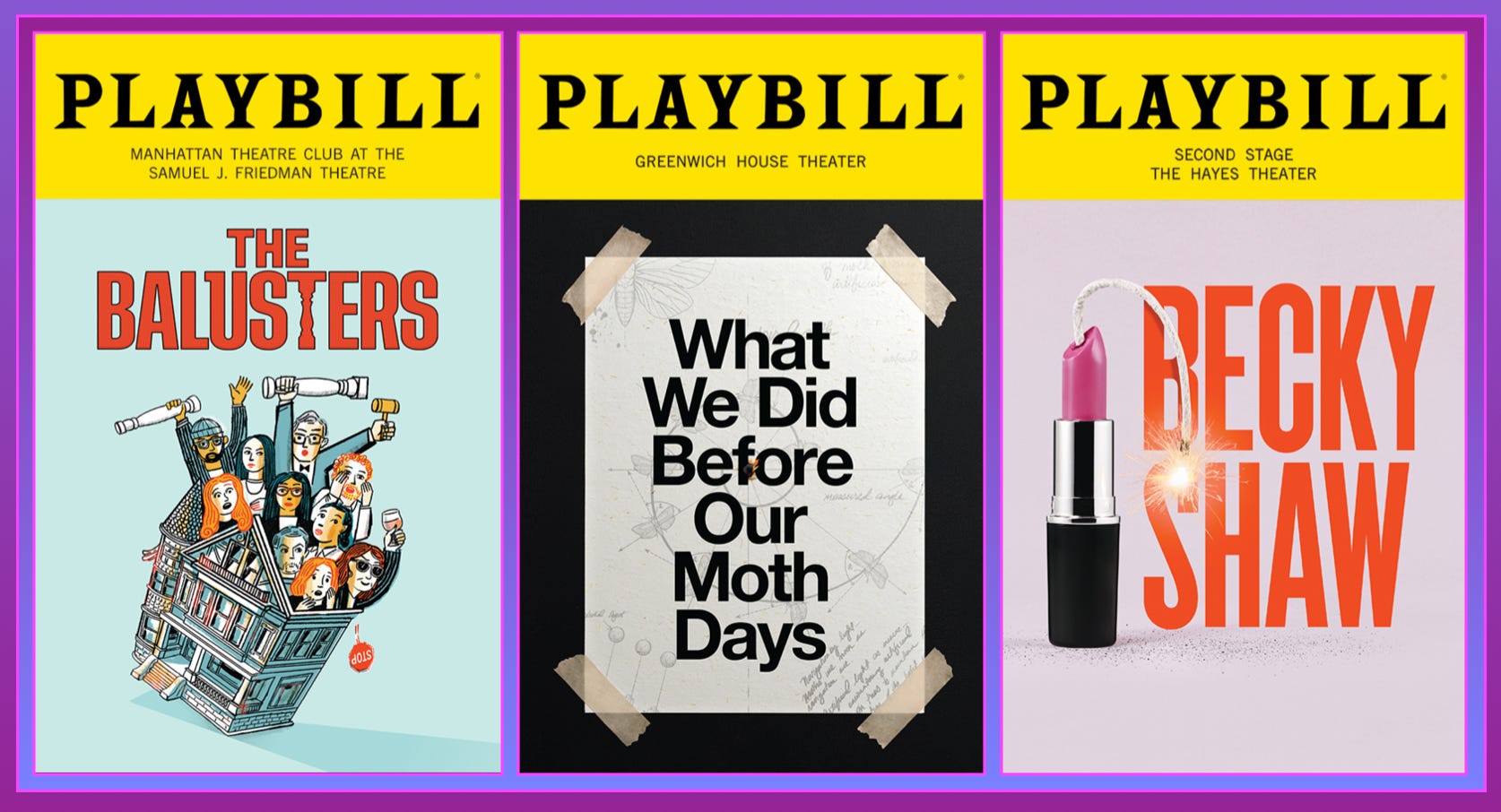
Written by David Lindsay-Abaire • Directed by Kenny Leon • NYC : Broadway • Manhattan Theatre Club / Samuel J. Friedman Theatre • April 2026.
A propulsive momentum undergirds this captivating, contemporary comedy of bad manners. At the center of the soon-to-be-roiling storm is Kyra (played with steely charm by Anika Noni Rose), who has recently agreed to host — in her beautifully appointed home, as designed by Derek McLane — the regular meetings of the historic Vernon Point neighborhood association. The play begins as Kyra — the support of her housekeeper Luz (a warmly wise-to-it-all Maria Christina Oliveras) — readies for the arrival what becomes a veritable rogues gallery of immediately recogizable (and already insufferable) models of “comfortable” privilege. There’s the not-so-quietly ostentatious gay travel writer (a silky Carl Clemons-Hopkins), the prickly and pointedly inappropriate Ruth (a sly Margaret Colin in what I just couldn’t not think of the Caroline Aaron role), and the youngest member of the board Willow (Kayli Carter) who is always at the ready to remind you to check your privilege. There’s also the well-heeled contractor Isaac (Richardo Chavira), the trod-upon teacher Alan (Michael Esper), and the sharp-elbowed attorney Melissa (Jeena Yi). But wielding the literal gavel of this meeting is the long-serving, long-suffering, and long-winded Eliot Emerson (Richard Thomas, in a perfectly-calibrated portrait of the pettiness of petty bureaucracy) while Penny — the indefatigably funny MaryLouise Burke — takes notes as secretary. It is a testament to David Lindsay-Abaire’s skill as a playwright that each of these boldly outlined characters become more textured, interesting, and complex amidst the unceasing cascade of comedic moments that punctuate several successive meetings of the board that comprise the dramatic action of the play. From the moment these characters begin to arrive, you know that a (literal) car crash — hat tip to Dan Moses Schreier’s evocative sound — is coming and someone is going to get hurt. Thankfully, Linday-Abaire’s uncommon capacity for crafting amusingly terrible characters becomes the sugar that helps the medicine of The Balusters go down. As these broad personalities righteously manipulate policy, protocol, and precedent in the most self-serving of ways, Lindsay-Abaire’s deft plotting — as amplified by the dexterity of Kenny Leon’s directorial guidance — crafts a subtle but unsettling portrait of the failures of the liberal social democratic experiment, or what critic Christian Lewis describes “as an almost anthropological study of liberal hypocrisy.”
See also:
at TheaterMania, independent theatre/culture writer Brian Scott Lipton talks to “one of the stage’s beloved treasures, Marylouise Burke” about her longstanding collaboration with David Lindsay-Abaire and about “still working professionally at the age of 85”
at Cote Notices, veteran theatre critic/writer David Cote reflects on both the work of David Lindsay-Abaire — “one of the smartest and most skillful playwrights in America today” — and also on Cote’s own now “two-decade-old flamethrower review” of Lindsay-Abaire’s Pulitzer-winning play Rabbit Hole.
Written by Wallace Shawn • Directed by Andre Gregory • NYC : Off-Broadway • Greenwich House • April 2026.
Wallace Shawn’s latest arrives as a constellation of overlain narratives that, together, interrogate not unfamiliar questions like “what is a life well lived” and “what does it mean to be a ‘good’ person” and “do you ever really know someone” and “how did my life end up this way”… So, yes, basically, Moth Days is about the fluttering dustiness of mortality staged with presentational yet confessional intimacy. Four actors sit, facing the audience rather than each other, as they tell their life (and sometimes death) stories. As each monologue unfurls, the patterns of a familiar familial drama emerge: a long-married man (a gently charismatic Josh Hamliton); his wife (an electrifyingly keen Maria Dizzia); his adult son (the indolently charming John Early); and “the other woman” with whom he has been having an affair (Hope Davis, a tangle of sharp edged vulnerability). The man — aptly named “Dick” — dies unexpectedly and his death tosses his three primary survivors together, momentarily, and propels them into living their lives (and deaths) without him. Yet, within the play’s mildly unanny conceit, Dick’s death does not stop him from reflecting on his life or theirs. For each digressive monologue unspools recursively, toggling between the ostensible presents and their remembered pasts (and, preternaturally, their futures). Though Shawn’s characters are not efficient storytellers, their monologues — as expertly performed here by this ensemble of exceedingly capable and captivating actors — somehow compel us to listen. Carefully. For fragments of narrative and character detail. Attentively. For motive. For deception. Hungrily. For meaning. For insight. And Andre Gregory’s meticulous staging — with only the slyest occasional moments of staged action — also insists that we listen. Likewise, Jennifer Tipton’s lighting guides the acuity of our attention with delicate precision while the sound and projection design of, respectively, Bruce Odland and Bill Morrison offer occasional exquisite aural or visual counterpoint. Yet even staged with such simplicity, Moth Days offers a lot to take in. (The play — three acts, plus two extended intermissions — runs a touch more than three hours.) And I suspect that, after taking it all in, most audience will have different takeaways. As for me, I was most taken by the ways Shawn’s monologues articulate his character’s interiority so that we might apprehend the unspoken, unresolved, and intolerable discrepancies between each character’s inner life and how they exist in the world. And I did find much to admire and much delight in Moth Days but the experience put me in mind — perhaps due to the eye-popping ticket price — of eating in a fine dining restaurant. Delicious, interesting, expertly prepared and elegantly served, with one or two memorably extraordinary components (for me, that would be Maria Dizzia’s searing performance) but, somehow, not entirely satisfying. Yet such ambivalence, I must admit, might just be Shawn’s puckish point in insisting that we listen so attentively to What We Did Before Our Moth Days.
See also:
The New Yorker’s Emily Nussbaum ponders What We Did Before Our Moth Days as an “unsettling meditation on the allure of a bad life and the trap of a good one”;
Vulture’s Sara Holdren contemplates Shawn’s “exhilarating and nauseating all at once” capacity to be “wracked and fascinated by the human ability to smile and smile and be a villain”;
The New York Times’s Helen Shaw contemplates Shawn’s Moth Days as “a sumptuous set of interlinked monologues about life, death and betrayal”;
Written by Gina Gionfriddo • Directed by Trip Cullman • NYC : Broadway • Second Stage/Hayes Theater • April 2026.
Throughout my first encounter with Gina Gionfriddo’s 2009 Pulitzer-recognized play, I was startled by the scathing acuity of its darkly comedic resonance in 2026. Becky Shaw follows Suzanna (an all-in Lauren Patton) as she tries to make sense of what she wants in and from her aduld life after her beloved father’s death. Caught between the relationships that defined her childhood — her unsparingly frank mother Susan (the blithely cutting Linda Emond) and her aggressively caretaking unofficially adoptive brother Max (an astonishingly good Alden Ehrenreich) — Susan stumbles into a spontaneous marriage to the sensitive and underemployed Andrew (a puppyish — sharp teeth and all — Patrick Ball). Max is of course convinced that Andrew is not a good match for Suzanna, while Andrew is not wrong to be concerned by the charged intimacy between his wife and Max. Into this love triangle steps Becky Shaw (a charmingly inscrutable Madeline Brewer) and what at first seems to be a blind date sparks a weirdly patriarchal battle between the emotionally-stunted finance bro Max and Andrew as the apotheosis of what has come to be called a “performative male” (and update of what prior generations termed the “sensitive new age guy”). Gionfriddo’s gift for character and dialogue charts the shifting affections (and affectations) of the characters — and thereby the audience — with exhilarating skill, as she turns each character’s oscillation between lovable and loathsome with dizzying delight. Trip Cullman’s direction (and David Zinn’s dynamic scenic design) sustains the necessary tension so that we’re never quite sure when or whether this always dark comedy might tip into a full-on bloodbath of a horror show. (And when Cullman/Zinn yank us from the depressive shadows of Suzanna’s world into the Nora Ephronesque brightness of Susan’s is one of the most gratifying scenic pivots I’ve seen on stage this year.) But what I most relished about Gionfriddo’s layered script is its frank reckoning with the proposition of love. Is it a spontaneous feeling? Or a tactical maneuver? Or some ineffably strategic combination thereof? As Suzanna finds herself caught between the brutally unfiltered honesty of her mother and Max, and the deflective manipulations and emotional deceptions of Andrew and Becky, Gionfriddo’s play emerges as one of the most emotionally compelling and shockingly funny “counter-romantic” comedies I’ve ever encountered. I can’t stop thinking (and laughing) about Becky Shaw’s many machinations and remain fascinated by the richly textured women characters that drive Gionfriddo’s exceptionally well-crafted play.
See also:
Town & Country’s Adam Rathe talks to Madeline Brewer about becoming Becky Shaw, while Vulture’s Jackson McHenry talks Alden Ehrenreich about the experience of “getting direct feedback from his audiences [as they] shift their allegiances between the characters in Becky Shaw”1;
The New Yorker’s Emily Nussbaum appreciates not only Gionfriddo’s “ear for cruelty but [also] her ability to see beyond it, and to shift the prism of audience sympathy, in tiny increments”;
and, once again, I encourage you to click out to Ramona at Midlife, where veteran playwrights Brooke Berman and Gina Gionfriddo reflect on the winding journey that has led to Gionfriddo’s Broadway debut with Becky Shaw.
TRANSPARENCY DISCLOSURES for #260430: I attended The Balusters as a guest of the production, and the cost of my ticket was offset by an institutional grant from Princeton’s Office of the Dean for Research.
Fun fact: I may well have been in the “rowdy, fun-loving audience” that “clammed up” as as discussed by Ehrenreich in this piece because, yes, at the performance I attended, someone a row or so behind me did indeed express their exasperation/contempt for Ehrenreich’s character in precisely this way at exactly the same moment.
Comments
Nothing yet. Say the first thing.
Sign in to join the conversation.