
WELCOME to #TheatreClique — my emphatically intermittent newsletter dedicated to encouraging you to click out to some of the most interesting, intriguing & noteworthy writing about drama, theatre & performance (at least, so says me)…
This installment of #TheatreClique clicks out to pieces that examine how to address accessibility gaps, that evince the oligarchic logics undergirding big finance’s recent acquisitions in the “theatre space,” and that remember a Philadelphia theatre legend. There’s also a discount code to be shared and, of course, some commentary about my experience of recent productions, including Disruption, An American Daughter, Broad Strokes, and Saviors. And be sure to scroll ALLLLLL the way to the very end for my brief #ASIDE about composing my first “AI-use statement” for this newsletter. But for this week’s opener, I lift this lovely short film from documentarian Joshua Charow that captures the unexpected turns that can come when one decides to make one’s life in (and of, and for) the arts.…and if clicking the embedded image below routes to an error message, try clicking here.
EDITOR’S NOTE: whenever possible, whenever linking to paywalled pieces, I try to “gift” the article to #TheatreClique readers, so that clicking out to articles in the New York Times, Washington Post, Philadelphia Inquirer, Atlantic, and Wall Street Journal doesn’t burn through your current allotment of free views. Here’s hoping more outlets adopt similar technologies for subscribers soon but, for those that do not, I try to link to a pdf version of the article. If any access obstacles to linked materials are particularly persistent, perplexing or annoying, please do alert me by replying to this message so that I can adjust accordingly.
Wherein I highlight a handful of the most click-worthy links I’ve encountered in the last few…
Joe Mantello’s recent staging of Death a Salesman offered many unexpected rewards; chief among them is the amount of really smart theatre criticism stoked by the production — and perhaps the smartest and most illuminating yet comes from Alisa Solomon via The New York Review of Books;
at GhostLightAccess, writer/performer/advocate Kelsey Maurine Brickl details the steps one NYC theatre took to address the serious accessibility gap caused by their use of Yondr pouches for a recent production;
performer/producer/advocate Jared Harbour crunches the numbers to evince the grim oligarchic logic that might explain why Ari Emanuel’s megafund bought ATG;
at Adventures in Theatre History: Philadelphia, writer/dramaturg Peter Schmitz reflects on the life, work, and legacy of Irene Baird, an acting teacher who became one of Philadelphia’s most influential theatre artists;
see also the simply amazing 1985 Philadelphia Inquirer “Madwoman of Philadelphia” profile of Baird that Schmitz mentions;
the good folks at The Sondheim Hub opens an expansive conversation with actor/advocate Francis Jue about “his unique relationship with Pacific Overtures, his decades of Sondheim experience, and the progress — and unfinished work — of Asian American representation onstage”;
and THIS WEEK’S MUST-READ…
in his latest “Goes to Show” column, American Theatre editor-in-chief Rob Weinert-Kendt takes a modestly contrarian stance on a few recent theatre hot topics, including the widely heralded crisis in new work development, Oskar Eustis’s declaration of the end of an era, and even The Potluck (oh how he and I disagree there), among other topics. Still, Weinert-Kendt’s syntheses are always worth reading…
Wherein I highlight noteworthy current or soon upcoming opportunities for remote theatregoing.
Flame: The Songs of Amara Janae Brady and Xander Browne - via 54Below
“An evening of stand alone songs and songs from the new musical, BaKed — an explosive reimagining of Cinderella’s story from the perspective of Amelia, the overworked and underappreciated baker who caters Prince Charming’s Ball. When the Crown fails to pay her, Amelia blows up her life and ends up on a wild adventure with all the folks in this story who don’t get a happy ending as they learn to make happy beginnings of their own.”
Streams LIVE Sunday, 8/23 at 945pET• $
Wherein I offer diaristic capsule commentaries chronicling what I liked best (or found most compelling) about the shows I’ve recently engaged... A full accounting of my 2026 theatregoing can be found HERE.
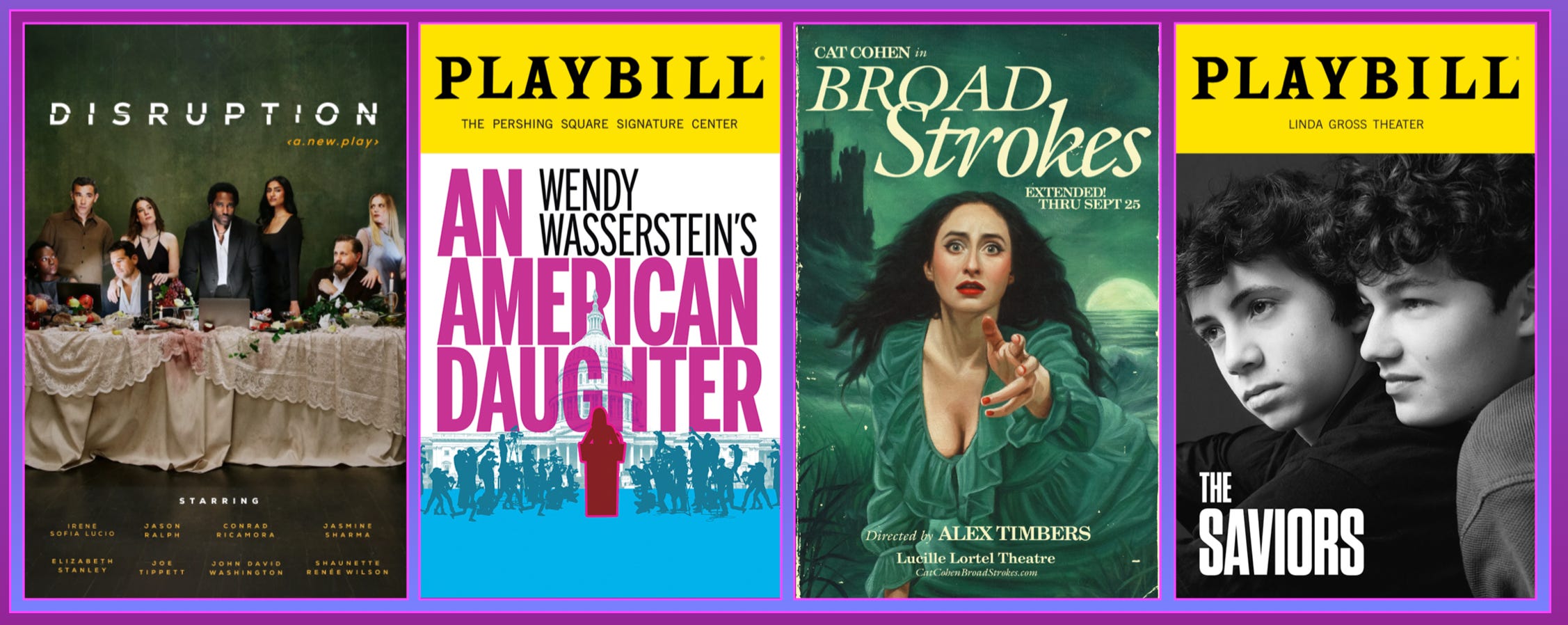
Written by Andrew Stein • Directed by Hersh Ellis • NYC : Off-Broadway • Jack DePalma Presents • August 2026.
I will likely never forget the expression on one friend/colleague’s face when I mentioned I was set to see Disruption. ‘Twas perhaps the first time I witnessed an actual, real-life example of that old expression “visibly blanched.” So as I took my seat and peeped through the strikingly framed set — the playing space is literally “framed” by two gigantic (um) frames, as if some giant had rested their very expensive foldable eyeglasses atop a black, rectangle with a mirror finish — I braced myself whatever would soon unfold. Little did I know that Andrew Stein’s Disruption, stylishly directed here by Hersh Ellis, would serve up a peculiarly diverting Agatha Christie-esque potboiler for the tech-oligarch era. We have a cohort of recognizable archetypes of nearing-middle-age privilege — the high-strung lawyer mom frustrated by her chill journalist hubby; the real-estate obsessed photographer and her overworked surgeon spouse; the practical therapist and the idealistic professor — all summoned by their mildly creepy gajillionaire friend to a gathering that promises to introduce his ominously young business partner. This familiar scenario (plus the women’s wariness) alerts us to the likelihood of danger, catastrophe even, resulting from this soiree; indeed, from the outset, I kinda sorta totally knew that at least one of these people would die. (I was not wrong. More on that in a moment.) But thanks to the exceedingly empathetic intelligence of this truly stacked crackerjack cast — including standouts Elizabeth Stanley as the lawyer, Shaunette Renée Wilson as the therapist, and Irene Sofia Lucio as the photographer — I did become invested, or at least curious, about how these characters would wrangle the play’s defining question: will we even notice when AI starts deciding our lives for us? But even as the ensemble sustained my interest, I became increasingly disappointed that the exceptionally skilled women actors were tasked with humanizing characters that edged perilously close to being, respectively, The Shrew, The Scold, and The Slut. [SPOILER ALERT: I am also still just mad that this play blithely inserts a Black woman character into a plot twist about an elective pregnancy at an advanced age that, in effect, deploys black maternal death as a dramatic device, all without anchoring that storyline in any meaningful context about the structural and statistical risk for Black women giving birth in the US and the UK — hazards this character as written would have certainly been alert to.] But, as with any Christie-esque dramatic contraption, the pendulum swings (in sometimes but not always gratifying ways) between exposition and reveal, until most of the loose ends are tied. All told, a glossy production of a slick play elevated in execution by a truly exceptional team of top-tier actors and designers. But… yeah… no. Still mad.
See also:
The Wall Street Journal’s Charles Isherwood ponders how Disruption “feels like a dispatch from the front lines of technology the day after tomorrow. Or do I mean the day before yesterday?”;
at The Guardian, independent theatre writer/critic Juan A. Ramírez notes thatDisruption struggles in the “typical battle of the topical play: even with the most expedient fast-track to production, works tackling current events are in danger of obsolescence upon arrival.”
Written by Wendy Wasserstein • Directed by Sarna Lapine • NYC : Off-Broadway • La Femme Theatre • August 2026.
As I took my seat for La Femme Theatre’s production of Wendy Wasserstein’s An American Daughter, I didn’t arrive with much prior knowledge about the play or the production. But as I perused the lushly specific set by Mikiko Suzuki MacAdams, and noted the the age/gender/accent demographic filling the seats around me, I quickly discerned that — yes — this was going to be a NoraEphron-esque Big90s throwback. And so ‘twas, but in a very peculiar way. You see: I am, by disposition and by training, a historian. I instinctively chart chronologies and delight in placing detail into context. I also specialize in 20th century history, especiallythe period between, say, the Golden Age of Radio in the 1930s and the “DotCom bubble” of the later 1990s. Which, as it happens, is the precise pocket of time inhabited by the characters of Wendy Wasserstein’s quippy, topical and intentionally “timely” play. I share all of this to explain — to myself, perhaps more than anyone — why this production of An American Daughter was such a brainbender for me. As Wasserstein’s pointed contemporary-to-the-1990s critique of an American political culture’s startling shift toward a glib, sound-byte driven style of “gotcha” politics, I found myself constantly rummanging through the many factoids stored in my brain. (“So this is clearly in response to the idiocies of “Nannygate.” And that Morrow character is obviously a riff on the rise of 90s conservagays like BruceBawer/AndrewSullivan; the generically handsome anchor Timber Tucker is probably more of a poke at Stone Phillips because Tucker Carlson didn’t take to tv until later; and even though she’s dressed like Sassy-era JanePratt maybe Quincy Quince is supposed to evoke camera-craving neo-feminist provocateurs like NaomiWolf/CamillePaglia. But is the charismatic Judith based on anyone real? I forget — was Lani Guinier Jewish? And aren’t we edging toward “Magical Negro” territory with this character anyway?”) Such was the buzz in my brain — a buzz that is always there but which I can usually keep at a low enough hum to engage the production actually happening in front of me. Not so here, alas. My craving for chronology and context kept the buzz running pretty loud for the entirety of the show. Why? I’m embarrassed to admit that I just couldn’t suspend my disbelief quite enough to wrap my imagination around actress/producer Jean Lichty in the tricky, essential, and titular role of Lyssa Dent Hughes, in part because of her being perhaps two decades older than the character but mostly because of her languid, patrician delivery of Wasserstein’s zippy-quippy dialogue. (Robert Sean Leonard’s performance as Lyssa’s husband was intriguing enough that I started imagining Martha Plimpton as his scene partner, until I realized that those elder GenXers are also maybe a decade too old for these roles as scripted. But imagining more age-congruent 40something actors like, oh, Reese Witherspoon and Oscar Isaac proved too much for even my buzzing brain.) Indeed, it was only when Lyssa was off-stage, or when expert veteran actors Dakin Williams and Mary Beth Peil — both cast somewhat age-congruently as Lyssa’s father and current stepmother — held center was I able to relax and really begin to hear the rhythms of Wasserstein’s voice in this knotty play. A peculiarly fascinating experience, if also a tougher-than-expected one.
See also:
Talkin’ Broadway’s Marc Miller insists that An American Daughter “does satisfy as an exercise in political nostalgia”;
BroadwayWorld, independent theatre/entertainment writer Cara Joy David details how this staging of An American Daughter “draws on eight different versions of Wendy Wasserstein’s play”;
at Forward, dramaturg/writer Rachel Shteir contemplates why the revival of An American Daughter underscores the prescience and enduring relevance of Wendy Wasserstein’s play.
Written & Performed by Cat Cohen • Directed by Alex Timbers • NYC : Off-Broadway • Lucille Lortel • Month 2026.
It doesn’t make sense to me that Broad Strokes was the first time I’ve had the opportunity to watch Cat Cohen live. (I’ve been alert to the distinctiveness of her formidable gifts as comedic vocalist since witnessing her senior show — a scrappy, irreverent music-stand concert staging of Kiss Me Kate — during my first year at Princeton.) I have also watched her steady incremental rise within and across the entertainment industry. (Clocking her small but vivid presence in 2025’s Sentimental Value filled me with a particular delight.) But even though I arrived to Broad Strokes with a clear sense of Cohen’s “vibe” — that para-feminist mix of peak-millennial brainy ditziness flouncing in a fashionista’s torn seam serving something between “girly” and “slutty” — I was not prepared for the sophistication and maturity of Cohen’s comedic high-wire act. Deftly directed by Alex Timbers, Broad Strokes places Cat Cohen’s bright melodies and giddy persona atop her actual far grimmer experience of a stroke at age 30, which was followed by a diagnosis of a literal hole in her heart and emergency heart surgery. This series of incongruities is distilled, hashtag-style, by the deceptively simple running gag “young for my grade.” The result is Broad Strokes — clock the layered puns in that title? — a stealthily profound work of solo performance. Sure, amidst all the satin-draped silliness and sparkling winks and light-footed crowd work and cartoonishly puffed baroque sleeves, one might miss the subtly unsettling dysphoric thread that guides every gesture. Whether recounting her own experience of “aura migraines” or of her first tampon or of an infusion into her actual heart, Cohen’s Broad Strokes captures — in a somehow appropriately effervescent/giddy/tingly way — the particular sensation of experiencing one’s body as somehow separate from one’s self. And somehow, Cohen captures the visceral yet feathery sensation of coming out of anesthesia — as experienced both from within (vulnerable, confused, scared) and observed from without (bonkers, hilarious, wtf). Yet, as her persona is wont to do, Cat Cohen appears to just waft through it all, as a mildly dim princess in vague pursuit of her prince… or her kingdom… or her throne… whatevs. But, honestly, I don’t know that I’ve ever witnessed such an apt depiction of the sensorial weirdness of heart surgery. I kept wanting to text one of my nearest and dearest to say: “Cat Cohen’s acting out everything you described happening before/during/after your surgery!” A giddy wonder, that Cat Cohen. She may be young for her grade but, don’t be deceived or distracted by all that sparkle, she’s much smarter than she lets on…
See also:
The Hollywood Reporter Seija Rankin talks to Cat Cohen about how her burgeoning film/tv-career sits alongside making her “Off-Broadway debut and her first foray into work with a specific narrative thru-line”
at Vanity Fair, independent arts journalist Kase Wickman talks to Cat Cohen about how leaning into her vulnerability in Broad Strokes “is a scary place to be when you live for laughs.”
Written by Bubba Weiler • Directed by Jack Serio • NYC : Off-Broadway • Atlantic Theater Company • August 2026.
Bubba Weiler’s particular gift as a writer probably stems, at least in part, from his training as an actor. His characters are precisely sketched portraits, of the sort that so welcome an actor’s interpretive idiosyncrasies that it becomes almost immediately impossible to imagine anyone else playing this or that role. At least until you pause to ponder and realize how interesting that part would be if played by any number of other actors. Weiler also seems inclined to two-person scenes in which one character is withholding something — a secret or a fact or a question held tight so as to not hurt or frighten the other. Put another way, Weiler’s characters allow actors lots of room and stuff so that they can play. And in Saviors — as in the only other production of a Weiler play I’ve experienced (each directed with humane precision by Jack Serio) — a strikingly gifted cast embraces the invitation of Weiler’s script and brings these everyday characters to vividly transcendent life. In Saviors, Weiler attends to the moment when two adolescent boys — dedicated altar servers at the church attached to the Catholic school they both attend — encounter a stranger seeking refuge in the church sanctuary and, subsequently, reckon with their feelings about their faith and each other as they ready themselves for confirmation (and for high school). The play is an often lovely, always tender, portrait of the particular intimacy of friendship among boys. No wonder, then, that Weiler insists that this play be staged only with age-congruent actors. Because to witness Ivan Howe and Julius Rinzel inhabit the roles of, respectively, Michael and Paul becomes truly rare moment of theatrical wonder. As the anxious people-pleasing Michael (experiencing the terrors of “the best little boy in the world” syndrome before our eyes), Howe toggles between sweet childlike delight and petulant teen angst. Meanwhile, as the astutely observant Paul (the kid precociously attuned to his own inner moral code), Rinzel offers one of the most astounding performances of “listening” I’ve seen, perhaps ever. And observing Howe and Rinzel play with and against each other — supported by the scaffolding of Serio’s clarifying direction, Dave Anzuelo’s finely tuned fight/intimacy choreography, and the extraordinary (if as yet unmentioned) adult actors — is all the more extraordinary because it feels like we are witnessing a moment in these char/actor’s lives. (I mean, at curtain, I could have sworn Howe actually had grown an inch in the ninety or so minutes of the show’s running time.) And though Saviors is a showcase for the necessarily young actors at its center, the two adult characters — deftly embodied with a perfect blend of humor and depth of prickly feeling by the indispensable Crystal Finn and the new-to-me Stanley Simons — remind us of how complicated life can get, even (or especially) for extraordinary kids like Michael and Paul. An exceptional production of a bold, distinctive, and strikingly accomplished play.
See also:
at America Magazine, theatre writer/editor Rob Weinert-Kendt proclaims Saviors “enough to maintain one’s faith in the power of theater”; if you hit a paywall, here’s a pdf;
at National Catholic Reporter, veteran arts/culture writer Jim McDermott highlights how Saviors “invites its audience to see and appreciate the complexity of their own experiences of religion”:
Exeunt’s Lane Williamson offers a deliciously precise appreciation of Jack Serio’s directorial skill — specifically his placement of one character’s purse — in Saviors.
Wherein I briefly highlight noteworthy current or soon upcoming things happening in my life, world, or work…
I would be remiss if I did not use this platform to highlight the big end-of-summer 50%-Off of All Titles Promotion at NYU Press. I would be doubly remiss if I did not also draw your attention to the extraordinary work published in NYU Press’s Performance and American Cultures series, which I co-edit with Robin Bernstein and Stephanie Batiste. Buy one! Buy three (to clear $40 and qualify for free domestic shipping)! Buy all twelve! You’ll be the smarter for it!

Wherein I offer programming notes regarding the ongoing publication of #TheatreClique. Also an occasional space for me to capture a thought or two that I just need to put somewhere.
Because I read this AI-literacy scholar/advocate Sam Illingworth’s recent post — You Will Be Accused of Using AI. Here Is How to Prove You Wrote It — and because found it instructive, I have updated #TheatreClique’s “About” section to include my own version of an AI-use statement, in which I “come out” as AI-abstinent. So… #FWIW.
Comments
Nothing yet. Say the first thing.
Sign in to join the conversation.