
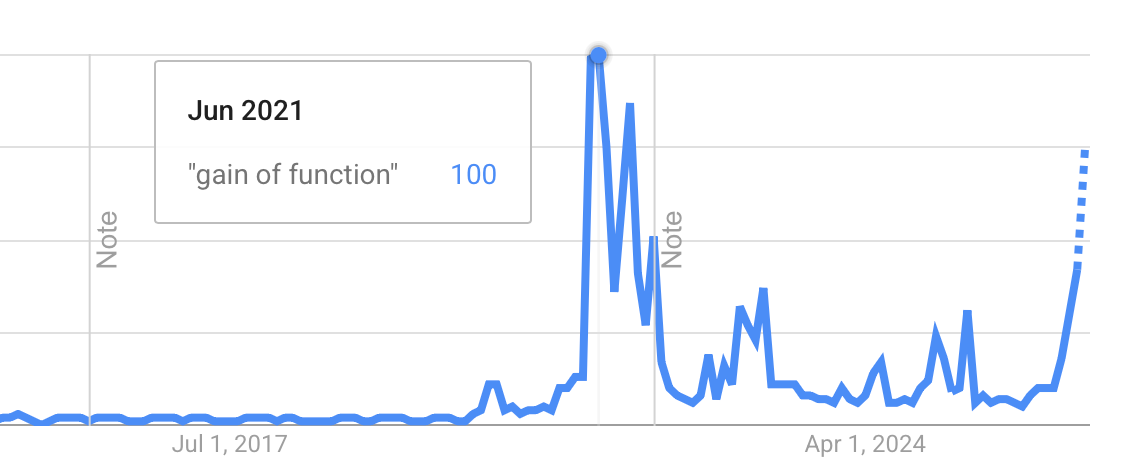
In mid-2021, the world was in the depths of the COVID-19 pandemic, and the US was gripped in a battle of disinformation. Career public health officials promoted public health measures which morphed as we learned more about this particular disease — change which populist politicians flaunted as corruption and ignorance on the part of the scientists. Radical anti-science senator Rand Paul, in particular, latched onto the term “gain-of-function” (GoF) research, and publicly charged Dr. Anthony Fauci with facilitating such research in order to make the SARS-CoV-2 virus as deadly as possible — all part of the fantasy “lab leak” conjecture Paul continues to share with other populists.
Ever since, “gain-of-function” has been a star of populist talking points. It sounds like “Efforts to make a disease even more deadly” — how Machiavellian! — a narrow political definition which actually is included in the much broader definition used by researchers.
What is GoF really? As its name suggests, the idea is to genetically alter an organism to simulate how it is likely to evolve naturally, in order to get the jump on it and be prepared with new vaccines and other therapies by the time those new strains appear in the wild.
Researchers have known the term is problematic for a long time, and they’ve long expressed fear that it would be abused politically just and Paul and other populists are doing now. Here are notes from a 2015 (that’s 2015, before the pandemic) meeting of the National Academies discussing exactly that risk:
[Imperiale] commented that the term GoF was understood a certain way by attendees of this symposium, but when the public hears this term “they can't make that sort of nuanced distinction that we can make here” so the terminology should be revisited.
How prescient he was, indeed.
Naturally, a virus evolves in order to survive better — that’s how evolution and selection work. If you kill your host, that doesn’t do you any good; so we usually see viruses evolve in a direction to become less deadly to their hosts (note that fewer people die from today’s SARS-CoV-2 strains than did in 2020). They may evolve to adapt to a broader range of host organisms, searching for one in which they’ll best thrive. They may evolve to improve transmissibility, thus increasing their numbers and chances of survival. GoF research is absolutely essential if we hope to stay ahead of infectious disease outbreaks.
But, in a shockingly foolhardy move to pander to populist xenophobia, last month the White House published a new policy statement, “United States Government Policy for Stopping High-Risk Life Sciences Research” which even abbreviates the term not as GoF as do scientists, but as DGOF, for “Dangerous Gain of Function” to make it sound even scarier:
DGOF research has the potential to significantly endanger Americans and should not be supported domestically or internationally.
This is like saying “heart surgery has the potential to harm patients, and so should never be performed.”
Horrified at how shortsighted and actually dangerous it would be to halt essential virology research, the American Society of Microbiologists published this statement:
…The resulting ban on swaths of research will inhibit national preparedness to combat infectious disease threats.
Diplomatically understated, to say the least.
Obviously, working on deadly viruses in a lab is hazardous, but the risk has been managed very well for the better part of a century now. Worldwide, research labs use a standardized system for Biosafety Levels:
BSL-1: Minimal risk agents (e.g., non-pathogenic E. coli); basic precautions.
BSL-2: Moderate-risk agents (e.g., Staph, Salmonella); gloves, limited access.
BSL-3: Serious/potentially lethal airborne agents (e.g., tuberculosis, SARS-CoV-2); controlled airflow, sealed labs, respirators.
BSL-4: Deadly, no-treatment pathogens (e.g., Ebola); full-body suits, isolated facilities, maximum containment.
The importance of doing research on deadly pathogens is why we have this system. It’s why the CDC — when under science-based leadership in the past — built such labs. It’s pretty damn good, but not perfect. The US safety record is nearly perfect, though in other countries there have been a handful of fatal accidents, though most took place prior to the worldwide adoption of these standards:
1967, Yugoslavia — 7 lab workers died after contracting Marburg virus from monkey tissue they were working on.
1978, United Kingdom — a lab photographer died of smallpox after exposure in a lab. The lab was closed and the lead researcher committed suicide.
1979, Soviet Union — 66 people died of anthrax after spores were released by the lab. It is the worst biosafety disaster in history.
There’s been only one death at a BSL-compliant lab resulting from research of any kind (GoF or not) since the BSL system was adopted worldwide in the 1980s:
2003-2004, China — 1 person died of SARS after several lab workers were sickened while doing SARS research in a series of incidents in affiliated labs in China, Taiwan, and Singapore.
Why so few? They are very good at managing the risk. Read about BSL-3/4 containment facilities. It’s a good time to remind ourselves of the difference between hazard and risk:
Being on the surface of the sun would be extremely hazardous.
Your risk of dying from that is extremely low. Protections are in place, including 93 million miles of space.
By the same token, playing with a SARS virus in your bare hands would be very hazardous, but doing controlled research in a BSL-3/4 facility, following procedures, is very low risk.
So the takeaway here is:
Comments
Nothing yet. Say the first thing.
Sign in to join the conversation.