
Last week was another week-long production loop on Alien Echoes, this time through southern California. On the final day we made it down as far as San Diego county, to the home of the Hugo and Nebula award winning science fiction author David Brin and his wife Cheryl, two of the nicest people you could ever meet.
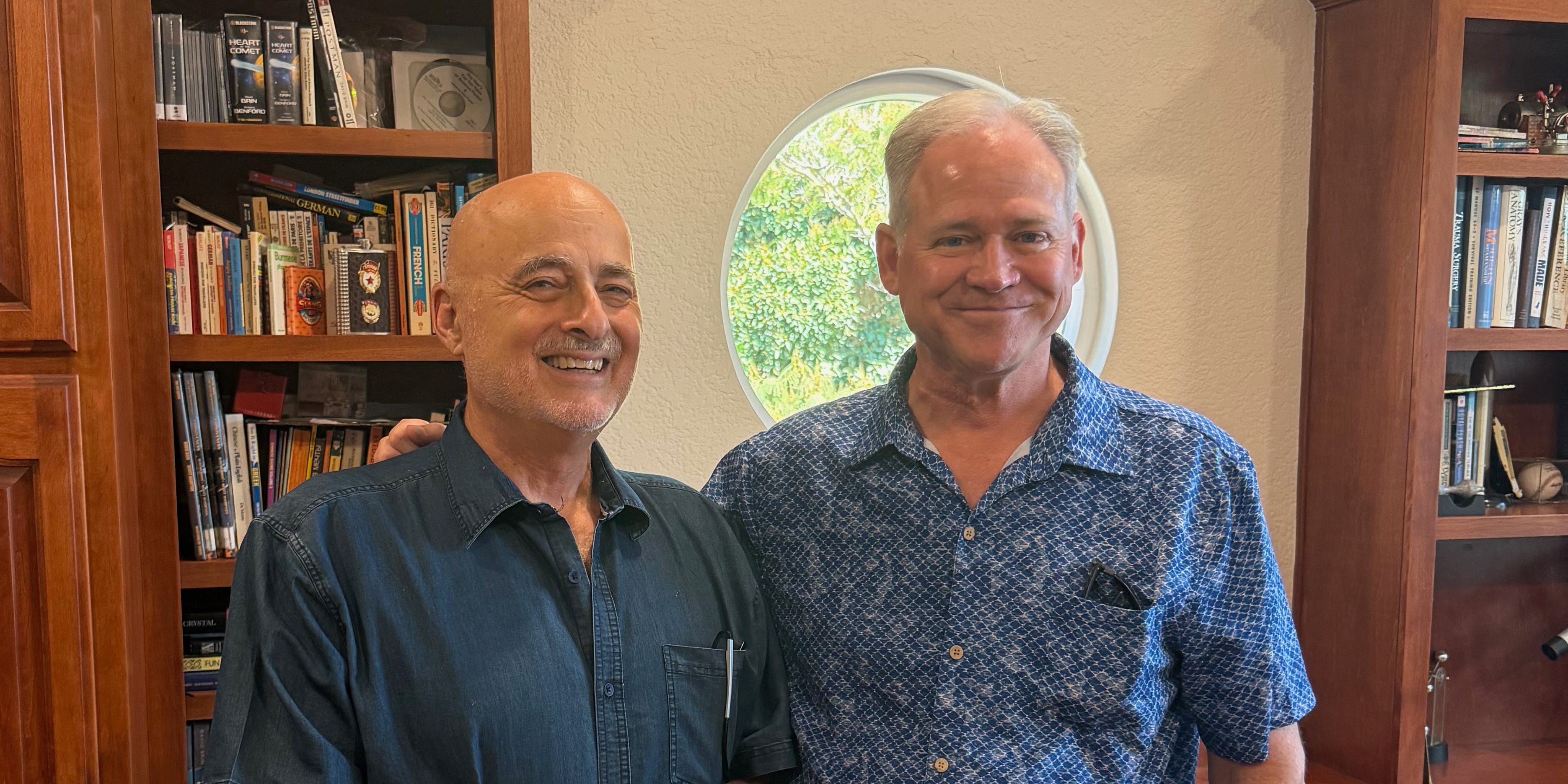
Some of you might be asking why would I have a sci-fi author in a film that’s about hard science? If you didn’t know, Brin’s PhD is in astronomy from UC San Diego. In 1983, he wrote a famous paper while he was a postdoctoral research fellow at the California Space Institute, titled “The Great Silence.” In it, he argues that the Drake Equation is inadequate because it gives us only the approximate number of communicative civilizations there might be out there, but doesn’t incorporate the likelihood of ever being able to contact them.
That’s important, he said, because — as we can all see — we’re not in touch with anybody out there,1 even Drake tells us there are perhaps tens of thousands of such civilizations in the Milky Way (depending who you ask; and we ask a lot of people in this film). We deserve to know why we’re not in touch.
“The Great Silence” posits two possible reasons:
“Berserker probes” — murderous, destructive, self-replicating robotic probes spreading everywhere — have destroyed anyone out there dumb enough to call attention to themselves; and
An “ecological holocaust” has befallen any civilization that has expanded enough to develop that level of technology. Resource exhaustion and other factors combine to keep any civilization below a certain level.
But cast him not as a pessimist on this matter. His PhD thesis was about comets, and in the early days of every star system, comets took water everywhere. Scarcely a celestial body out there has not had a liberal dousing of water at some point in its early history. Even here on Earth, practically an ocean world, some 10% of our water probably came from comets and asteroids (according to isotopic analysis).2
And as Jeff Goldblum said in Jurassic Park, “Life finds a way.” Give a planet water and you’ve probably given in life; the more we learn about our own solar system, the less and less important a “Goldilocks zone” becomes. Europa is only one example of a body likely bearing submarine life that’s well outside the Sun’s habitable zone.
Of course many other explanations for the Great Silence besides Brin’s two have been hypothesized over the decades, and we talk about a bunch of them in the film. In the end, we hope to come to a synthesis of some very solid reasons backed by real science for why the Great Silence exists.
I’ll be banging away on the keyboard for a short break over the next couple weeks before our next production trip, which should wrap all the principal photography.
In the meantime, I’m holding a Zoom event this Wednesday at which I’ll go into detail and answer your questions about all the interviews we’ve done so far. Everyone who has donated $500 or more to the film is invited, and you can do that here.
In the meantime, even though I like to think I’m a “grown-ass man,” David and Cheryl prepared little snack baggies for the road for our entire crew, which hit the spot on my red-eye flight home. Like I said — very nice people.
Opinions vary, obviously, even among the many experts in the film. I share the majority view that there is probably lots of life out there probably even including intelligent life, but none that has ever made it to Earth.
And it’s fair to point out that this is a rough median of estimates, which range from 0 to 100%. Check the Wikipedia article on it to learn more.
Comments
Nothing yet. Say the first thing.
Sign in to join the conversation.