
*Please read the disclaimers at the base of this report. The author has a short position in the companies mentioned below. Does not constitute a recommendation to buy or sell the securities mentioned herein. Do your own due diligence. For Permitted Recipients only (UK - see disclaimers).
There is much to ponder about recent events at Tullow. First the Kosmos Q3 results revealed further declines at Jubilee, with state data showing the field down to 84.5kbd (thousand barrels a day) in September, with a recent10 month production update suggesting further falls in October (perhaps lower than 82kbd if you back out the first three quarters). Then we heard from Tullow about the imminent release of the ICC verdict on the first case lodged by Tullow with them on Branch Profits Remittance Tax. Then on December 5th we learned that Rahul Dhir the CEO was leaving Tullow to spend more time with his business interests, academic pursuits and family. Followed by a hasty ramp in the shares, and then - “ta-da!” an after hours RNS claiming Kosmos was in preliminary talks to buy Tullow with shares. Why own half of Ghana’s ailing petroleum sector when you can own all of it?! And the eye-watering debt that comes with it. Unsurprisingly Kosmos’s shares tanked 12% in the US market before Kosmos put out their announcement stating that discussions were not preliminary, but “very” preliminary. And that other acquisitions structures were on the table (a hint perhaps that Kosmos is interested in Tullow’s debt holders not the equity holders).
Perhaps nothing remarkable at all in all this but the clustering is suggestive of things continuing to go awry at Tullow, and the board thrashing around for a quick fix.
For what its worth I think any deal that involves Kosmos offering material value for Tullow equity holders is dead on arrival. The RNS went down like a bowl of cold sick for Kosmos shareholders with shares down 15% at market close. Maybe, just maybe a debt for Kosmos equity offer (via Tullow equity) could be viable. But why would you want MORE Ghana??! It already dominates their production portfolio and has seen disappointing production trends at both fields. The only answer would be that Tullow without Kosmos wouldn’t be able to finance drilling to keep Jubilee afloat. Especially with upcoming tax arbitration risk. And that would drag Kosmos into the mire too.
And so to this note, written in large part before this shock announcement.
There’s no point labouring the point on production or valuation: all that can be said is that with an oil price below $80/Brent it is quite easy to come up with a negative equity value for the business especially if Jubilee slips further in the next six months. A question for the debt experts is whether the 2026 bondholders would wish to be given equal status to the 2025 holders assuming the company uses the Glencore facility to pay them out. That could trigger a potential default situation.
No, my interest here is in the upcoming ICC case (one of three) which is on the application or disapplication of BPRT - Branch Profits Remittance Tax on Tullow. A material loss of this case which is imminent, would put further pressure on any refinancing negotiation.
Tullow discusses this in its 2023 Annual Report, published earlier this year:
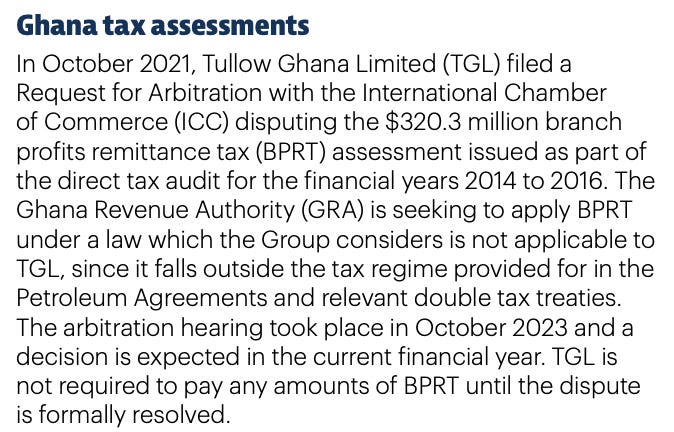
Tullow confidently state that the Petroleum Law governing their blocks protects them from this impost. However a close reading of the documents suggest there is some wiggle room for the Ghanaian government.
The tax summary in the Petroleum agreements for both West Cape Three Points and Deepwater Tano (the two relevant blocks) is almost identical bar for one significant ommission in the latter agreement (for Deepwater Tano). That omission is represented by 12.12 in the West Cape Three Points agreement:

The Deepwater Tano agreement excises this subsection, which somewhat weakens the contractors position regarding “fiscal stability”.
In both agreements it reassuringly states the following:

That would appear to preclude, in blanket fashion, additional taxes or levies by the State on Tullow and its partners.
However, within the article there is one significant fuzzy subsection which appears to open the door to further taxes:
“Contractor shall be subject to the following:” [followed by a list of the familiar taxes in the agreement - and then this in section vi]

The key phrase here is of course “of a minor nature and amount”. It doesn’t define “minor” in the paragraph, and also the grammar apportioning “minor nature and amount” isn’t clear. Does it just apply to “other imposts” or does it include the preceding words “Taxes, duties…”. Clearly the door is open to two questions - what does minor mean, and does it lock down the word “Taxes” for example.
Consider the following (made up) sentence:
“Paintings, Sculptures, furniture or other paraphernalia of a minor nature and value were sold at auction from the Estate.”
There is a case above that it is the furniture and other paraphernalia that is minor and low value. But not the paintings or sculptures. It is the clarity of the language that is at fault.
I might be wrong, but I think this is the scholastic argument pinning down the ICC panel. On that basis, there is a “minor” and possibly “major” gap in the agreement through which Ghana can extract additional tax value in the BPRT case. And while the WCTP block has the reassurance of clause 12.12, no such clause helps out Deepwater Tano (the other part of the field).
The only other potential protection for Tullow in the BPRT case theoretically comes from the UK-Ghana Double Taxation Treaty 1993. I’ve read through the Treaty (full disclosure - am not an international tax accountant!) and (unless I’ve overlooked something - comments welcome) the only potential protection appears to come from section 5 of the Dividends section of the Treaty:
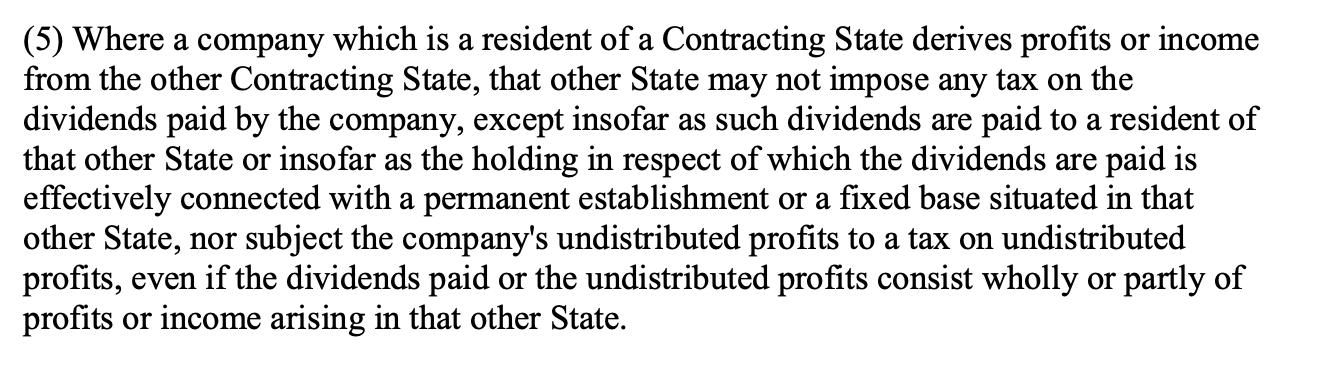
The first part of the sentence suggests the “other state” - Ghana in this case - may not impose any tax on the dividends paid by the company. Yet the second “insofar” carves off dividends paid from a holding “effectively connected with a permanent establishment or a fixed base situated in that other State” [ie Ghana].
That holding, one would presume is Tullow’s fixed base in Ghana, or Tullow Ghana and its operation of the Jubilee and TEN fields. Therefore, one could assume that the treaty, in this article 10 (on dividends) might not offer much additional protection against BPRT.
To conclude: the probability of an adverse outcome for Tullow on this specific upcoming case may be higher than many analysts and shareholders discount. I suspect this may well be the case with the future ICC arbitrations that Tullow faces on interest protection disallowance and business interruption insurance, but thats a subject for a later note. Either way, it’s an odd time for an outsider (Kosmos) to place a bid, perhaps not such an odd time for Tullow’s board to solicit one.
The information contained above is not intended to constitute and should not be construed as investment advice and should not be construed as an offering or a solicitation of an offer to invest in any product or share. It is for personal use and information use only. It should not be relied on in the context of the investment objectives and financial situation of particular needs of any particular person or class of persons, and relevant advice should be obtained before taking any investment decision. The information above has been obtained from sources that we believe to be reliable and accurate at the time of publication, however, we give no warranty of accuracy as to the information or opinions offered above. Opinions given above are given at the time of posting and are subject to change without notice. The value of investments may fluctuate and you may not receive back the amount originally invested. Past performance is not a guarantee of future performance. At any time we may have a position long or short in a given company under discussion.
Each report on this substack is opinion journalism. Brevarthan Research is providing its journalistic views about issues of concern based on facts that are fully disclosed to the readers. To the best of our knowledge, all information contained herein is accurate and reliable and has been obtained from publicly available sources that we believe to be accurate and reliable. The information presented herein is “as is,” without warranty of any kind, whether express or implied. All expressions of opinion are subject to change without notice, and Brevarthan Research is not under any duty to update or supplement this presentation or any information or opinion herein.
In relation to readers from the United Kingdom, the research and materials on this website are being issued only to, and are directed only at, persons who are “Permitted Recipients” under the terms of the FPO (“Financial Promotion Order” - articles 19 and 45 - ie an “investment professional” or “high net worth individual”) and, without prejudice to any other restrictions or warnings set out in these Terms of Use, persons who are not Permitted Recipients must not act or rely on the information contained in any of the research or materials on this website.
No posts
Comments
Nothing yet. Say the first thing.
Sign in to join the conversation.