
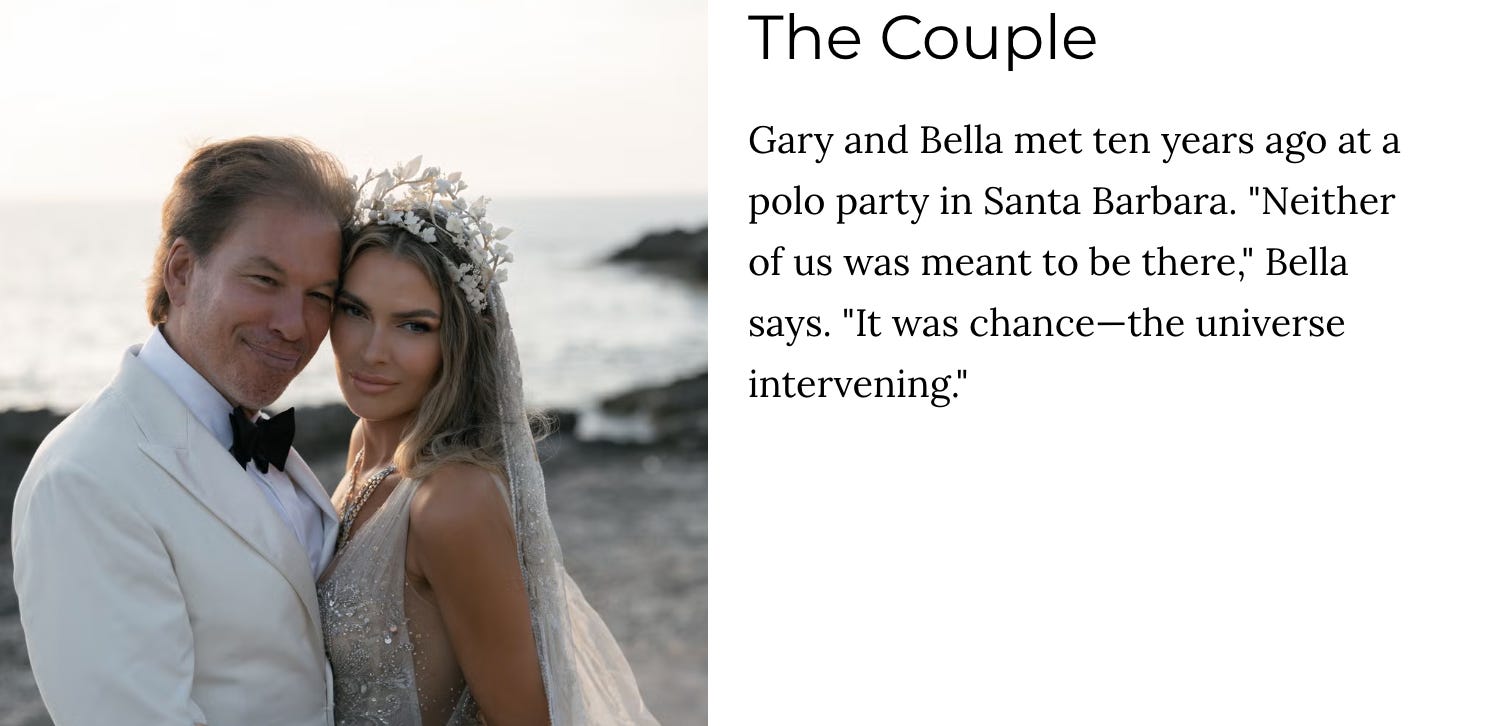
(Credit: Town and Country Magazine)
*Please read the disclaimers at the base of this report. The author has a short position in the company mentioned below. Does not constitute a recommendation to buy or sell the securities mentioned herein. Do your own due diligence. For Permitted Recipients only (UK - see disclaimers).
A luxury yacht? Two gulfstream jets? A six room luxury hotel in NYC? A historic palatial retreat in the English countryside? What corporate behemoth possesses the funds to throw on these billionaire status symbols? Which new Corporate Colossus flaunts such extravagant baubles? Enter RH’s “visionary” CEO, Gary Friedman, with his “premiumisation” strategy for his debt-saddled US furniture chain, surfing the “luxury wave”. As for the stock price of his company, RH (formerly Restoration Hardware), it’s down 70% since COVID highs and more than 50% since the start of the year, the descent turbocharged by a year end results announcement notable for two things; first a complete absence of any cash generation, and second - its timing, on the same day as Trump’s “Freedom Day” tariff announcement.
Following that disastrous Q4 report, and in an attempt to stabilise the situation, RH’s first quarter 2025 report pulled every rabbit out of the hat and sent the stock briefly back above $200 for the first time in since the previous “Freedom day” earnings release. Sure, things were on the face of it “in-line” with where the market expected, and there was even a modest amount of cashflow to cheer about, with a yet more punchy free cashflow forecast for the year. But scratch the surface and it is clear the business deterioration is continuing. Nothing makes that clearer than CEO Gary’s admission that store discounts for RH members would rise to 30% from 25%; potentially shrinking the gross margin by 3% every thing else being equal.
And then, this:
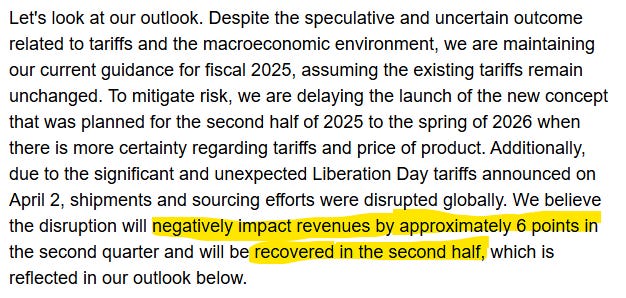
Six over par in the front nine and birdies all the way to the clubhouse? Forgive the golf analogy, but how exactly does that work? One of the analysts on the Q1 25 call pointed out some potential contradictions but got shot down pretty quickly:
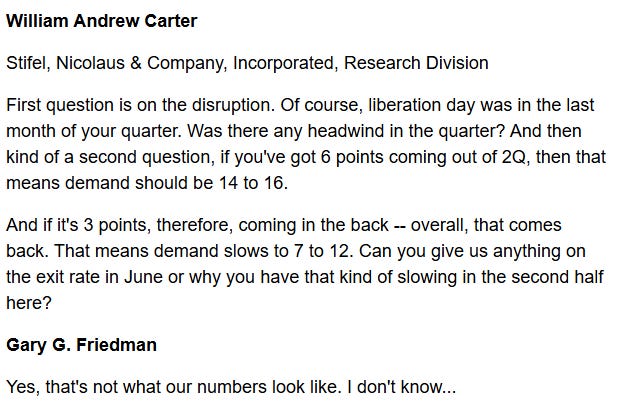
The analyst’s point was that given guidance of 8-10% revenue growth in Q2, and the prepared remarks saying that there would be a 6pt shortfall in revenue growth in Q2 to be made up in H2, that would imply significantly higher revenue in the final two quarters of the year than the 12.25% growth yoy for Q3 and Q4 that would fit the annual guidance. That not being the case, the guidance points to a “demand” slowdown in H2, as shipped revenues are booked late and reduced trend demand fits the rest of the revenue growth number.
Most noticeable of all was the sheer lack of explanatory power on the conference call to justify the guidance. I suspect that management are flying blind and therefore anything forward looking in the earnings release should be taken with a pinch of salt. More relevant is the statement in the 10-Q “..the timing and precise outlook for these improvements [macro and micro one assumes] is uncertain” Meanwhile, the company’s balance sheet looks shot and the membership base has been haemorraghing. Has RH’s luxury lifestyle brandshift left its customers behind?
Restoration Hardware, or RH as it is now known, retails furniture at high end prices. Much of this furniture is relatively “low end” in composition - mostly veneered MDF or composite board, finished in veneer to achieve a “luxury look”, and sold in glamorous locations (Design Galleries) many of which are historic or iconic buildings in their own right. The company has rapidly moved up the luxury ladder over recent years and now offers private yacht rental, private jet rental and luxury Guesthouses to stay in. RH has also starting opening a number of Design Galleries abroad, in England, France and Germany. Much of this investment has been at a cost - stretching the balance sheet which has already been loaded up with debt after CEO Gary Friedman bought back millions of shares in 2023. Currently, the company has a market cap of around $3.5bn (although substantially more if options are exercised - up to $4bn), and approx $2.4bn of net debt, with a further $1.2bn of lease liabilities. Its net income has fallen progressively over the past three years from the covid years of bounty to barely breakeven ($74m in 2024). In recent quarters its operating income has barely been enough to match its interest expense from its debt burden with effective interest rates of approx 7.5% (floating rate term loans).
In 2014 RH had 572,000 square feet of selling space (average for the year), and ten years later that figure had more than doubled to 1.46m square feet. Net revenue for the most recent year (year ending 31 Jan 2025) was 3.18bn, while for 2014 (year ending 31 Jan 2015) it was $1.87bn. In other words, in 10 years square footage has gone up 160% while sales have only risen 70%, or, down 36% on a sales per square foot metric. Adjust for inflation and that’s more than 51% down in 10 years. In terms of profitability. whilst COGs only rose 50% allowing gross margin to rise, SG&A has more than doubled (113% growth) to $1.09bn. Overall, operating income last year was down 25% on a per square foot of selling space basis, and 44% in real terms adjusted for CPI. All in all, this doesn’t look like a great business, and not the sort of improvement you would expect given the “premiumisation” of the business model that CEO Gary Friedman has championed.
RH is primarily, a catalogue/member driving business. At its heart it is very “old school” with heavy catalogues mailed out each year selling “rooms” of furniture. Not much has really changed despite the glitzy website. In 2016 the business moved from a “promotional” sales model to a “membership” model (with discounts of 20% for members); membership quickly rose to over 400,000, peaking at 459,000 at the end of 2021, and falling each year since then to a new low of 265,000 at the end of 2024 (Jan 2025). Given approximately 97% of sales come from members, the number of members is a fairly good barometer of sales trends.
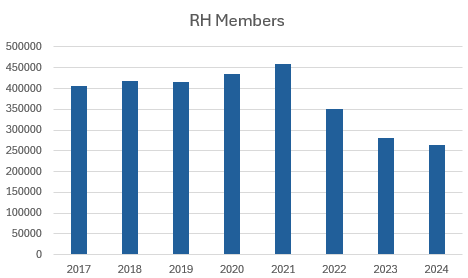
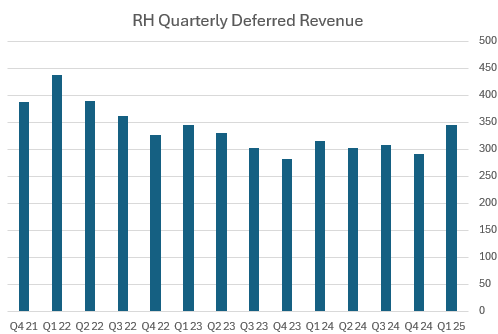
Unsurprisingly, calendar year 2021 was the peak year for members and the peak year for group net reviews ($3.76bn). Since then revenues have fallen approximately 15% while membership has fallen over 40%. Any recovery in revenues would require a major expansion in membership. Yet on the face of it, that hasn’t happened yet, and the trend is still weak. A boost to deferred revenue this spring (Q1 $346m) has provided a filip to free cashflow but it is still within its two year range and unlikely to have been driven by a material increase in membership (annual membership fees on trailing membership would not amount to much more than $50m spread throughout the year). Far more likely it represents a brief rush in purchases to pre-empt tariff effects from “Freedom Day” which came late in the quarter (April 7th). Moreover, orders that are paid for but not delivered (with time horizons likely extended due to tariffs) would likely fit into this context. In short despite the improved year on year and sequential trend we would be sceptical about this uplift unless it was sustained in future quarters.
The question of memberships brings us onto another development that could be perceived as a red flag: discounting. On the recent Q1 conference call the company announced that the permanent discounts for members would rise to 30% from 25% for RH purchases (and 20% on sale items). On top of this members apparently get 35% on Outdoor purchases for (presumably) a limited time period: is the promotional model coming back via the backdoor?
The savings below were clipped from the UK RH website:

60%+30% = 90%?

Certainly if we look at inventories over the past few quarters we haven’t seen a dramatic fall. In fact they remain stubbornly high, and adjusted for days payable net days of inventory are at all time highs:
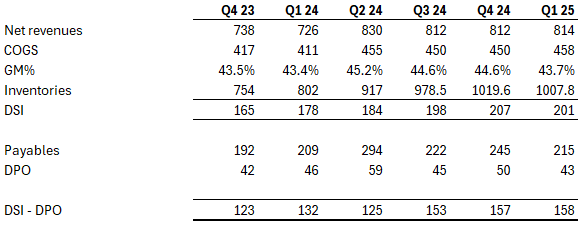
Combining a picture of a) higher discounting, b) declining gross margin and c) high inventory levels and relatively high inventory staleness (approximated by DSI-DPO as above) provides a pretty clear warning light for a business under strain.
Whilst all these warnings lights have been flashing, RH has been embarking on an aggressive expansion into the European market, starting in England with its somewhat absurd “Buckingham palace in the Cotswolds” design gallery, in Germany with galleries in Dusseldorf and Munich (collectively impaired by $19m in the 2024 accounts), in Brussels, and galleries yet to open in two ill-starred former Abercrombie and Fitch stores in London and Paris. The London site now touts 2026 as its opening year.
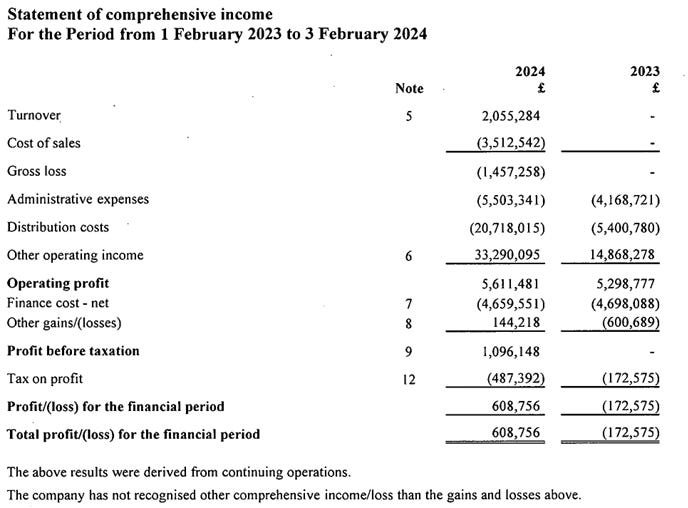
Results from the first 7 months of RH’s Cotswold’s gallery don’t exactly suggest a tsunami of sofa sales (excerpt from RH London ltd - the managing entity for the Aynho Park gallery)
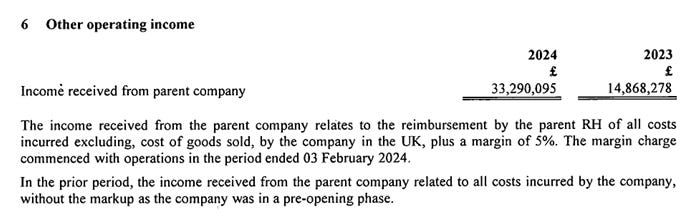
RH in the UK is being bankrolled by the parent company for all costs except for cost of goods sold - which looks like a potentially costly injection of liquidity if it continues:
Certainly it seems that RH has misjudged the mood in the UK, but if we listen to the conference call Gary Friedman certainly seems to have a different take:
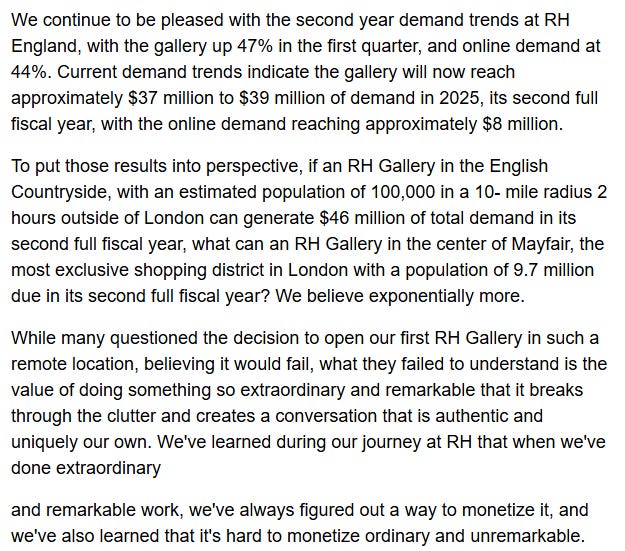
Two things don’t really reconcile here - being up 47% on presumably a very low number (given what we know about year end 2023 (end Jan 24) sales, and $46m of demand. That’s a massive change from approx. $5m of annualised demand in 2023 if the accounts from the UK entity accurately denote sales from RH England in the Cotswolds.
Obviously we can’t reconcile the difference between the reported number in the Companies House accounts and the claimed demand in the RH press releases - however we can get a certain impression of how things are going from insider employee reviews (taken from Glassdoor).
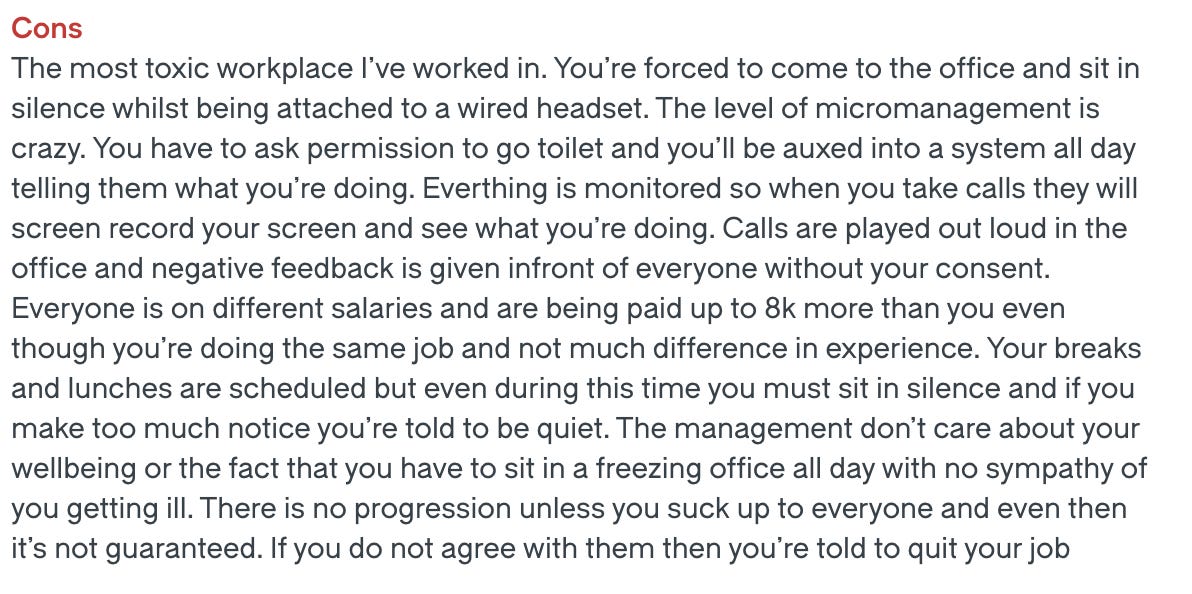
More pertinently:
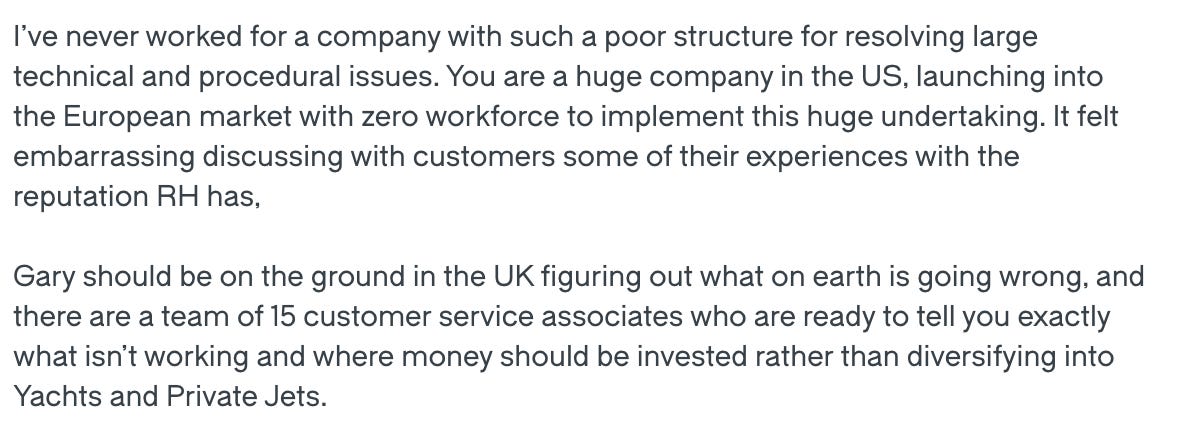
The comments (snipped from Glassdoor - see below for more) above chime with my own experience at RH England, and they are not out of place with the broader reviews on the site which unsurprisingly give a low rating to the company (2.8/5) and the CEO (23% approval!!)
All this begs the question - what is demand? The 10-k refers to it as “an operating metric we use in reference to the value of orders placed”…which presumably leaves some wiggle room. However, since it was unveiled as a non-GAAP metric in Q1 2024 there has been no attempt at a clear definition and it has consistently and materially outstripped revenue growth trends despite in theory it needing to “average out” with revenue over time:
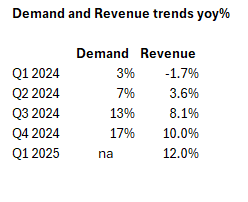
As you can see in the above table demand actually stopped being mentioned on a company basis in Q1 2025. Perhaps it was no longer flattering any more? Certainly revenue growth will bump into much tougher comps in the back half of 2025: I suspect it will be hard to sustain that sales momentum on the back of last years sales growth.
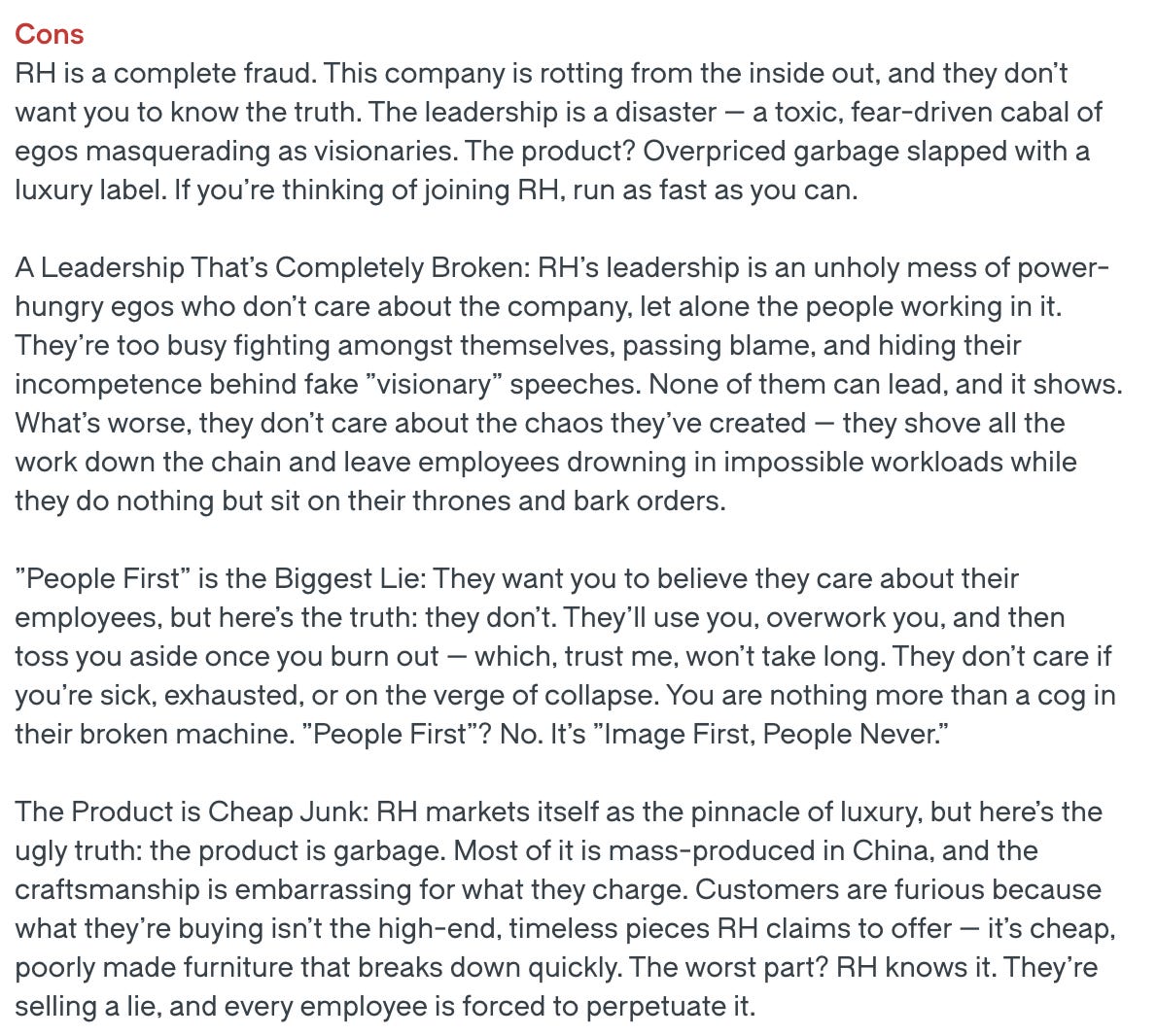
And what of the much vaunted culture at “Team RH” as Gary likes to call it. This excoriating Glassdoor review below came from an employee at the Corte Madera HQ:
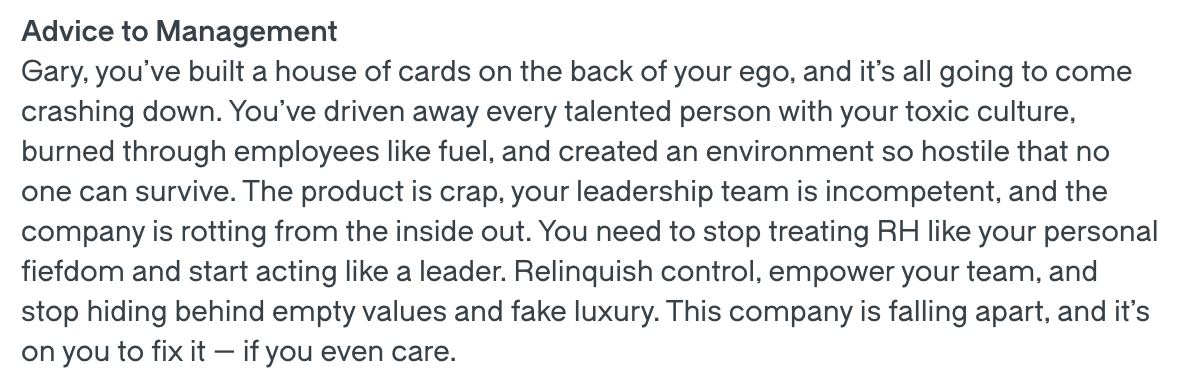
In finishing the reviewer offers cut out and keep advice to the CEO:
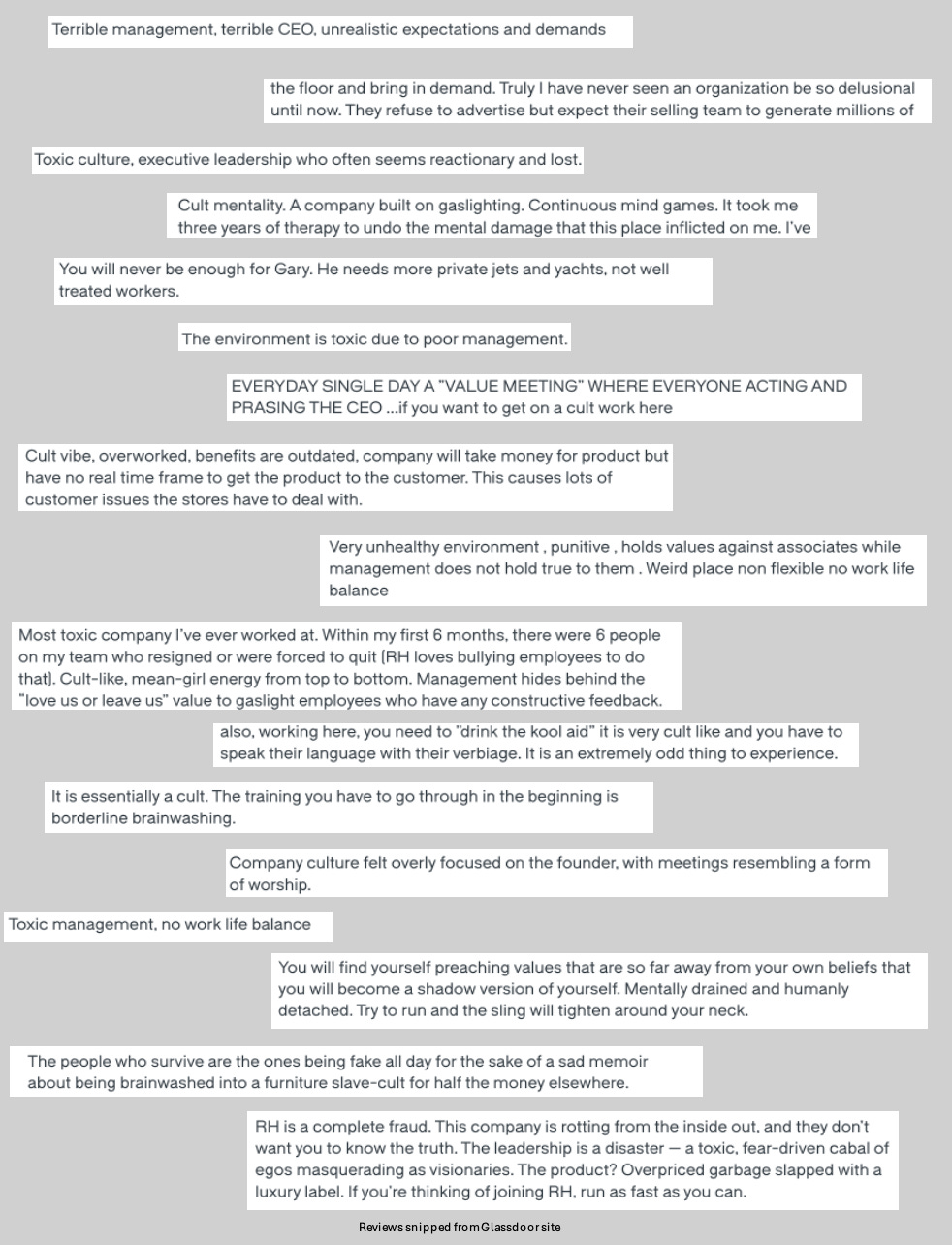
Clearly not pulling any punches here. But then the employee reviews from the last six months are fairly consistent in their criticism, and two words feature more than most: “toxic” and “cult” (by contrast the few praiseworthy reviews I read are fairly boilerplate and milquetoast):
Perhaps this is what it takes to successfully ascend the luxury mountain but if so it would seem that there is an unnecessarily high casualty rate amongst the sherpas and mountaineers needing to get there.
Arhaus is one of RH’s main competitors in the premium furniture space. Looking at its performance over time it appears to have taken share from RH and successfully built its own brand in modern contemporary furniture. Recently RH poached a key executive, Lisa Chi from Arhaus, and a recent court filing by Arhaus allege she brought some of Arhaus’s IP and inside information with her. Below is a snippet from the court filing:
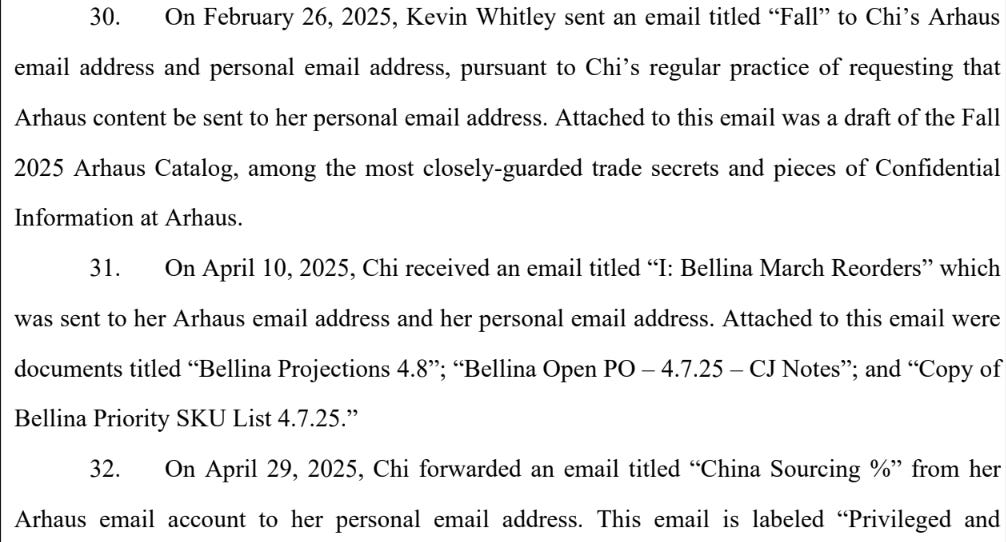
The filing alleges that Chi, in her new role as RH’s Co-Chief Merchandising and Creative officer (she was previously CMO at Arhaus) shared Arhaus IP with RH.
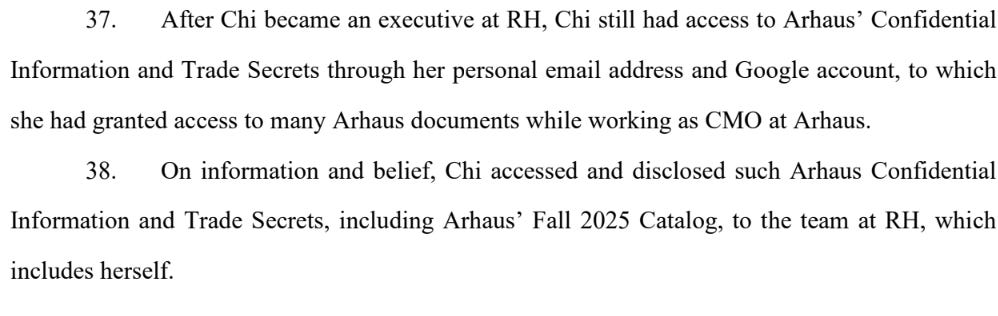
It appears from the allegation that RH was quite a happy to appropriate Arhaus’s style in its new offering:

Just for fun here are a couple of snippets from the two catalogues - first the Arhaus and then the RH…
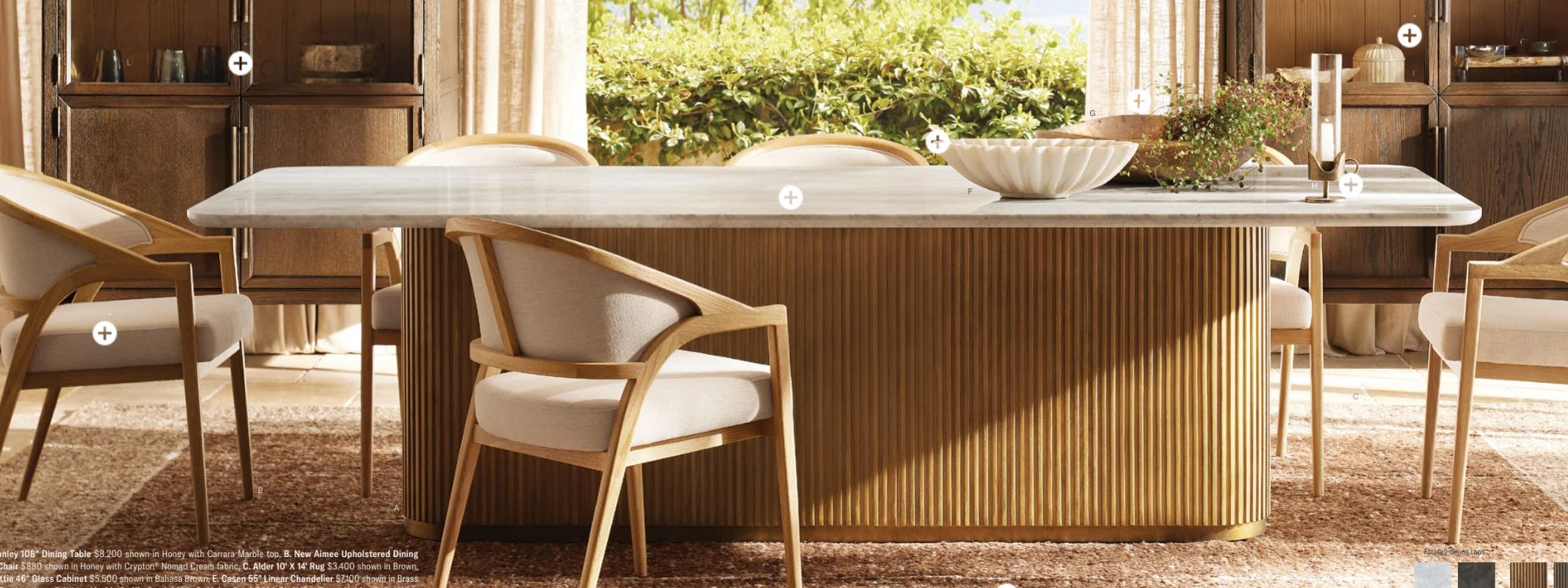
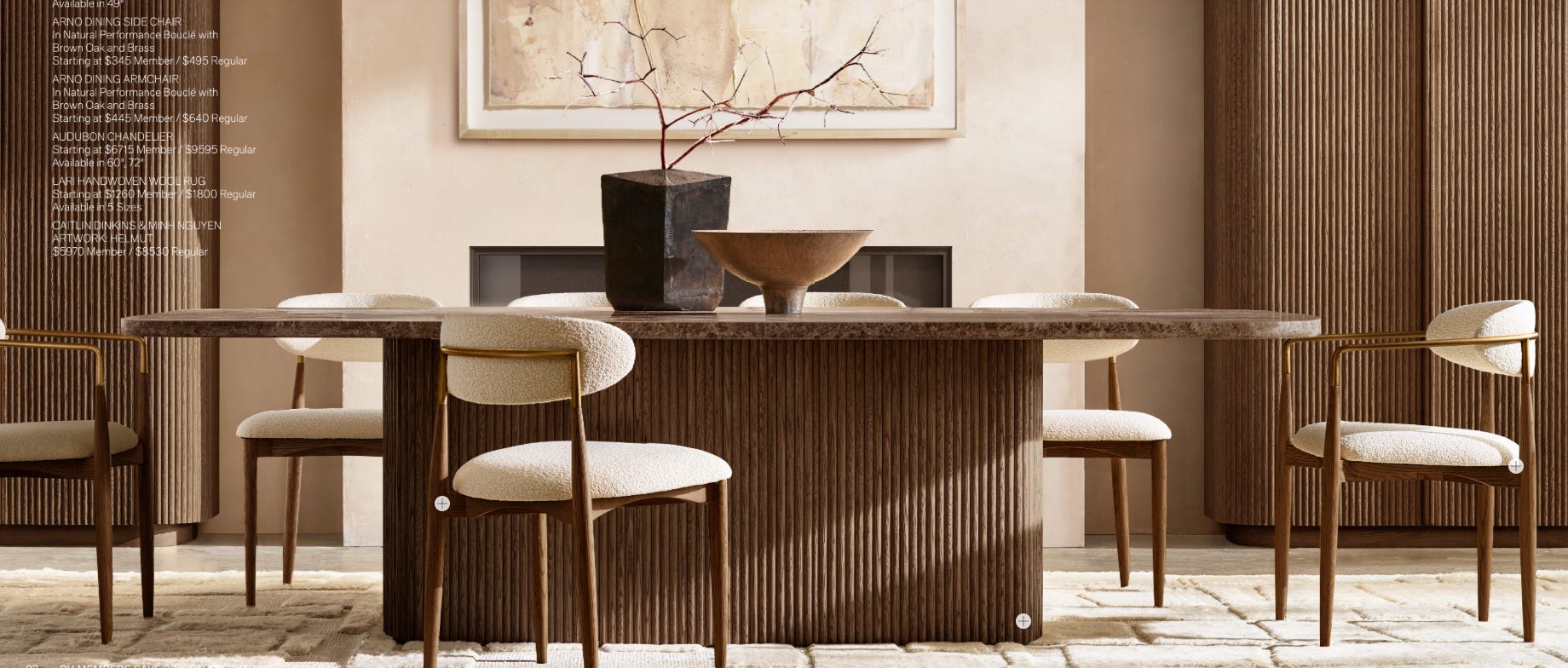
The catalogues are pretty similar in look and feel it has to be said, although the Arhaus colour palette seems a bit less restrictive.
Imitation is surely the best form of flattery, but it is understandable if Arhaus doesn’t see it that way. And if RH really is selling individual, luxury design from its own stable of designers, why (allegedly) copy a peers products?
At any rate Arhaus have claimed for material damages which might put a further dent in RH’s strained balance sheet.
The problem for RH, unlike premium furniture peers Arhaus and Ethan Allen, who have pristine balance sheets, is that its balance sheet is already fully geared to the tune of $2.6bn of net debt. Beyond this, the company is sitting with $1bn of inventory (over 200 days of sales). By contrast fellow premium furniture chain Arhaus has inventory days of just 140; other chains are also lower. Furthermore, current assets have been quietly ticking up with questionable figures: “other current assets” which are undefined, have gone from zero in 2019 to $40m in 2024. Capitalised catalog costs have gone up 200% since 2019, despite revenue only rising 20%. Not a great sign for revenue quality…. Unsurprisngly, cash conversion has been trending down for the past five years, and both cash from operations and cash taxes suggest RH has been “overearning”, a clear indicator of a reversal in years to come:
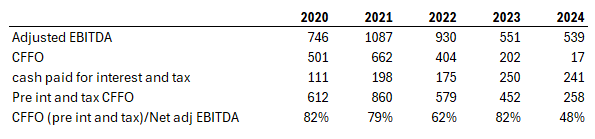
The company’s high debt levels raises further obstacles to any cyclical recovery. $170m+ a year of interest expense and $25m of debt amortisation payments, along with circa $200m in cash lease costs (likely rising) are two chunky non-discretionary items to pay at the best of times. Add to that up to $200m of capex which may be committed and perhaps $400-500m for employee remuneration and that means the $3-3.3bn of revenue they are annualising at needs to come in at over 2x the cost of sourcing, acquiring and shipping the inventory. That doesn’t leave an awful lot of headroom for the sorts of hefty discounts and sales we are seeing on their products right now. From previous SEC filings we can see that RH has been capitalising numerous costs and splurging on expansion capital to shore up a faltering top-line. No wonder it’s hard to see how cashflow doesn’t bleed further from here.
The difference between peers is increasingly stark. If we just consider Net Operating Assets (Operating assets - Operating liabilities), RH’s NOA has been steadily marching upwards. All the while its EBIT return on NOA has been heading in the other direction (to 10.5% last year vs 30% in 2022). RH’s net operating asset turnover has worsened considerably over time, from 121% in 2022 to 88% in 2024. Contrast this with peer Arhaus whose net operating asset turnover was just under 2x in 2024. Even Arhaus’ turnover of net assets (Total assets - cash) was almost double RH’s (1.26x vs 0.7x). It certainly appears that over recent years RH has been piling up unproductive operating capital while its earnings power has diminished.
We can trace RH’s diminishing returns by looking at NOA/Sales, and EBITDA/NOA: you can clearly see that growing capital intensity of sales is the main driver of sustaining EBITDA margins, which ostensibly is not a very “sustainable” way to run a business…
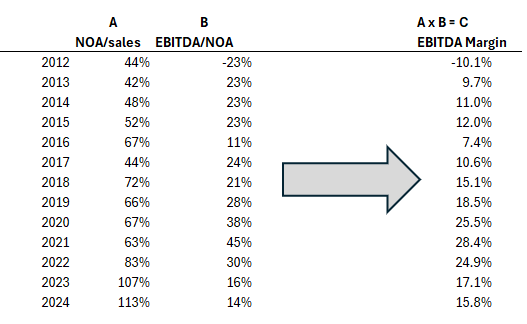
Put simply a dollar of sales at RH now requires $1.13 of net operating capital, as the the return on that net operating capital slides.
The Street has RH trading on about 22-23x 2025 earnings ($10.50 EPS at pixel time). I’m sceptical given derisory earnings in Q1 and tariff headwinds into the autumn. Even if there is apparent earnings growth in the last nine months of the year it is likely to be cashflow-lite and even more asset intense. Massive price cuts to shift stocks, a decimated membership base, the uncertainty from tariffs and the heavy debt burden increase the risk for cash calls from shareholders assuming material asset sales fail to materialise. The laundry list of red flags including insider selling, failing employee culture, a copycat lawsuit, accelerating discounting, apparent weakness from international expansion and recent cashflow trailing earnings by a material quantum. All the while, RH is attempting high risk openings in London, Paris and a number of other “prestige” locations. It isn’t inconceivable that shareholders will have to pick up the tab if the numbers don’t meet the hype. And in that case they won’t be paying 23x, but a much lower multiple.
The information contained above is not intended to constitute and should not be construed as investment advice and should not be construed as an offering or a solicitation of an offer to invest in any product or share. It is for personal use and information use only. It should not be relied on in the context of the investment objectives and financial situation of particular needs of any particular person or class of persons, and relevant advice should be obtained before taking any investment decision. The information above has been obtained from sources that we believe to be reliable and accurate at the time of publication, however, we give no warranty of accuracy as to the information or opinions offered above. Opinions given above are given at the time of posting and are subject to change without notice. The value of investments may fluctuate and you may not receive back the amount originally invested. Past performance is not a guarantee of future performance. At any time we may have a position long or short in a given company under discussion.
Each report on this substack post is opinion journalism. Brevarthan Research is providing its journalistic views about issues of concern based on facts that are fully disclosed to the readers. To the best of our knowledge, all information contained herein is accurate and reliable and has been obtained from publicly available sources that we believe to be accurate and reliable. Forecasts are the author’s own and subject to error or miscalculation. The information presented herein is “as is,” without warranty of any kind, whether express or implied. All expressions of opinion are subject to change without notice, and Brevarthan Research is not under any duty to update or supplement this presentation or any information or opinion herein.
In relation to readers from the United Kingdom, the research and materials on this website are being issued only to, and are directed only at, persons who are “Permitted Recipients” under the terms of the FPO (“Financial Promotion Order” - articles 19 and 45 - ie an “investment professional” or “high net worth individual”) and, without prejudice to any other restrictions or warnings set out in these Terms of Use, persons who are not Permitted Recipients must not act or rely on the information contained in any of the research or materials on this website.
No posts
Comments
Nothing yet. Say the first thing.
Sign in to join the conversation.