

*Please read the disclaimers at the base of this report. The author may maintain either short or long positions in the companies mentioned below. Does not constitute a recommendation to buy or sell the securities mentioned herein. Do your own due diligence. For Permitted Recipients only (UK - see disclaimers).
Ibstock plc (IBST.L) is a UK based brick and precast concrete manufacturer spun out of CRH into private equity and then publicly listed shortly afterwards (2015). Short interest has been high of late after several profit warnings and earnings downgrades given a weak UK construction market and high energy costs. With a market cap of slightly over £500m it has a net debt balance that has been creeping up of late, while earnings expectations have compressed. The UK government’s confused messaging on housebuilding, and the delayed budget haven’t helped. That’s helped Ibstock remain in the top 5 registered UK shorts over the past few months (number 2 as of pixel time). I wanted to investigate if this is justified, and what the rationale is for the short going forward.
Ibstock, as a brick maker, has a history that dates back to the glory days of the British Empire and the reign of George IV (1825). The company mined coal (until the 1920s) and developed brickmaking as a side business. After listing in the 1960s, it was absorbed into CRH, punted out to private equity and then relisted in 2015 (£775m market cap) as a brickmaker yoked together with a concrete products business grandfathered to it by CRH. Following several acquisitions and after disposing its US brick-making business it remains today a UK brickmaker and concrete products business. Revenues and operating profits peaked after Covid in 2022 at £513m and £103m respectively and have since slumped in 2024 to £366m and £39m respectively, significantly below historic non-covid levels. Meanwhile net debt has been rising materially since covid as profits have shrunk. With the current economic malaise in the UK and world-beating (not in a good way) energy costs, its easy to see why short-sellers have had their attention piqued.
Here’s the performance of the company since relisting, it has been a rocky, but ultimately unrewarding ride with the stock trading close to the bottom of its 10 year trading range:
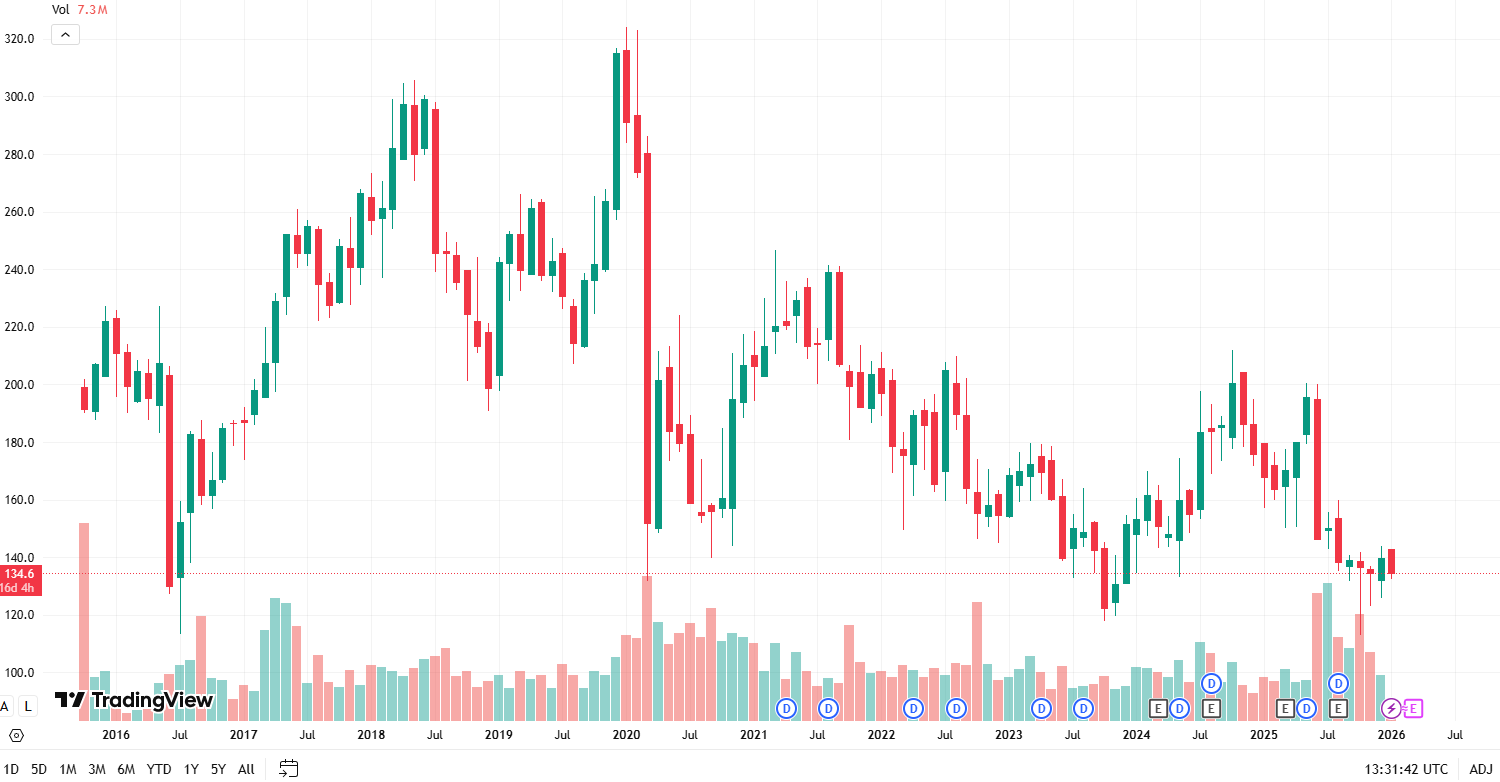
The company currently has a market cap of £530m, with interim 2025 results seeing net debt creeping up to £145m, guided to be roughly flat from their at the year end. That’s currently an enterprise value of around £675m or 9x adjusted EBITDA (a number which seems inflated - more below). Not super rich, but not a steal either.
Sagging Shares
The recent decline in the shares followed the departure of the CFO announced at the end of April to another firm, and a profit warning in June of this year citing weaker selling prices (“adversely impacted by sales mix”) along with cost pressures. These pushed back adjusted EBITDA expectations at the time to flat(tish) versus the previous year (£77-82m). This expectation was further tempered in the third quarter trading update (10th October) which pegged full year adjusted EBITDA back to £72m, with an implied 2nd half year on year drop of around 12%. Finally while the refinancing of a £125m RCF was no doubt welcome, the addition of a £50m accordion feature may well have invited understandable fears that the rising trend in net debt may not have peaked.
The other slightly concerning development from the trading statement was the fudged language on net debt despite the implications of lower EBITDA for the full year. The company in its last trading statement wrote:
“As a consequence, whilst net debt at the end of the 2025 year is expected to be above previous guidance, the Group retains a strong financial position with covenanted leverage at year-end expected to be around 2 times.”
Two times pre IFRS 16 EBITDA given guidance adjustments would be approx £120-£125m net debt at year end (ie not much changed from year end 2024 of £122m.) However, in the Half Year statement the company stated:
We continue to expect a modest increase in net debt for the full year versus the comparator (Dec 2024: £122 million), with positive underlying free cash flows
“Above” (see first quote) this “previous guidance” would suggest a materially higher net debt number: perhaps £130-140m. Yet this would be considerably more than 2x the covenanted leverage ratio on pre IFRS 16 EBITDA (more on this further down). Something just doesn’t add up. Given my somewhat cynical stance my money would be on the higher number. It is confusing, however.
Admittedly that would be still flattish to down from the interim results, but the interim results were always flagged as being at the “seasonal peak” of working capital. Not so seasonal anymore, it would appear. Below the paywall I look further into working capital, additional red flags, challenges in both the Brick and Pre-cast division and recent mishaps.
Brevarthan Research is a reader-supported publication. To access content below the paywall, consider becoming a paid subscriber.
Comments
Nothing yet. Say the first thing.
Sign in to join the conversation.