
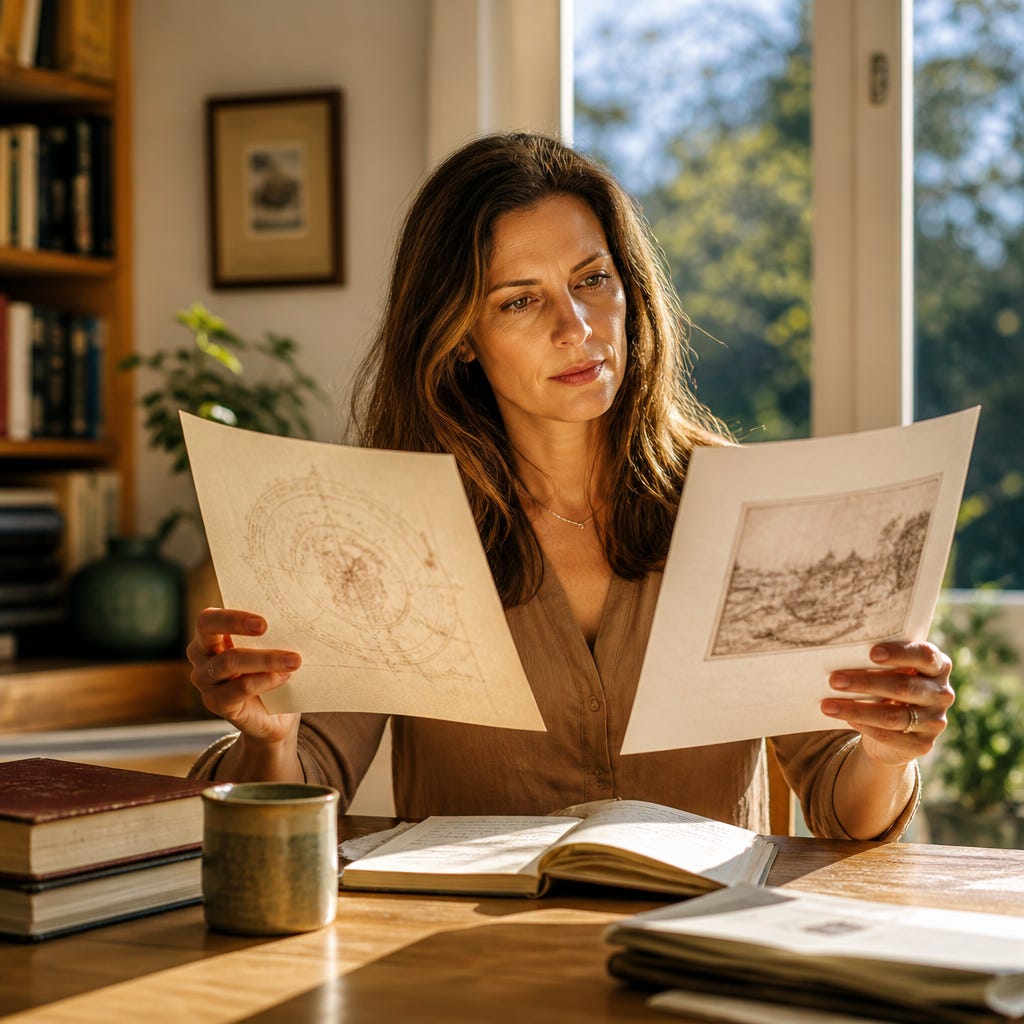
Some of the most valuable moments in life arrive quietly, in the pause before a decision, when we stop and ask ourselves what is actually true. Discernment is the faculty that makes that pause productive. It is not merely skepticism or caution; it is the trained, deepened ability to see differences, relationships, and tendencies that others may miss entirely.
Discernment is the mind's power to distinguish one thing from another with penetrating accuracy, to see not just what is present but what it means and where it leads. It draws on experience, self-knowledge, and the willingness to look beneath the surface rather than accept appearances. Crucially, what one person discerns may not be visible to another at all, because this faculty is shaped by each person's unique history and inner life. It is not a fixed trait but a capacity that deepens over time.
Every human being, in every culture and era, has faced moments when things were not what they seemed and when the cost of being wrong was real. The need to separate the trustworthy from the deceptive, the meaningful from the trivial, and the wise course from the merely convenient is woven into daily human experience everywhere. Discernment is not a luxury reserved for philosophers or leaders; it is a survival skill that all people exercise, whether they name it or not.
Without discernment, we act on incomplete pictures, follow persuasive voices that lead nowhere good, and mistake confident presentation for reliable truth. With it, we make choices that hold up over time, build relationships grounded in genuine understanding, and avoid the regrets that come from rushing past the signals we were given. In a world saturated with information and competing claims, the ability to perceive meaningful differences is not just useful; it is essential.
In recent years, security researchers have documented a surge in scam calls using cloned or synthesized voices to impersonate bank officials and other trusted figures. The voices sounded right, the scripts were polished, and the urgency felt real. Those who avoided harm were not necessarily more educated; they were more discerning. They paused, noticed something slightly off, verified through a separate channel, and trusted their own inner reading of the situation rather than its surface presentation.
By the mid‑2020s, newsrooms around the world were grappling seriously with the spread of fabricated images and false claims, tightening source verification and cross‑validation practices as waves of misleading content moved through online channels. The challenge was not simply about technology; it was fundamentally about collective discernment. Editors and readers alike were called to look at provenance, weigh context, and resist the pull of a compelling but unverified story. When communities practice discernment together, they become harder to mislead and more capable of shared understanding.
When you sense that something feels off but cannot immediately explain why, do you trust that perception long enough to examine it, or do you let the pressure of the moment override it?
In what areas of your life has experience taught you a kind of discernment that no amount of reading or advice could have given you?
How do you make space, in a fast-moving day, for the quality of attention that genuine discernment actually requires?
More principles, daily reflections, and 15 wisdom-tradition perspectives in 44 languages at https://TheRainbowBridge.TV.
For an extra boost of positivity and energy throughout your day, check out http://TheDailyEnergizer.com.
No posts
Comments
Nothing yet. Say the first thing.
Sign in to join the conversation.