
In This Issue

One interesting thing about moving to Canada from the US has been observing how different the housing policy debates are, even though the underlying concerns are very similar. For example, both Washington, DC and Toronto are facing housing affordability challenges. In Toronto, a lot of debate is focused on the impact of the housing crisis on families in particular, and there is vigorous public discussion on a bunch of related questions:
Is there a shortage of units suitable for families? What makes an apartment family-friendly? Is it the size? Or is it the interior finishes and features? Should planning policy dictate unit mix, unit size, and other attributes?
This isn’t something I recall spending much time thinking about when I was working in DC. Here’s a summary of how I understood the issue at that time:
Families mostly didn’t live in new apartment buildings. The young families I knew usually lived in older single family homes or in newly built small condo buildings (e.g. a row house that was converted to two or three big units).
We wanted to make our larger units suitable for families, and we did our best to design them as such, but we expected that almost all of our larger units would be rented by roommates. And indeed, that is what happened in most DC apartment buildings.
The data were clear that large units tended to have slower absorption, meaning that when a building opens, it takes longer to rent large units than it takes to rent small ones.
Large units also commanded lower rents on a per-square-foot basis, meaning they were less profitable than small units. The difference was substantial, with a rent premium around 20-30% for the smallest units compared to the largest. This premium outweighs the minor construction savings that you get on larger units (e.g. both 1- and 3-bedroom units only have one kitchen, which drives down the psf cost of 3-bedrooms).
We knew that when families moved in, they were less likely to move out in any given year compared to roommates, who tended to move out much more frequently. Higher renewal usually means you can mark-to-market less frequently.
DC’s inclusionary zoning program required that the mix of affordable housing units resembled the overall mix of market units, but there were no unit mix requirements for market units that I can recall.
Altogether, this created a financial incentive to build relatively fewer large units and more small units. That doesn’t mean that we wanted to build massive communities of only studio apartments, because that creates its own unique problems. Instead, we built a mix of studio, 1-, 2-, and 3-bedroom apartments in every project. There were a few reasons for this, some better than others.
First, there was a lot of speculation at the time that aging Baby Boomers would start to downsize, moving out of their large single-family homes and into urban apartments, putting upward pressure on rents for 3-bedroom units. This trend has been predicted for 20 years or more, but has only ever happened at the margins. Never enough to meaningfully move large apartment rents at the scale of a city.
Second, and more importantly, we knew that different unit sizes had different R&M (repair and maintenance) costs and renewal rates (the likelihood that someone will stay in their apartment beyond the initial lease term). To reduce churn and volatility on the rent roll, we built a more diverse unit mix.
We would usually build around 10% of our mix to be 3-bedroom apartments and 20-30% 2-bedrooms. Interestingly, this happens to be close to what Toronto mandates in certain parts of the city. We got to the same place without any hard rules. In the end, it was a private decision based on market forces.
That said, I definitely don’t support unit mix mandates. They harm projects at the margin by preventing units that the market wants. For example, if someone wants to build a bunch of small units as furnished rentals or as student housing, I think that should be allowed!
In the last few months, I have started to see the topic of family-sized units pop into the broader discourse much more frequently, including in the US. One of the more active advocates on this issue is Bobby Fijan, who is making the case that developers should provide more family-friendly units; he believes that when faced with better housing choices, many young families would stay in cities rather than move to the suburbs. He also thinks that developers are currently leaving money on the table by failing to deliver this type of product.
He recently co-authored an interesting report that examines these preferences and whether it might be more profitable for private developers to provide larger, well-designed urban apartments. I’d encourage you to read it. Bobby focuses a lot on the details of unit layouts, arguing that small design changes can change the incentives for families to stay in urban apartments.
Earlier this week Brandon Donnelly posted about Bobby’s report, and made a few really good points. Even if young families are fleeing cities just about everywhere, you can’t assume that the same approach will work everywhere. For example, apartments in most US cities are just much bigger than apartments in Toronto. It’s common to have a 750 sf 1-bedroom or a 1,100 sf 2-bedroom. Bobby is right that a developer can create a lot of value by adding bedrooms, dens and/or offices to these units. But in Toronto, a typical 1-bedroom is going to be closer to 450-500 sf, and 2-bedrooms are only 750-800 sf. There simply isn’t any room to squeeze in more bedrooms.
So what could Toronto do to encourage families to stay in the city?
The truth is complex, encompassing school quality, personal safety and public order, and the accessibility/reliability of transit, and yes, the availability of family-friendly housing options. But even more important, in my opinion, is price.
Here’s a sample table to help you understand a fairly typical Toronto unit mix.

A few things to notice. Let’s start with a general renter’s perspective.
First, as units get bigger, the monthly rent goes higher. Most people will pay more for 500sf than they will for 400sf.
Second, even though the rent grows with unit size, the rent per-square-foot gets smaller. This is because the marginal utility of more space falls as your home gets bigger. Another way of saying this is that the demand curve for living space slopes down. As the price of something increases, you want less of it. As the price falls, you want more.
Next let’s consider things from the developer’s perspective.
Let’s say you, as the developer, are approved to build 64,500 square feet of rentable area. If you want to build larger units, the extra space needs to come from somewhere. If 90% of your building is made up of smaller units that command higher rents, then every extra square foot of 3-bedroom space is dilutive (i.e. worse) for your proforma because it’s taking space away from the smaller, higher-rent unit types.
From a financial perspective, you would only build more 3-bedrooms if you’re required to, or you think the future rents on 3-bedrooms will be higher than today, or you think the savings from less turnover/R&M will be greater than the rent loss. More qualitatively, you might think a diverse mix of unit sizes creates a more positive resident experience.
Now let’s think about this from a young family’s perspective.
Families compare housing options at the monthly payment level — for a given price, what is the tradeoff you choose to make in terms of location, local amenities, and size?
The rent on a 3-bedroom unit in our example building is pretty high, at $3,600 per month. What are a family’s other options at this price point? Imagine they took that amount of rent and started shopping for houses instead. Assuming a 5.25% interest rate and 25 year term, a monthly payment of $3,600 gets you a mortgage of around $600,000. With a 20% down payment, that’s a home price of $750,000.
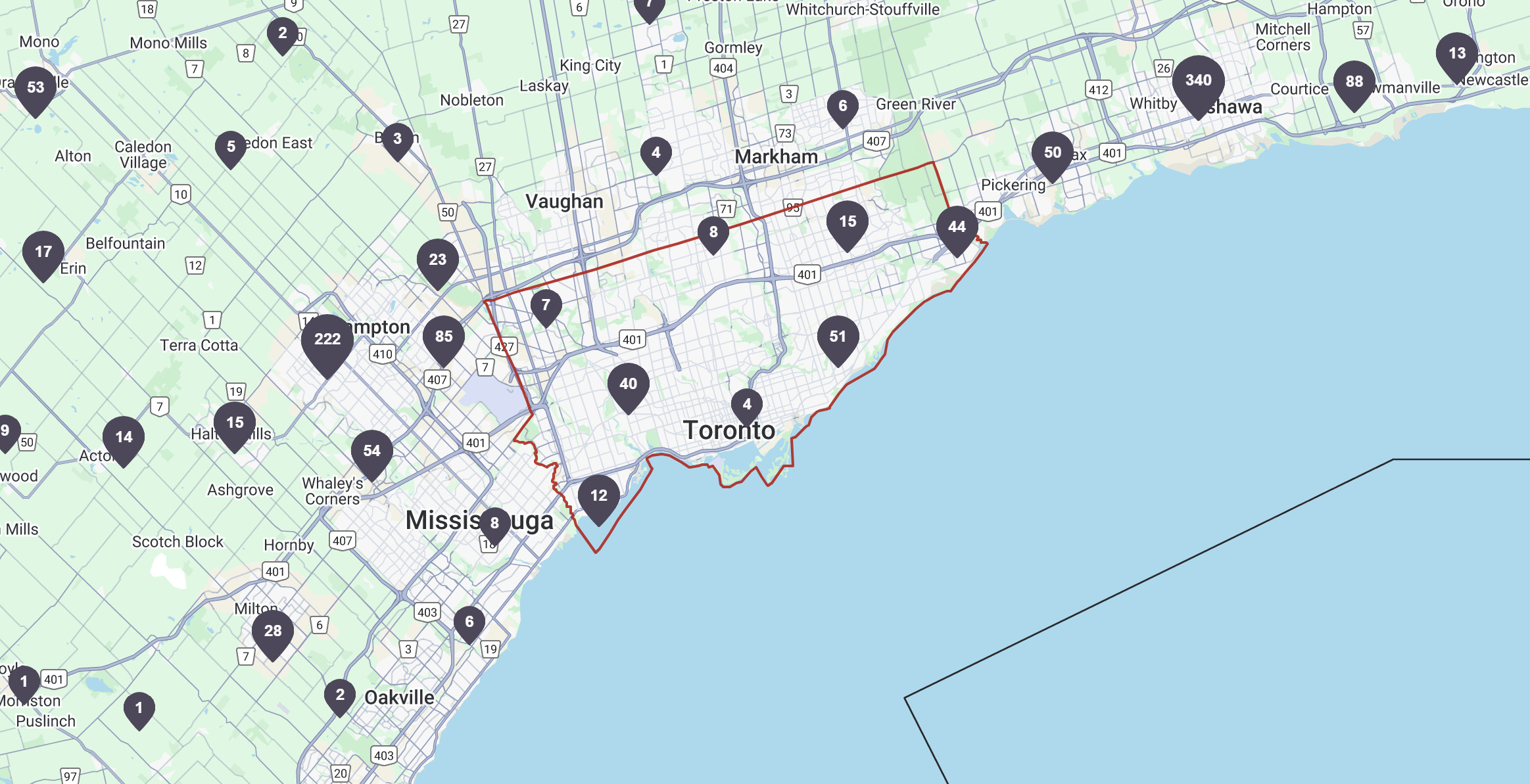
Today there are more than 1,000 single-family homes listed for sale with prices below $750k in the map shown below. These homes will almost all have more storage, more interior space, more outdoor space, and more privacy than a 3-bedroom urban apartment. The tradeoff is worse access to jobs and urban amenities, which means a lot more commuting, on average.
It’s pretty clear to me why many young families trade a longer commute for more space and lower prices in the suburbs, even before we account for other qualitative factors like quality of urban life and unit design.
Now, many municipal planning departments believe that the reason families are leaving cities is because there is a lack of large, urban units available. To address this perceived shortfall, they will often require (or strongly encourage) developers to provide a higher percentage of 3-bedroom units and larger minimum floor areas for these units.
The reality is more complex, and this leads to unintended consequences from unit design policies.
Here is a unit mix where I have kept our 3-bedrooms at 10% of the unit mix, and have also increased their size to 1,100sf which is roughly the City of Toronto’s guideline. Other than that, I have only changed the unit mix and 3-bedroom rent, keeping the average rent psf constant. This provides an apples-to-apples comparison with the previous table.
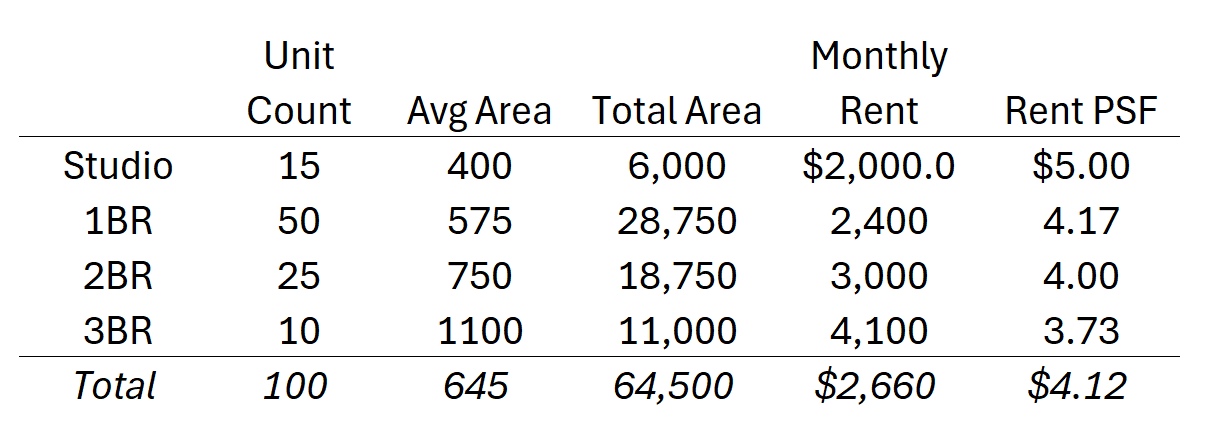
Notice how the price of the 3-bedroom units has increased by 14%, to $4,100 per month! This policy, of forcing 3-bedroom units to be larger than the market demands, puts large apartments even more out of reach for young families. It makes it more attractive to move to the suburbs, because the suburban homes are now an even better financial tradeoff than before.
This raises another unintended consequence of mandating minimum unit sizes. Who do you think is more likely to pay $4,100 per month for a 3-bedroom unit… a young family, or three roommates each paying $1,367? Notice that this per-bedroom cost is still way lower than the $2,000 studio rent. So we’ve further incentivized families to choose the suburbs, and at the same time roommates are still incentivized to bid up the price of a bedroom to save on monthly rent. We’ve created a situation where we will get even more roommates, and even fewer families.
This is the exact opposite of the policy objective, so let’s look at a different way to encourage families to stay in the city: reduce the cost of new construction. Here’s the original unit mix again, now showing a total development cost of $750 psf and a (very simplified) development yield calculation that assumes 70% NOI margin. This is roughly what it costs to build today.

And here’s a scenario where instead of focusing on making units bigger, we focus on cutting total development costs to $500 psf. Note that I’ve reduced the monthly rents to keep the development yield constant.
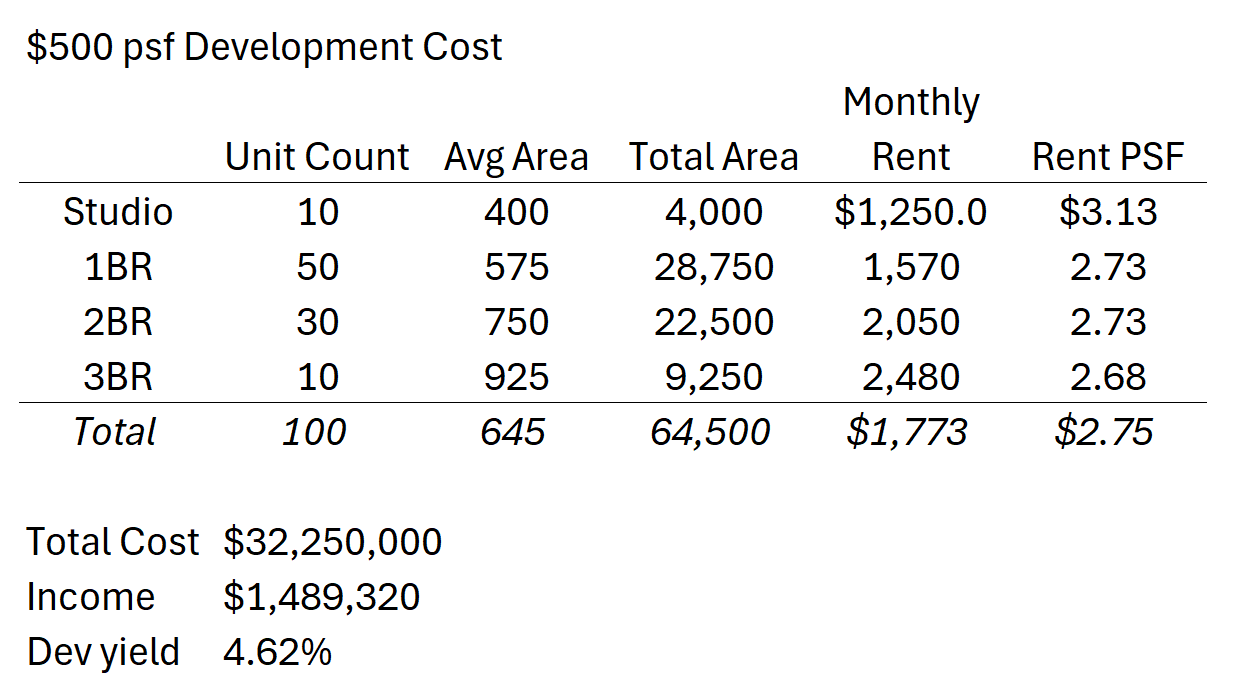
Look at how much cheaper the rents are! A family can rent a 3-bedroom apartment for just $2,480 per month. Suddenly, the decision between staying in the city and moving to the suburbs looks very different. Now it’s a much better deal to rent in the city.
The key thing for everyone to remember — developers and public officials alike — is that building bigger apartments without lowering input costs will tend to price families out of these units. When total development costs fall, rents can drop without impacting deal economics. By paying lower rents, families can afford to prioritize other things like unit design and location, building managers benefit from more stable rent rolls, and cities benefit from families staying downtown. Win-win-win.
If we want families to stay in our city, we should focus on cost drivers first.
Impossible Toronto. A project by my friends at the Neptis Foundation, Gabriel Fain Architects, and Studio VAARO, examining how Toronto could create better urban spaces by legalizing European-style courtyard blocks. It provides a detailed overview of the code, planning, and zoning restrictions that currently make this vision impossible.
Zoning and the Dynamics of Urban Redevelopment, by Vincent Rollet. The author uses NYC data to create a model of floorspace supply and demand. Another on the heap of evidence showing that restrictive zoning raises housing prices.
We Can’t Double Homebuilding by Taxing It to Death. Mike Moffat and Alex Beheshti’s testimony to the Canadian Senate’s Standing Committee on Banking, Commerce, and the Economy.
I write this newsletter because I like to connect with smart people who are doing interesting things. Reach out by replying to this email or commenting below.
Thank you for reading, and have a great October.
No posts
Comments
Nothing yet. Say the first thing.
Sign in to join the conversation.