
Hi friends,
In June of 2021, I wrote this short science fiction story about a team of space explorers sent to a distant planet to investigate the disappearance of a previous exploration team. I pitched it to several SF magazines, online and in print; but my effort was perhaps only half-hearted. I gave up after a relatively small number of rejections.
But I still like this little allegorical tale, and I hope you will too. So here it is, available to the world for the first time:
by Brendan Myers.
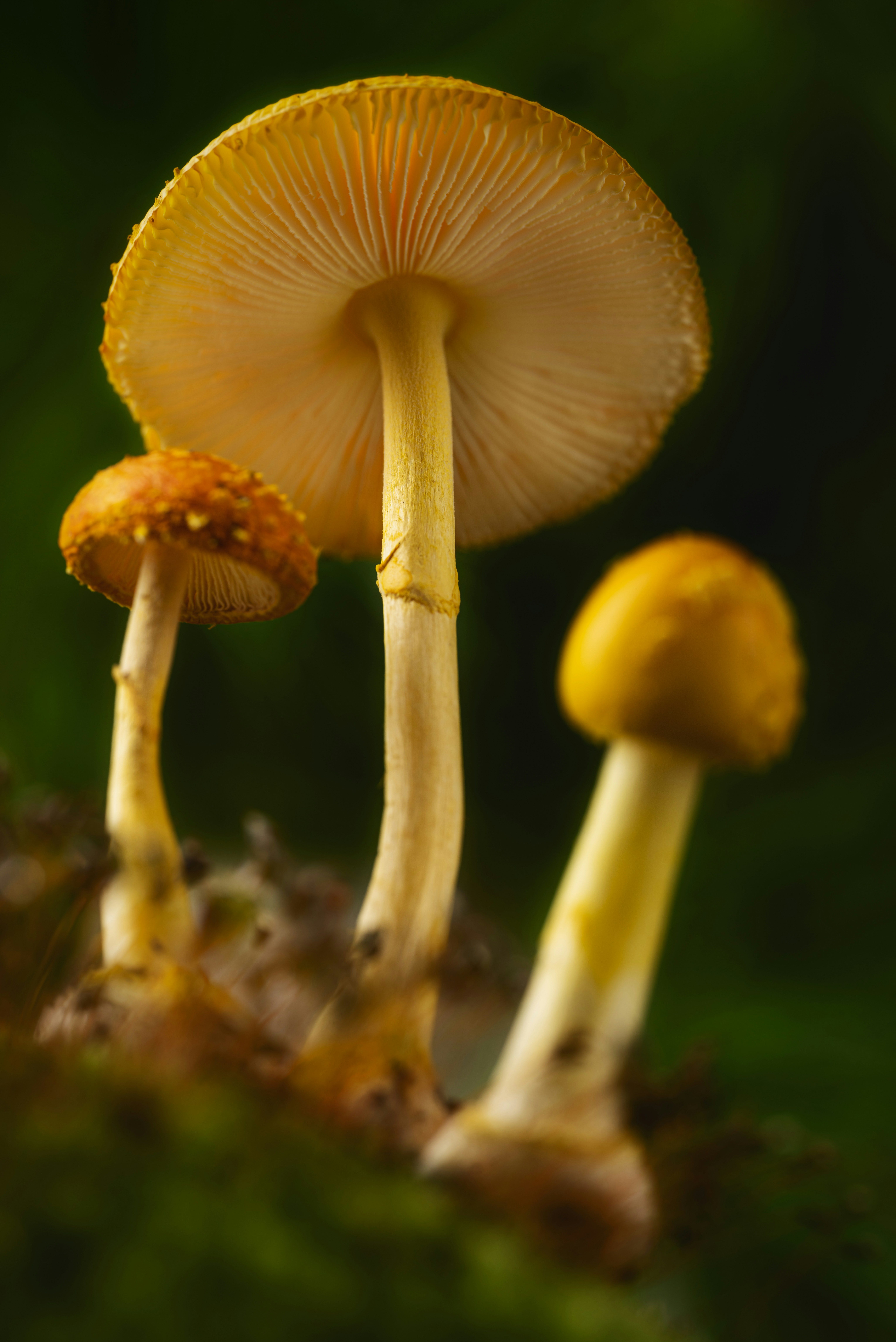
[Image by Skyler Ewing, unsplash dot com.]
Nobody notices such things until they are everywhere. They grow under the carpets, or along the edges of unfinished basement walls. The kind of basement where you put boxes of things to store them for the long term, only to forget you put them there. Maybe there’s a leak somewhere that allows moisture to seep through, a little drip at a time. Then they grow. At first, you might mistake them for dust, or for mouse droppings. You might sweep them away with an ordinary broom. But by then, their roots have taken hold. By the time you realise they are mushrooms, their roots are so deep that not even fire will remove them.
Thus when Professor Rawdon Gar saw the patch of gold mycelium, delicate as a cobweb, growing on the threshold of the laboratory, he brushed it aside with his shoe.
“Shouldn’t we sample it?” said Claire Eisen, Rawdon’s research assistant, gesturing to the fungus.
“Let’s see if the first team hasn’t already done so,” Rawdon told her.
Claire shrugged, and followed the scientist into the lab: a prefabricated module of standard size, shape, and design for research stations on unexplored planets. It was one of a dozen such modules stacked and connected by walkways, stairwells, and machinery, themselves of standard design. The patch of land on which they sat had been cleared of trees and ground cover, but a few grasses and saplings had already reclaimed its edges. An island of humanity in a swirling foliage sea.
“I’ll check the galley,” said Vera Nox, the team’s technician. “If the first team ate something that killed them, that’s where we will find it.”
“See if you and Pento can fix the generator first,” Rawdon told her.
“As long as we don’t have to stay here the night,” Vera said, as she adjusted the shoulder strap of her equipment bags. “The air on this planet smells like a fart.”
Pento, the medic, grinned. “That’s not the planet. That’s me,” he said.
“Maybe if you showered more often than once a year,” Vera replied, and she gave her companion a friendly grimace.
Professor Rawdon said, “Claire: get the sparrow flying.”
Claire carried an equipment case to the roof of the complex, and unpacked a small drone. She attached its cameras and batteries, and donned her VR headset and gloves. Within a moment, she and her sparrow were cresting the canopy of the jungle, searching from ultraviolet to infrared for any sign of what happened to the station’s first crew.
“Okay, guys, where are you?” she asked out loud, as if her quarries could hear. “It’s only been a week. You can’t have gone far. Whatever happened, we’re here to help.”
Pento and Vera found the generator in a module near the centre of the station. Vera examined it. “Nothing wrong that I can see,” she declared. “It’s just switched off.”
She turned it back on. LCDs in all the modules, and in a ring of lamps around the edge of the clearing, bathed everything in a septic-white light. Small animals in the ferns and grasses scurried away; their warning cries disappearing into the forest.
“There— home sweet home!” Pento said, pleased to hear the humming of the air filters and the electric transformers.
“Not for me,” said Vera. “Give me a planet where you can go to a restaurant, meet people, do things. I’ll take a shopping mall over an empty jungle planet like this one. Any day.”
“I hear that,” Pento said, agreeing. “But then, why did you take this job?”
“Same reason you did, Pento,” she replied. “I need the money.”
From across the complex, Rawdon shouted: “Great work with the power! Now let’s get the computers online.”
The medic and the technician joined Rawdon in the lab. A short communications video played on the largest wall monitor, featuring two members of the first crew, smiling as they spoke.
“It’s just the most wonderful place,” said one of the faces in the video. “I love it here— we all do! We’re thinking of asking the Council to open this planet to full colonization.”
The other face in the recording said, “That’s right— and you should see what a sunset looks like on a planet with rings! It’s incredible!”
Rawdon stopped the recording. “That was the last transmission we received from this station, before it went dark,” he explained. “So: when you went to fix the generator, did you see anything unusual? Besides the obvious, that is?”
“Nope, not me,” said Pento.
“Neither did I,” added Vera. “No sign of animals breaking in, no equipment failures. It’s as if the first team just walked away.”
“Then Claire had better pick up their trail,” said the professor. He took up his Q-link to talk to his assistant, who was still on the roof. “Claire, getting anything yet?”
“Yeah, I got what looks like a campsite, not far from here,” Claire reported. With a twitch of her fingers, she sent the image from the sparrow’s cameras to the monitors in the lab. The sparrow hovered above a patch of ashes in the centre of a circle of flattened underbush. A tent lay on the ground nearby: its corners fluttered in the light breeze. A rucksack lay in the centre of a scattering of torn food packages: the aftermath of a visit from a scavenger. And on the edge of the camp, almost inconspicuous, stood a gold mushroom: tall, slim, and gangly, perhaps half as high as the surrounding trees. Its cap was likewise long and slim, like a bell, or a wizard’s hat. A carpet of mycelium spread from its foot: roots like tentacles twisting into every contour of the soil, searching for new minerals to absorb, new earth to eat.
“I’ve set up exploration teams on twenty planets, and never seen a thing like that,” said Rawdon, marvelling at the image. “But we have other priorities right now. Vera, Pento, check out that campsite. Maybe there’s something there that can tell us where everybody went.”
“Maybe you could send Claire, instead of me?” asked Vera. “It’s just that, this is my first planet, and we don’t know what’s out there—”
“My first planet was a jungle planet, too,” said Rawdon. “Trust your training, and your teammates, and you’ll be fine.”
Pento handed her a machete, so they could clear a path to the campsite. “On jungle planets like this,” he said, “everything’s either poisonous, venomous, or trying to kill you. So it’ll be fun!”
“Not my kind of fun,” said Vera.
They cut their way into the campsite at almost the same moment that the sun slid beneath the jungle’s canopy, casting everything into twilight. The bow of the planet’s rings cast their own shadows. The whistles and cries of forest birds calmed and softened. Vera put her hand near the heap of ashes that had once been a campfire.
“Still warm,” she reported. “This might have been used as recently as last night.”
Pento, however, made for the mushroom. Its stem was barely as wide as his arm. Too slim, it seemed, to support its height. Like the tips of the nearby tree branches, it swayed in the slight breeze: an alien pendulum, tracing slow spirals in the air. He stepped carefully, mindful of the places where the carpet of roots was thinnest, so he would cause the least damage. He reached out to touch it. When his fingers were close, a patch of fine hairs rose from the stem, reaching to touch him back.
“This is exactly the sort of weird shit I signed on to this job to see,” Pento said, grinning happily. “The first team must have made this camp to study it.”
“But why make a camp here at all, when the station is only a hundred meters away?”, said Claire, through their Q-links.
“How should I know?” said Pento.
“Dude, it’s just a mushroom,” Vera told him. “And I need your help over here, searching the tent.”
“I just think it’s amazing that a thing like this could find a patch of ground for itself in a jungle,” Pento said, keeping his eyes on the discovery. “Where everything grows an inch a day. Wonder why nothing has eaten it yet. It must be really strong. Maybe it’s a predator— a mushroom predator! Imagine! And yet at the same time, it’s a thing of beauty—”
His fingers brushed the mycelial hairs on the stem. The action triggered a cloud of black spores to fall from the gills under the cap.
Pento inhaled them. He coughed, covered his face with the sleeve of his jacket.
“What happened?” said Vera.
“Spores— must have triggered its spores,” Pento said. His coughing became more violent. He stepped away from the mushroom, crushing its mycelial carpet underfoot.
Vera ransacked her field gear for Pento’s first aid kit. She injected a cartridge of universal antibiotic into her companion’s arm.
“Thanks,” Pento said. He wandered to the edge of the camp to lean on a tree as Vera put the first aid kit away. “I feel a little dizzy,” he said. Then his body began to tremble. He knelt on the ground, then fell to his side, captured by spasms.
“Back to the station,” Vera told him. She threw his arm over her shoulders, and helped him down the path.
Having seen the incident from her sparrow-eye view, Claire ran to the station’s infirmary.
“Rawdon!” she shouted. “Pento’s inhaled some kind of alien fungal spores.”
Rawdon ran to join Claire in the infirmary, arriving at the same moment that Vera fell through the door. A wheezing and choking Pento stumbled beside her. They lay their patient on the examining bed, and placed an oxygen mask over his nose and mouth.
“Isn’t it just our good luck that the first of us to get injured is the medic?” Vera said. “We should ask the fleet to send us an evac ship.”
Claire checked her Q-link. “It wouldn’t get here until next week,” she said.
“Next week!” Vera howled. “He could die!”
“This is the frontier,” Rawdon reminded her.
“Yeah, I know,” Vera complained. “But— if it’s an emergency, if someone’s dying, someone should get here!”
“Did you think ‘The Frontier’ means the suburbs?” Rawdon barked at her. “It means there are no coffeeshops, no movie houses, and no rescue ships. The Council sends teams like ours out here so that some day there will be coffeeshops. But until then: there is the jungle.”
Vera sat on a chair and folded her arms. Claire pretended to examine Pento’s medical indicators.
“All the same,” said Rawdon, to ease the tension, “we should signal the Council, let them know what happened.”
“On it,” said Claire, glad for a reason to leave the infirmary.
“Now, then,” said Rawdon, “Is there a chance you got a mouthful of those spores, yourself?”
Vera shrugged. “I don’t think so. I was far enough away.”
Rawdon nodded, and walked away. At the door, he said, “You did the right thing, bringing him back here. You might have saved his life.”
When Rawdon left the infirmary, Vera prepared an injection of Universal Antibiotic for herself. But instead of injecting it in her arm, she only stared at it.
“This is the frontier,” she murmured to herself, imitating Rawdon’s tone. “Didn’t sign up for this crap. The hell am I doing here, anyway?”
She left the hypo-shot on a counter, and walked away.
After Claire sent the message to the Council, she rolled her chair to a different terminal in the lab, to examine the previous team’s scientific records. They had classified around fifty different plants, insects, and animals, but only one mushroom. She found photos of its cellular structure, taken through the microscope. There were thin channels between the fungal cells, inside of which there was a line of slightly blackish cells, having the thinnest membrane she had ever seen in a fungus.
Claire went to the storage closet to find the sample from the photo. She separated out the strange cells and put them into a DNA sequencing machine. Knowing that the results would not be ready until the next day, she left in search of an empty module that she could claim as her bedroom for the night.
In the morning, the crew found Pento’s medical bed empty. The breath mask lay on the floor, discarded.
“That shouldn’t be possible,” said Rawdon. “There’s a sleeping agent mixed with the oxygen. So, which of you woke him up?”
“I didn’t!” and “Not me!” said Claire and Vera, almost at the same moment.
“And how do we know you didn’t do it?” Vera accused him.
“Check the security logs,” Rawdon said.
They checked the logs, and found that Pento had, in fact, awoken on his own, and let himself out.
“And why didn’t any of you think to lock the door when you left!” Rawdon thundered.
“You didn’t think of that either, Rawdon!” Vera shot back.
“I wasn’t the last one to leave!”
“Then let’s check the security logs again.”
Claire said, “Maybe instead of blaming each other, we could go looking for him?”
Rawdon and Vera groaned, but agreed. “Claire, get the sparrow ready,” Rawdon ordered.
“Don’t bother,” said Vera. “I know where he will be.”
They found Pento at the campsite, sitting on the ground, his back to the path, and facing the mushroom. He swayed his spine in harmony with the mushroom’s bending in the breeze: an acolyte in silent communion with his god.
“Pento!” shouted Vera, running to his side. He turned when he heard his name, and smiled. There were circular patches on one side of his face, as gold as the stem of the mushroom. Pento made a confused look, when he saw his friends recoil from him.
“What?” he asked.
“We have to get you in quarantine, right away,” Rawdon ordered.
“It’s fine,” said Pento, touching the gold spots. “It doesn’t hurt.”
Rawdon turned to Claire: “Prep an isolation pod in the infirmary,” he ordered.
Claire backed away from Pento, and made for the path to the station.
Pento rose to his feet. “It’s just a little spot on my face. It’s not like I grew three heads.”
“We don’t know how else the spores might be affecting you,” Rawdon said. “They might be slowly poisoning you. And you might be contagious!”
“Come off it, Grandpa,” Pento said. “All four of us have been breathing these spores since we landed here. Sample the atmosphere, you’ll see. I got a few more of them last night, that’s all. I admit, they made me feel woozy for a while. But I’m fine now.”
“We will let the doctors decide that when they get here,” Rawdon told him. “Unless this infection kills you first.”
“I’m not getting in no stasis pod,” Pento said. “I mean, come on. I’ve been a hard working and reliable member of your team for years. I deserve better. You should trust me when I tell you I’m fine. Vera: Tell him I deserve better.”
“It’s not a matter of what you deserve, Pento,” Rawdon said. “And it’s not that we don’t trust you. We don’t know what those spores are doing to you. What they might do to us.”
“If we studied this planet by the book it would take too long,” Pento said. “There’d be health and safety checks, oversight committees, policies, regulations— a giant mass of bureaucracy, whose only purpose is to stop explorers like us from doing any actual exploring. Well, I decided last night that I just don’t give a damn about the rules anymore. And for the first time in my life, I feel like a free man. If that spore cloud did anything to me, I think it actually made me better! For one thing, I feel like I could run a marathon. Like I’m in my teens again! So what if there’s a little spot on my face—”
“It’s covering the entire right side of your body,” Vera said.
Pento frowned, and shook his head. “If you won’t listen to reason, you leave me no choice but to show you.” He broke off the stalk of the mushroom, causing another burst of black spores to issue from its gills, and he threw it at Vera.
Rawdon jumped out of the way to avoid the spore cloud, but Vera had to knock the missile away with her hands. Spores burst from the cap where she struck it, covering her fingers.
“You jackass!” she screamed at him. “You trying to kill me?”
Rawdon pulled a blanket out of the tent, and used it to fan the spore cloud away.
“I’m trying to purify you,” Pento said. “You’ll have a bit of a rough night tonight, but you’ll be fine by tomorrow morning. And as strong as a bear. You’ll see!”
“Get away from me!” Vera said, and she ran back to the station.
Pento watched her go, and laughed. “Ha! Isn’t it just like a woman to hate you for doing her a favour,” he said to Rawdon. His tone and posture suggested that he was looking for Rawdon to agree.
Instead, Rawdon clobbered Pento in the head, knocking him unconscious. Then he shouted down the path to the station: “Claire! Need a little help here!”
They dragged Pento, unconscious, back to the infirmary on the blanket, careful not to touch the fungus patch on his face. They put him in the isolation pod, where medicinal gasses would keep him both nourished and asleep for a month at a time. For good measure, Rawdon sealed the chamber with a security lock.
“He won’t hurt anyone else again,” Rawdon reassured Claire. “Log the incident with the Council.”
Claire spent most of the rest of the afternoon flying her sparrow over the forest, searching for Vera, as well as any sign of where the first team might have gone. But she found nothing. Even when searching the infrared bands, where the body-heat signatures of hidden people would stand out, all she found were a family of primates, a flock of parrot-like birds, and an otter in a shallow river. But she saw no sign of Vera, nor any other humans. She searched until it was time to bring the sparrow home and recharge its battery.
Rawdon joined her on the roof that evening, bringing a meal pack for each of them. They spoke of the poor quality of the Council’s standard meal packs, and the funny things that happened during their last mission. But they did not speak of Pento, nor of what might have happened to Vera, until Rawdon could not handle the trivialities anymore.
“How is it possible that you couldn’t find her?” he blurted out, giving Claire a startle. “She’s on foot, she can’t have gone far.”
“There are caves in the area,” Claire said. “If she’s hiding in one of them, I won’t be able to see her.”
“So you did the topograph when you should have been searching for her,” Rawdon accused.
“Didn’t have to; the first team did it already,” Claire said, and she showed it to him on the screen of her Q-link.
Huddled among the struts and beams that supported the habitation modules on the uneven ground, Vera perked at the sound of her companion’s voices. She risked crawling closer, the better to hear their conversation.
“The first team also studied those mushrooms,” Claire continued. “So I read their files, and— well, I think I know what happened to them.”
“The spores drove them to kill each other,” said Rawdon, “One look at what Pento’s like today, and anybody could have figured that out.”
“But in that last transmission that you showed us, they were happy, they were smiling. They invited people to come. So the explanation had to be something else.”
Rawdon considered this. “Any theories?”
“Back on Earth,” said Claire, “there are several types of fungus that pass their spores through the bodies of living insects, as part of their life cycle. Not by using their excretions, like birds spreading fruit tree seeds. Rather: the spores affect the insect’s behaviour. For example, they make ants climb trees to the topmost branches, and then hang there from their mandibles, so that the spores catch the wind and spread over more territory. I think the mushrooms here— the big ones, like the one at the campsite— I think they use animals the same way.”
“What happens to those ants?”
“The fungus consumes all their insides. The stems break out of their backs, and scatter the spores.”
“So they die,” Rawdon concluded.
“Yeah, they— they die,” the researcher confirmed, unhappily.
Vera crawled back into her hiding place among the station’s support legs. She looked at her fingers. She tried scraping them on the rocks and on the station’s steel tresses, but the effort only thinned the specks of gold fungus that had grown upon them. Nothing she did could scrape all of them away.
She went to the infirmary, careful to avoid being seen by Rawdon or by Claire. They could not help her, she reasoned. Nobody could help her. The only thing she could do, she decided, was load a hypo-shot with a cyanide solution. It would be painless, quick, and easy. She could even take the shot back to the campsite and use it there, so that when her body turned into a spore factory, it would pose no danger to her friends.
She loaded the hypo-shot and turned to leave. But first she glanced at Pento, peacefully sleeping in the isolation chamber. She put her hand on his plexiglass prison, to say goodbye. The gold texture had taken over all of his face. Vera turned a lamp on to him, for a better view. How alien he was now—and yet, how perfectly, purely human! The gold accented the sharpness of his jawline and the nobility of his brow. Where had she ever seen a face like that? Only on statues of the gods. How had she never noticed this about him before! And gold is such a lovely colour.
She ordered the medical computer to awaken Pento from his induced coma, and to release him from the chamber. He opened his eyes.
“Are you here to kill me?” he asked, his voice gravelly and laboured.
Vera held a finger to her lips, both to signal the need for quiet, and also to show him the golden blessing that graced her fingertips. Pento smiled.
They escaped together to the campsite, and spent the night enjoying each other’s new bodies by the glow of a campfire.
When Rawdon discovered the empty isolation pod the next morning, he ordered the station computer to lock everything down. Claire ran to the lab when she saw the steel shutters close over the windows.
“You can’t lock down the station,” she she told him. “Vera and Pento are still out there!”
“They’re both infected,” Rawdon reminded her. “We can’t let them back inside. They might infect us, too.”
“But they won’t survive out there!” Claire said. “This is the frontier, remember?”
Rawdon chuckled. “Interesting dilemma we’re in, eh?” he said. “What do you say we do about it?”
“We leave supplies for them at the campsite,” said Claire. “And medical monitors. They’re our friends: we have to show them we still care about them.”
“Only problem with that plan,” said Rawdon, “is that they’re not safe anymore. It’s not just their infection. It’s their behaviour. You saw what Pento did to Vera.”
Claire made a sheepish grin. “One of us can go, while the other watches from above, with the sparrow,” she said. “And whichever of us goes out there, puts on a haz-mat suit, just in case.”
“It’s really that important to you, that we help them?” Rawdon asked.
Claire nodded. “Imagine what life would be like if we abandoned our friends when they need us the most,” she said. “Or if we treated all strangers like potential enemies. We’d lose our human hearts!”
Rawdon imagined it. “Well, as the team leader, the dangerous jobs fall to me,” he said. He reached for a hazmat suit. “But keep the station on lockdown until I return. Don’t open the doors for them.”
Claire agreed. Rawdon gathered the supplies, suited up, and went to the camp. Through the sparrow’s cameras, Claire saw only Rawdon’s heat signature; Vera and Pento must have been somewhere far away.
Thinking it safe, she put the sparrow on autopilot and checked the DNA sequencing results that she had initiated earlier.
The report said that the black cells from the mushroom sample were human.
Gasping in horror, Claire pushed her chair away from the lab terminal and across the room. She ran to the infirmary and injected herself with universal antibiotic. Then she ran back to the lab, and composed a message for the Council.
“This is Claire Eisen, of the NavCom Seventy-Four mission to Planet 45-P, in the South Frontier,” she identified herself. “I’m recommending to the Expeditions Council that this planet be classified as a level-three biohazard. There is a species of fungus here which—”
A banging on the lab interrupted her recording. The exterior cameras showed her it was Rawdon, asking to be let inside. She opened the door for him.
“Rawdon! Did you find them?” she asked.
“I found Vera, anyway,” said Rawdon. “Fully infected.”
“She didn’t try to—”
“No, she didn’t throw a mushroom at me,” Rawdon chuckled. “She was glad to see me. Spent the night in the tent. With Pento. Said that she liked it here, and wanted to stay.”
Claire nodded, digesting the news. “Reminds me of that recording by the first team.”
“Yeah, me too,” said Rawdon. “But you know, while I was out walking, I got to thinking— I’d like to stay here too. The air’s not so bad. And I feel energized. I feel like I belong here.”
“I still think it smells like dead things,” said Claire.
“By the way,” said Rawdon, as he took off his hazmat hood, “this suit has a hole in it. Well, to be honest, the hole got there when Vera jumped me from behind. At first I thought she was trying to kill me. Kept screaming something about how this was her planet, and that if I wanted to stay here I had to be purified.”
“Purified?” said Claire, taking small steps away from him.
Rawdon removed the top of his hazmat suit, revealing that his neck and shoulders were covered in fine golden particles.
“It doesn’t hurt,” he said. “Not for long.”
Claire shrieked, and ran out of the lab. But she found the door blocked by Pento. He had lost most of his clothes; every part of his flesh shimmered golden in the sun.
“Claire!” he said. His voice was low and quiet: almost a whisper. “I won’t let you lock me up again—”
He stumbled before he finished his sentence. He fell to the deck, and curled into a fetal ball. Tiny fibres spread out from his body and entwined themselves, wrapping him in mycelial cocoon.
“Pento?” she said. She took a step near him, and then a step back.
A small golden bud broke from his shoulder, and took on the shape of a mushroom cap, balanced atop a slim golden stem.
Claire ran for the nearest computer terminal. She entered the codes to lock down the module from the rest of the station— twice, as her fingers trembled so much she bungled the code the first time. Steel shutters came down over the windows and doors.
“This is Claire Eisen, of the starship NavCom Seventy-Four,” she said, recording a new message for the Council. But she was too shaken to continue. She drank some water, and watched the perimeter through the station’s cameras for a while. Rawdon pounded on the station’s doors, looking for her, crooning her name.
Vera joined him. She, like Pento, was all golden. “This is my planet now,” she shouted, as she searched for a way inside the station. “If you want to stay, you have to be purified. And if you refuse, I won’t be responsible for what happens to you!”
Watching their movements through the monitors, Claire saw Rawdon piling mushroom caps into the station’s air intake valves. Black spores infiltrated Claire’s hiding place.
Grabbing an oxygen mask, she ran for the landing shuttle, intent on escaping to orbit, where she could wait for the rescue ship. The golden creatures gave chase, wielding machetes, and screaming.
They arrived just as Claire sealed the hatch of the shuttlecraft, and blasted off. Rawdon and Vera’s bodies burned in the wake of the shuttle’s rockets.
Only then did she relax. She activated the autopilot, so she could weep for the loss of her friends.
The shuttle had wide windows. The sunlight on the rings, and the glistening of the planet’s green forests and azure oceans, put her in a peaceful mood.
She opened a line of communication to the council: “Please disregard my previous transmission,” she said. “The planet is quite beautiful, really. The air is fresh and sweet. I recommend full colonization, right away. And I’m coming back with a sample of some very interesting mycelium. Such a lovely shade of gold.”
[end]
Did you enjoy this? Please consider buying one of my novels, and telling everyone about them.
-Bren
No posts
Comments
Nothing yet. Say the first thing.
Sign in to join the conversation.