
Tree Roots, by Vincent Van Gogh, July 1890.
Look at this painting for a while before reading the next sentence.
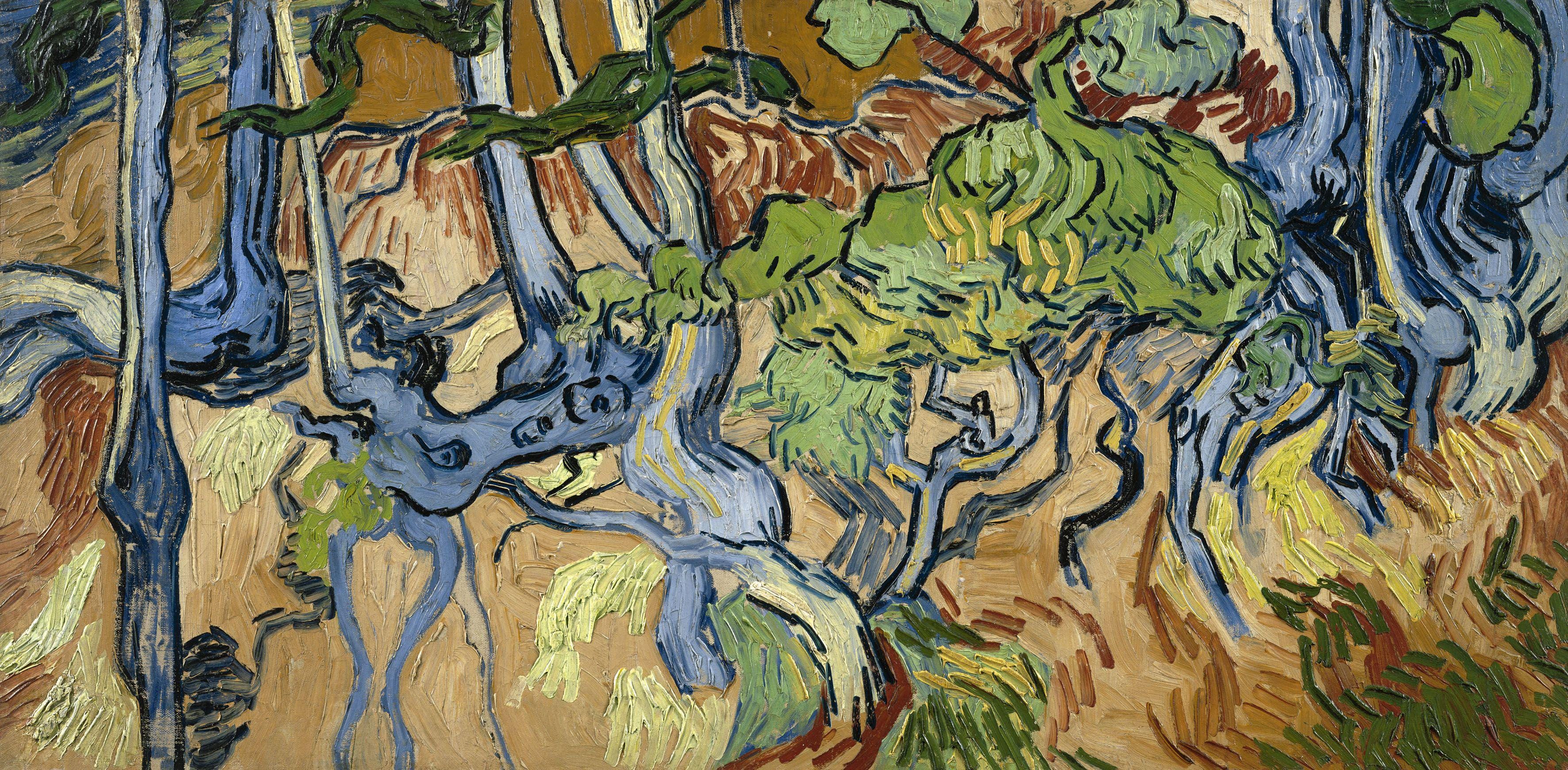
This is (most likely) the last painting Van Gogh made before he shot himself.
You know, during his time in the asylumn in Arles, Vincent painted a new picture a day, every day, for nearly eighty straight days. Most of them simple, small, one could even say quaint images of ordinary things like flowerpots. There are three of them in the National Gallery, a few kilometres down the road from me.
It is like he was painting this way as part of his struggle against depression. He was trying to hold on to something to look forward to: the completion of each work, and its effect on others who saw it. He was painting to give himself a reason to carry on. Painting, as it were, to save his life.
And it occurred to me today: what if all of us are engaged in a similar struggle?
Here’s a working hypothesis for you: whatever creative or expressive activity we’re doing, be it painting, music, dance, cooking, running a business, raising children, or even writing crappy poetry that makes your friends laugh: it’s all an attempt to invest one’s life with meaning.
And it’s a negotiation or a dialogue with others to whom we bid for their recognition of our efforts.
And if the bid succeeds, if we gain the recognition we seek, it’s a pushing-back of the walls of darkness, a kind of resistance against The Nothing.
2.
Terror Management Theory is a theory of social and evolutionary psychology which holds that all of culture is an effort to distract ourselves from the inevitability and immensity of death.
Escapist pop culture is the easy example. It’s also found in religious beliefs, such as the belief that the soul can move on to the afterlife.
I’m wondering if our artistic and creative works are also a kind of engagement or response to death. Maybe they’re an effort to produce something of meaning or goodness or worth, which others might enjoy together with you, and the enjoyment might give death itself pause for a while.
Yeah, that’s why I don’t get invited to parties anymore. Ha!
But if I’m right: we decorate our houses and invite friends over to parties for the same reason. We post selfies to Instagram and argue with people on Reddit for the same reason.
We’re bidding for the attention of others: the attention that both of us can use as the material for the crafting of a moment of meaning strong enough to hold back the Nothing.
We’re calling out to the world: “I am here! Is anyone else out there?”
3.
“But, hold up there Brendan, why should it matter if no one sees your art? It’s enough that you made it. It’s enough that you created something of meaning to you.”
We live in an individualist culture, and the messages of individualism come at us from every direction. That’s an example of one of them that comes up every time and without exception before I finish describing the idea I’m laying out before you now.
But if we learned anything from the pandemic, it’s that we are social beings. We need each other. We go mad without each other.
No one paints a painting only to bury it underground when it’s done. No one composes a song without wondering who will dance to it. No one builds a house or a library or a temple only to tear it down the next day.
Buddhist sand mandalas are an interesting counter-example: but even they are meant to be seen before they are swept away. Even the procedure of destroying them is a ritual, a shared activity.
So here’s another proposition for you. It is not the crafting of creative works alone which pushes back the Nothing. The crafting of creative work is a bid for the recognition of others, the recognition we cannot do without.
But it’s not the creative work itself which pushes back the Nothing. It’s the recognition from others, the shared moment of life-affirmation facilitated or enabled by the art, which turns the Nothing away for a while.
As an example: Consider how the denial of recognition from others in the field of identity-formation is now widely treated as a form of oppression.
Suppose a person announces themselves to be trans, or non-binary, or autistic. If their friends, families, or employers refuse to acknowledge that announcement, or treat them as if they are nothing of the sort, they will feel pain. They will demand that recognition with incrementally-increasing degrees of political activism.
But if their friends, families, and others, acknowledge the new announcement and roll with it, a shared moment of life-affirmation ensues.
And in that moment, The Nothing is forgotten. Or if not forgotten, then at least temporarily banished.
Is it so different with art, as with identity? Is it so different with anything we do whose meaning fully flowers only in shared affirmation?
Well, if no one wants to see a painting I made, I cannot reasonably invoke the law to force them to see it. Yes, in that sense, they’re different.
But they are perhaps not so different in the sense that the rejection of a bid for shared affirmation can be a source of suffering.
“You should not need anyone else to make you happy,” says the trope of modern individualism. “You should be able to find your own happiness within you.”
But imagine a life with no significant relation to others. Imagine being that invisible to them, and them to you.
Or, imagine being the last human being alive on earth, and everyone else gone.
It would be hell.
4.
Van Gogh’s efforts ended in failure. I got to thinking today, that perhaps he lost his struggle against the darkness because too many of his bids for shared life-affirmation went unheeded. He painted hundreds of cries for help. And no one of his friends, or perhaps too few of them, understood what he was saying.
So, if there’s any point to this short reflection, it’s to encourage you to seek out your people and to do something creative for them. And to encourage you to find the good in the creative things they do, too.
We will get through this thing called life together, or not at all.
5.
The above notes were written a few years ago, and intended to be the beginning of a new book on the philosophy of being and meaning. If you’re a long-time follower of my work, you might recognise ideas here which I had already offered the world in my book Loneliness And Revelation, and in my TED talk at the University of Guelph. If there’s enough interest, I might return to that project. But that very sentence is— wait for it!— a bid for recognition…
No posts
Comments
Nothing yet. Say the first thing.
Sign in to join the conversation.