
ℹ️ Attention, truth-hunters and reality hackers: I’m about to light a fuse. After years inside the data—afterlife mapping, reincarnation mechanics, consciousness taxonomy, “soul trap” critical analysis—Book 2 is entering the activation phase. This is not “spirituality lite,” it’s a whole other—disruptive—level of insight. Soon I’m opening the gates so YOU can make history with me (big call, I know). My Substack peeps get first warning, first access, and first shot at shaping the launch. Stay tuned. The signal is coming. ⚡️
Welcome to Awakening Minds—a reader-supported publication for open and discerning minds devoted to consciousness expansion, reality creation, and self-mastery.
Experience a “revolutionary healing science expanding the boundaries of being.” (NEXUS magazine) > Discover the unique and life-changing EVOLVE YOURSELF biofield activations.
Read my first book, THE GRAND ILLUSION: A SYNTHESIS OF SCIENCE & SPIRITUALITY - Book 1 📘 10,000 hours of life-changing research—distilled
Grab a paid Substack subscription to get FULL Substack access (includes all audio 🎧 versions + comments on all pieces)
Thanks in advance for supporting.
Heaven and Hell: It’s All at Your One Stop Astral Shop
The will is that which has all power; it makes heaven and it makes hell; for there is no hell but where the will of the creature is turned from God, nor any heaven but where the will of the creature worketh with God.
- William Law, The Spirit of Prayer
British afterlife researcher Dr Robert Crookall (1890 - 1981) found through his detailed study of out-of-body experiences that while most people experience earthly scenes in their OBEs, about 3% experience hellish realms. These were similar to what Christian apologist Dr Maurice Rawlings (University of Tennessee) had been documenting in books such as To Hell and Back (1993) with obvious Bible-thumping zeal.
By 1993 NDE researcher Nancy Evans Bush had collected around 50 cases of “negative” NDEs, a small portion of her total cases. She categorised them into three groups:
1) people who thought they were “losing control”,
2) those caught in the frightening void of a “great cosmic nothingness,” and,
3) those who saw a vision of “hell” where people were being tortured or tormented.1
Based on her own huge database, P. M. H. Atwater (2007) stated that the relatively rare hellish NDEs are encountered most often by “ordinary people” rather than fundamentalists or “bad” people, but only 3% of child NDErs, and 15% of adults encounter the unpleasant or hell-like scenario—largely people who, in her estimation, appear to have “deeply suppressed or repressed guilt, fear, and anger, and/or those who expect some kind of punishment or discomfort after death.”
Additionally, of this roughly 18%, “only a third of them were truly hellish.2” Overall, 79% of Atwater’s database were affected by these unpleasant experiences in a “significantly profound way” (positively).3
Six people in the 1976 Noyes-Kletti NDE study experienced “heaven,” while two “found themselves lost in ‘hell.’” One woman who escaped drowning at fourteen experienced a life review seemingly projected on a screen which caused her to feel intense remorse for the things she had done. She felt “God would judge me doomed and unfit for heaven.” Such was her “hell.” The other woman who experienced her own personal “hell” found herself in extreme brightness with a single large eye (with lashes and a brow) scanning her. She recognised it as her own eye (self-scrutiny) and wondered what she had done to be sent to “hell,” to which a thought responded, “no big thing just a lot of small ones.4”
Clearly these “hells” were very personal (as opposed to archetypal and transpersonal), and the “eye” the latter woman saw represented her own conscience regarding how she had lived her life—a common theme in the literature. It bears pointing out that neither of these “hellish” experiences were derived from deep NDEs, but appeared to merely constitute the early, shallower stages of the dying process which tend to show cultural conditioning as one enters into the imaginal. It is now well known that the classic or “core” NDE is what tends to produce the most profound psychological shifts and spiritual rebirth (renovatio).
NDE researcher Todd Murphy (2001) proposed one reason for unpleasant/hellish NDEs as being resistance to the death process (whether through underlying guilt or fear5).
Fundamentalists seek to shoehorn all so-called “hellish” experiences into their simplistic Christian eschatology, but the lack of perspective and tenure required in such an effort is truly breathtaking. Overall, the evidence simply is not remotely on the side of the fundamentalist outlook. Virtually all fundamentalists appear to be misologists: people who hate reasoning or reasoned argumentation (we might also note a certain fear of new ideas [misoneism] at play).
It is easier to retreat into an emotionally-shielded conceptual construct for many people than it is to face empirical reality however it presents itself.
Dr Thomas Fleischmann—who, as of 2014, had been present for the deaths of over 2,000 people—refers to the “third phase” of the near-death experience as one in which people, having left the immediate surrounds of their non-functioning physical body, suddenly find themselves in a dark, confined—and yet peaceful—space. Ninety-eight to ninety-nine percent report it variously as comfortable, pleasant, warm, and soothing. Only one to two percent describe it as frightening, reporting terrible noises, smells, and creatures. According to Fleischmann, visual descriptions of this phase of the experience strongly resemble the medieval paintings by Hieronymus Bosch (1450 - 1516), which suggests that Bosch himself may have had some visionary experiences of his own (or drawn on those of others).
Accordingly, Aldous Huxley (1894 - 1963) wrote in Heaven and Hell that
many of the punishments described in the various accounts of hell are punishments of pressure and constriction. Dante’s sinners are buried in mud, shut up in the trunks of trees, frozen solid in blocks of ice, crushed beneath stones.
All of which sounds rather medieval indeed. (Dante also lived in the medieval period, specifically from 1265 to 1321.)
Fleischmann adds that, of the one to two percent who experience fear, a proportion of them report the NDE later develops into a pleasant event. That would not be possible if Christians were right about “hell,” as it is supposedly a permanent destination for the “damned,” and certainly not a pleasant one. Interestingly, Fleischmann states that, in his experience, religious views are not predictive of these types of experiences6.
Specifically, being a Catholic or Christian was/is no safeguard against the “hellish” experiences. This would baffle fundamentalists who are simply committed to belief in their saviour and take no account of what kind of person they are, nor of the ontological status of their expected afterlife—but it makes perfect sense within our model here.
The NDE of French ballet dancer and choreographer Janine Charrat in 1961 would likely also baffle fundamentalists: she reported an initially hellish NDE in a realm of flames, which she successfully used her intention (prayer) to reduce to a soothing gentle translucence after she became lucid. In her case the fiery content of the NDE may have been a direct result of the fact that, while filming for a television show, her tutu caught fire, rapidly engulfing her and causing massive burns which precipitated her NDE—Charrat was already being tortured hellishly with fire as she lost consciousness.
(As for her interpretive lens, she was almost certainly raised Catholic, or at least within a Christian belief structure, and her comments about the flames in her NDE being “the devil’s work” and herself being “a believer” affirm such a view.)
After the fire calmed, Charrat encountered her deceased grandmother who guided her to a beautiful peaceful garden with a pond, before Charrat returned from cardiac arrest.7 Charrat’s experience is one of the relatively few that starts fearfully then, through use of prayer or intention, becomes pleasant.
Fleischmann states in the fourth phase of the NDE (which he says only 10% of people reach), a light begins to emerge and the experiencer then finds themselves in beautiful surroundings, enveloped in a feeling of unconditional love. (Note: in the NDE context, entrance into higher states of consciousness is almost always heralded by the appearance of a bright light.) From that point of the NDE his outline more or less matches what we have fleshed out in detail here and covered already.
The fact that the scary/less pleasant section of the NDE is generally shorter and happens at the start perfectly fits the general esoteric picture: more dense “astral bodies” (more troubled or wayward psyches) require a brief “descent” into “hell” to purge the heaviest and coarsest matter (psychic content), before the person can raise their awareness to the next “realm”—usually one of the “lower” astral heavens, which is still experienced as utterly sublime and otherworldly).8 Here they will likely have the opportunity to reconnect with friends and family who have already passed over (and no, there is no good reason to leap to the conclusion that these familiar faces are really devilish “Archons” in disguise, as some people naively assume.)
The Christian mystic and seer Swedenborg (1688 - 1772) confirmed this pattern with his own visionary insights into the non-physical dreamscapes:
all the people who arrive from the physical world are put in connection either with a particular community in heaven or with a particular community in hell…9 [What The Monroe Institute calls the Belief System Territories.]
He elaborated by saying:
After death, people are their desire or impulses [kama].
People stay the way they are insofar as their impulses or strongest desire is concerned.
People who have a heavenly and spiritual desire enter heaven; while people who have a physical and worldly desire without a heavenly and spiritual desire enter hell.
Desire in act is what lasts; hence this is the person’s life. After death, a person is his desire or intention (impulses).10
Thus, even Swedenborg with his Christian bias recognised that “hell” is a self-made condition.
It is reported people who have hellish experiences tend to be less alert, suggesting a drowsy dream-like state, with limited awareness of their surrounding environment. This likely makes such people more vulnerable to the shared nightmares in the collective human unconscious/imaginal.11
The fact that blackness or darkness is often experienced right at the beginning may speak to the adjustment the mind has to make in perceiving its environment/information initially through the vehicle of the etheric-astral composite body, as opposed to the physical eye-brain system (blackness can also be the initial experience of someone who expects non-existence after death).12
I doubt I have encountered even a single NDE that began as pleasant and then devolved into something hellish, which again fits the rational “esoteric” picture perfectly. The NDE and transition into death proper has a general directionality and teleology (or algorithm, as Todd Murphy suggests)—it is not random or arbitrary. There are energetic changes occurring naturally in the psyche/“dark plasma bodies” which dictate the flow of experience.
Swedenborg had written of a realm of “tortured souls” in Heaven and Hell (1758) based on his own direct visionary experiences. This work was, according to Whitley Strieber, the first modern text claimed to be derived from contact with the dead and voyages into their realm. Before the Swedish prophet, Dante too had written of a realm of tortured souls in his early fourteenth century work Divine Comedy, so this is anything but new.
Dante’s account represents more or less the medieval worldview of Christianity at the time and probably is a hybrid of his own genuine mystical experiences in the imaginal realm—created through his Christian lens—and creative interpolations ex post facto designed to support (or at least not contradict) the ideology of salvationism and render an allegorical account of the soul’s heroic journey towards “God” (Source/Home).
These types of visionary-fiction accounts should never simply be taken at face value as true representations of post-mortem life, though they may contain some kernels of truth. For instance, Dante’s eventual contact with the “divine” reads much like many modern NDE accounts, and features implied nonlocality, entanglement, and holographic aspects (as well as the idea that someone who reaches this sublime realm never wants to leave):
In its depths I saw in-gathered, and bound by Love into one volume, all things that are scattered through the universe…as if joined in such a manner that what I speak of is One simplicity of Light…Man becomes such in that Light, that to turn away to any other sight is beyond the bounds of possibility.13
At any rate, as Nancy Bush found out, there have been plenty of NDEs that have featured viewings of tormented, despairing souls, or direct “hell-ish” experiences. They are anything but uniform and certainly do not all adhere to the stock Christian concept of hell. What fundamentalists lack is the only thing that matters here: perspective.
Dr Edith Fiore, having performed between 20,000 and 30,000 past-life regressions never encountered a single case where a soul found itself in a situation approximating the popular concept of hell.14
Michael Newton, Brian Weiss, and Joel Whitton are among many skilled therapists who have also failed to find any credible evidence to support the Catholic/Christian version of hell and loving-God-inflicted eternal damnation. Regression therapist Elizabeth Sweetman stated to me:
I’ve done hundreds of regressions and had countless regressions myself and I have never had anyone encounter a demon or anything like hell. Not once…and I know quite a few therapists and they’ve not encountered it either.15
As noted earlier, the seven “planes” identified and explored by occultism theoretically contain seven primary sub-divisions within each of them (and so on into infinity). The lower sub-divisions (7th and 6th) feature the least desirable emotions, ambiance and inhabitants, while the higher sub-divisions become increasingly more pleasant, enjoyable and transcendent; more “heavenly” in other words.
Operating within this framework, we could say the majority of recorded NDE have probably occurred on the mid- and higher sub-planes of the astral and mental dreamscapes—and of course the nearby “real-time zone,” where the action often begins with an OBE and a focus on perception of “physical reality” before the NDE develops eschatological elements and attention turns more towards the non-physical realms. Many hundreds of experiences include accounts of passing over lush meadows, beautiful mountains, rivers and other natural landforms prior to arriving in a pleasant and peaceful world indicating that they probably belong to mid- to higher sub-planes of the “astral” or “mental” dreamscapes.
Stays in these realms are most definitely temporary, like their less common hellish counterparts.
A Mind-Based Afterlife
In speaking of the afterlife, Arthur Conan Doyle wrote, “the world in which [the deceased] find themselves is very much like that which they have quitted, but everything keyed to a higher octave.16”
Gurdjieff had also asserted that the universe is based on a principle of octaves, much as “Ra” (Law of One) and Seth had done when speaking through their human channels. (We noted the ubiquity of the octave theme in Book 1.)
Doyle added that in the “hereafter,” “children grow up, but there is no ageing apart from this, and there is ‘close union between the sexes’ but no physical side to love.” Jim Pike explained that sex is different in that you enter the whole person,17 since we are dealing not with solid bodies but an interaction between minds/subtle vehicles (info-energy fields). This melding of two (or more) people in complete union was something that Monroe has also written about in his expositions on his out-of-body activites, as has his colleague and fellow OBEr Bruce Moen.
The less pleasant, or even hellish experiences had by NDErs constitute a very small minority of NDEs. People are drawn into such an episode because of their own emotional and psychological makeup at the time of death. Psychology is the key here, not blind faith. Since the afterlife is mind-dependent, we find ourselves in a “place” (state of consciousness) that corresponds with our deepest emotions, desires, intentions, and beliefs. Thus, since most people are not particularly “evil,” malicious, or hate-filled, they experience death in a relatively positive way, a manner reflective of their beingness at the time.
The truly diabolical person may well be found in a very personalised state of self-created torment (or a dreamscape community of other malicious souls).
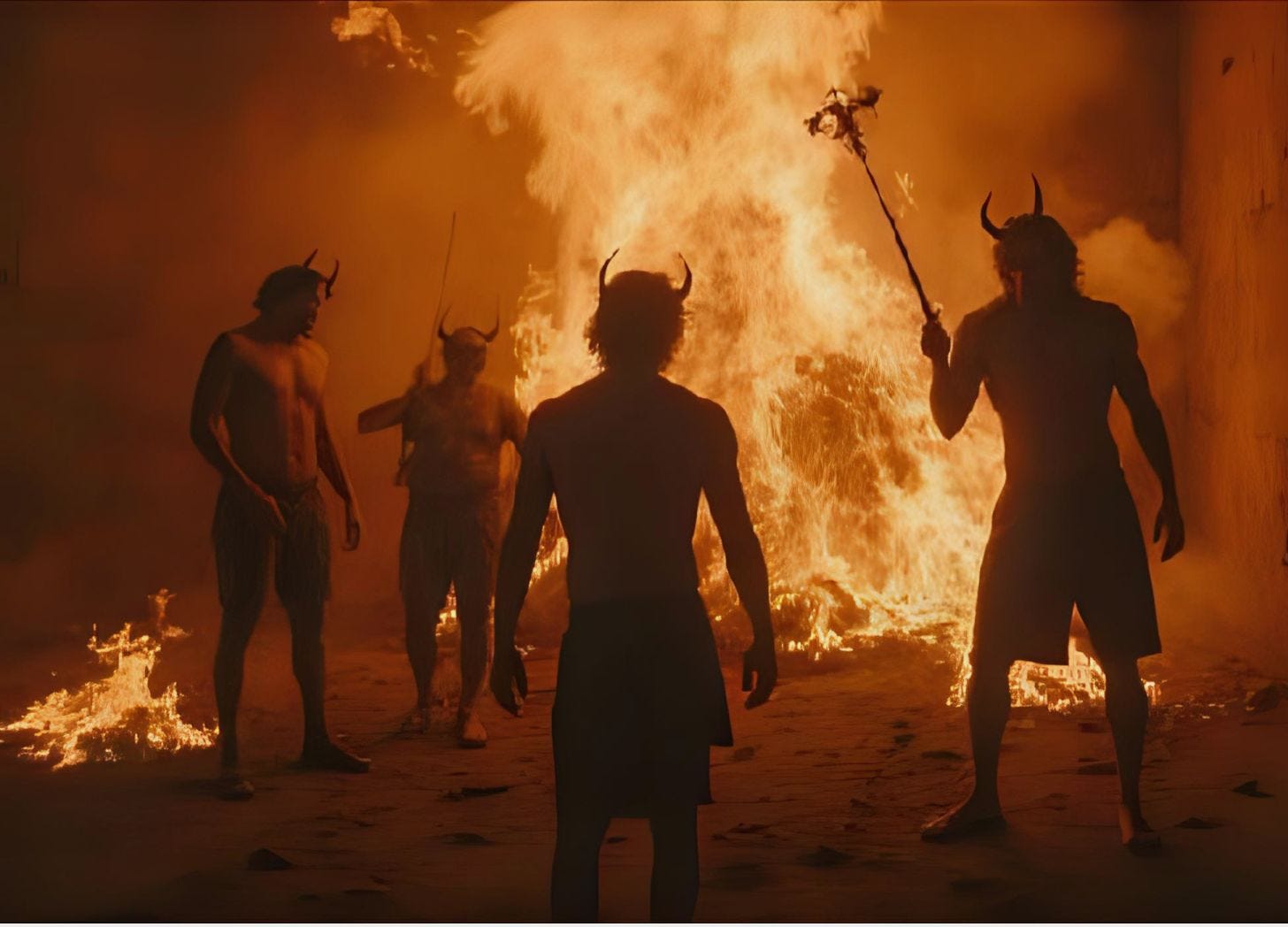
One deceased man encountered by Jurgen Ziewe in the afterlife dreamscape inhabited what Ziewe experienced as a Hollywood version of Dante’s Inferno, a place of menacing desolation full of dark billowing smoke rising toward a threatening stormy sky, the ground full of strewn rocks and dark cracks. The man in question was found at the centre of one of many piles of burning human bodies writhing in agony. The “people” reaching and clamouring toward the man at the centre were actually thought-form renderings of his victims and their pain. The heavy curtain of smoke around the pile was a representation of his profound regret at the realisation that what he did to his victims could never be undone.18
He was trapped in a custom thought-form prison of guilt and remorse.
Ziewe encountered a Helper soul in the realm who could do little other than despair at the entrenched and hypnotic hopelessness of the inhabitants of this truly hellish place. Likewise for Ziewe: it was above his pay grade to do anything more than look on. (Ziewe’s testimony echoes that of many other OBE and channelled sources, as he states there are many discarnate “social workers” trying to help the confused and troubled deceased.21 The channelled discarnate Philip Gilbert refers to it as “welfare work.”)22
[SIDE BAR: Emily French and Edward Randall in their “spirit rescue” work encountered a deceased successful businessman who was fixated on money. He reported himself to be in a very cold and dark environ, surrounded by a “wall of money, nothing but money, it shuts out the light.”19 His personal hell was constructed out of thought-images of that which obsessed him during earth life—he could not pass over, through, or around the wall to escape. French and Randall also produced other channelled testimony in total alignment with Ziewe’s firsthand imaginal experience, which included the observation that some of the confused deceased souls in hellish realms who didn’t realise they were dead were heard to be shrieking in fear of their victims, failing to realise their victims were not really there, only unconsciously-conjured thought-form visions of them.]20
The late D. Scott Rogo made the salient speculation that some hellish experiences may be artefacts—hallucinations created by the mind in reaction to the sometimes brutal physical ordeal of being resuscitated with standard medical techniques,23 not unlike the way physical stimuli in the outer world can be incorporated into our dreams in strange and symbolical ways (a widely recognised phenomenon). This should not be overlooked when deciphering the possible meaning of certain aspects of some NDEs.
For Atwater, NDEr testimony demonstrates “that self-acceptance or self-rejection is what creates our energetic ‘signal,’”24 and thus determines the nature of our immediate post-mortem experience.
In light of the information here, consider the way that salvationist religion trains the faithful to think of themselves as unworthy, innately loathsome sinners who require “saving” or redeeming by a being more pure than they. It is also known that suicide-related NDEs are frequently unpleasant or hellish, unsurprisingly, given that the state of the psyche of someone attempting suicide is typically “hellish.” It is interesting that Greyson found that the seriousness of a suicide attempt did not correlate with the resulting NDE’s intensity—those least endangered by the attempt were the most likely to see a bright light, enter a void, or have other characteristic experiences.25
Theosophical compiler Arthur E. Powell noted in The Astral Body:
The many kinds of “heavens,” “hells” and purgatorial existences…all fall naturally into place and become intelligible as soon as we understand the nature of the astral body and of the astral world.26
The astral imaginal dreamscape is a world of thought-forms, comprised of the contents of both the collective and personal consciousnesses. (Whereas regular dreams are contained in and constructed by the personal consciousness and its experiences, beliefs and perceptions. As Nick Sambrook points out, dreams are varied and unstructured whereas NDEs have a common collectively structured pattern.)27
Thus, the less pleasant, somewhat traumatic descriptions of the afterlife we find from older sources on the subject, featuring the wailing wraiths of Hades and sorrowful shadows of Sheol (Sheol was later unfortunately translated into “hell” in the Christian Bible). 👇
These are probably reflections of the state of consciousness in the etheric world, the “no-man’s land” between earth and “heaven,” according to “Scott,” one of Jane Sherwood’s channelled entities.28
There are plenty of NDEs (and some OBEs) on record that feature descriptions of lost and tormented souls, sorrowful or desperate wailing, and hands emerging from pits, grey mist, or the ground and attempting to grab the experiencer and pull them in.29 Again, most of these are explainable through the state of mind—and the belief system and sense of identity—the experiencer has at the time. Pioneering afterlife communicator George Meek affirmed “hell” is “more like the traditional purgatory…referred to by the Catholic church. It is a dark, dismal, uninviting place filled with countless numbers of souls who are lost and wandering about in great distress.”30
Crookall would refer to these as “Hades conditions.”
Todd Murphy’s research into Thai NDEs led him to write:
It is worth noting that although five of my ten cases included seeing hell and being forced to witness the same horrific tortures that appeared in the Phra Malaya, none included the NDErs having been subjected to any of these torments themselves. The same can be said about hell in medieval European NDEs. (Zaleski, 1987).31
The fact that Dr Carol Zaleski made the same observation about medieval NDEs only makes it more profound. It is extremely rare to find the NDEr reporting being tormented directly in such a context. These could be seen as relatively “shallow” visionary experiences preconditioned by religious exposure—they do not appertain to deep “levels” of the afterlife. In line with this, Murphy believes that for the Thai people, “the idea of karma is used as a medium to explicate the ‘karmic effects’ individuals unconsciously expect from their behavior during their lives.”
As he points out, “The most popular expression of the laws of karma in Southeast Asia is the formula: ‘Do good; receive good. Do bad; receive bad.’” Unsurprisingly, Thai NDEs—whether they feature tours of hell or discussion of future life possibilities (perhaps as a lower life form)—tend to adhere to this formula.32
People tend to experience what they expect, at least to a point; on the flip side, simply being in a particular culture is not enough on its own to completely dictate NDE content—it’s a personal experience partly informed by belief and expectation. Atwater has found that NDEs with visions of the classical Western hell are much more likely to occur in the Southeastern part of the United States, the so-called “Bible Belt,” where Biblical literalism tends to prevail.33
Margot Grey believed a typology for the nightmarish NDE existed which was similar to Moody’s positive NDE pattern, to which she designated five stages. Grey was not inclined to accept a literal version of hell as a way to explain her findings, but felt a “more generalised archetypal interpretation”34 was a possibility for hellish experiences. She almost had the right idea but needed to extend this psychologically oriented epistemology to all NDEs, not just the unpleasant ones. Rogo (1989) stringently critiqued Grey’s reasoning and considered that perhaps Swedenborg was right in that there is no one plane of the afterlife, but multiple, each different from the next—just as a video game might contain many different levels, types of scenery, and characters.
Three decades later I suggest both researchers were partly right, because all of these experiences can only occur in consciousness, and the way the mind creates and de-codes information (makes meaning) in the Source Field is frequently in such a way as to create the appearance of many different “planes” or realms of reality—all different layers and aspects of psyche/the imaginal realm.
In more recent years, a young American boy called William began speaking of being his mother’s father reincarnated (making him his own grandson). At the tender age of three he explained a little of the afterlife adventure to his mother: “When you die, you don’t go right to heaven. You go to different levels—here, then here, then here,” moving his hand higher each time. William had been born five years after his grandfather John was shot and killed by thieves during a robbery, and he showed many indications of being John’s reincarnation.35
His description of the “layered” afterlife journey fits the model in this book well.
*This article is excerpted from Book 2 of THE GRAND ILLUSION
About Brendan & His Other Offers
Brendan D. Murphy is the “consciousness guy”, afterlife expert, and author of the critically acclaimed epic, “The Grand Illusion: A Synthesis of Science and Spirituality — Book 1”
📕 BOOK 2 IS COMING! Get on the wait list for the astonishing Book 2 of “The Grand Illusion”
UPGRADE YOURSELF with a “revolutionary healing science expanding the boundaries of being.” Watch the free How to Evolve Yourself (WITHOUT Hard Work or Meditation) Masterclass to learn how this transformative evolutionary biofield activation and healing work with sound can change your world. Watch the webclass to register and save your seat for the next live ceremony
1 Rawlings, To Hell and Back, 88.
2 Atwater, The Big Book of Near-Death Experiences…, 24-29.
3 Atwater, The Big Book…, 221.
4 Noyes and Kletti, 1976.
5 Murphy, The Structure and Function of Near-Death Experiences: An Algorithmic Reincarnation Hypothesis, Journal of Near-Death Studies, 20(2), Winter 2001.
6 Thomas Fleischmann, From life to death, beyond and back, TEDxTUHHSalon,
7 See Jean Baptiste Delacour, Glimpses of the Beyond.
8 Thomas Fleischmann, From life to death, beyond and back, TEDxTUHHSalon,
9 Emmanuel Swedenborg’s near-death experiences, https://www.swedenborgstudy.com/articles/heaven-hell/ndes.htm
10 Ibid.
11 Alfred, Between the Moon and Earth, chapter 14.
12 Confirmed by regression therapist Elizabeth Sweetman through a personal communication, December 1, 2023. Also corroborated by discarnate Erik Medhus via medium Jamie Butler in My Life After Death, cited in Lawton, Afterlife, 253.
13 Paradiso Canto XXXIII:49-145 The Final Vision, https://www.poetryintranslation.com/PITBR/Italian/DantPar29to33.php
14 Fiore, The Unquiet Dead, 160.
15 Personal communication, December 1, 2023.
16 Wilson, The Occult, 658.
17 Ibid.
18 Ziewe, Vistas of Infinity, 113-114.
19 Cited in Lawton, Afterlife, 117.
20 Ibid., 119.
21 See Ziewe, Multidimensional Man.
22 Lawton, Afterlife, 178.
23 Rogo, The Return from Silence, 136.
24 Atwater, Is The Afterlife What We Think It Is? New Dawn, Special Issue No.7.
25 Rogo, op. cit., 164.
26 See Powell, The Astral Body, chapter 1.
27 Personal communication, November 2024.
28 See Sherwood, under the sub-heading of A DIFFICULT DEATH
29 Rogo documents a number of these in The Return from Silence, and apologist Rawlings gleefully made a point of drawing attention to such hellish experiences.
30 Meek, After We Die…, 101.
31 Todd Murphy, Near-Death Experiences in Thailand, Journal of Near-Death Studies, 19(3) Spring 2001
32 Ibid.
33 Cited by Murphy in Near-Death Experiences in Thailand...
34 Rogo, The Return…, 142.
35 Jim B. Tucker, Life Before Life, 1-3.
Comments
Nothing yet. Say the first thing.
Sign in to join the conversation.