
Be first in line to access the groundbreaking Book 2 of THE GRAND ILLUSION series
Experience the “revolutionary healing science expanding the boundaries of being.” (NEXUS mag) > EVOLVE YOURSELF biofield activations.
Read THE GRAND ILLUSION: A SYNTHESIS OF SCIENCE & SPIRITUALITY - Book 1 📘 10,000 hours of life-changing research—distilled
Grab a paid subscription for full access (includes starting Chat threads, access to all audio versions 🎧 + comments on all pieces). Paid members get direct access to me and priority conversation in Chat.
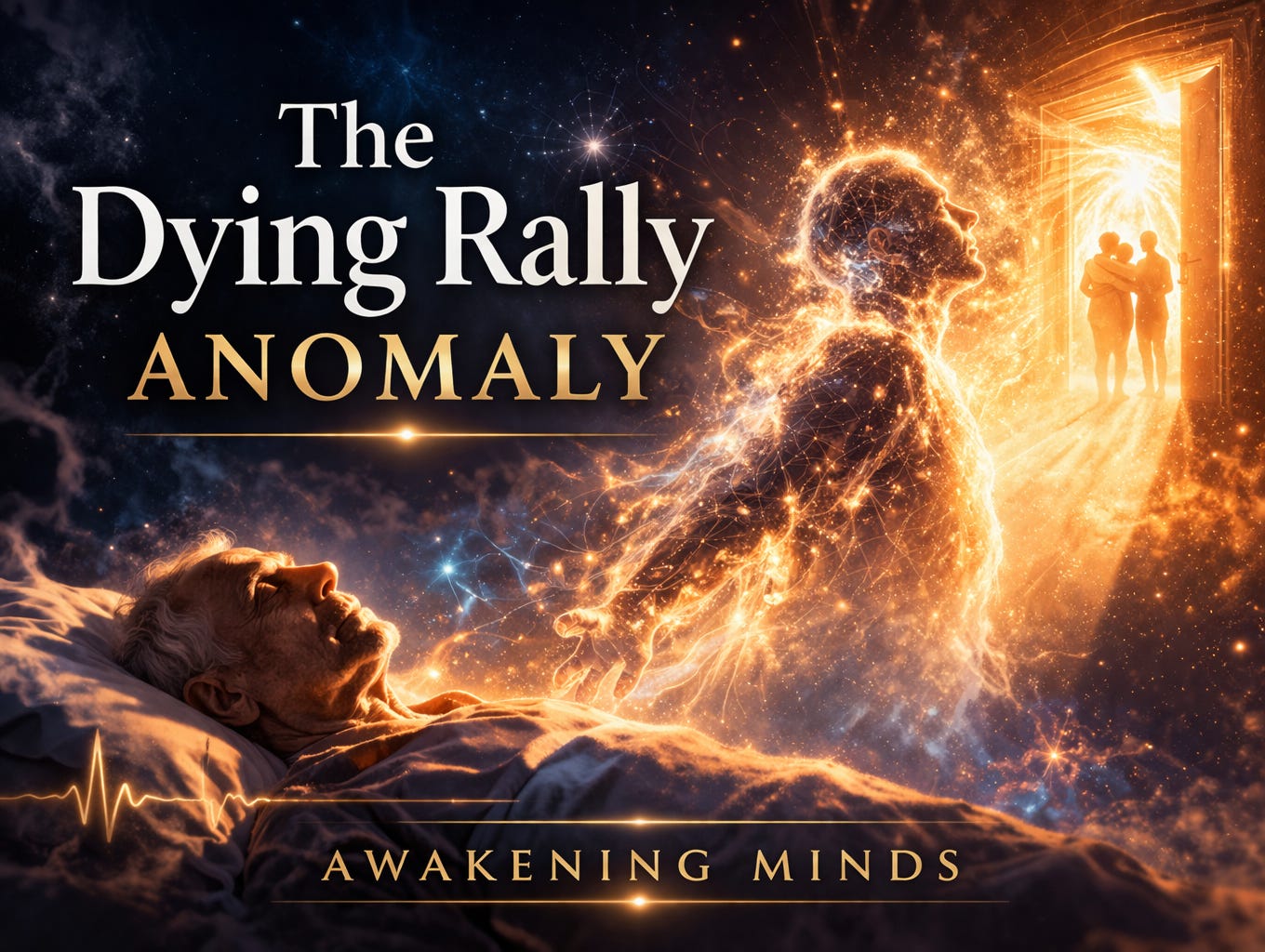
It shows up quietly in hospital rooms, hospice beds, and dimly lit living rooms where death is no longer theoretical. A person who has been gone—mentally gone—for days, weeks, sometimes many years…suddenly returns.
They sit up.
They speak clearly.
They recognise loved ones.
They say what needs to be said.
And then they die just as suddenly.
This phenomenon is known today as terminal lucidity.
And if you actually look at it—properly, not dismissively—it doesn’t merely challenge our models of mind, it completely breaks them.
Among the various items NDE research pioneer Dr Raymond Moody counts as proof of survival of consciousness is the curious phenomenon of “terminal lucidity” (TL)—and there are some impressive case studies. The term was coined by biologist Michael Nahm (2009) who first defined TL as a sudden return of mental clarity and vitality taking place shortly before death.
TL is far from a new phenomenon, though—it has been with us a long time, as Nahm points out: “Hippocrates, Plutarch, Cicero, Galen, Avicenna, and other scholars of classical times noted that symptoms of mental disorders decrease as death approaches.”
As recently as 2009 TL was also referred to as “lightening up before death,” while in Eastern Europe it was recorded as “madness”; in Italy it was sometimes written off—predictably—as “possession by demons.” In the early days of Moody’s medical career it was known as a “fey” experience, likely after Scottish custom. The TL label is currently evolving into “paradoxical lucidity,” which—if nothing else—admits the obvious: something is happening here that shouldn’t be (according to established “wisdom”).
There are drastic instances where people who are effectively brain-dead suddenly make a profound (but temporary) recovery and speak lucidly, despite EEGs showing an electrically non-functional brain. In conventional medical terms, this is inexplicable. In structural terms, it’s a direct contradiction.
If the brain produces consciousness, this cannot occur. And yet—it does.
Modern neuroscience operates on a premise so deeply embedded it’s rarely stated outright:
Consciousness is generated by the brain.
From that single (unproved) assumption, everything else follows:
Damage the brain → damage consciousness
Degrade the system → degrade the mind
Destroy the brain → eliminate the self
Linear decline, clean causality, no ambiguity. But in truth reality doesn’t behave that way. Terminal lucidity shows us something far stranger:
As the brain fails, consciousness can return—coherent, structured, and intact.
Not improved or partially recovered, but lucidly and intensely present.
One of the most striking cases documented by Nahm is that of Katharina Ehmer, a twenty-six-year-old German woman from the early 1900s. From birth, she suffered from severe mental disabilities.
She could not:
Speak
Move with coordination
Engage meaningfully with her environment
Her condition was not ambiguous. It was lifelong and neurologically entrenched. Repeated bouts of meningitis had left her cortical tissue in a severely compromised state.
In modern terms, there was no functional substrate for coherent cognition—let alone musical expression. And yet, on March 1, 1922, something medically baffling happened: She became lucid.
We’re not talking vaguely responsive or momentarily alert. We are talking about total and utter lucidity. Then, after a lifetime of mutism, she suddenly began to sing.
Not random babbles or fragmented sounds, but a hymn—“The Home of the Soul”—in full form, for approximately thirty minutes. (Ponder for a moment on that hymn’s title.)
Her face, according to attending doctors, appeared “transfigured and spiritualised.”
Then, shortly after, she died.
A woman who had never spoken suddenly pipes up and sings with perfect articulation non-stop for half an hour. A brain that had never supported coherent expression… suddenly does so flawlessly.
And then it shuts down permanently. There is no known neurological pathway that accounts for this. Not gradual recovery, spontaneous structural repair, nor a neurological compensatory mechanism.
Just a brief window in which something comes through—clearly, coherently, and purposefully. Before the (biological) candle flickers out for good.

Another case, reported by physician and philosopher Gotthilf Heinrich Schubert, involves a man who had been deaf and mute his entire life.
No speech. No auditory engagement. No linguistic expression. Not until the final hours of his life. In what was described as “the elation of his last hours,” he began to speak—comprehensively—for the first time.
In a separate account, Schubert describes an elderly man who had been debilitated and entirely speechless for twenty-eight years. That’s twenty-eight years of silence.
On the final day of his life, after a vivid dream announcing the end of his suffering, he regained:
Awareness
Speech
Coherent communication
Then died.
Let’s be clear about what we’re looking at. These are not cases of gradual healing, neurological rehabilitation, or misdiagnosis
These are cases where:
The required brain function is absent or destroyed
The individual is incapable of coherent expression
And yet—briefly and without warning—they are no longer incapable of coherent expression
Then moments later they die. If your model requires the brain to produce consciousness, this is where it fails structurally.
You can try to rescue the model, and people have—desperately (for centuries).
Doesn’t work. These cases involve global or lifelong impairment.
Chemistry doesn’t rebuild identity, memory, and structured language in the space of minutes.
Randomness doesn’t produce hymns, farewells, or coherent conversation—as if 10,000 monkeys with typewriters might inadvertently punch out a Shakespearean sonnet after producing years of incoherent gibberish (or silence).
At some point, the “explanations” stop explaining.
There is another way to interpret this—one that actually fits the data: Instead of treating the brain as a generator of consciousness, treat it as a filter; a limiting interface within a broader transpersonal field of consciousness which requires no biological substrate to exist.
In this model:
Consciousness exists independently
The brain constrains and channels it into physical expression
Damage to the brain disrupts expression—not existence
This flips the entire physicalist framework on its outdated head.
Now the question isn’t:
“How does the brain create mind?”
It becomes:
“How does the brain restrict something that is already there?”
If the brain is a filter, what happens as it breaks down? The standard assumption—or dogma—is: consciousness fades with it.
But terminal lucidity suggests the opposite.
As the filter weakens, the signal becomes less obstructed.
Not permanently and not fully, but enough to break through for a brief shining moment.
This is the key point most analyses miss. Terminal lucidity is not a recovery of brain function, but a reduction of interference. What is it doing the interfering? A dysfunctional brain. This is actually a transitional phase where:
The biological system is failing
The constraint on consciousness is loosening
The underlying mind becomes briefly accessible again
This is why the pattern is so consistent:
Sudden return of clarity
Meaningful communication
Emotional resolution or farewell
Rapid decline into death
It’s not random, but structured—so much so it’s almost procedural.
Now we push further—because the data demands it. If consciousness is not being restored by the brain then where is it operating from?
The most coherent answer is this:
The locus of consciousness is shifting away from the physical nervous system.
Not instantly or all at once, but gradually. Clairvoyants have provided vivid descriptions of how the subtle energy body changes and detaches as death sets in—and what they describe matches up with our hypothesis here.
In terminal lucidity, as death approaches:
Conscious processing becomes less dependent on the brain (neuronal-axonal system)
More of it is occurring in a non-physical domain (nonlocal mind)
The individual is, in effect, transitioning operating environments
Terminal lucidity is what happens when the person is still biologically alive but no longer fully constrained by the biological interface. Therefore you get a brief window where clarity returns—because the distortion is reduced.
Then the transition completes and the body shuts down. Meanwhile, the dearly departed are now entering into a degree of lucidity they have likely never before known.
There’s another detail people tend to ignore: These moments are not just lucid, they are deeply purposeful and meaningful.
People:
Recognize loved ones
Express love
Resolve unfinished emotional threads
Deliver final, coherent communication
Katharina Ehmer did. not merely produce noise—she coherently sang a hymn about the soul’s home (for 30 minutes).
The deaf-mute man doesn’t babble, he speaks comprehensively.
This isn’t what system failure looks like—instead it’s what completion looks like. This is a natural process. The fact that it does not happen to every single dying person should be no impediment to that realisation.
Terminal lucidity doesn’t stand alone as a fluke of nature.
It aligns with multiple fields of empirical research:
Near-death experiences
Deathbed visions
Shared-death experiences (SDEs)
All of which point to the same underlying structural truth:
Consciousness is not confined to the brain.
The dying rally is simply one of the cleanest examples—because it occurs under conditions where brain-based explanations “should” be strongest. And yet they fail completely.
If even a fraction of these cases are taken seriously, the conclusion is unavoidable:
The brain is not the origin of consciousness.
At best, it is an interface, and at worst, it is a constraint temporarily endured for a fleeting experience in the earth life system.
And death is not the destruction of consciousness—it is the removal of that constraint. With the constraint gone, we transition back into a more or less “nonlocal” paradigm and have the opportunity to recover our temporarily submerged memories (limited biological bandwidth means that forgetting most of who we are is part of the cost of admission to “Fun Park Humanity”).
We tend to imagine death as a dimming, a loss of signal. Extinction.
But the mystery of the Dying Rally Anomaly suggests something far more interesting:
The final phase of life may involve a brief increase in clarity, as consciousness disentangles from the biological system.
Not universally. Not predictably. Just consistently enough to really matter to anyone truly curious about why we are here and where we are going.
In The Grand Illusion—Book 2, I map “anomalous” phenomena of consciousness into a broader framework that integrates:
Nonlocal models of consciousness
Post-mortem operational states
The layered structure of subjective reality
Within that model, terminal lucidity is not an anomaly, but to be expected.
A transitional artifact of consciousness shifting out of the physical domain and into another mode of operation.
If consciousness were truly produced by the brain, these cases would not exist.
They wouldn’t simply be rare, they would be impossible—and yet they keep happening. So the real question isn’t whether terminal lucidity fits the model, it’s whether the model survives contact with it.
You can ignore the anomaly, or you can follow it to its logical conclusion. Because once you see what’s actually happening here, the implication is difficult to avoid:
Consciousness doesn’t fade at death.
It simply reorients or “relocates.” OBE pioneer Robert Monroe used the term Focus Levels, signalling that the mind’s experiential reality is determined by its focus or orientation (largely informed by belief and expectation). Focus renders “reality.”
In Book 2 I bring Robert Monroe’s Focus Level model into alignment with centuries of NDE, OBE, and clairvoyant data—and what emerges reshapes our understanding of post-mortem topology.
Brendan is architect of the Consciousness Transition Model (CTM), an emerging framework that integrates NDEs, OBEs, and decades of altered state observational data into a coherent map of post-mortem reality. Brendan researches consciousness and the origins of modern metaphysical narratives. His work synthesises contemporary data with classical esoteric frameworks, most notably in The Grand Illusion Book 2—a cutting-edge study into the afterlife system and rules of non-physical perception and state changes (coming soon!).
Grab your copy of the first volume “The Grand Illusion: A Synthesis of Science and Spirituality — Book 1”
It’s coming. Get on the wait list for the astonishing Book 2 of “The Grand Illusion”
UPGRADE YOUR LIFE—watch the free How to Evolve Yourself (WITHOUT Hard Work or Meditation) Masterclass to learn how this transformative evolutionary biofield activation and healing work with sound could change your world. Watch now to register and save your seat for the next live ceremony
Comments
Nothing yet. Say the first thing.
Sign in to join the conversation.