
It may seem to many that I’ve pretty much disappeared from the digital art world. It probably wasn't helped by my personal decision to delete my longstanding Twitter account1 last year together with refusing to just put-out content in the hope the algorithm will look on me more favourably.2
Instead, I’ve been quietly working without the never-ending distractions and demands of social media, developing systems and building new tools for my own art practice.
Right now I’m in what I would term a Systems Phase rather than a Public Art Phase. I’m building infrastructure, building and researching knowledge graphs, traversal systems, embeddings and new generative pipelines to better serve me in the future. I’m taking my time – I’m not in any hurry.
Much of this work manifests in outputs that I can’t talk about or even show to the wider public which results in the feeling I’ve dropped off the face of the Earth.
There has however been the occasional thing I’ve been able to publish. So as the end of the year approaches here’s evidence that I’m still around and making things…
New triptych as part of Subject to Change, now showing at Gazelli Art House in London
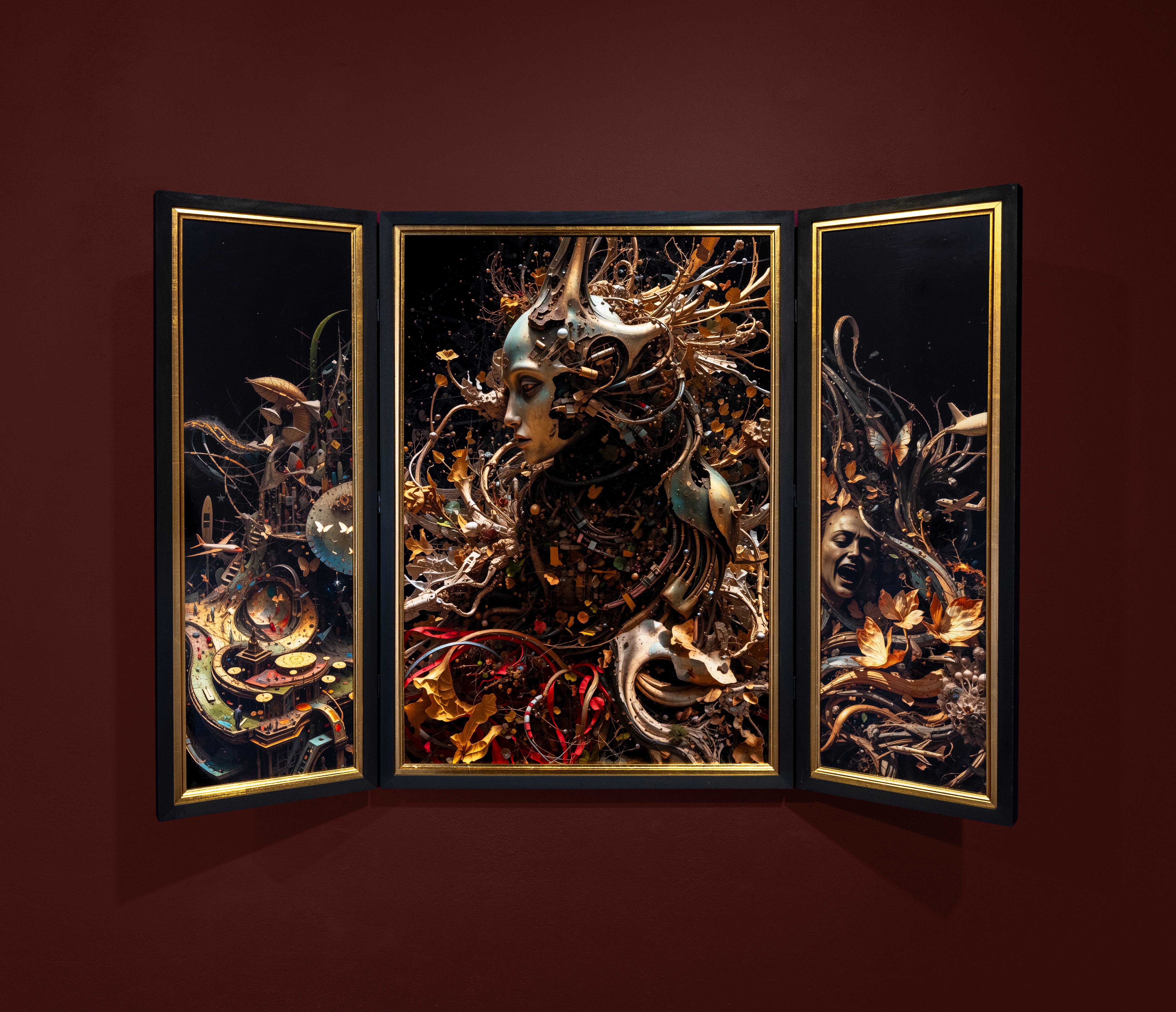
For the group show Subject to Change at Gazelli Art House I created a new, second triptych, following on from The Divinity which was auctioned at Christie’s in New York at the beginning of the year.
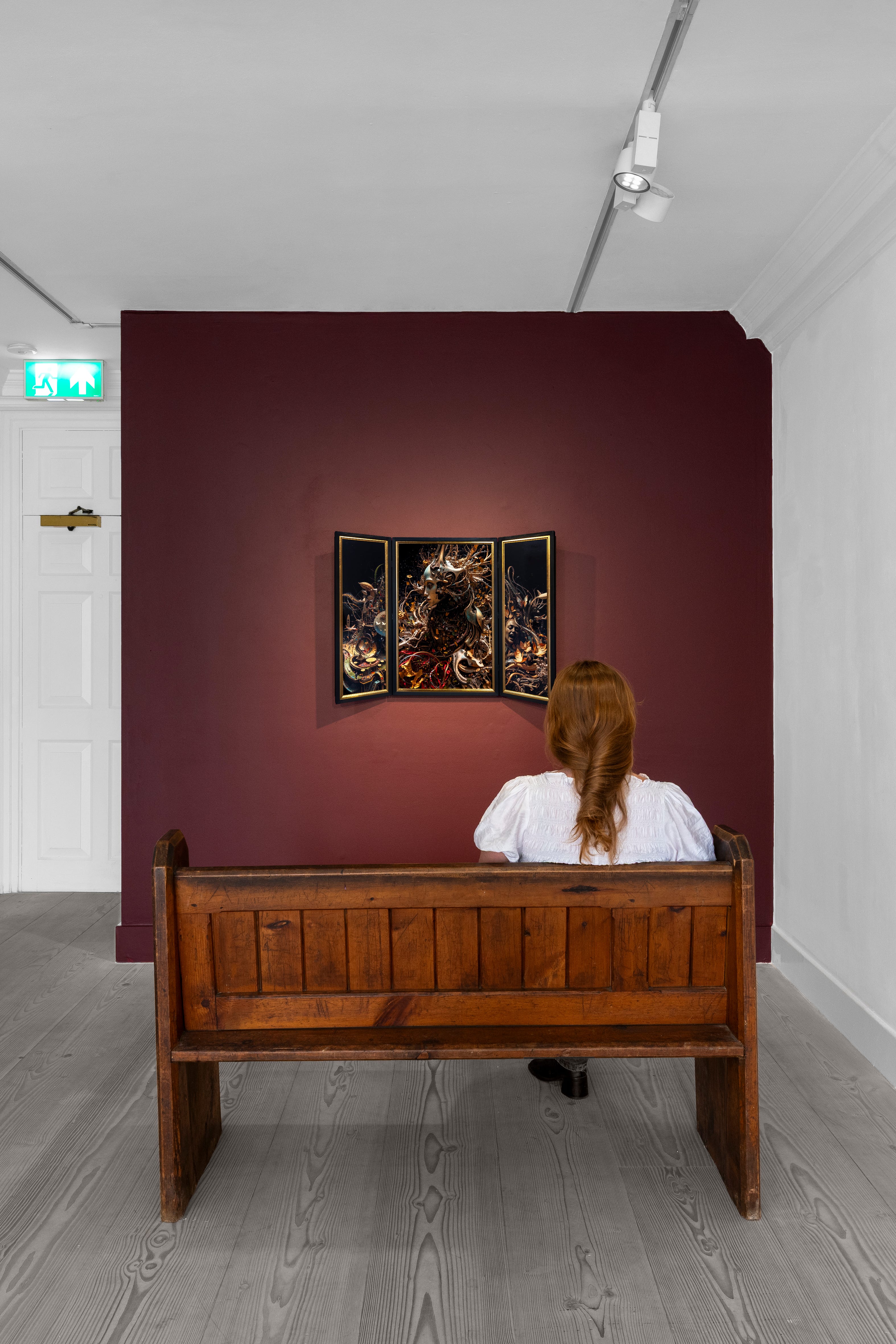
To accompany this second edition the gallery sourced a beautiful Church pew to encourage people to sit for a while in front of the work. I’m a big advocate of sitting on benches – religious or otherwise – as benches can encourage stillness and a chance to pause, a chance to breathe.
Here’s the official description about the work:
Brendan Dawes’ Altarpiece: Ascension (2025) continues the artist’s series of triptychs that fuse the iconography of church altarpieces with contemporary reflections on AI. Building on Altarpiece: The Divinity, shown in February as part of Christie’s first AI auction in New York, Ascension addresses the sweeping rise of AI and its influence across every aspect of human life. The left panel imagines a utopian future of progress and harmony; the centre reintroduces the goddess figure from The Divinity, now assimilated with the machinery of AI; while the right panel warns of the chaos that might follow unchecked technological proliferation, populated with fleeing CEOs and “tech bros” in private planes and spaceships. Created through meticulously collaged images using the ComfyUI interface, the work’s golden and bronze tones, dramatic lighting, and layered “scenes within scenes” offer both grandeur and unease. As with earlier works, the triptych’s three panels also reference the architecture of modern computing as proposed by John von Neumann: input, processing, output.
The exhibition is on till 19th December.
Subject to Change is a major group exhibition bringing together nine internationally recognised artists who work critically with algorithms, datasets, and machine learning – processes often bundled together under the term artificial intelligence (AI). While acknowledging the significant societal impact of fast-developing AI tools, this exhibition focuses on artists who critically engage with their biases, limitations, and possibilities, and in doing so actively shape this new landscape.
A new outing of this real-time work, running for five months as part of the Aesthetica Art Prize 2025
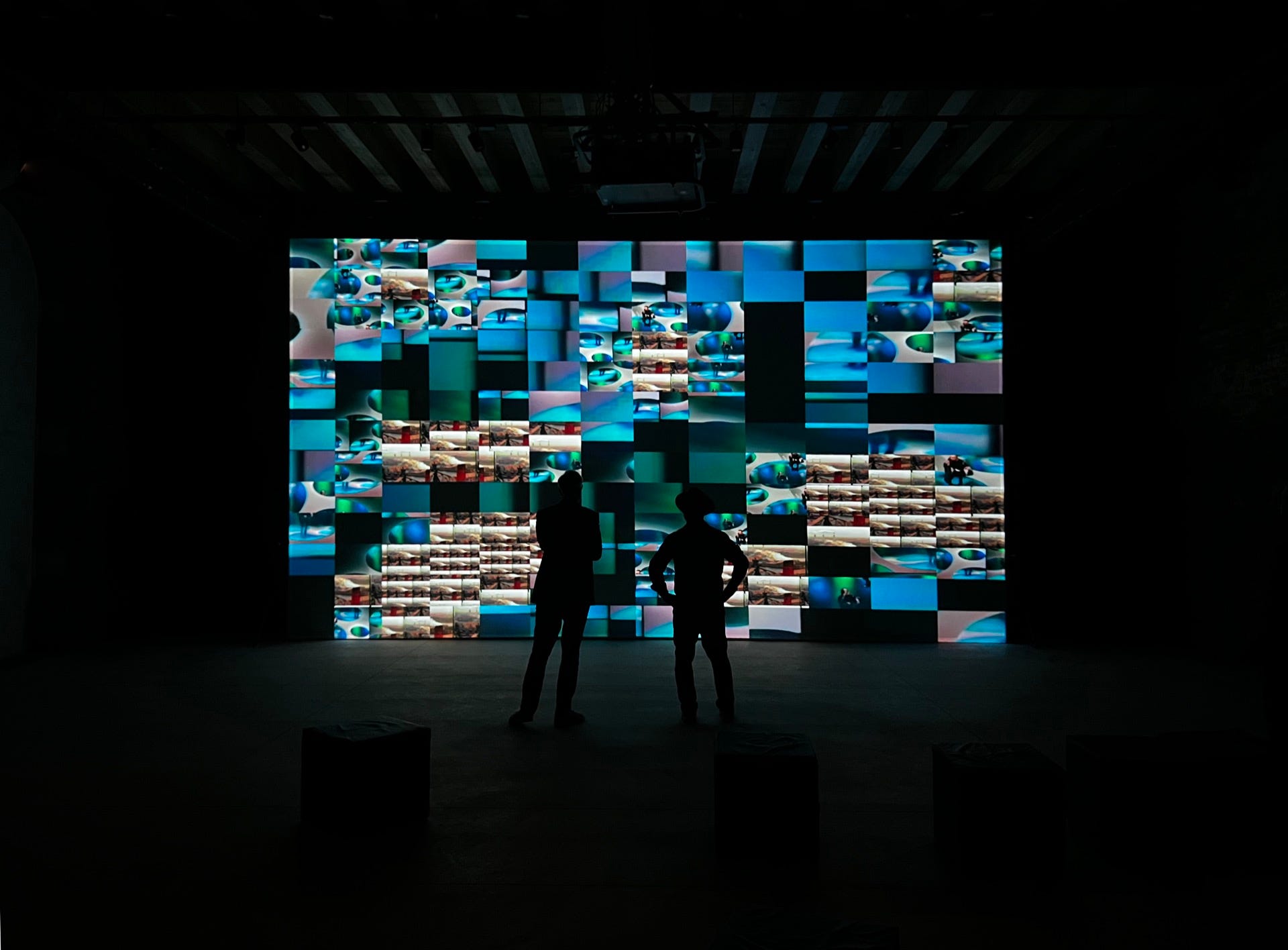
Nothing Can Ever Be The Same, the real-time generative work based on the archive of Brian Eno – an experimental playground and pre-cursor to the Eno documentary – is currently on show as part of the Aesthetica Art Prize 2025 final at York Art Gallery.
The work has been running non-stop, in real-time, since the show opened on the 19th September and will continue running until 25th January 2026. This five month run-time is the longest we’ve shown the work, with the system constantly creating, combining and juxtaposing new visuals, interspersed with archival interviews with Brian Eno.
The Aesthetica Art Prize brings together 25 shortlisted visionaries from around the world, as well as a longlist of 175 artists, who confront the biggest issues facing humanity today. This collection of work confronts the relentless advancement of technology, the existential realities of climate change, the deep scars of colonialism, and the ongoing fight for gender equality and racial justice. These artists use bold, boundary-pushing mediums – painting, photography, sculpture, video and installation – to give voice to stories often untold.
Algorithmic, real-time, intelligent systems such as these are very much a large part of my focus, both in my art practice and through the work i’m doing at Anamorph – the company myself and Gary Hustwit started following the success of the Eno documentary.
Visit the York Art Gallery website to find out more.
An experimental generative experience as a tribute to David Lynch’s masterpiece
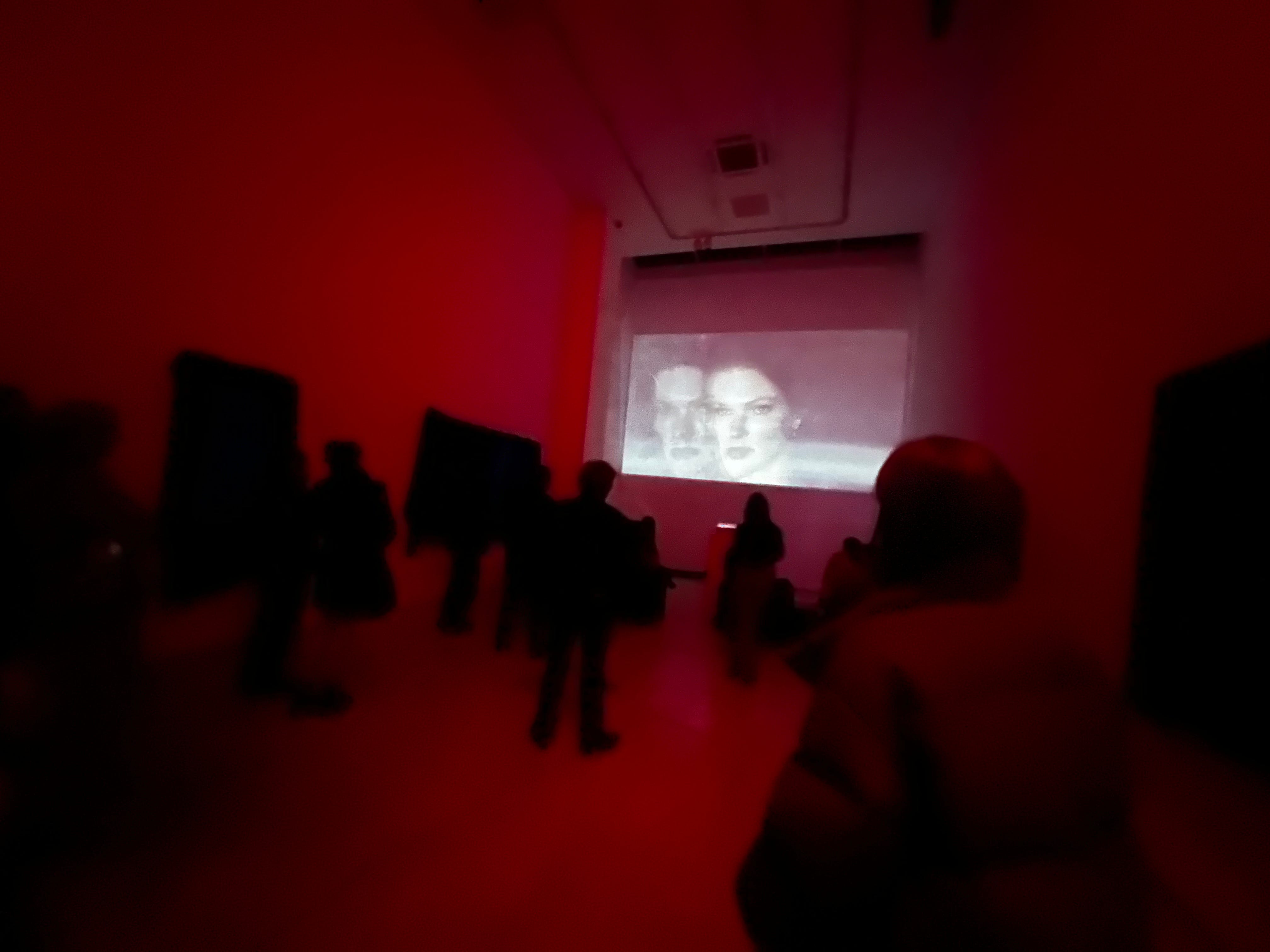
Mid-November I found myself in New York for the third time this year, meeting up with Gary to present a new project we’ve been working on for many months but can’t say too much about right now.
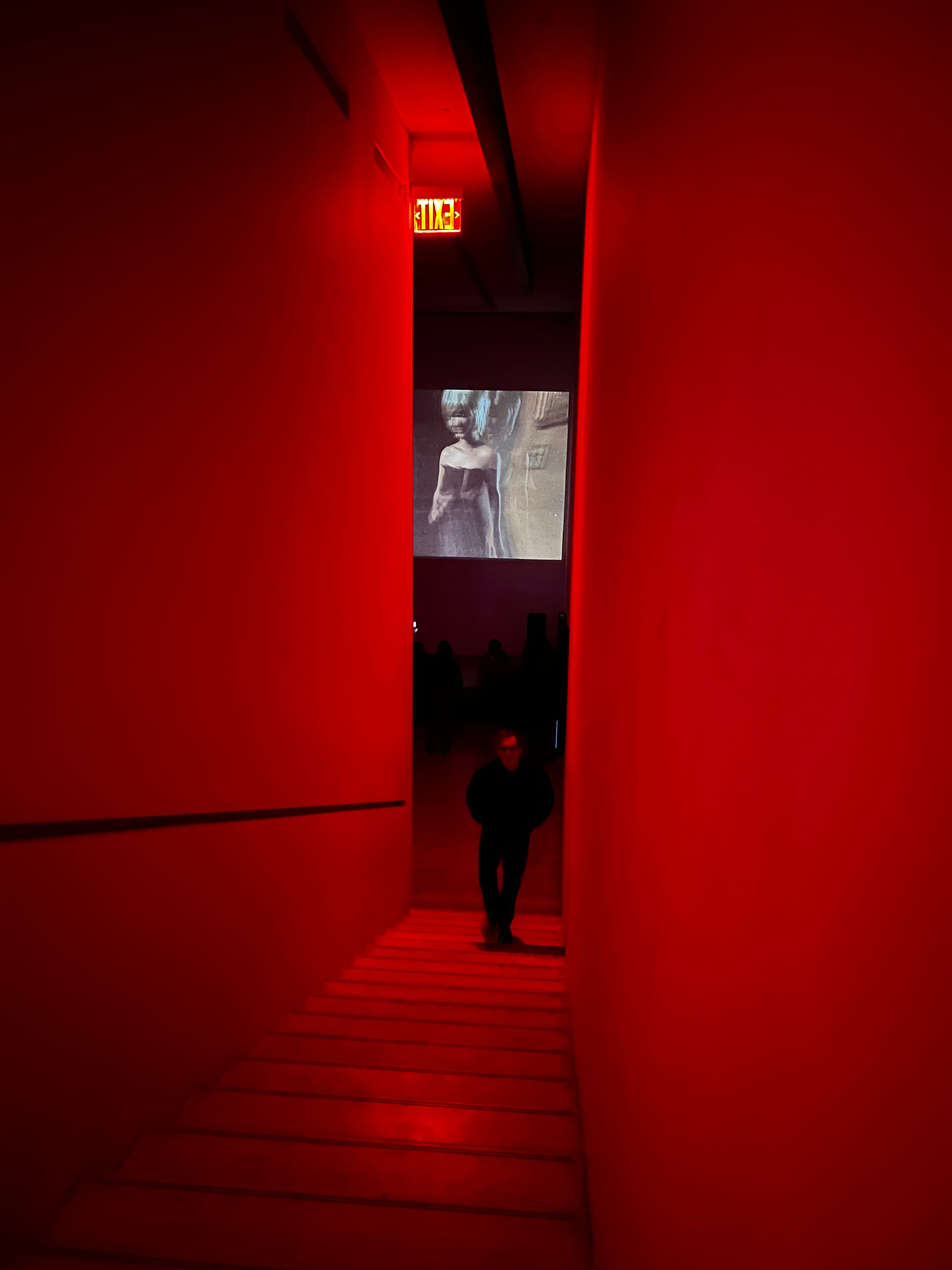
As part of that trip we thought it would be interesting to show for one night only something else we had been playing with, spun-out of Nothing Can Ever Be The Same, but this time as homage to Mulholland Drive, David Lynch’s surreal masterpiece.
So we got together with Offline gallery in The Bowery and showed Evil Landlord Hum, running for 36 hours, remixing and reworking Lynch’s work into a never-ending fever-dream of image, music and dialogue.
With any system such as this I want to be surprised by what it sends forth into the world, out of the algorithmic, considered process. New unimagined combinations and juxtapositions of image and sound suggested new interpretations and new narratives. Many of the visitors in the space stayed for several hours, unable to pull themselves away, transfixed by what may come next.
“I wonder where you were going?”
We may revisit this idea further in other locations. As Naomi Watt’s character pondered “I wonder where you were going?” we both feel there is lot more to explore with this idea.
Creating a new piece of software for presentations
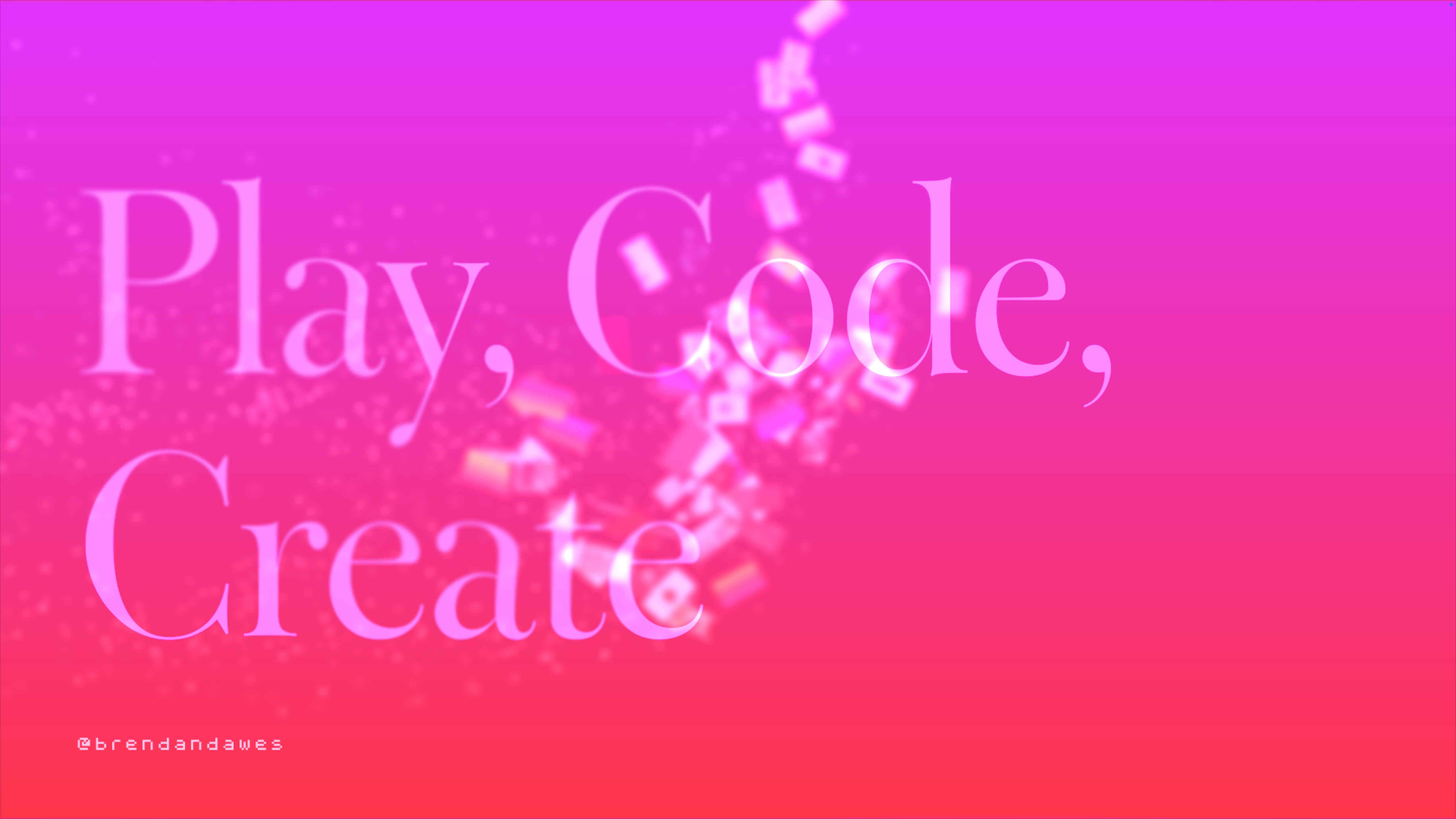
Following a talk I gave at Salford School of Architecture, it got me thinking about the software I used for these talks.
Over the years I’ve experimented with my own presentation software rather than use Keynote or heaven forbid Powerpoint. Yet the last few talks I’ve delivered reverted back to the default of Keynote, which I think came about because of a conference needing all talks in Apple’s severely bloated app.
After getting back from New York I had a little bit of downtime, so I dusted off the old systems, specifically the way the systems worked – using folders of images, text files and video – and built a complete new system which I called Drift.
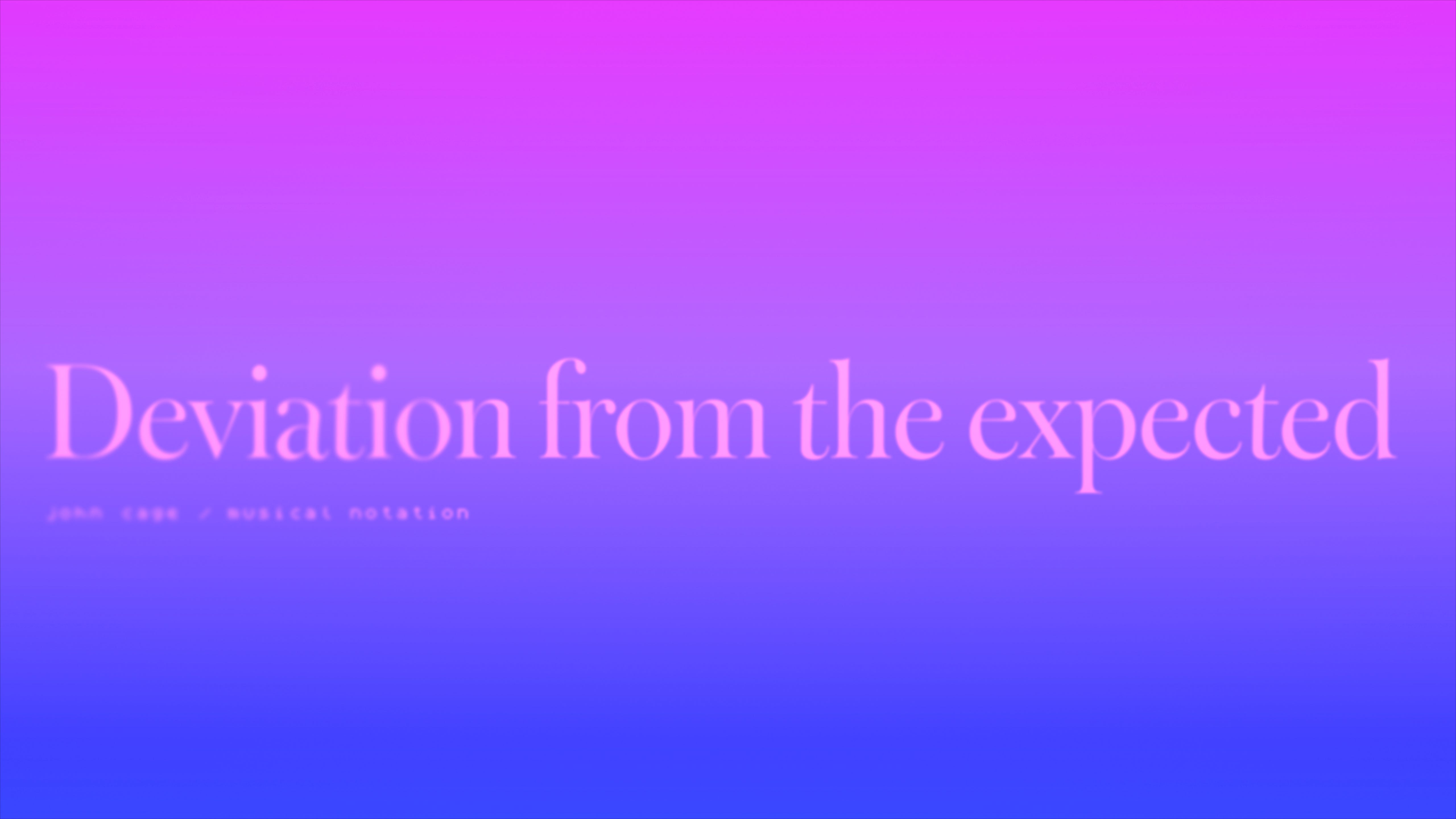
This new software better represents me and how I present, think and work. Slides – such as they are – are first shown scattered in a three-dimensional space. Occasionally the cluster reforms into new shapes. This is much more akin to how I like to think about collecting ideas and inspiration. It’s not linear or neatly laid out , but messy, playful and fuzzy on purpose.
As these objects float around in this space, you can observe particles drifting off into the void beyond. Are these other ideas, questions and provocations?
This preview mode serves as both visual introduction and overview of the pending talk, without death-by-bullet-points. Alongside the visual element, a real-time, generated drone creates an abstract soundtrack, suggestive of space – both physical and mental.
When I then choose to dive into the talk, images, text and video can be gone through as you would expect, except text is displayed in a more artful way, constantly shifting in focus and depth of field with the background colour-field also shifting in hue and saturation. There’s a sense it’s not a fixed thing or idea. Text in my talks is always used very sparingly and serves more as visual markers or jumping off points so why not make these words more akin to an image, but in a constant state of flux?
Here’s a little video of it in action:
Technically each slide is a point in 3D space which then uses the GPU through the magic of instancing to apply a texture (image, video, text) onto a 16:9 plane. The GPU doing all the heavy lifting means the frame rate ticks along nicely at 60fps, no matter how many elements there are in the deck.
Creating this system was incredibly rewarding. I’m a big proponent of McLuhan’s the medium is the message, so that the method of communication is just as important as the thing being communicated, and that the medium and the method of its construction is an extension and representation of myself.
Now I just need to line-up a few talks to put it through its paces. Feel free to get in touch.
A forty page, large format algorithmic broadsheet publication to mark twenty five years of brendandawes.com
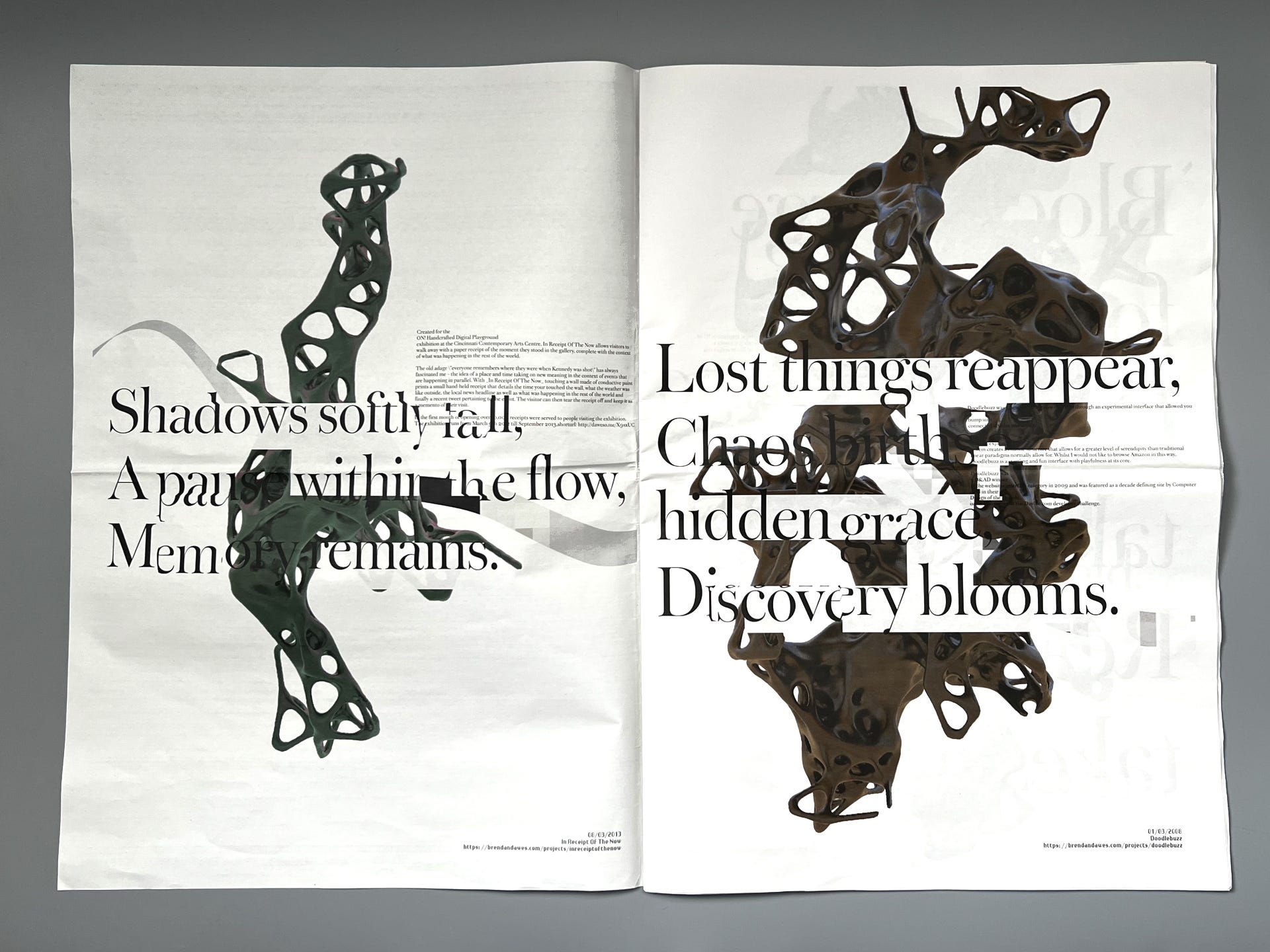
This year saw the 25th anniversary of my website brendandawes.com Many people will no-doubt wonder why I still have a website in the age of Tik Tok and social media?
Well, this space on the Internet is a place I have total control over. Nobody can tell me what I can and can’t put on there, no algorithm can decide a piece of content violates some bullshit rule. It’s both a place to publish work, experiments and thoughts alongside being a complete archive of all my output. I decide what goes on the shelves.
To mark this anniversary I created some new generative publications.
First came Certain Irregularities – a limited series of coded plotter works, then came this large format publication entitled Now Becomes Then.
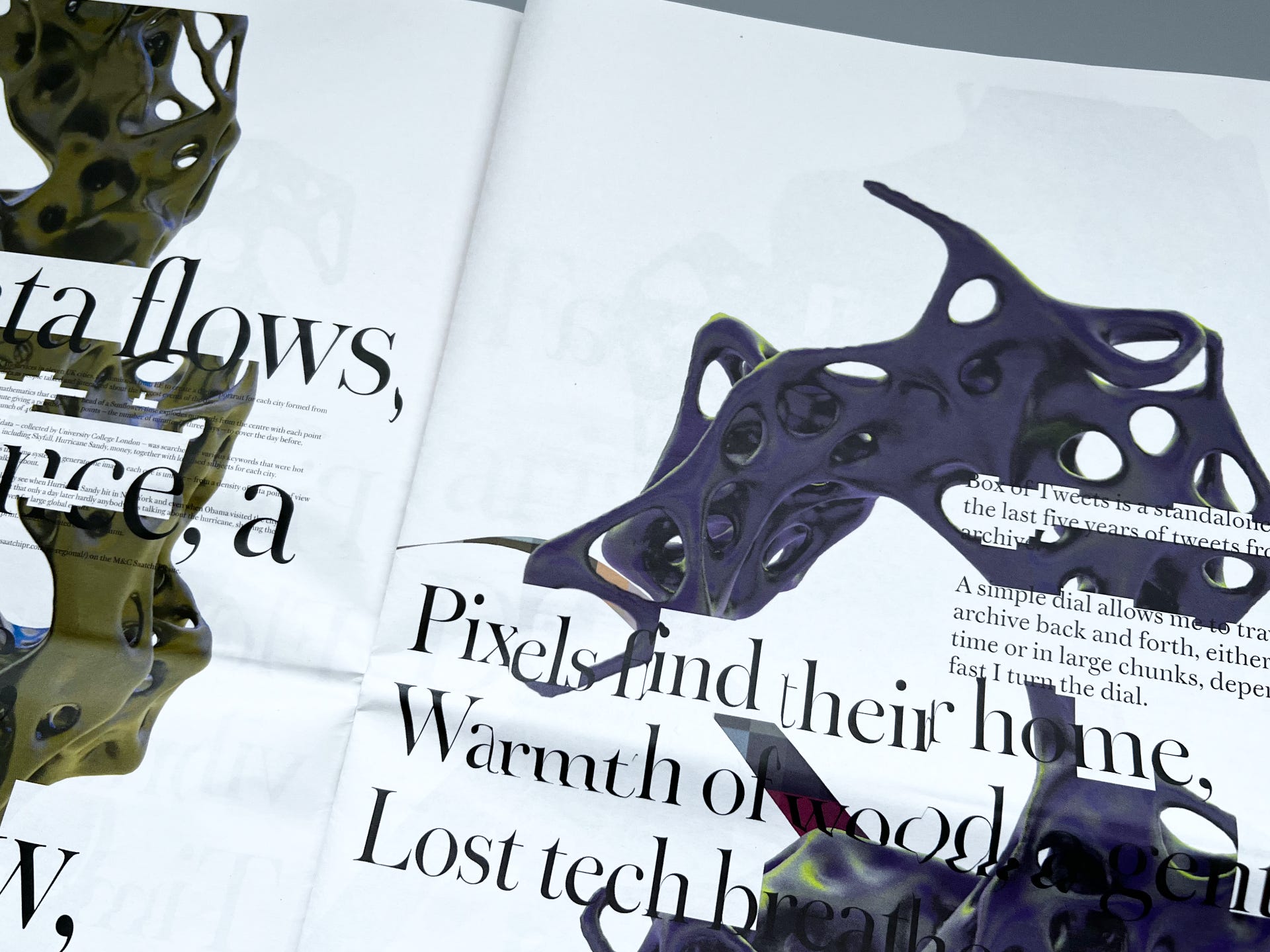
Rather than create a regular retrospective look-back of my work I instead used an algorithmic process – in Houdini – to generate a series of sculptural objects born from the title of the selected works. This technique is something I’ve developed over the years to create these unique forms from data.
These images were then composited in Touch Designer with text from each project, driven by the API to my website, together with a Haiku generated from that same project text via a locally run LLM. The result is new representations of the works, effectively souvenirs, all driven by the original data. Each time I ran the system it would create new compositions which I then spent some time curating my favourite outputs.
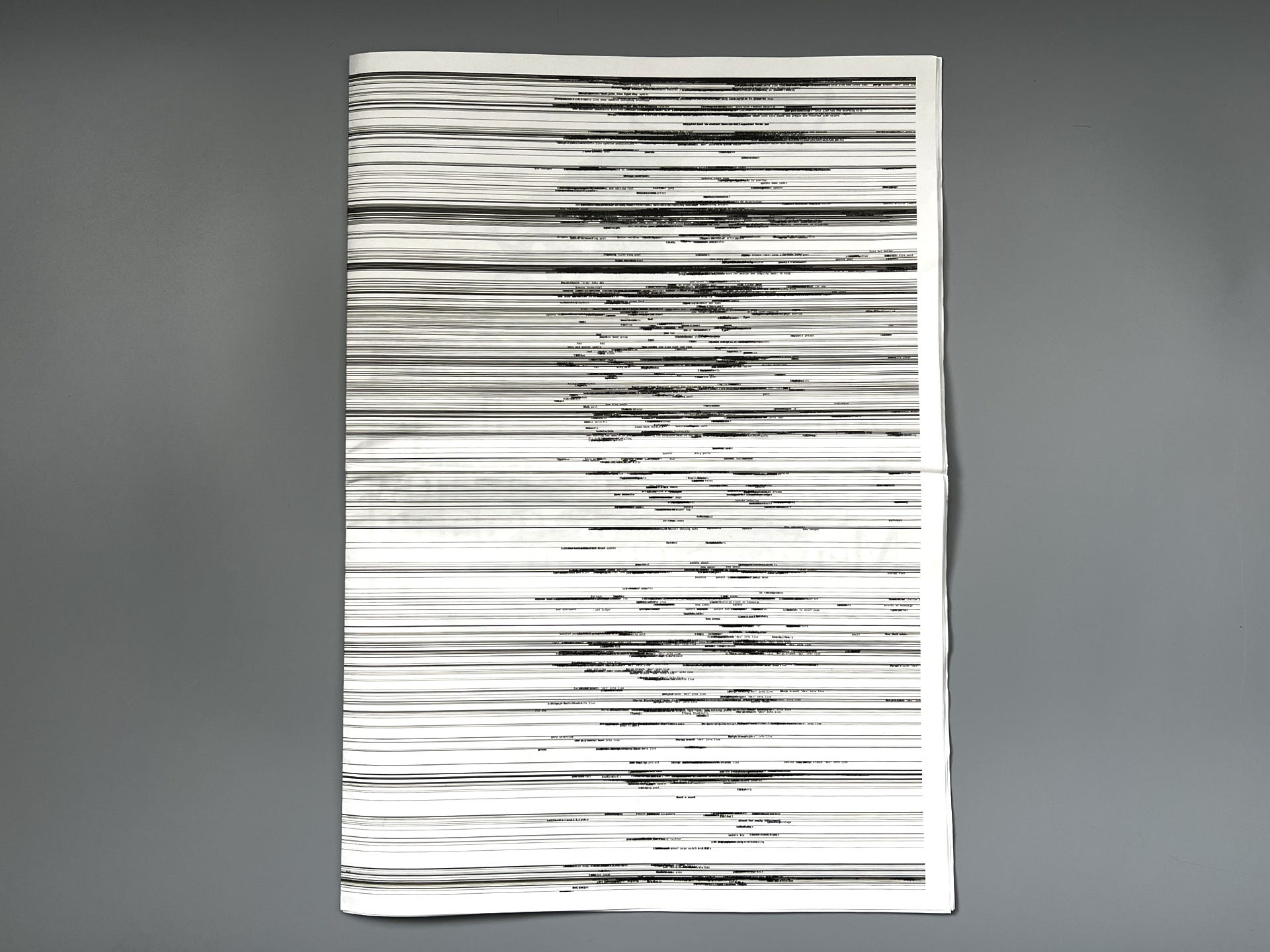
For the front and back cover I used my Git repository detailing all the changes to my website over those years to create (in Processing) a minimal, monochrome, time-based diary of those code commits.
Finally, I took these high resolution compositions and wrote a Python script to take these layouts, randomly shuffle them and create a single PDF ready for printing.
Not only is it a physical souvenir of some of my work, but its assemblage, using disparate pieces of software and code – from Processing to Houdini to Touch Designer to LLMs to website APIs and Python – is a good representation of my approach to making digitally-born work, with the coming together and combination of discreet components to make a larger whole.
Now Becomes Then is strictly limited and won’t be re-printed once this edition is sold-out.
You can get yours here.
📖 Ten Arguments for Deleting Your Social Media Accounts Right Now by Jaron Lanier
📖 Sum. Forty Tales from the Afterlives by David Eagleman
🌐 Analyzing and Translating an Alien Language: Arrival, Logograms and the Wolfram Language
Thanks for reading! This post is public so feel free to share it.
This was a personal decision brought about because I could no longer be on a platform designed to promote and amplify outrage and sew division.
Typically my posts on Instagram get shown to 1% of my followers because I’m not playing the content game.
No posts
Comments
Nothing yet. Say the first thing.
Sign in to join the conversation.