
This is the second essay pair in the sisters to witches series, a feminist horror curriculum. Part I is for paid subscribers. Part II, on possession in horror, drops Thursday and is free to all!
When I first saw Simone Martini’s Annunciation at the Uffizi, I didn’t pay much attention to it. Like much of the Trecento art, it is drenched in gold: the background is entirely made up of gold, the halos are golden, the angel is draped in gold. If you want to be dazed by gilded gold, seek out 14th century art. It is a beautiful painting, but Martini’s is just one among many others, and that day at the Uffizi, I was focused on those others.
I’ve been back at the Galleries many times since, almost always in the Trecento rooms. And I have noticed that particular (and particularly large) Annunciation. I have noticed Mary. I have noticed the way her body twists away from the angel, how her arm pulls her shawl tight across her chest and her face as if to shield herself. I have noticed her face, her downturned mouth and knitted eyebrows: a look of disgust, anger even. She looks like a woman interrupted in her reading by someone she does not want in her space.
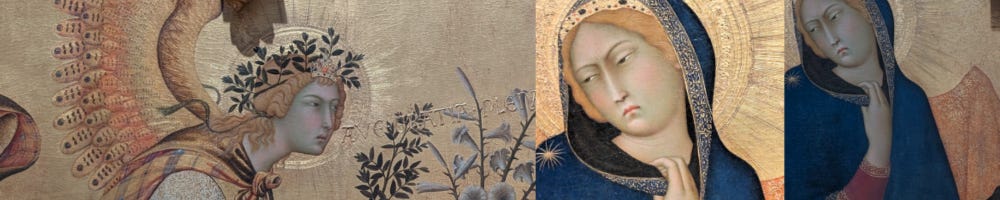
For a Trecento painting, this is a remarkable amount of emotions on display1. If we look past the mesmerizing gold and rich fabrics, we hardly see a joyful announcement of pregnancy. Martini is showing us a woman recoiling from the words spoken to her. Ave gratia plena, dominus tecum. Yet it doesn’t feel like the Lord is with her, certainly not with grace. Mary just looks like she wants to leave the room.
This painting was the beginning of this whole curriculum, of my questioning of women’s bodies in both religion and horror (society, really). I’ve encountered many an Annunciation since, but two others have lived in my brain and heart just like Martini’s: Fra Angelico’s and Leonardo da Vinci’s, Three paintings depicting the same scene, three artists imagining the same moment, three different reactions to the same event: the moment God enters a girl’s body and makes it His.
The Annunciation was the first possession narrative in our current Western culture. A force more powerful than a woman enters her body without her meaningful consent and changes it forever. In horror, that would be the moment they’d call an exorcist. But we choose not to when the perpetrator is God.
Comments
Nothing yet. Say the first thing.
Sign in to join the conversation.