
Dear Reader,
—This interview continues my Soy/Somos conversations with people in the US rooted in more than one culture. Aquí estoy. Aquí estamos. This is who I am.
Claudia, I was excited to hear about you through a mutual friend. You are an artist and you write poetry, two worlds I naturally gravitate to. Would you give us a sense of your work as a graphic designer?
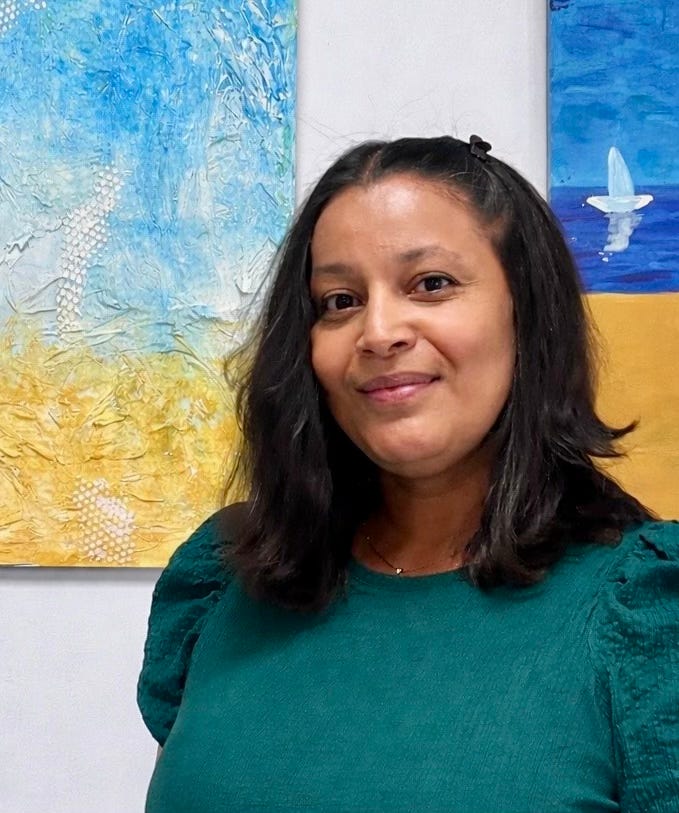
I work for a humanitarian organization that is working to eliminate child and forced labor from the building environment. This is a global concern. The company is addressing the building materials supply chain, bringing this awareness to the architectural sector.
I’ve come across this kind issue in the coffee growing areas of Panama. Small farms are being observed to make sure children are not being used in the labor force, or that they are getting an education while their parents are working in the cafetales.
I work mainly with educational and promotional materials—posters, menus, print material for children, anything tactile. I also work in the branding department, trying to assure that there is consistency in our product, that everything has the same look and feel.
Graphic design is a very broad field. Everything from the design and user experience on a website to signs on a subway station—or a subway map. It’s about giving the user a positive experience with a piece of communication, a captivating ad in a national magazine or food packaging that makes the product more appealing.
I’ve worked on both print and digital products. Like most designers, I use computer programs such as Adobe Photoshop and Illustrator to help me create.
How did you recognize that graphic design was something you liked?
It begins at home, I believe. My mother always loved photography. When I was growing up, there were photographs on all the walls of our house.
Strangely enough, I studied political science and advertising communications in college, and when I designed my own ads, I discovered that I really enjoyed being hands on, considering the colors, coming up with a visual that spoke to people.
I worked at Scholastic for a number of years. I was an art director, creating computer-based digital products. At that time digital products were being used to teach the Common Core curriculum, teaching kids how to read, how to find information within a text, and so on. I was one of many people on the team. I was also involved with print magazines for the classroom.
In my personal work, I work with mixed media, photos, acrylics, collage. I use canvas, paper, sometimes the computer for putting things together. I might print images, then tear them up and place them on canvas. Then, brushes and paint.
I’ve started to explore watercolors. Acrylics are easier to control. Watercolors have a mind of their own--and that is part of the excitement.
A designer I worked with for years, has been studying watercolors more recently. She’s becoming brilliant at it, learning when to hold back.
Working with watercolors is somewhat like poetry, which can be of the moment and not needing a punto final on the story.
Do you sketch your first ideas by hand?
I might do a simple sketch on a piece of paper. Then I’ll take it to the computer. For my personal work I might write down the ideas or do a doodle of what I want it to be. If not, (a) I’ll forget it, or (b) the placement of things doesn’t fall in.
Claudia, you were born in Colombia, no?
Yes. My family is from Cali. My mother came to the United States with me when I was nine. I didn’t know any English; kids bullied me, the whole Afterschool Special. It was challenging.
We became citizens early. We were very lucky compared to immigrants who arrived in later years. When we came, US citizens or lawful permanent residents (LPRs) could request close family members. That’s what happened with us. When we came, we arrived with our residency approved.
Hablas en casa en inglés o en español?
With my husband I speak in English. With my mami—of course—in Spanish. Though my husband is also Latino, we met in high school in a mostly English-speaking world. Now it’s hard to do otherwise. We are now trying to speak in Spanish at meals. We want our son to have both languages.
Ah, as a mother of a young boy, how do you manage work and life?
Our son is in elementary school. Life has gotten much more hectic since I had a child. I’ve had to find work that is flexible. I’ve had to change my schedule to do things like picking him up at school, taking him to doctors’ appointments and activities. The company that I am working for is very supportive of working women and life balance. They’ve allowed me to work part time and to work from home when I’ve needed to, let’s say a snow day at school. My husband and I have more traditional gender roles in our home, but we support each other in all aspects. He works full time. He is a very involved, hands-on-parent, reading constantly with our son, doing puzzles with him. He’s the fun dad.
What about community, other mothers and fathers. Is that a big part of it?
My husband’s parents passed away and my mother lives far away, so we’ve had to build our own community. We now have friends that feel like family. Through my Buddhist practice, we have a good community as well.
I am a Buddhist. We have a very active community, part of the SGI (Soka Gakkai International). We read Buddhist texts to encourage each another. We talk about what we can do in our own communities to foster world peace and honor the dignity of human life in each other.
Do you meditate?
Actually, chanting. I recite a mantra over and over. I do that every day. We do it as a community as well.
What is the purpose of the chanting. Where does it take you?
The best way it’s been described to me is that it helps bring out your Buddha-nature the most positive part of your life, the part that is connected to the universe. When I call your name, there’s a response from you because it’s your name. When we chant, we call out to the highest part of ourselves to give us wisdom, compassion, to help us deal with any troubles we may be going through at the time.
We will go to somebody’s house who is facing a difficult obstacle, and we’ll chant together. Sometimes we’ll bring food. Mostly it’s about encouraging one another. You can do this. Every change in one individual can make a change in the world.
We focus on the individual, because it ripples out into the world.
I am wondering about the quieting, calming effect of doing artwork.
Creating art for me is a kind of meditation. When working a collage with different materials, you have that tactile experience that keeps you grounded in the moment. Just holding a brush is calming.
I noticed a wonderful poster—really a billboard—on your website for which you received a prize.
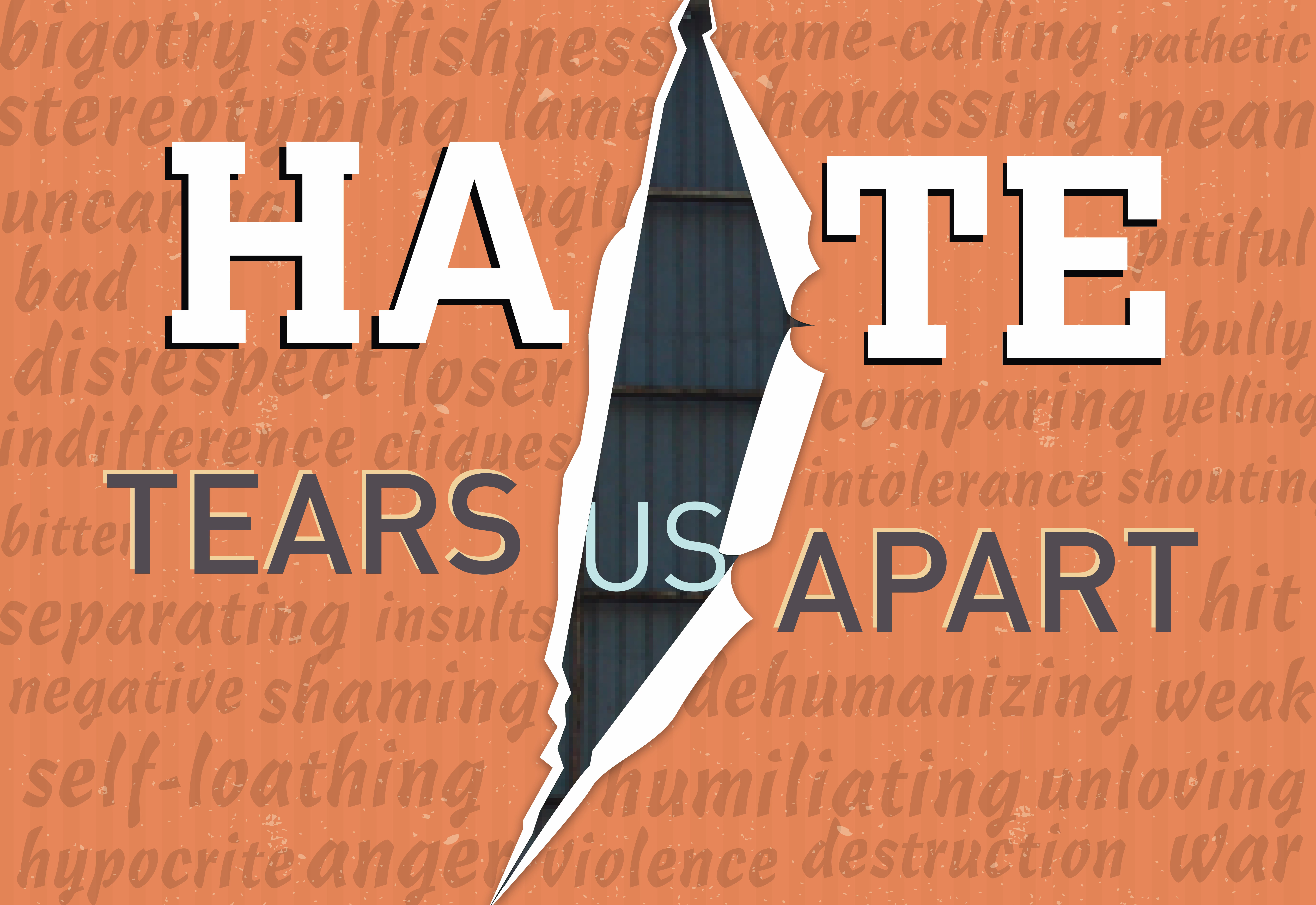
I entered a contest “Embracing our Differences,” supported by a non-profit in Florida. I was exploring the idea that violence is not something outside of ourselves. It’s not something that we see on tv or the news. It starts with experiences in our own lives. With people dehumanizing others. With self-loathing. With lack of compassion. Since these things exist at the individual level, we have first to work within ourselves. The organizers made my design into a billboard and displayed it in Sarasota, Florida.
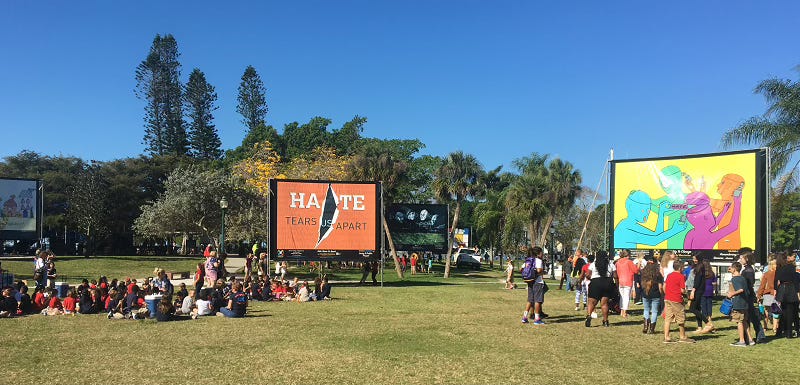
How did people receive this image? Why do you think it’s working?
The word “Hate” is drawn as if it is torn. We have to break through in order to make a peaceful world. I thought the 3-D effect would work in billboard size. I wanted the billboard to captivate people as they drove through. It needed to be understood fast.
Art is something that hits you right at the heart. You can lecture all you want about issues and causes. Sometimes it takes a visual to strike a chord. Words can sound preachy. If you can convey the feeling in a less preachy way, you’re ahead.
Art has the ability to take you by the hand. Look at this. This is what I see. Why don’t you join me here in this moment.
Is there something I haven’t asked you that is still in there?
I always ask myself if I can leave something positive. For example—how can I make something easy to read? How can I create a positive interaction? Lately I’ve been inspired by my own company. They are very mindful about every material they use. They have inspired me to look closely at the goods I work with. To think about sustainability. How do I use inks that are recyclable? It’s a work in progress.
The overarching piece of Buddhism is how do we foster peace in the world. That part of my life always has me questioning. It informs what I do. It keeps me curious. Especially now, how can we bring good things into the world?
Talk to me, dear reader. As you know this is a conversation. My encounter with Claudia humbled me, calmed me. How can I bring something of value into the world?
Please show the love by checking the heart.
Comments
Nothing yet. Say the first thing.
Sign in to join the conversation.