
It dawned on me this morning that good thinking about strategy is getting harder to come by. I think this was prompted by a Substack post I saw from a well-known influencer, whose reasoning was mostly vibes and strong feelings, dressed up as an argument. Good strategy thinking has always been hard to come by, but today it’s also hard to recognize when you see it. So I wanted to share a few thoughts that may help you sort out junk strategy from the good stuff.
For most of the time businesses have been around (let’s call that a few thousand years),1 strategy was not a discipline. Then in the mid and late 20th century, thinkers like Peter Drucker, Igor Ansoff, and Michael Porter started to give shape to strategy.2 It became a discipline one could study and practice. But it could be hard, esoteric, and often more theoretical than practical. Nonetheless, having a solid grasp of strategy fundamentals could provide an advantage, because you had a lens for thinking about business that competitors may not have enjoyed.
That’s no longer the case.
Now, you can know nothing about strategy and use your LLM of choice to quickly get strategy advice, tuned exactly for your specific situation. First by asking: “What is strategy in a business context? What are the main strategies a business can use to grow and compete?” From there: “Here is a bunch of information about my industry and my competitors. Use Porter’s 5 Forces Model and Blue Ocean Strategy to look for threats and opportunities.” And finally: “Here’s our historical data. Here’s our current product roadmap. Develop a strategic plan to help us create a defensible moat and persistent differential returns.” Within a single sitting, you can have a fully-baked, confident-sounding strategy at your disposal.
That could be better than simply winging it. Possibly. But here are two things you must consider if you’re going to go down that path.
The first consideration is the more obvious one: LLMs may sound confident, but that doesn’t mean they are exercising good judgment. If you are not capable of developing a good business strategy independently of an LLM, then you are not in a good position to assess the quality of an LLM’s strategy recommendations.3 (This is true for every discipline, by the way. I have asked Claude for help repairing my mountain bike many times. I was a mechanic in college, and often its advice doesn’t pass my smell test. More often than not, I’m better off ignoring it.)
If you are not capable of developing a good business strategy independently of an LLM, then you are not in a good position to assess the quality of an LLM’s strategy recommendations.
The second consideration is less obvious: for a strategy to be useful, it must be a differentiated strategy.4 That’s to say, pursuing the same strategy as your competitors won’t confer any advantage. Yet, if you and a competitor ask an LLM to develop your business strategy from whole cloth, there’s a good chance you will receive similar recommendations. The advice is generic. Having generic strategy advice might have helped you compete decades ago, before everyone had access to the same knowledge base. But today that advantage is gone.
This isn’t to say that this problem exists only with LLMs either.
You can hire a well-educated strategy consultant who simply sells you existing knowledge or a pre-canned strategy that may or may not be appropriate for your situation. Or you can end up with an artist/rebel type who gives you advice that sounds exciting but isn’t useful, or is even dangerous.
There are two criteria for good strategy:
It must be grounded in what’s useful to your business and possible to execute, not reliant on speculative thinking.
It must help you differentiate from the status quo by avoiding generic strategies that competitors may also pursue.
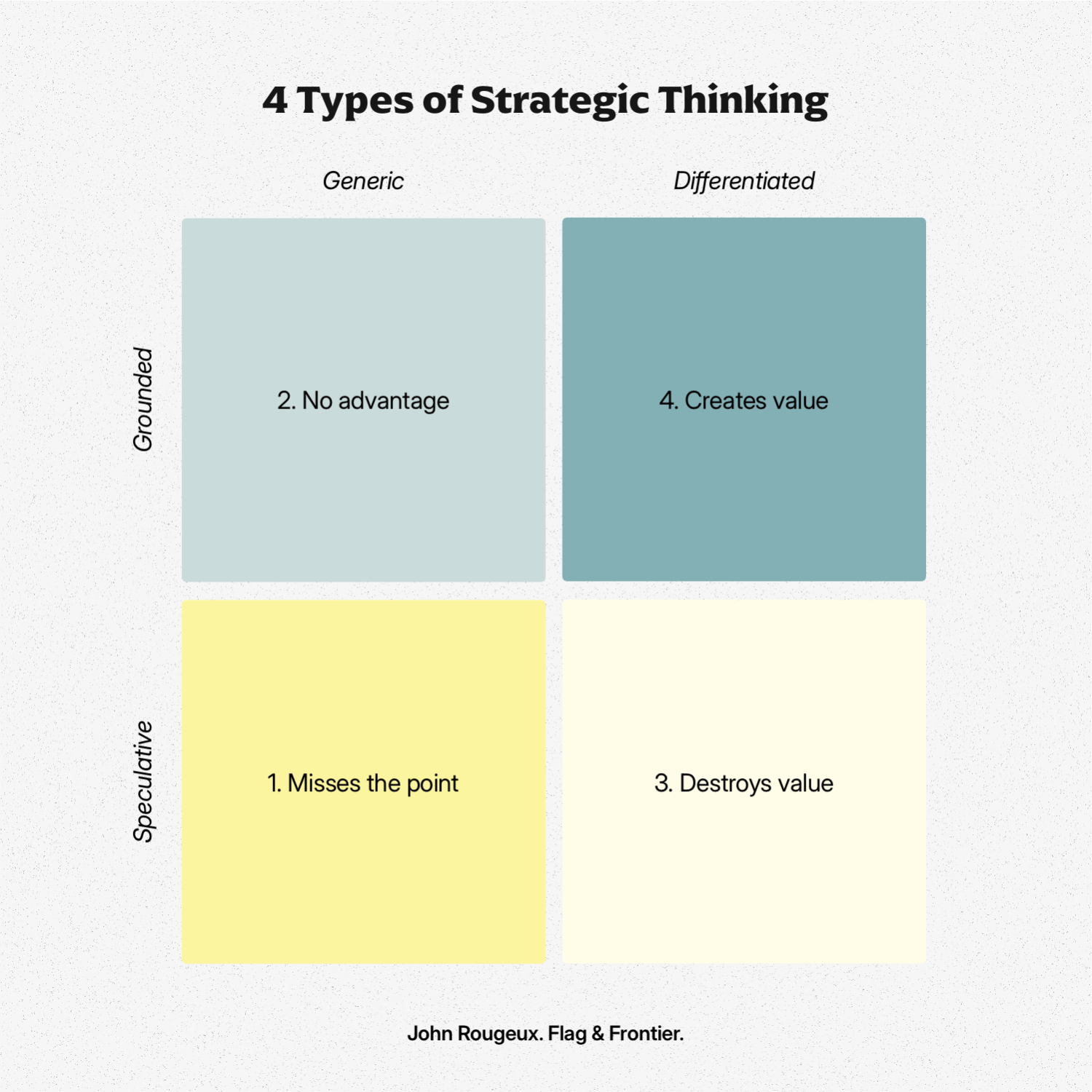
Put those two criteria together, and we get four types of strategic thinking:
Speculative / Generic: This is what happens when you prompt an LLM for a strategy, and you get a reasonable, well-articulated answer that completely misses the point.
Grounded / Generic: This is the standard strategy advice you will get straight from a textbook, a strategy consultant who only recycles what’s known, or (sometimes) an LLM with good prompts.
Speculative / Differentiated: This is the advice that sounds exciting in the moment, precisely because no one has done it before. But it will run you right off the edge of a cliff, because it rests on wrong assumptions or thin thinking.
Grounded / Differentiated: This is the gem: a strategy that your competitors can’t replicate (or won’t, because they don’t think creatively enough). It's based on a deep understanding of what's really true and a willingness to take calculated (and often necessary) risks.
I told you where to get the first three, but I didn’t address where to get the fourth. That’s for you to decide. Maybe that perspective comes from you. Maybe it’s from someone on your team. Maybe it’s someone you hire. Maybe it’s a peer from another industry. Wherever you go to find solid thinking on strategy, remember this: if your team is going to execute it well, they must believe it.
But generic strategies never help you win. Speculative strategies only create unnecessary risk. Your team won’t believe in either one. Not for long anyway.
So the only thing I want to prescribe is this: if you’re going to work on strategy, set your standards high.
John Rougeux is the founder of Flag & Frontier, a strategy consultancy that helps executive teams align around their strategy and narrative when the future is up for grabs.
If you really want a hard date, the Dutch East India Company is often cited as one of the first real corporations. It was founded in 1602 and even had its own flag.
I’m grouping these people together, but they made different contributions at different times. Drucker is the “father of modern management” and introduced ideas like management by objectives in his 1954 book The Practice of Management. Ansoff wrote Corporate Strategy in 1965 and developed ideas like market penetration and diversification. Porter, whose Five Forces framework was just one of his many major contributions, was prominent in the 1980s.
This isn’t to say LLMs can’t be useful as a tool in the process of building a strategy. They can be. Like many tools, the output depends on the operator.
This is not my idea, by the way. Porter made this claim in 1996, in his HBR piece, “What Is Strategy?” If you can’t access the article, here’s the quote: “Competitive strategy is about being different. It means deliberately choosing a different set of activities to deliver a unique mix of value.”
Comments
Nothing yet. Say the first thing.
Sign in to join the conversation.