
This is Part III in a series on how agentic AI will drive category consoliation. Head here for Part I. To make sure you get every issue, subscribe here.
What do these software businesses have in common?
When Notion launched in the mid-2010s, it was a humble document editor, offering a neat alternative to tools like Google Docs. Today, Notion has encroached on multiple categories: CRM, databases, project management, workspace collaboration, and task trackers, to name a few.
HubSpot used to be a pure marketing automation platform that cheerily espoused its “inbound marketing” philosophy. Not anymore. Now, HubSpot provides a full stack of GTM tools for everyone, from marketing, sales, and customer success.
CrowdStrike, a cybersecurity company, began by protecting employees' devices, such as smartphones and laptops, from security threats. But CrowdStrike covers so much more today, like threat intelligence, cloud security, and managed response.
HR platform Workday got its start by moving employee records software to the cloud. But once that was locked in, they soon expanded into payroll, benefits, talent management, and workforce planning, covering all the bases HR needed.
SaaS Has Always Had a Good Reason to Consolidate into Platforms
See the trend? SaaS tends to scale from point solutions to broad platforms. And they’ve had good reasons for doing so over the last couple of decades.
For starters, many SaaS companies are VC-backed, which comes with a high growth expectation. It can often be faster to fuel top-line revenue by acquiring other firms and selling more functionality to existing customers. That move also creates higher switching costs and can improve appeal to enterprise customers, who tend to prefer a few large software vendors over dozens of smaller ones. And finally, let’s not forget that scale brings compound advantages: lower cost of acquisition from better brand recognition, better pricing power from being the “safe” choice, and better negotiating power with suppliers, to name a few.
But as SaaS companies themselves have good reasons to scale in this manner, it doesn’t mean that’s what every buyer wants.
When the “cost of coordination” exceeds the benefits of a “best of breed” approach, buyers switch from point solutions to platforms.
Why get locked into a single vendor when you can piece together a selection of “best of breed” tools, so the thinking goes. Software integrations and APIs certainly make it possible. Not only do you get more flexibility, but you also get to avoid the lengthy and expensive integration process that’s often part and parcel with buying big enterprise platforms (if you’ve ever gone through a Salesforce deployment, you know this all too well).
So why do some businesses buy big platforms at all?
One reason relates to trade-offs. As your business (and the software running it) becomes more complex, the cost of maintaining all of those integrations increases. At a certain point, whatever benefits you might gain from a “best of breed” approach are outweighed by the cost of keeping such a system running.
In other words, when the “cost of coordination” exceeds the benefits of a “best of breed” approach, buyers switch from point solutions to platforms. Since there are businesses on both sides of that equation, there’s a sort of equilibrium that exists between platforms and point solutions.
That’s where agentic AI will change things.
Agentic AI Changes the Value Equation for a “Best of Breed” Approach
As a reminder, agentic AI means optimizing for business outcomes with minimal human intervention. To do that well, an AI agent needs accurate information about your business, awareness of what other AI agents are doing, and context about its goals:
For AI Agents to operate effectively, they need seamless access to high-quality, real-time data. Yet, many enterprises struggle with fragmented data spread across disconnected systems, limiting the AI’s ability to make informed decisions. Without a unified foundation, AI Agents can’t fully optimize workflows, automate tasks, or adapt to new information. (source)
In other words, AI agents must coordinate their actions with everything else that is happening in the business. And it must do so on its own, in real time.
That’s a stark contrast to how things work today.
Here’s just one example. In one of my VP, Marketing roles, our executive team would review our BI dashboard each morning, which showed data from across the business. It was useful, but rarely something we could act on directly. Partly because there were always reporting problems and partly because that data needed human interpretation before we made a decision. That created a disconnect between reporting and action. But for agentic AI to optimize for outcomes on its own, the cost of coordination needs to be manageable.
That’s why the “best of breed” approach breaks down when it comes to agentic AI. The cost of coordination is simply too high. Here’s an example of a software vendor, Bird, that has reached a similar conclusion…
Point solutions promised to solve specific problems exceptionally well... But as businesses adopted more of these "best-in-class" tools, an unexpected problem emerged: the connections between them became the weakest links… Companies that embrace unified platforms early will gain significant advantages. They’ll have cleaner data, faster operations, and AI-powered insights that point solution users simply can’t access. (source)
Before agentic AI, the cost of coordination might have been manageable because the stakes were lower. Having your BI analyst fix a reporting issue was annoying, but it wouldn’t shut things down. Agenetic AI, though, doesn’t have such tolerances. Best case, data problems shut things down, eroding your efficiency gains. Worst case, they cause AI agents to make poor decisions.
Since Agentic AI raises both the costs and the stakes of coordination, the point at which the costs of a “best of breed” solution begin to outweigh its benefits happens earlier. As this happens, platforms will become increasingly attractive to smaller businesses because this will be the only way they can access agentic AI cost-effectively.
You can map this shift in a simple graph:
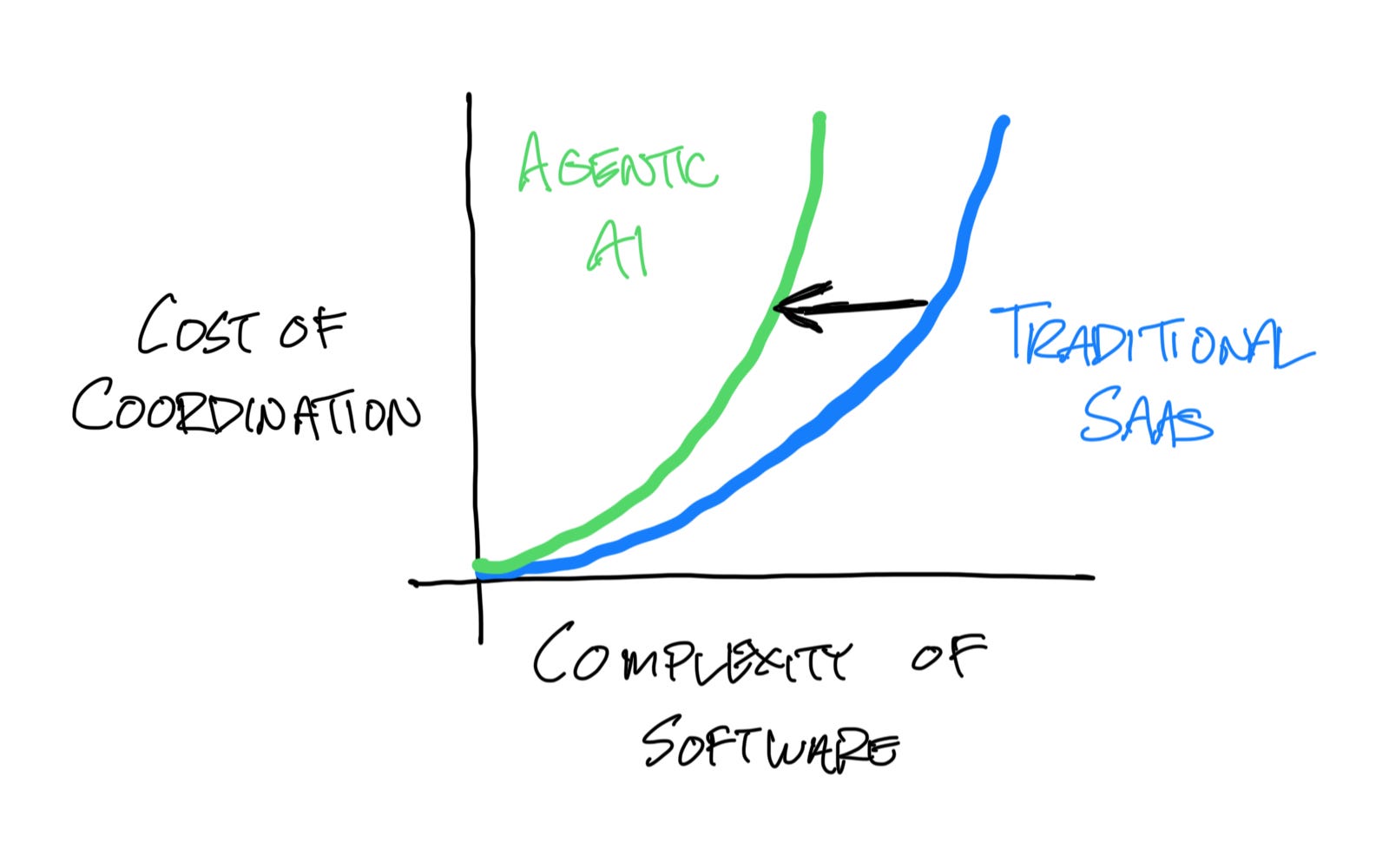
And while software vendors have always had good reasons to consolidate, this shift only adds another reason to the list. If agentic AI is how you stay competitive, taking a more platform-centric approach is how you get there.
To put a bow on this:
If you’re a SaaS buyer, you have a strong reason to choose a platform over a “best of breed” approach because that’s the only pragmatic way to access agentic AI.
If you’re a SaaS vendor, you have a strong reason to expand the breadth and depth of your offering, because that’s how you deliver the agentic AI capabilities the market wants.
So if you’re a niche player, how do you avoid getting eaten alive? And if you’re already a software platform, how do you stay ahead when the platforms you’re competing against will be making the same moves?
That’s what we’ll explore next week. See you then.
As the founder of Flag & Frontier, John Rougeux partners with executive teams to align on their strategic narrative, build belief in the market, and win the next chapter of their business. You can chat with John here or connect with him on LinkedIn.
Comments
Nothing yet. Say the first thing.
Sign in to join the conversation.