
Many software companies start out offering a point solution and expand into something broader. Yet as that metamorphosis plays out, many of them run into the same trap. They’ve expanded beyond a point solution, yes. But they end up with a collection of semi-related tools that don’t offer much additional value to customers over a “best of breed” approach assembled from multiple vendors1. You’ve likely run into software like that yourself as a user.
If your business is going through such an expansion, how do you avoid ending up there yourself? Some might expect a strategic narrative to provide direction. But that’s not its job.2 While a strategic narrative is a fantastic way to align your team around the problem you’re solving, it doesn’t dictate how the products you build should relate to each other. It won’t prevent you from ending up with that grab-bag of point solutions that customers struggle to make sense of.3 So today, I’m going to share one approach you can use to answer that question. It’s the same one used by SpaceX, Disney, and Apple, but it can apply to companies of all sizes.
But first, let me tell you a story about a former client of mine.
Let’s call them Ecommerce Co.4 The business got its start offering an easy way for online merchants to save on the costs of handling customer returns. It was a useful point solution. But the space had relatively low barriers to entry and soon invited competitors. Pricing pressure followed. As you might expect, Ecommerce Co. responded by adding features. But those same competitors simply copied them a few weeks later, often charging less, and eroding their advantage.
Ecommerce Co. saw that this game wouldn’t produce any winners, and set its sights on pursuing more fruitful territory. That’s where our work together began. After a few weeks, we landed on a new direction: Ecommerce Co. was no longer only in the business of helping merchants save on the cost of returns; it was in the business of helping merchants find margin improvements across their entire operation. We captured the thinking in a new strategic narrative for Ecommerce Co., and the team was excited about knowing what game they needed to play going forward.
Good progress, but also a risky place to be.
With the right choices, Ecommerce Co. could create something that was truly defensible. With the wrong choices, it would simply encounter a larger version of the same problem: a smattering of point solutions that was too easy for competitors to replicate, and too hard to convince customers to buy over a collection of “best of breed” solutions. How did Ecommerce Co. proceed? I didn’t get the chance to find out; that was outside the scope of our work together. But I want to share one approach they could have used to end up in the right spot.
Workforce management platform Rippling’s CEO, Parker Conrad, calls it the “compound startup.”
Instead of basing product decisions on standard questions like “What do our customers need?” or “What helps us catch up to competitors?”, he essentially asks a different question. Something like: “How do the things we build compound off of each other, so that the whole is greater than the sum of the parts?”
According to Rippling:
“Compound startups often have an integrated strategy that aligns the development and marketing of multiple products or services, so each complements and enhances the others. Plus, the products they develop are natively built together, often on top of a shared source of data…”5
The basic idea is that instead of building product capabilities in isolation, you build product capabilities that mutually benefit from each other’s existence. The result is something with more value than the sum of its parts. It sounds a bit abstract, and it’s hard to visualize with software.
So to explain this better, we can look at SpaceX.
On the surface, SpaceX looks like a conglomerate: a collection of unrelated businesses with a shared owner. SpaceX proper manufactures, launches, and maintains rockets for various customers, including NASA7. Starlink is a satellite communications network. xAI provides AI infrastructure, an LLM (Grok), and the social network, X. The relationship among those offerings might be hard to grasp at first glance.
Yes, independently, each of those businesses has the potential to be a viable contender in its respective category. But that’s not how SpaceX treats them. Instead, they are means to an end, where the benefits from one provide new advantages to the others.
For example: SpaceX’s rocketry customers have helped the company achieve a very low cost per launch. This is beneficial on its own, but it also benefits Starlink, which relies on hundreds of satellites for its communications network. But that’s just the start. Low-cost rocketry may also make orbital data centers viable. And how will those data centers in space communicate back to Earth? Likely Starlink.
Let’s keep going.
Orbital data centers confer another advantage: they give SpaceX access to more power (and more compute) for xAI. That, in theory, could give xAI a leg up over rivals like OpenAI and Anthropic if they continue to rely on terrestrial data centers, where power is limited. The social network X is part of the picture, too. All those tweets give Grok (the LLM) more information about what’s happening in the world, which, according to SpaceX, will improve its usability. And to wrap it all together, SpaceX’s improvements in AI will further improve its technological progress in other domains. All this is in pursuit of SpaceX’s larger mission of making humans interplanetary.6
That’s the plan anyway.
It depends on a lot going right (and there’s no guarantee of that). But as ambitious as that sounds, it’s the same approach Disney used to multiply value across its films, theme parks, music, and other properties. It’s why Apple’s customers enjoy so much value from its ecosystem of devices, services, and IP. And it’s how Rippling is planning to compete against the likes of Workday.8
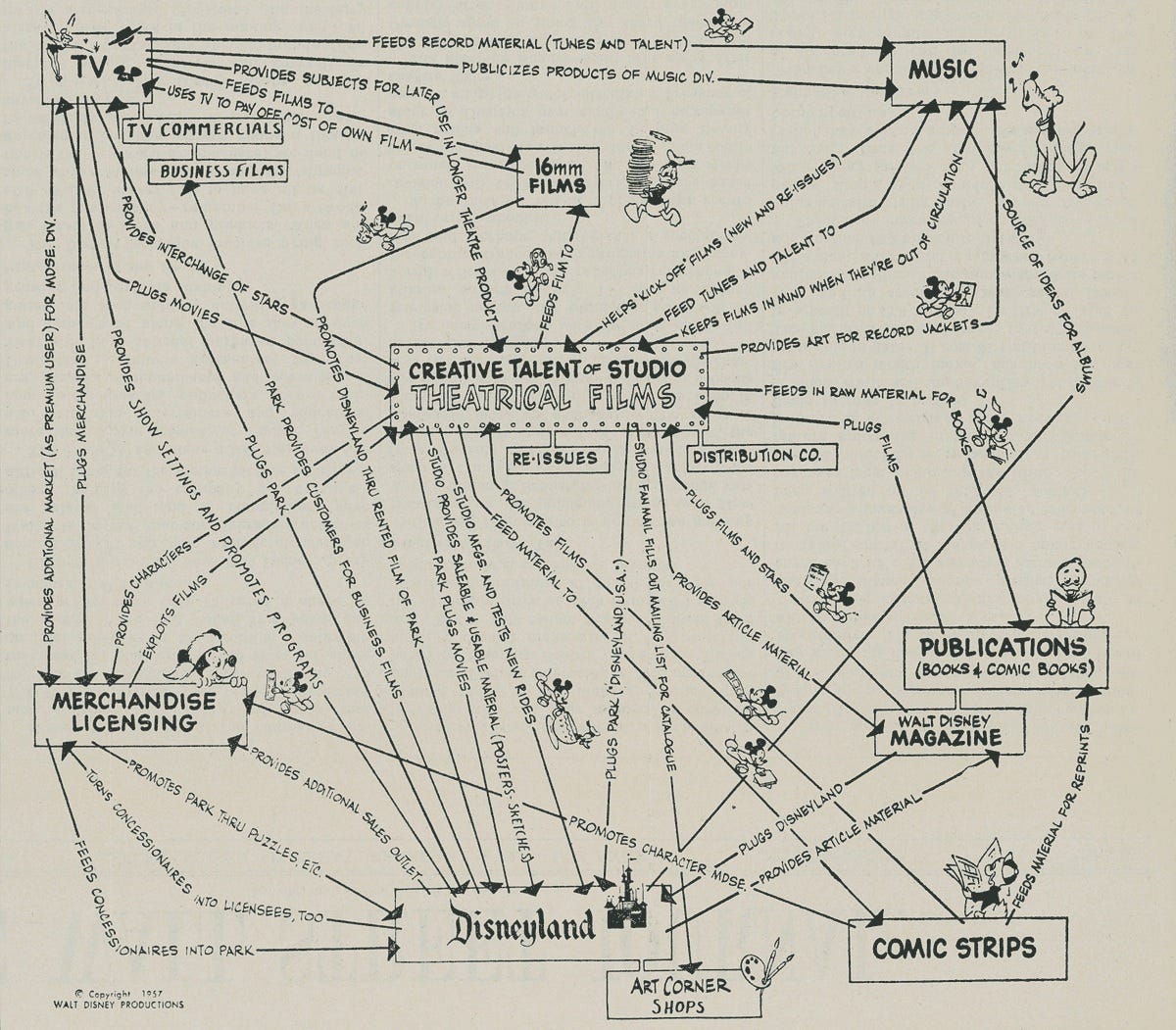
While the Parker Conrad term “compound startup” might be new, the underlying theory behind his thinking is not (that’s not a criticism, by the way). Todd Zenger, a professor at the University of Utah’s Eccles School of Business, developed a term called “cross-sight.” It’s a component of a larger approach to strategy he developed called Corporate Theory, in the 2013 HBR article, “What Is the Theory of Your Firm?” Here’s how he describes cross-sight:
Cross-sight: A well-crafted corporate theory identifies complementarity that the company is singularly able to assemble or pursue by acquiring assets that can be combined with existing ones to create value. Disney’s theory suggested a broad array of entertainment assets that could draw value from a core of animation.9
Put simply, cross-sight is a framework for thinking about how to combine multiple assets, so that the resulting whole is greater than the sum of the parts. Zenger named it; you can see the same logic in how Rippling, SpaceX, Disney, and Apple companies were structured.
Cross-sight may sound like other concepts you’re already familiar with: building a flywheel, creating a platform, or building an ecosystem. But it’s distinct. A flywheel, which comes from Good to Great author Jim Collins, is about compounding a single mechanical loop: Netflix has better shows because it has more audience insights, and it has more audience insights because it has better shows. A platform is a term that’s liberally applied, but it’s really intended to refer to a product or service that connects buyers and sellers, like Shopify. And an ecosystem has to do with bringing in external partners in pursuit of a shared goal, like Formula 1 is doing with its Net Zero initiative.10
How Might Cross-Sight Apply to Ecommerce Co.?
As I mentioned before, our work together didn’t include product direction. But here’s my take on how they might have used cross-sight in practice.
If Ecommerce Co. is in the business of improving margins for merchants, then it stands to reason that the building block for its products could be “customer insights.” The more a merchant knows about its customers, the better its ability to capture revenue (e.g., increased basket size, order frequency) and avoid costs (e.g., fewer returns, better product decisions, lower customer support needs). Customer insights are even richer when they are based on patterns across customers or across time.
Therefore, the solutions Ecommerce Co. builds shouldn’t just solve customer needs; they should be sources of insight that improve the ability of other solutions to improve margins further. This “customer insights” lens could serve as both a requirement for vetting existing product ideas, and a vein to mine for new product ideas.
Cross-sight is about finding opportunities to build things that don’t just create value as standalone offerings, but confer advantages to other solutions you offer. If you’ve already decided on the “game you’re playing” and want to continue your thinking into specific product choices, it’s worth keeping on your radar: especially if you want to avoid the trap of selling a collection of point solutions that offer little benefit over a “best of breed” approach.
Remember: Rippling, SpaceX, and Disney may be worth billions now, but the thinking they used to get there was likely in place early on.
John Rougeux is the founder of Flag & Frontier, a strategy consultancy that helps executive teams align around their strategy and narrative when the future is up for grabs.
This can happen with acquisitions, too, if the acquired products aren’t integrated deeply into the rest of the software. Cisco, Yardi, and SAP are a few examples I found plenty of criticism related to this.
I wrote a related piece to this, called Strategic Narrative is Not Messaging, if you’d like a fuller definition of its role.
Also known as a “franken-stack.”
Ecommerce Co. was a real client, but I am using a fictitious name.
From the Rippling Glossary entry, “What is a Compound Startup?” You can also view a talk that Parker Conrad gave on this theory here.
This section is paraphrased from the Prospectus Summary in SpaceX’s S-1 filing on May 20, 2026. As complicated as my summary was, it’s a simplification of SpaceX’s complete vision of how its businesses work together. But here’s an excerpt to give you a flavor: “The rapid emergence of the AI era intensifies the urgency of our mission, as AI has the potential to accelerate not only space exploration, but also transformative societal advancements on Earth. However, AI’s ability to revolutionize human potential is directly dependent on meeting exponentially increasing resource demands…. The Sun contains approximately 99.8% of the solar system’s energy and, as a result, we believe it is the only truly scalable solution to terrestrial energy constraints in the age of AI… SpaceX is well-positioned to capture this space-based solar energy through our ability to rapidly access Sun-synchronous orbit through our satellite manufacturing scale and launch capability.”
Here’s a short overview of how NASA and SpaceX work together.
According to them. Here’s how Rippling compares itself to Workday.
Zenger, Todd. “What Is the Theory of Your Firm?” Harvard Business Review, June 2013, https://hbr.org/2013/06/what-is-the-theory-of-your-firm.
The initiative involves efforts from tire suppliers, engine manufacturers, travel and logistics providers, fuel suppliers, and more. So far, they are on track.
Comments
Nothing yet. Say the first thing.
Sign in to join the conversation.