

After so many years in the finance industry—a field I would characterize as speculative—whenever I reflect on my major successes, I classify them this way: luck played a bigger role than competence. Not that competence isn’t important, but without luck, my results might have been different. The major turning point in my career came when I started using technical analysis; it helped me primarily with the discipline of entering new trades and with risk management.
I would be unfair to the academic approach if I didn’t acknowledge the importance of fundamentals. They are always present, but it has been a long time since they were my primary focus. Let me give a practical example: looking at Brazil’s fiscal situation, I would say that betting against the real would be the most attractive option in terms of pricing. Readers know I have been looking for an entry point using technical analysis, but one hasn’t appeared yet. This is a classic case where fundamentals point one way but technicals haven’t confirmed it yet—and for me, the latter carries much more weight when it comes time to pull the trigger.
This tug-of-war between fundamentals and technicals has entered a new chapter with artificial intelligence, and Bloomberg recently offered an interesting look at this trend. The report highlights individual investors trying to replicate at home what funds like Millennium and Citadel achieve with armies of PhDs: one investor spent over a year programming an automated options system—without outperforming a simple index fund—until he rebuilt the model with more rigorous testing and loss limits; another connected an AI dashboard to his brokerage account and claims to have made more profit than he could on his own, without needing to monitor the market all day; a third outsourced decisions to an AI agent, arguing that the machine eliminates the bias and fear a human brings to every trade. I can’t say for sure if these home-grown models will actually succeed in the long run, but looking at what happened to the fund industry—including hedge funds—it doesn’t seem like a good idea to try to copy what they do. The report cites Millennium and Citadel specifically as benchmarks, but the author may not fully grasp what these funds actually do: they allocate capital among dozens of internal managers, employing a constant model of bringing in top performers and letting go of those who fail to deliver. It is a smart strategy because it captures the upside of each manager while discarding them as soon as results deteriorate—precisely what these amateur investors cannot manage on their own, lacking the infrastructure to quickly replace underperforming elements.
This trend of amateurs turning into home-grown “hedge funds” is not an isolated case. It fits into a broader pattern of capital migration I have been tracking: traditional funds are losing ground to ETFs. Over the last decade, $170 billion has flowed out of multi-strategy funds in North America, whereas ETFs have attracted over $7 trillion since 2016. The explanation is no mystery: index replication is cheap and, more often than not, delivers results that most active managers fail to achieve consistently. Those who get it right often do so only for a time; winning for a short period doesn’t justify management fees in the long run. It is no wonder ETFs are so successful in the US market.
Speaking of questionable management, Michael Saylor of MicroStrategy has finally taken a positive step. The company sold $333.7 million in common stock to repurchase preferred shares and bolster its cash position—not to buy more Bitcoin. There was no movement in its cryptocurrency holdings during the seven days ending August 16, and the company hasn’t bought Bitcoin since mid-June. It is only a modestly positive step, as the ideal move would have been to sell some Bitcoin to fund the repurchase. But perhaps Saylor is realizing—albeit belatedly—that the “infinite accumulation” model isn’t working the way it used to. If he stays on this path, shareholders will eventually realize that, ultimately, MicroStrategy looks increasingly like a Bitcoin ETF, only with much higher costs. I believe that all this effort to maintain the structure will ultimately be in vain.
So, I return to the question in the title. It is far more gratifying to attribute a successful trade to competence than to admit it was luck—because admitting luck can make it sound as though you simply flipped a coin and let chance decide for you. But I can assure you: if you aren’t honest with yourself in this assessment, your ego will cost you money. When closing a trade, take stock of the situation sincerely. Over time, I believe you will reach the same conclusion I did. It is the same reason why so many professional fund managers—despite having vast resources and PhDs at their disposal—fail to replicate their performance year after year. Getting it right once is luck disguised as talent; getting it right consistently is a different story. It requires a model, discipline, and, above all, risk management. There is no point in trying to recoup losses by increasing your bet size, nor in chasing that one “big score” to solve all your financial problems at once—when that actually works, it is a matter of sheer luck. That is where the difference lies between a trader and a survivor.
Technical Analysis
In the post “nvidia-garante-galera,” I made the following comments regarding the IBOVESPA:
“Under this new hypothesis, the orange ‘wave C’ could end at 160,000 (-4%) or around 150,000 (-6%); I used orange symbols to mark this. Crucially: if the market drops sharply and continues its downward trend, hitting 119,500, my scenario predicting a continued rise will be compromised, and I will have to revise my hypotheses.”
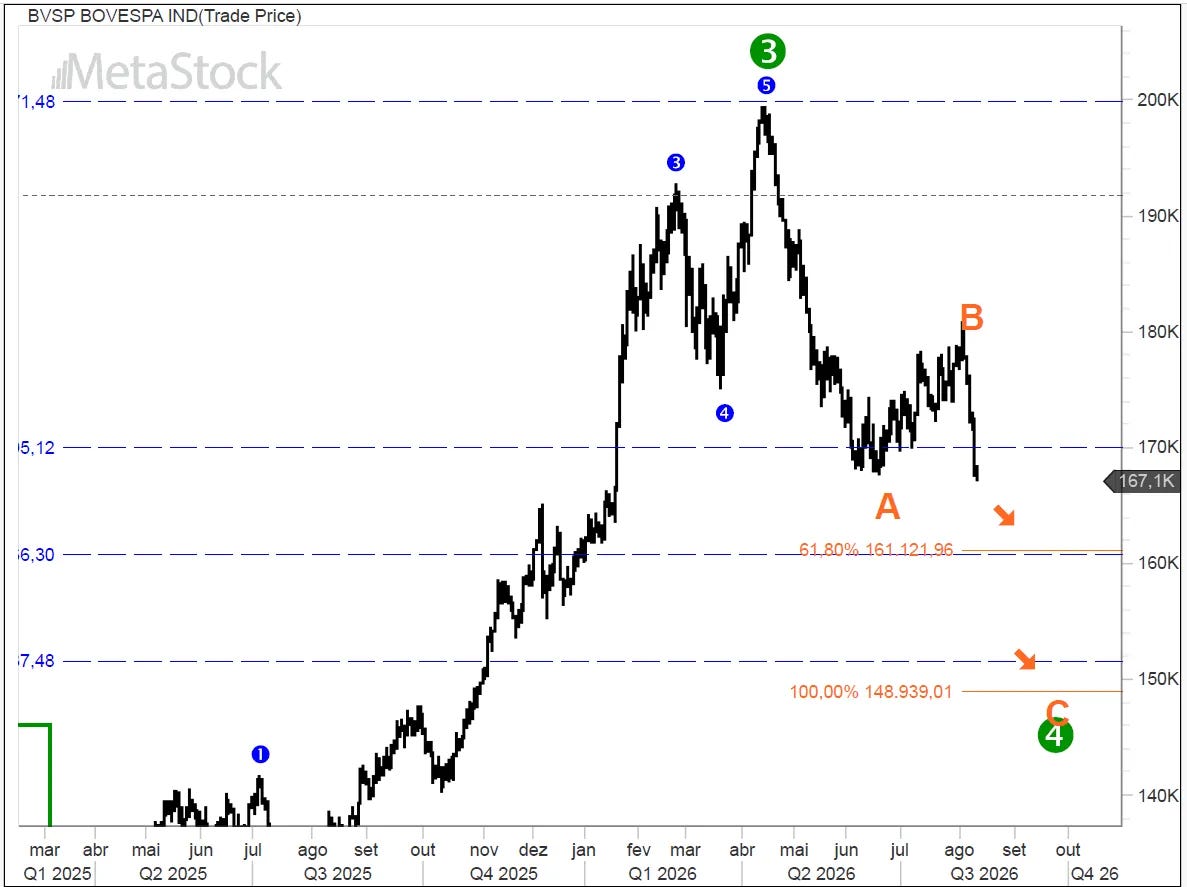
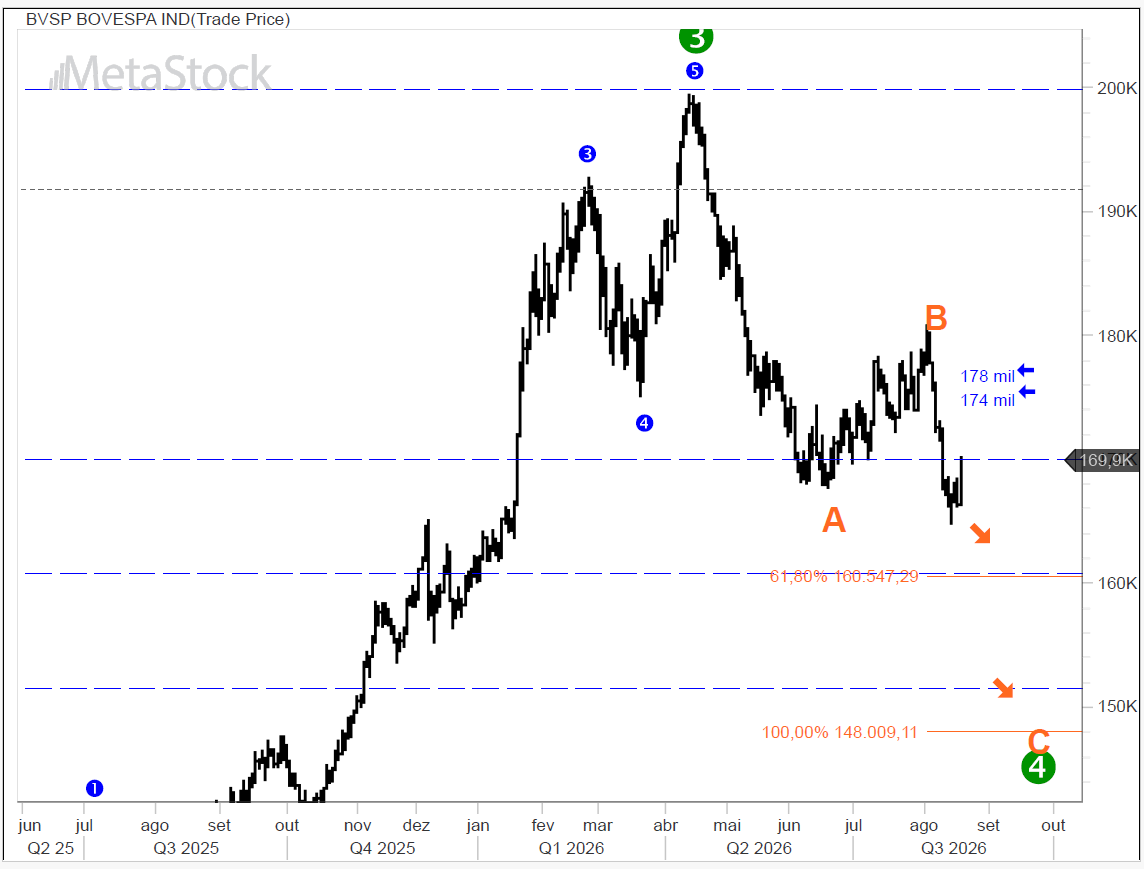
This morning, the US Treasury announced plans to repurchase long-term US bonds (maturities exceeding 10 years) and sell shorter-term bonds in their place. Markets will likely react positively: stock exchanges—including Brazil’s—will rise, while interest rates and the dollar will fall. Are the Americans trying to copy the Japanese? In a way, yes. I do not think it is a good idea; it might work in the short term, but the pressure for higher interest rates is a more widespread factor, as I discussed in yesterday’s post, “tudo-tem-dois-lados” (everything has two sides). As I mentioned above, in the scenario I am working with, the stock market would still see a slight decline from current levels. Although it did not reach the initial 160,000 mark, the correction might be over—I emphasized the word “might”: I am not implying that it has definitely ended.
How should one position oneself? For now, observe. If we are in an upward trend, two things must happen: the market must surpass the 174,000 and 178,000 levels and show a five-wave pattern on a shorter timeframe. On the other hand, if the decline is ongoing, the market should fall again without breaking through the aforementioned levels—a technical detail: to rule out the possibility of further drops, the 180,600 level must be surpassed.
At 4:30 PM, the S&P 500 stood at 7,719 (up 0.36%); the USDBRL exchange rate was R$ 5.1711 (down 0.91%); the EURUSD rate was € 1.1678 (up 0.89%); and gold was at US$ 4,508 (up 4.01%).
Stay tuned!
Original Post: Click Here
This is not an investment recommendation.
About the Author of this Post: David Gotlib has 45 years of experience in investment management. An engineer from Polytechnic School of the University of São Paulo, he was one of the founders of the first Brazilian hedge fund in 1993 (AUM US$ 1 billion). Later, he was Managing Director of Deutsche Bank Asset Management (AUM R$ 2.2 billion) until the company was sold to Bradesco. He is currently the manager of his own investment portfolio and the author of the blog Acertar na Mosca, where, since 2011, he has shared his thoughts on the global economy and the financial market on a daily basis.
Comments
Nothing yet. Say the first thing.
Sign in to join the conversation.