
My conversion was at church camp, around a bonfire. While the youth pastor played quiet acoustic guitar, he talked about:
“the God-shaped hole we all have that only a relationship with God can fill.”
He asked if we were lonely sometimes and if we tried to fill that hole with toys, friends, making our parents happy. Under stars that felt like silent angels, the pastor asked us to close our eyes and raise our hands if we wanted to fill our lonely hearts with God.
I was scared, but I raised my hand. I knew about loneliness more than anything. He led us through the sinner’s prayer, and I invited Christ into my heart.
In the years to follow, I became a very real Christian, fully invested, fully committed.
I didn’t do it out of obligation or because my parents made me go. I loved going to church, asking questions in bible studies, engaging in the youth group. After high school, I moved to California where I attended Lutheran Bible Institute in Anaheim. I told people I was going there instead of a regular college, “Just to learn why I believe what I believe”.
In hindsight, it wasn’t the truth. The real reason I went was because my four best friends and one of them—a girl I liked —were going and I’d do anything to not be lonely.
In the early 2000’s, I co-taught a Wednesday night bible class of maybe a dozen grade schoolers at Camelback Bible Church in Paradise Valley, AZ. I don’t remember what the lesson was about, but I set it up by reminding them of the creation story and Adam and Eve and the serpent in the garden of Eden.
“On the first day of creation,” I said. “God said
“Let there be light.”
And then I heard myself say:
“God didn’t make the sun and the other stars until the fourth day. How is that possible?
You know? Cause light comes from the sun and stars, right?
A boy enthusiastically raised his hand.
“I think I know!”
I humored him.
“Maybe, like, God made light, and it was everywhere and then he just crumpled it into balls of suns and stars a few days later?”
I giggled, then carried on with my story. Somewhere between Eve and the forbidden fruit, I said:
“Wait a second. Do you guys think Adam and Eve talked to animals all the time? Was Eden like Narnia where all the animals talked, so it was no big deal for a serpent to be talking?”
The kids blinked at me, intrigued.
“I don’t know the answer,” I said. “I was just thinking out loud.”
I laughed it off and went on with my story, but the question stayed with me. After class, I asked my co-teacher, then the children’s pastor, then the senior pastor himself:
“Why do we teach this story as though it’s completely normal that a serpent is talking Eve and Eve is just rolling with it like it happens all the time?
Why don’t we say that we don’t know?”
They all brushed it off.
“I bet there’s a lot of things in the bible like this that’s never talked about and we act like it’s completely normal. Why doesn’t our church leaders and teachers bring it up and face it head on, even if the answer is “we don’t know”?
“Theological white space,” one called it, as if my curiosity was a waste of time.
The silence I heard around the question was louder than the question itself.
Around the same period, I wanted to become a teacher instead of only an assistant, like many of my friends who were moving into those roles. I knew I was good with people and conversations came easily for me.
The process was laid out clearly by the head of church teachers:
Complete five steps
Memorize the material
Demonstrate readiness
Deliver a sample lesson with a leader watching.
I aced the first three.
And then: silence.
Weeks passed. I followed up, asked when my practice teaching slot would be scheduled. I got polite half-answers, vague promises, and no scheduled date. Eventually, I expressed my frustration about why they were stalling to my dad.
“I can tell you why they’re hesitant,” he said.
His reply cut sharper and deeper than he knew.
“Joey, it’s because you ask questions that make people uncomfortable.”
“If my questions cut to the heart of things, in an honest, sincere, polite way then why would a church—of all places—be afraid of them? Isn’t that what we’re about as Christians? Truth?”
His silence was not passive. It was deliberate. Intentional. I didn’t realize then that silence would keep following me, louder each time.
A decade later, in 2016, I’d begun to wonder about the history of the Lutheran church. In researching the life of Martin Luther, I came across a Wikipedia entry that alarmed me. I brought it up with my mom.
“Did you know, that though Martin Luther wanted to convert Jews to Christianity for most of his life, that in his later years he wrote a book called On the Jews and Their Lies, where he advocated that Jewish homes be burned, no mercy be given, they be drafted into forced labor, and that ‘[W]e are at fault in not slaying them’?”
“No, I’ve never heard that,” she said calmly, like I’d just mentioned it might rain.
“Doesn’t that surprise you?” I said. “I went to a Lutheran Bible school for two years. I studied the bible and Martin Luther extensively in classes. I spent my life in Lutheran churches and membership classes. Not once did anyone mention this.”
Her response was almost dismissive:
“Nobody’s perfect. It just shows the love of God that he uses anyone.”
Why was her first reaction silence to my question and instead defensive?
Why wasn’t this knowledge not only admitted, but embraced as being alarming?
Why wasn’t it part of membership classes, an honest acknowledgment of the man the whole denomination was built around? Like “…but we denounce Martin Luther in his later years”?
Why was silence always the default, be it a serpent or the darker chapters of Christian history?
Last Thursday, I walked through downtown Phoenix after a nostalgic concert where I’d seen Toto (my fifth time seeing them, going back to the early 1990’s), under a moonlit sky, the smell of summer rain still in the air. As I waited alone for the intersection light to turn green, so I could cross, I said out loud:
“I’m an atheist agnostic.
Atheist, because I don’t believe there’s a God.
Agnostic, because I know I can’t say for certain.”
I admitted silently that the truth is messier than either word allows. I can’t ignore the possibility of a creator. Some days it feels likely. If there is one, I imagine they’d want something personal, interactive, intimate. Most days it seems unlikely. I’ve been listening for the truth for a long time (and I won’t stop) but I won’t accept non-answers anymore.
The labels of ‘atheist’ and ‘agnostic’ don’t fit snugly, but they get me close enough. That’s where I live now: inside the tension, and somehow, at peace with it.
I’m comfortable not knowing, with living inside questions that may never resolve. That isn’t resignation: it’s freedom, joy, and love for who I am: questions, curiosities, and authenticity.
If silence is what a community serves, I’d rather name it and laugh than drink it blind.
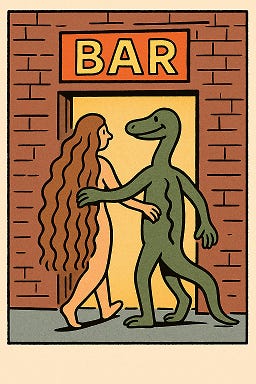
A serpent and Eve walk into a bar.
“What can I get you?” says the bartender.
“I’m not thirsty,” says Eve.
“And for you, sir?” says the bartender.
“I’ll take a tall glass of White Space.”
No posts
Comments
Nothing yet. Say the first thing.
Sign in to join the conversation.