
Read Part 1:
You think you’re at the bottom? You aren’t quite there yet…
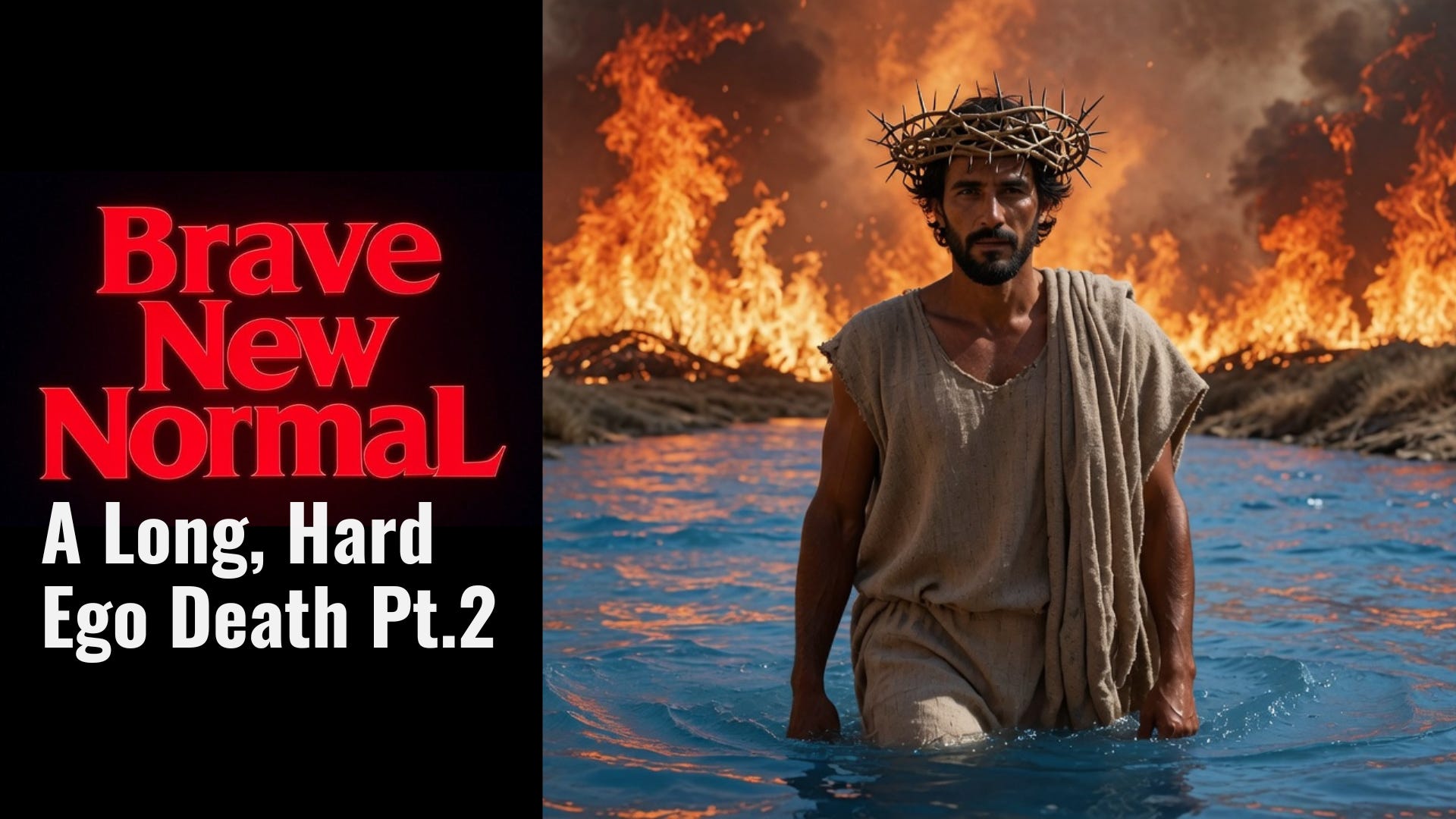
That was the phrase ringing in my ears as I smashed through the floor and was swallowed by the abyss. For the next six months I was repeatedly forced to confront my anger, hatred and bitterness. In those moments where it all surfaced I was held there, pushed inside, thrown through it; made to observe myself and the pain that distanced me from the love that was waiting on the other side. Every time I hit the bottom I slid and fell into another layer of anguish; another series of memories from a past life; another theater of my own wickedness. I white-knuckled through that summer and early fall while God fractured the person I thought I was and tore away my ego one millimeter at a time. The burden I carried was being removed. The extraction was like having my entire skeleton pulled through a pinhole opening in my skin. It all culminated on that snowy October morning driving in darkness. My eyes felt like I hadn’t slept in years, my bones were weathered and creaking beneath tired muscles. I begged God to reveal my path to me with the same desperate sincerity that filled my heart when I handed my life over. Less than an hour later I stood in the parking lot, spiritually naked and renewed, laid off from my dead end job with a single mandate:
Go and do the work.
Do the work. Go into the world and share the love that replaced my wretchedness. I had been pulverized and purified—and now I was ready. God touched so many people through me during that time, and for every broken person I laughed and cried with, there was another who immediately dismissed me as a worthless gig worker. Through them I learned humility. I discovered humanity in desolate places, and desolation in the superficial constructs designed to give the impression of fullness. I found the real world, and was shown what both connected me to it and repelled me from it. I learned to cherish the brief instances where the intangible threads that run between us become perceptible, and how to empathize for those who seem to have missed the magic altogether. It was an eighteen month masterclass in the human condition—and an education God spent six months preparing me to receive.
You don’t need this anymore.
The voice spoke to me again on a Saturday during my routine visit to the liquor store. I was staring into the cooler deciding on which case of beverages to purchase when the desire to drink alcohol left me completely. I was never an alcoholic in the sense that I needed to drink in order to function, but I had a compulsive habit of drinking on the weekends to escape the sadness of unrealized dreams and the immutable sense of crushing inadequacy. I wish I could say this moment of clarity occurred early in my transition, but it didn’t. I think God allowed me to keep this vice for a short time because that early period of transformation was so extreme I wouldn’t have survived without it. But now, on the other side of the fire, I no longer carried the resentment that fueled much of my drive. I had been freed from the dungeons I spent my life inhabiting, and as a newly liberated spirit, I felt no inclination to escape. My emancipation from alcoholism was something I could’ve never imagined in years prior, much less the ease with which I was able to leave it behind. It was the final layer of an old skin that belonged to a person who died in the furnace.
Brave New Normal is a reader-supported publication. To receive new posts and support my work, consider becoming a free or paid subscriber.
Start with the gospels.
Those were the instructions I received, and that’s where I began—with Matthew, Mark, Luke and John. As I pressed forward through the New Testament I noticed something bewildering: Jesus’ message in the gospels was often contradictory and contradicted the later messages in Paul’s epistles. What I noticed almost immediately were the sudden changes in language and tonality in the middle of a passage or a verse that seemed to be inserted between others to change the meaning. As a writer, my eye is trained to read for authorship. I can see the markings of editors quite plainly and those editorial fingerprints were all over the New Testament.
The key to finding the later additions and edits in the New Testament is in reading it chronologically or almost backwards. I, like most others, had always assumed it was assembled in chronological order—but it wasn’t, and now having read it both ways I’m convinced it was compiled with the intent to deliberately deceive the reader. The Epistle of James, Jesus’ brother, is relegated to the latter third despite being the oldest book in the collection.
If you begin with James you get a clear understanding why: his letter is a warning about everything that comes after. He’s writing roughly ten years after the crucifixion of his brother and is watching Jesus’ transformation from man to idol in an emerging theology spearheaded by a Roman Pharisee and former persecutor of Christians (Paul). He tells us in his address to the Twelve Tribes of Israel that his brother is not God, and that faith in Jesus Christ without the works of love and charity that characterized so much of his brother’s teachings will bring you no closer to God than you would be without it. James’ epistle was almost excluded from the Biblical canon and was only included by the early church fathers because of his blood relation to Jesus.
James is an essential preface to Paul’s seven authentic epistles (thirteen total, seven confirmed authentic), and the next oldest books in the New Testament. The first five—1 Thessalonians, Galatians, 1 and 2 Corinthians, Romans—are written largely in defense of his revelatory claims and credibility as the “thirteenth apostle,” and at times is a scathing rejection of James, Peter, the Jerusalem Church and “the circumcision” (Judaism). It appears by this point James, Peter and John (the fisherman, not the Baptizer) had caught wind of what Paul was up to and began to travel, warning against the new religion Paul was proselytizing for. The last two epistles—Philemon, Philippians—take on a more somber tone as Paul begins to realize what his fate will be as a Roman prisoner.
I have no doubt in Paul’s conviction as a Christian convert. He was beheaded under Nero after the Great Fire of Rome in 64 AD, for which Christians became the scapegoat. Paul was a true believer, and stayed a believer until he faced the edge of a Roman sword.
Mark is the oldest of the four gospels but was written after Paul’s theology took shape, which means Paul’s theology was written into the account. In this first telling of the Jesus story the virgin birth is not included and the earliest Greek manuscripts abruptly end with Mary, Jesus’ mother, Salome, Jesus’ sister, and Mary Magdalene, Jesus’ “companion,” discovering the empty tomb. The sightings of the resurrected Jesus were added later as other folkloric stories began to circulate. Matthew and Luke are written 10 - 20 years later, and John ten years after Luke. What we can observe in the chronology of the gospels is the evolution of a legend. Matthew injects the virgin birth and resurrection sightings into the narrative, Luke attempts to reduce the accountability of Pontius Pilate and the Romans in Jesus’ death, and John becomes a wholly mystical text that strangely incorporates historical details not found in the other gospels with an expanded emphasis on the more fantastical elements. What’s obvious is that as more pseudonymous epistles written in Paul and Peter’s names begin to surface, the more extravagant Jesus’ story becomes in the gospels. Incredibly, we have a letter from Jude, Jesus’ youngest brother, written during this time and unsurprisingly included as the second to last book in the New Testament, that echoes James in warning about exactly what was already happening in diverting from the righteous path Jesus called us to follow.
To locate the real Jesus Christ we have to look outside of the canonical New Testament and into texts like The Didache (early Christian handbook for new converts), Dead Sea Scrolls (pre-Jesus Essene documents) and the Gospel of Thomas—a collection of 114 sayings from Jesus with no narrative structure that was a primary source document for Mark. Matthew, Luke and John use Mark as their foundation with Matthew and Luke incorporating parts of another lost (Q) text in their writings.
When we go to the source we find Jesus the man: a devout Jew influenced by a lesser known Essene sect who worked in a blue collar field and discovered his calling sometime in his mid-late twenties. Jesus was the Messiah, but there were many before and after him who would lay claim to the title. He grew up during a time of social and political unrest as Jews struggled against oppression under the Roman Empire—specifically in the Galilee region, which was a hotbed of revolutionary activity. He would have witnessed a series of revolts and would have perhaps been inspired by figures like Simon of Peraea: a former slave who led a short-lived yet storied revolt against Roman client King Herod around the time of Jesus’ birth.
Jesus Christ didn’t die for your sins in some ceremony of ritual human sacrifice—that’s the story we prefer because it makes us feel special and worthy of God’s love by virtue of simply existing. Jesus was brutally tortured, humiliated and crucified high on a hill above Jerusalem because he threatened the power structures of his time. His Nazarene movement challenged the corrupted Jewish temple system under the Sanhedrin: a council composed of Pharisees (priestly class), Sadducees (aristocratic class) and Scribes (legal class). He, as the Nazarene leader, was a direct menace to the Herodians (Israel’s ruling dynasty) since his claim to Davidic lineage placed him as the prophesied King of the Jews, which could ultimately break Rome’s loosening grip on that side of their empire. To the Jewish elites he was a harbinger for a total overthrow of their power, and to Rome he was a pest that needed to be squashed. After John the Baptist was beheaded by Herod Antipas, Jesus knew his days were numbered. He withdrew from public life for a brief period and returned to Jerusalem on a donkey—a blatant declaration of himself as king; a fulfillment of Zechariah’s prophecy (“see, your king comes to you, righteous and victorious, lowly and riding on a donkey”). He was nailed to a cross less than a week later.
There’s no real indication that Jesus or his inner circle—James, Peter and John (the fisherman)—ever intended for their non-violent baptismal revolution to grow beyond the borders of Israel. Ironically, it was Paul who would continue Jesus’ mission to create the kingdom of heaven on earth as he spread the Nazarene message far and wide across Rome. We as 21st century non-Israelites only know the name Jesus Christ as a result of Paul’s efforts—and I would go as far as to say this includes Jews since the memory of Jesus would have dissolved with time as just another Messiah among many. As Christianity progressed beyond Paul, the early architects knew the Romans would never accept a doctrine taught by a poor Jewish laborer, so they incorporated paganism with Egyptian and Greek mythology to create Jesus Christ, the living God. The virgin birth, embodied resurrection (the literal physical return to life or as I have coined it: “Zombie Jesus”), and Eucharist (communion) became the mythological cornerstones that would eventually move Rome to adopt Christianity as their official religion in 380 AD—long after Jesus, James, Peter, Simon and Paul had all been executed by the empire.
Take up your cross and follow me.
I don’t know if Jesus actually spoke those words verbatim—the foreshadowing is a little too on the nose and screams of editorial coloring—but this is the teaching I’ve come to live by. One might think that downgrading Jesus from the status of God to flesh and blood human would dramatically reduce the power of his words, however, in my mind it’s done the reverse—it’s made him more powerful. He was a man with a real history, real influences, real traditions. He had a mother, father, probable wife (Mary Magdalene, his “companion”) and potentially even children—and I say this because marriage and family were central to Jewish society at that time. He was calling us to let go of our worldly burdens and carry a greater purpose—something of larger magnitude; of cosmic consequence. He was instructing us to pour love into the world; to sacrifice our selfish tendencies for service to those in need. He showed us the pathway to God—and it isn’t through any religious rituals, it’s through the empathy we feel for total strangers, the compassion we share without expectation, the forgiveness in our hearts for those who have been deemed unforgivable. It’s through these acts that we create the kingdom of heaven on earth as he envisioned, and it’s in what Jesus actually stood for that I found the spiritual philosophy I’ve committed my life to.
My journey is far from over, and I’m sure in a year I’ll revisit this essay with a different perspective as I continue to grow—but I know the hardest part is over. My time inside the belly of Leviathan was crucial to my transformation, and I reflect on it now as a series of tests; a trial by fire to prove my worthiness of God’s grace. In the aftermath of the initial transition I’ve become a better husband, father and person. As the leader of my household I set a quiet example and my wife followed me along this path with my children in tow. I consider myself a non-religious Christian, but we attend a Pentecostal church because I believe it’s the portal to locating the man behind the myth. My wife and I hold frequent discussions about the sermons—the good and the bad—and I can see the same flame that ignited in me three years ago flickering in her heart.
“I am the way, the truth, and the life: no man cometh unto the Father, but by me.”
Amen.
Thanks for reading Brave New Normal! This post is public so feel free to share it.
Comments
Nothing yet. Say the first thing.
Sign in to join the conversation.