
I’ve been working on this essay for three years. I couldn’t find the words to explain my transformation. It was difficult to capture my thoughts since the change was so abrupt and constant. Every time I picked this up from where I left off I had to start over because my view had drastically expanded or altered completely.
But then midway through a Catholic mass I was required to attend I found the thread I’d been searching for. I was at the center of a spiritual black hole; a theater of rituals and prayer chants; a building erected with the purported intent to house God, yet had long been purged of any living spirit that may have at one time been present.
Faith without works is dead.
That’s the crux of the polemic Jesus’ brother James wrote against Paul the Apostle. He was watching as the teachings of his older brother and Nazarene Messiah were warped by a Pharisaic convert. Paul turned his brother into an idol for blood sacrifice—the exact cult behaviors Jesus and his Nazarene group were rebelling against, and the religious orthodoxy the Romans crucified Jesus to protect at the behest of the Jewish high priests. Paul’s manipulation of the Nazarene traditions laid the foundation for what ultimately became the Roman Catholic Church and later Protestant Christianity. To date most Catholic and Christian leaders build their ministries around Paul and the Old Testament. Jesus is rarely referenced, and when he is he’s deliberately quoted out of context because Jesus is near impossible to square with Paul’s mythic theology. Jesus’ message was clear: unconditional love is the only gateway to God. It was a simple yet arduous message to follow. How does one love their enemy? How does one conquer the darker aspects of human nature?
Paul entertained the same questions and concluded that humanity couldn’t, so he turned Jesus into God, therefore making Jesus an ideal we lowly humans could never reach. He wrote of Jesus as a ritual sacrifice to God, thus justifying the previous sacrificial systems Jesus vehemently rebuked. But why would God sacrifice himself to himself? Why did Jesus cry out that he had been forsaken by God in his dying moments nailed to a cross? Why did the God of peace and love demand death and murder?
Paul can’t answer these questions either and that’s why he created a shortcut. Jesus was explicit in that faith, though important as a foundation, wasn’t the way to God. It was through works—and works meaning through acts of selfless love—that humanity connects to the greater spirit and builds the kingdom of heaven on earth. Paul created a faith-based ideology that reduces the emphasis of works in favor of belief. The only requirement in Paul’s theology is an acceptance of Jesus Christ as the personified God. Works are less important than faith, and faith is the preferred method for those who would rather claim to believe than put their claimed beliefs into action and do. The contradictions become obscured because questioning the tenets of faith is considered heresy, and consequentially, confronting the contradictions becomes sacrilege.
That’s how Christianity grew into a behemoth that massacred millions of people across centuries. Paul’s faith-based system gave cover to conquest; torture, savagery and murder were justified as long as it was committed in Jesus’ name.
And Jesus was lost in the process. John the Baptist was Jesus’ cousin and teacher. He was considered by the Nazarenes as the Levite (priestly) companion Messiah to Jesus, the Davidic (king) Messiah. Jesus himself proclaimed there were “none greater born of a woman”—a declaration that diminished his own significance since he too had a mother. John was arrested and beheaded by Herod Antipas in 29 AD. His role in modern Christianity has been reduced to a footnote in the New Testament. Similarly, James was Jesus’ brother and was named by Jesus as his successor. He was stoned and clubbed to death under orders of the High Priest Ananus thirty years after Jesus was crucified. James has been purposefully erased from Christian history with his lone epistle shoehorned into the closing pages of the New Testament, despite being the oldest book from that period written by the Messiah’s brother and undisputed leader of the Jerusalem Church.
Peter, who has been mythologized as the first Catholic pope—although there is no evidence to suggest this is true—was crucified upside down by the Romans. Simon, Jesus’ second youngest brother and inheritor of the Jerusalem Church after James, was tortured and crucified in Rome as well. The rest of the Nazarenes were pursued and scattered at the demands of the early church fathers. The works-based philosophy Jesus taught needed to be destroyed.
That’s why the church feels empty—because it is. It’s an extension of Paul and Rome and the religion that was established as a mechanism of imperial control. It successfully eliminated Jesus by adopting Jesus as a deity. For most of my life I was repelled by Christianity, and it wasn’t until God called me that I understood why. I never considered myself an atheist, but to date I empathize with atheists because their reasoning is sound. They are correct in their assessment of Christianity as a fairy tale. It is largely folklore written by a former persecutor of the Nazarene movement who claimed to have visions of Jesus until he himself was beheaded in Rome around the same time Peter was crucified.
Go and do the work.
Those are the words I heard while standing in a snowy parking lot on October 23rd, 2023. Less than an hour prior I was driving down icy roads in the dark, begging for God to reveal my path to me. Thirty minutes later I was laid off from my job and given the opportunity to start again from zero.
I spent eighteen months driving for Uber while I built Brave New Normal. I didn’t know exactly what “work” meant. I didn’t sell my possessions and give to the poor like Jesus commanded. I didn’t fly to Africa and cure diseases. I was alone in my car, driving strangers around the city by day, then talking to journalists and academics in recorded conversations by night.
I assumed “work” meant the podcast I launched since the timing was impossible to ignore. I was laid off on the same day I was scheduled to record the first episode. I immediately connected the two together and came to the conclusion that hosting a podcast was the path God had always intended for me to follow. But as I spent ten to twelve hours a day navigating highways, residential streets and dusty range roads, I came to understand that the work God sent me to do was less extravagant than I imagined.
Every day brought an endless stream of broken people. I drove politicians, prostitutes, professors and drug dealers to all corners of the city and beyond. Naturally in most instances a conversation would materialize, and in those conversations I became a low-rent therapist. What I discovered is that most people just want to be heard. They want to share their stories and intimate thoughts with an unbiased ear. I was the perfect sounding board since I would listen and provide insights, yet they could confidently speak without caution since the probability they would ever see me again was almost nil. I learned a lot about the human condition during that time, and I had countless interactions with people who appeared to be straddling the line between their present dilemmas and something much darker. I was informed daily that I helped solve a problem or brought solace to inner turmoil. On a handful of occasions I was told that I had inadvertently talked somebody out of harming themselves or others.
Come out and be separate.
Paul wrote that in his second letter to the Corinthians, and it’s one of the few passages from him that spoke to me. I carried a chip on my shoulder for most of my life. Since I was a child there was something inside that set me apart; something that made me feel and appear slightly off-center. It was a force flowing through me that compelled me to constantly create; music, screenplays, graffiti, essays—even the words you’re reading now are the product of that compulsion. I could never turn it off. That engine was always roaring; my internal pistons firing at maximum RPMs even in my sleep. It was a curse that I lived with; an obsession that never let me rest, never allowed me to stop dreaming. I sped through life at high velocity, never able to live in the moment, always whittling away at another creation.
I lived in chaotic solitude because of it. I was always reaching for something bigger than what was in front of me. Nobody could understand my creative visions or why I would pursue them in the first place. I could never explain why I felt I might die if I didn’t indulge them. I still can’t. Writing it now I feel stupid sharing that about myself, but it’s the most honest way I can communicate it.
That eccentricity made me a target for bullies and miserable people. The non-dreamers couldn’t connect with me on any level. I was often singled out for ridicule or deliberately ignored. I didn’t like most people since I had developed a disdain for what I believed were the dominant characteristics of human nature, while at the same time spending a lot of my life seeking approval from the people who wished nothing but to watch me fail, and knowing this, devoting most of that creative energy to proving them wrong.
Now here I was: an Uber driver. I landed exactly where many predicted I would. Were this any other period in my life I may have spontaneously combusted from the agony of it all. But I understood this was the first leg in a new journey. God was refining me into something greater than what I was.
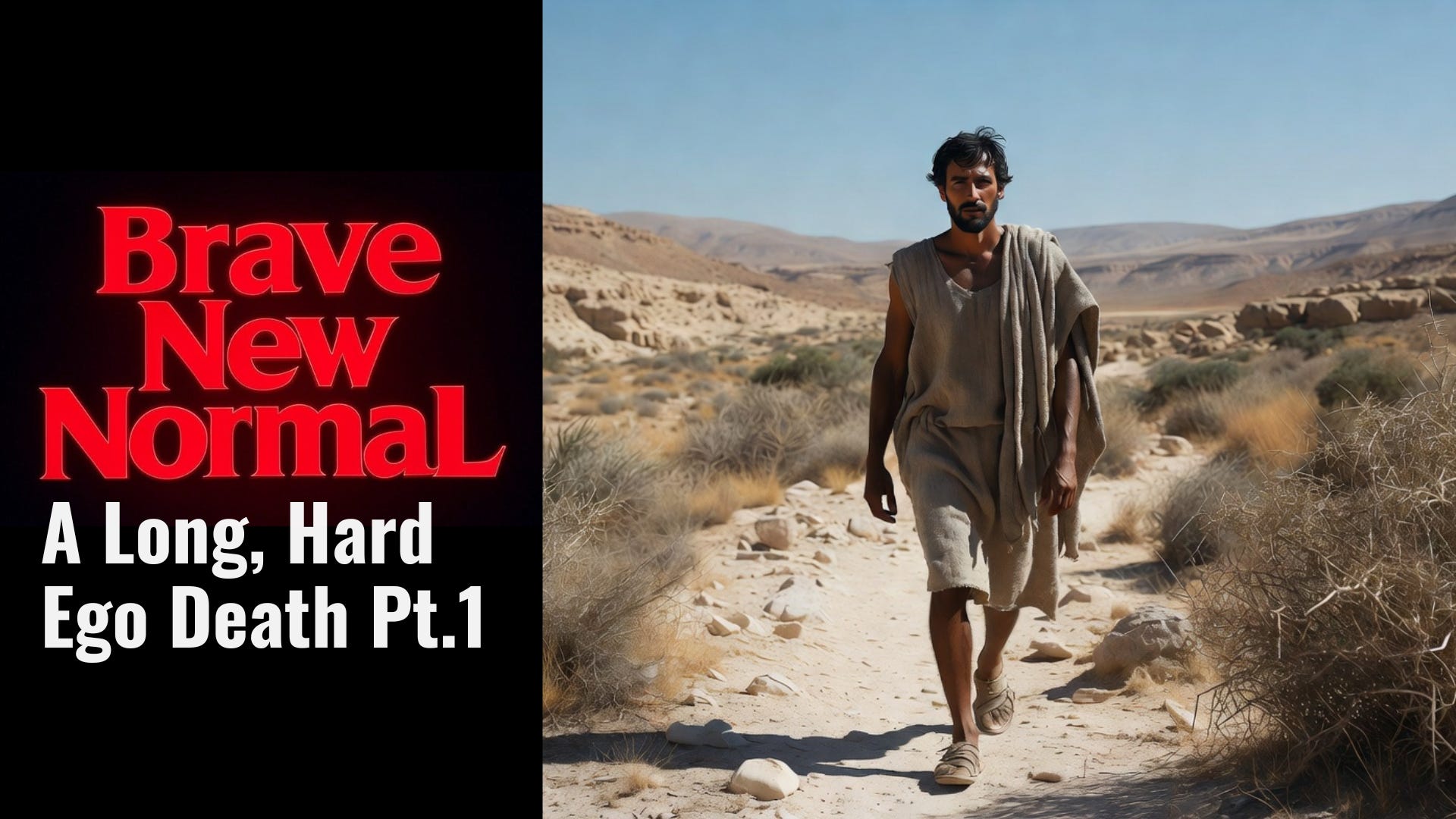
Jesus in the desert.
Shortly after being baptized by John, Jesus fasted in the wilderness for forty days and forty nights. It’s here that he’s tempted by Satan.
But why does Satan appear while Jesus is fasting in self-imposed isolation? Why doesn’t Satan appear to him at any other point in his written story?
To truly understand what this story means, you have to get to the Hebrew root of the word “Satan.”
Satan is often described as a fallen angel or external figure in Christian lore. He is evil personified; the antithesis of all that is holy. But the name Satan itself derives from the Hebrew śāṭān, which translates to “adversary” or “accuser.” In the Old Testament or Torah, the word “satan” (frequently lower case) is used to describe an oppositional force. It generally represents an external threat or internal challenge. Satan doesn’t appear as a singular demonic entity until later in the chronology of the New Testament after Paul and the Romans had established Christianity as a theology. That’s not to say Satan didn’t or doesn’t exist, but the image of a horned devil with a pointy tail is a Christian invention. What Satan actually is—or at least the way I’ve come to understand it through my own reading—is an absence of God; the furthest edges of darkness where light does not penetrate. If God is the omnipotent source of life and love, then why would God create a being that lusts after death and depravity? And if God gifted humanity with free will, then humanity was also given the choice to either retain or abandon our relationship to our creator. It’s in this context that Satan begins to make sense—as a product of free will in absentia of God; a spirit generated out of the rejection of light.
So considering Jesus lived and died thirty years before Paul’s “revelation,” it’s safe to assume that the version of Satan that visits him is not the entity Christians imagine. Jesus was roughly thirty years old at the time of this experience, and had just come to realize he was the Davidic half of Zechariah’s Messianic prophecy. He was the man who would be king, destined to overthrow Rome and restore Israel as the seat of God in the Kingdom of Heaven on earth. It’s a heavy realization for a man his age—especially a charash (more than likely a stonemason or laborer, not carpenter) from a poor family with a single mother (both Joseph and Joseph’s brother Alphaeus or Clophas appear to have died early in Jesus’ life) with four brothers and at least two sisters to provide for.
Jesus was as far from royalty as one could possibly be, and as a practicing Jew, somebody who would rebuke the notion of a Messianic calling unless he was absolutely positive about his place in the scriptures. An epiphany of this magnitude could severely warp his self-image, and I am of the belief that Jesus purposefully went into the wilderness to confront any illusions he had about himself. In this story Satan is his ego. The temptations he endured—the delusions of grandeur—were the product of his own inner voice attempting to convince him of his eminence. He had yet to heal the sick or perform miracles, and he would need to eliminate that voice before he joined his cousin John in a revolt against Rome and the corrupted Jewish establishment. He went alone into the desert because he was subjecting himself to an ego death.
The general assumption is that once you hand your life back over to God the clouds part, you’re struck by a beam of light and your body fills with the euphoric bliss of the Holy Spirit. Perhaps that’s the experience of some, but that wasn’t my experience at all. I gave my life back to God in a quiet prayer during the spring of 2023. I didn’t know what it meant, or even how to do it, but I spoke to God for the first time in my life with an open heart and a genuine desire to reconnect. I had recently moved my family to Alberta, was trapped in a dead end job, and found myself immersed in overwhelming instability. I needed to reorient myself with the living spirit that flows through all things across our universe. There was no other way around it. Without some spiritual calibration I was going to self-destruct.
Read Pt.2:
Thanks for reading Brave New Normal! This post is public so feel free to share it.
No posts
Comments
Nothing yet. Say the first thing.
Sign in to join the conversation.