
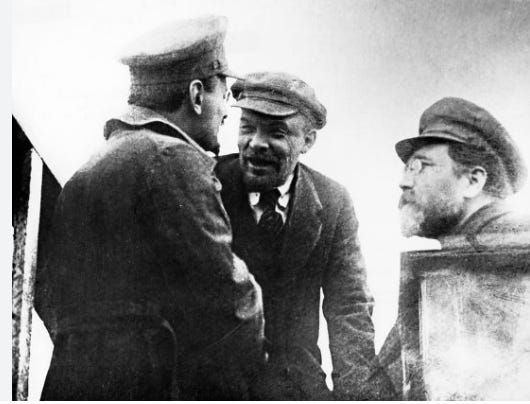
Several years ago when I was rereading Kolakowski’s Main Currents of Marxism I was struck by his pitiless portrait of Trotsky. Kolakowski was scathing. And it was not that Kolakowski was scathing of every Marxist who came after Marx because at that time, after 1968, when the Main Currents were written Kolakowski was still transitioning from Communism of his youth toward what he later in life became, a conservative and religious fanatic. Thus his judgment on many of the thinkers discussed in The Main Currents (Lukacs, Gramsci, Plekhanov, even Lenin) is much more balanced and often full of admiration. But Trotsky, for Kolakowski, was a “poseur” and as for later Trotskyists: “[t]here was never any such thing as a Trotskyist theory—only a relapsed leader who tried desperately to recover his role, who could not realize that his efforts were vain, and who would not accept responsibility for a state of affairs which he regarded as a strange degeneration”. (vol. 3, p. 219)
The question I asked myself was, why? I tried to explain it in the essay that I wrote in August 2021 and that I recirculated yesterday—for no other reason that a reader liked it, mentioned it to me, and this reminded of the piece. (By the way, the essay is not included in my World Under Capitalism because I decided not to include book reviews and this could be, in a way, considered one.) Alex Callinicos, whom I very much admire, wrote today a deeply critical essay on my piece (here). This short Substack is my attempt to explain to Alex and to the others some parts of my thinking, a view of Trotsky and Trotskyism that they find erroneous, both as formulated by Kolakowski and the way I interpreted it.
What drove Kolakowski to such a contemptuous attitude, I wondered? There was something deeply problematic with Trotsky despite many extraordinary qualities that I list in my original piece: intelligence, bravery, ability to manage people, armies and diplomatic negotiations (the first Soviet in 1905, the Red Army, Brest-Litovsk), excellent writing skills, general culture. His qualities came to the fore only when he played No.2 role under somebody whom he respected. That somebody was Lenin. In my view—which is not original—Trotsky never wanted to be No. 1, a position that of right belonged to him after Lenin’s death. One needs only to remember that Bolsheviks’ meeting rooms were routinely decorated by only two portraits: those of Lenin and Trotsky. The party was also colloquially known as the party of Lenin and Trotsky.
With Lenin, Trotsky’s huge qualities were on display; without Lenin, Trotsky’s flaws came to the fore: his arrogance, impatience with less well-educated Bolshevik cadres, certain hauteur that all contemporaries noted; so much so that at the Central Committee vote in May 1924 (just four months after Lenin death) Trotsky received the second lowest number of votes. His tribulations with the Party continued: he was offered to be the head of the Sovnarkom, he declined; he created, half-heartedly and not very effectively, a faction within the Communist Party of the USSR (as it become known) and all the way to 1927 the struggle continued. It is at the time of the tenth anniversary of the October Revolution that Trotskyists for the last time gathered freely and organized an alternative celebration. A year later, most of them were in jail even as Stalin, in an abrupt volte-face, decided to go for industrialization at all costs, argued by Trotsky and Preobrazhensky, and originally rejected by Stalin.
Why do I go through all these details? Because I think they are important to understand what later became of the Trotskyist movement. Despite the extraordinary courage of Trotsky himself (who sacrificed himself and his entire family), and many other members of the movement, the “original sin” was reflected in that unwillingness to take responsibility and power when the occasion presented itself. There was, I think, always a seed of defeatism in the movement: they liked to discuss, argue, pontificate, “couper les cheveux en quatre” but not to take power and rule. This is true despite doubtless personal qualities of its members. Let me give three examples about which I wrote: Trotsky himself and his first-rate book on the Soviet system The Revolution Betrayed reviewed here; Victor Serge, a man imprisoned by all regimes, including Stalinist and his beautiful and dark diaries (reviewed here), and Wang Fan-his a brilliant Chinese Trotskyist, a man of warmth, bravery and erudition (his memoirs reviewed here). I could go on listing other Trotskyists, equally extraordinary people. But the movement, spread to five continents, never came close anywhere to taking power—and this is my contention—it did not want to take power. Not even in China where it had a strong base in the industrial areas, but was sidelined by Mao’s accent on peasant rebellion. Perhaps the only important role that it ever played was in the Spanish Civil War, and had the republicans won that war, it might have fought seriously for the role in government, against more moderate socialists and Stalinists alike.
Now, I am fully aware that my statement that the Trotskyist parties did not want to seriously struggle for power can be challenged. They never said so explicitly—and it would be folly to do so. My impression is just an impression. But I do think that this reluctance to accept responsibility of governing, to take the bull by the horns, first time displayed by Trotsky, seeped afterwards to other parts of the Communist movement, even when they had nothing to do with Trotsky himself or with Trotskyism. I do not think that it is particularly controversial to claim that the Italian Communist Party (PCI) really liked being in opposition rather than governing, even when in 1976 it obtained 35% of the popular vote and became the second largest party (4 percentage points behind Christian Democrats). Indeed, it was not easy to govern Italy, not the least because of country’s “limited sovereignty” that it enjoyed with respect to the United States. Yet a combative “Leninist” party would have gone for power. PCI did not. The same is true of the PCF in 1968. Many, including de Gaulle and Raymond Aron thought that the communists would go for the jugular. They had control of the industrial proletariat while the youth totally disorganized le bloc bourgeois. But de Gaulle and Aron (politically so different) quickly realized that PCF was, in fact, a party of stability, a party that would not rock the boat, would extract some concessions for workers (as they indeed did), but would “vote” for the maintenance of capitalism.
The point is, I think, that many in the worker’s movement ceased believing that transcending or overthrowing capitalism is possible. They fled from responsibility and action that an alternative belief would have required. And I thought that the first who clearly declined to take the responsibility for governing a socialist state, when it was given to him on a silver platter, was precisely Lav Trotsky. And that that decision opened the way to Stalinism.
No posts
Comments
Nothing yet. Say the first thing.
Sign in to join the conversation.