
Hello again! Sorry for the long break, I became a father a few months ago, and then we decided to move to a new place in NYC with a newborn because we are Smart. After what seems like a lifetime of unpacking, it’s time to stop Being A Helpful Father and go back to writing about videogames.
I am aware that I posted a Final Fantasy essay only two entries ago and that I am in danger of pigeonholing myself in the style of that excellent FFVIII website. However, we are in the Year of Too Much Final Fantasy, as was decided by a very shortsighted and frustrated SquareEnix, so here we are on our path towards an inevitable Final Fantasy Essay XXIV. I’m working on another piece about comedy in games and I’m very excited to play Chants of Senaar and 1000xResist, so other things are coming soon – wait, the Elden Ring expansion just came out. Fuck. Anyway:
I miss anime. No, it hasn’t gone anywhere, nor has it been banned (not everywhere, at least), but more accurately, I miss enjoying anime – of the shonen variety, to be exact. If you’re not aware of this word, it’s a demographic in Japan that translates to “teenage males.” That means we're talking your Demon Slayers and Dragonballs and Fullmetal Alchemists, the shows with the fighty boys and long monologues (when I showed my wife an ep of DBZ, she said “they just talk?” and I responded, “so you get it then”). Back when I myself was a teenage male, there were many days I would escape my school problems by letting epic fights, and even better, monologues about epic fights, wash over me. However, I am now in the classic scenario of becoming a Hard Times headline. In adulthood, when revisiting any of these shows or checking out the ones that I’ve missed, I can’t enjoy any of them fully. Possibly because I’m no longer the target demographic, but also because I’m unable to ignore the myriad problems that I didn’t notice as a child. Characters are tropey, gender dynamics from the age of dinosaurs are in full effect (if you have a death wish, drink every time a guy is a creep and every character reacts as if it’s… normal? Or even funny?), and stories rarely employ fundamental dramatic structure. And while I now have complaints about this as a parent whose kids will watch these shows in the future, I am more a storyteller who sees some unique, incredible aspects of shonen anime and wishes its creators would treat their audience as smart as it is. OK, fine, I am also someone who wants things that once catered to him as a child to cater to him as an adult as well.
But really, I do absolutely love some things that are unique to the genre, with one specific aspect towering above the rest: the stakes. And folks, these are some stakes. Shonen anime is entirely held together by its immaculate ability to escalate the story, which is done so well that you will ignore all transgressions because you must see what happens next. These are stories that start with a poor, illiterate farm boy, have him establish some friendships, enter a shadow tournament, and then make him follow the natural path of fighting God. This obsession with stakes is rarely present in western media, and it is such a powerful trait for storytelling that the entire medium is a juggernaut of entertainment. So of course I want to be able to enjoy anime! Thank goodness, then, for Final Fantasy XIV, the game that is actually a shonen anime for modern times: it completely deconstructs the genre and then puts it back together with tropes worth having for their newfound depth. That’s right, I get to have my cake and eat it too!
I would like to clarify that this game is not just a deconstruction. The ‘de-’ prefix is the important part of that word, as it is all about taking something apart; the goal is erosion. Watchmen, Madoka Magica, Bioshock, and Half-Minute Hero are all about how their archetypes couldn’t exist, and if they did, it would only be for some horrible reason. Superheroes are products of government propaganda and marketing, amnesiac heroes are instruments of death, magical girls are the results of murderous time loops, etc, etc. But Final Fantasy XIV takes a different tack, approaching not just the silly parts of its structure, but also using the original intent as a guiding light, leaving us with something altogether new. It isn’t the first time this has been done, but it is the first time I’ve seen a videogame take on an entire genre in such a constructive manner, both celebrating and, I would argue, saving it. The genre is not in dire straits, as Demon Slayer and Attack on Titan are financial behemoths steering an entire industry through oceans of sick-ass explosions with worrying instances of anti-semetic messaging. But as the audience matures more and more, the genre will need to as well, and FFXIV is the prototype of how to do so – and hit a goddamned home run in the process.
It might surprise you to learn that it took a long time for me to even consider playing FFXIV. It’s an MMO composed of a base game and four whopping expansions (and another one out in mere days), and… I mean, it’s an MMO, man. These are games masquerading as communal experiences with the open secret that they’re addictive click-fests, complete with daily achievements designed to manufacture FOMO. It’s just gambling, full stop.
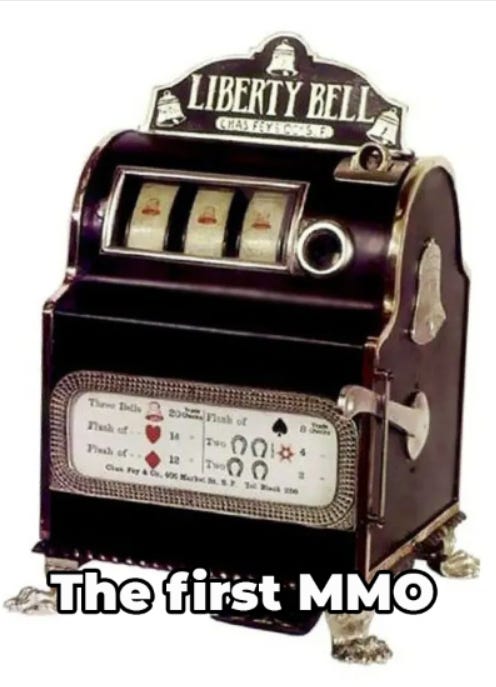
The fact that Konami, a company that solely makes digital slot machines now after abandoning its murderer’s row of excellent franchises, has not made an MMO to date is absolutely shocking to me (I’m convinced that the Silent Hill 2 remake will end with James picking up the phone to listen to his past spirit-self tell his ailing wife that she should really work on her dailies. You know, the equivalent of murder). To quote an annoyingly popular cartoon show, these are just loot boxes with extra steps, and they are the things that initially attracted the predatory companies that now lay off everyone in the industry with glee by employing MBAs dressed in nerds’ clothing.
MMOs are the original sin of this entire medium. So of course I was against the very idea of FFXIV, but as the years wore on, I kept hearing about its story in hushed tones. How there’s such an intentional narrative that the studio refuses to let people skip it easily; it elicits such an emotional response that the studio makes memes about it, which didn’t make any sense to me. That’s like being told a slot machine has something to say – but it’s a slot machine. On the other hand, a slot machine that has something to say? I can’t just ignore that. So I got my bucket of quarters, installed the game… and finished it three years later.
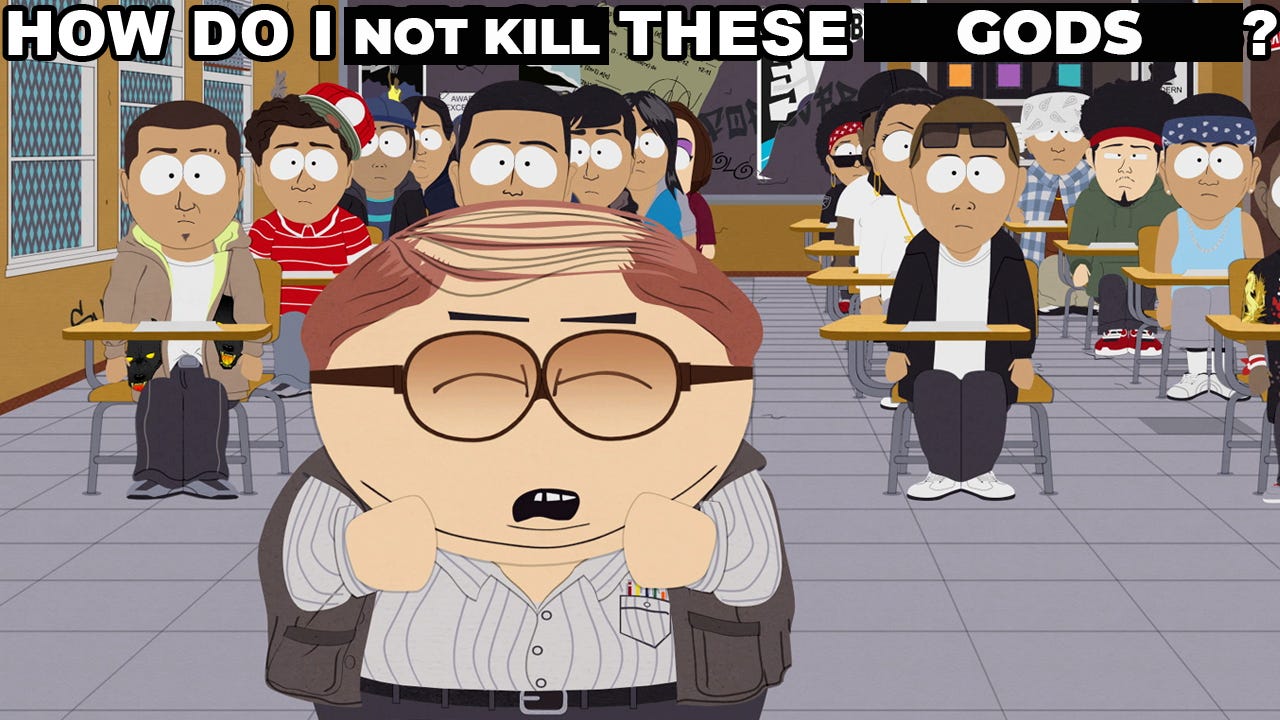
The game is long, requiring around 300 hours of playtime for the story itself. Yes, 300 hours. That’s without the optional stuff. If you’re anything like me, that number should make you boil over with rage. We have limited time on this earth and most games are already too long as it is. Whenever I find something a mere eight hours in duration, I buy it immediately out of principle. Turnip Boy Commits Tax Evasion is two hours long and is a Perfect Game. Unless you’re an Elden Ring or a Tears of the Kingdom, a playtime of 120+ hours is always always always an indicator of overstaying one’s welcome – I’d prefer to play something, you know, designed rather than a slow drip from the Content Machine. So how can a 300-hour long game be worth the effort? Would it be by having solid writing chops that understand fundamental storytelling? By giving bite-sized miniature arcs that consistently have great catharsis while dramatically advancing a large narrative? Well, yes and yes, and FFXIV absolutely does both of these things, but that’s not enough for the equivalent of thirty seasons of Game of Thrones. The solution is to make a payoff for not just your own game, but for an entire genre of TV. Instead of trying to kill God,it asks the more mature question: how do we not kill every God?
To pull this off, the base game of FFXIV, titled A Realm Reborn, is a bit of a rough start. They need to set the table with the classic shonen formula, and good lord, is it campy. There’s a Chosen One protagonist, a forgotten hero with amnesia, an antihero hell-bent on revenge, a kung-fu woman with a weirdly sexy blindfold she never removes, floaty shadow men in robes they got from the Kingdom Hearts store (it’s just a Hot Topic), and villains with a bit of good in them that is just buried under all of the pain. It is truly a who’s who of tropes. The result of all of this is an arc that is… just OK! It’s fine, it gets the job done. It has moments that are fun, but there is absolutely no emotional depth present, it’s basically an evening with my dad. However, unlike time spent with my father, this all happens for a very rewarding reason: the shonen anime structure has been established, and once that’s done, it can be pulled apart and subsequently recreated. Every character is forced to re-evaluate exactly what they’re doing and why, resulting in deeper relationships that grow along with the consistently heightened stakes of classic anime.
This kind of reconstruction feels like a mature processing of one’s past, rather than an immature aggressive reaction. The game does not distance itself from the material it critiques – it instead immerses itself in the tendencies of the structure, accepting that it is something that had some good inside all along, much like many of its villains.
The game is also an important response to the toxic positivity seen throughout our culture in the last decade that attempts to will good vibes into being without any critical thought, such as the brilliant Stardew Valley’s unfortunate subculture of “cozy games.” Achieving a positive outlook takes a monumental amount of hard work with therapy, emotional intelligence, and self-acceptance. Anything else results in brazenly amateurish work that feels as hollow as it does positive (see Spiritfarer or that horrific Christmas episode of Ted Lasso, season 2). Final Fantasy XIV actually earns its positivity, and in the natural course of this kind of work, its characters eventually must consider whether life is truly worth living, which results in a conversation about nihilism that feels simple and complex, profound and moving. It lives in a space of constant empathy, looking for the authentic path in which each villainous character might have the chance to change for the better.
It turns out that the highest stakes possible are not about asking how we could end villains, but how to make them become human again.
No posts
Comments
Nothing yet. Say the first thing.
Sign in to join the conversation.