
The Rotten Tomatoes critic-vs-audience divide is something that occupies my mind at least once a month. There is, of course, the inherent problem with a system that flattens nuanced reviews into bland yes-or-no results, but I’m wondering more about the fact that critical reception does not reflect public opinion. A movie with a low score does not mean it will be unpopular, and the opposite is true as well: Hocus Pocus is a stone cold classic despite being quite flawed, while I’m Thinking of Ending Things was a masterpiece most people did not enjoy (I will keep bringing up this movie). The easy knee-jerk reaction to such a difference in reception is that of the condescending elitist claiming that media literacy is declining over time, flailing your arms in frustration while continuing to not understand the very obvious reasons that Trump is an electable candidate. But I encourage everyone to persevere through the easy response and instead reflect on the fact that beloved, flawed works have a common trait: they take a wild swing that makes the price of admission worth it, no matter how well the piece works as a whole.
The logical deduction of the Rotten Tomatoes divide is that quality and success are different metrics of art that often do not affect one another. As I write this, Palworld, a survival videogame that bites many mechanics wholesale from other titles such as Pokémon, is dominating the charts despite its many detractors. In lieu of understanding what makes something strike a chord with the public, this should serve artists everywhere as a reminder that they should strive for quality instead of capital-S Success, a phrase my wife is tired of saying every time another peer of mine gets some Goddamn Success. Fuck you, Jim.
Any time the critic-audience divide makes waves in the zeitgeist, the literati return to the questions of ye olde man yelling at cloud: Why did it work? Why did people want to experience this thing instead of my novel that publishers won’t touch? Why can’t I stop crying, Maddy? These questions kept replaying in my head over the past few weeks as I replayed one of the titans of videogame history, Final Fantasy VII, and I think I may have stumbled upon an answer. For why it worked, that is, not for why you’re crying – we already know the answer to that.
To clarify things for those whose eyes glazed over at my mention of that title, Final Fantasy is a franchise of epic narrative games that are effectively Japanese Star Wars, combining high adventure science-magic with spiky hair and emotional climaxes that involve people shouting at each other about fate.
If you’re not familiar with the series, you should be, at least on a conceptual level. The Star Wars comparison is artistic as well as financial - the series has sold over 180 million copies. Compared to the non-videogame world, it’s competing with the behemoths of Avatar, Lord of the Rings, Harry Potter, and Marvel. In the videogame world, the franchise takes twelfth place, and of the top twenty seven series, it is the only franchise that focuses on narrative before gameplay. Each of the franchise’s seventeen mainline entries has a playtime ranging from twenty to eighty hours (not including the online games’ minimum playtimes of 300+ hours and counting), with a significant portion of that dedicated to dialogue. That means that a massive amount of dialogue and characters from the series is taking up real estate in peoples’ minds throughout the world. Its importance cannot be overstated. For anyone interested in storytelling, it is something to pay attention to.
“Good God,” you may be thinking, “how can anyone keep track of that much plot? The third season of Game of Thrones made me want to live in the woods.” I have good news: this is not the Trails series. Final Fantasy is an anthology of unrelated stories, allowing you to drop out for a decade, then pick up the latest entry of your own choosing. In that way, it’s the antithesis of Marvel’s own mission statement of “the beatings will continue until morale improves.” However, as is the case for capitalism, there is a Sequel Corollary from which FF is not exempt: if a game makes a shit-ton of money, all bets are off. In that case, multiple sequels will be created until they stop making money, which is where Final Fantasy VII comes in – it never stopped being profitable, to the point where the original 1997 release of the game is now being remade as three different entries. This begs the question: why this game? What is so special about it that the beatings will continue here as well?
The second of the remakes, Final Fantasy VII Rebirth, is on the eve of release, and I wanted to experience the original’s story again to understand just how much the new entry is going to (intentionally) go off the rails. It’s also been literal decades since I was exposed to the source material. I blew the dust off the old case – and by that I mean I installed the Steam edition and then spent hours tinkering with mods to find the perfect graphical updates and quality-of-life changes, went to bed, tinkered some more, then started the game – and began preparing myself for retro videogame problems the same way I do for an old comedy. The story will take forever, the mechanics will be archaic, I will have to reframe all of my thoughts in a lens of the past and say “it was good for the time.” I pressed New Game, watched the opening unfold, and suddenly found that none of those preparations were necessary.
FFVII rules. It wasn’t hard to see why the game was a hit nearly thirty years ago.
The very opening moments are a heist (hell yeah), followed by explosions and a chase scene (hell yeah again). The game does eventually go through a core JRPG trope involving a visit to every city on the planet as if you’re a young Queen Elizabeth on a royal tour, but this is only done once the key dynamics between most of the characters are firmly in place, making the world-wide trek a joy instead of a trudge. Once the first act ends, it becomes a non-stop ride until the credits roll. Beyond all of this, it’s fun to boot.
This all explains why the game was a hit, but not its status as an icon. Ask people online for their opinions (like some kind of masochist) and you’ll get a huge range of answers on their favorite Final Fantasy – the series has a very high standard. FFIX is my personal favorite with well-developed characters, tight pacing, moving moments, and dramatic structure that leads to a huge catharsis for the audience. FFVI is another entry famous for crushing just about every piece of the experience. FFVII, on the other hand, has poor translation, dialogue that is fine, a final climax that makes you raise your eyebrows in confusion, and a sidequest structure that drives me completely insane. But again, no other entry, IX or VI included, resulted in ten spin-off games, an anime, and a theatrically released film.
I think it can be boiled down to one real reason: VII really swings for the fences.
While IX may have better storytelling mechanics, the nature of the story is that of a dashing rogue on a quest to understand himself – ancient fodder as old as time (and it works!). VII, on the other hand, is about a domestic eco-terrorist with a traumatic identity disorder.
What?
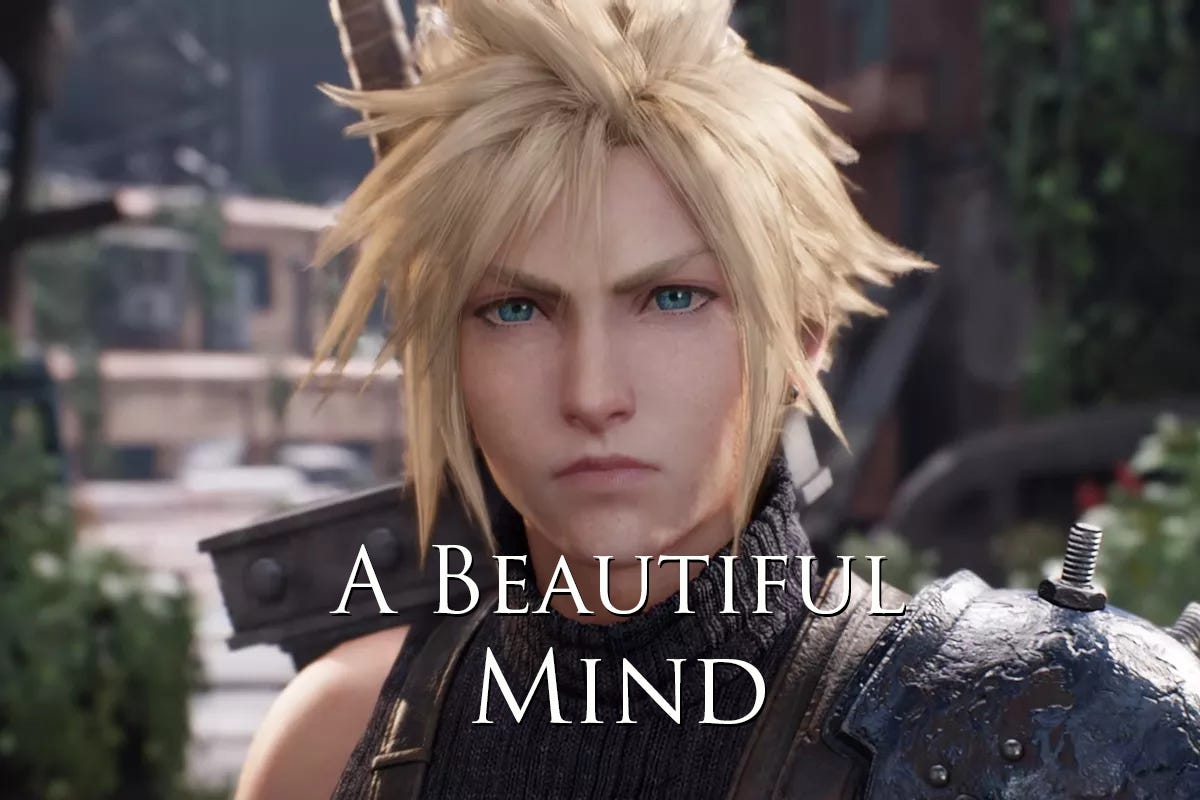
I just described a premise that you would only find in today’s indie game scene, and even then it would make me tense up and file it in the “maybe” folder. “Uh, sure, I’ll check it out,” I say as I try to change the subject. “Don’t worry,” you assure me, “the main character has a sword too big to possibly hold, and he’s chased by the spirit of an insane, beautiful man with another impossibly big sword.” “Why didn’t you say so?” I respond as I text my wife to call me and pretend an emergency is happening. This is a premise so primed to go wrong that it would have to pay off extraordinarily well to make the journey there worth it, and FFVII… does. It pulls it off. It doesn’t quite have the final catharsis of other stories – the twist in the middle was so poorly explained that I had to search online for clarity, and the final moment gives more of a “huh” than an “of course.” But as the game pulls a master stroke of rug-pulling by killing off the most useful character, and delves into the meat of the protagonist’s mental disorder, I was gripped. The very nature of this was thrilling, to the point where it didn’t matter what the end would be. I was just excited about experiencing it.
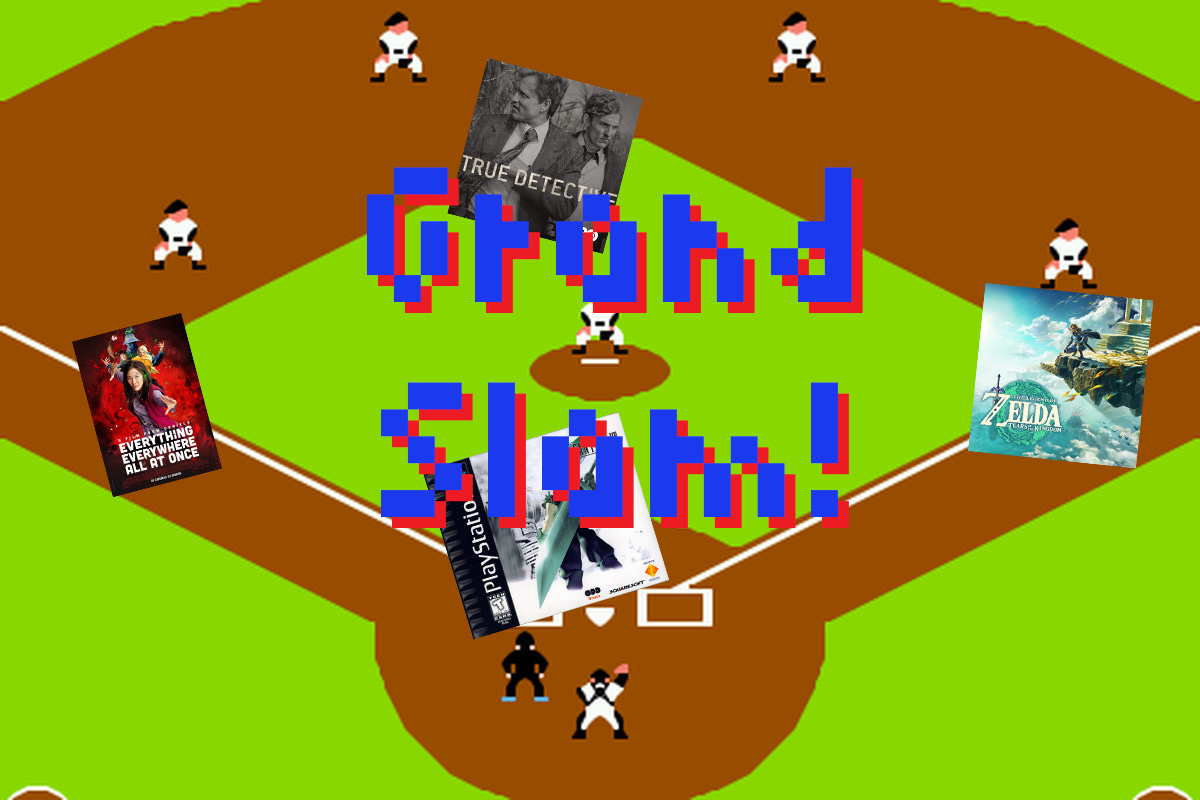
It’s a feeling we’re all familiar with. Everything, Everywhere, All At Once was a bunch of killer actors working with a couple of the most capable directors around in terms of visual focus and made a multiverse satire. The oner in the first season of True Detective was so good that it spawned three universally maligned followup seasons, and the franchise somehow has another season currently airing. Tears of the Kingdom made building in a videogame fun for the first time in history (don’t @ me, Minecraft freaks). In all of these cases, you get the feeling that a skilled creator has proven that they have the fundamental skills, and then decides to leave caution to the wind. At the highest highs of these stories, we feel like we’re watching Klay Thompson score sixty points in twenty minutes. We’re seeing Evel Knievel jump fourteen Greyhound buses. We’re seeing someone leave everything behind to strive for something new, giving us the feeling that we’re seeing a world record broken in real-time. We’re on the edge of our seats screaming, “Holy shit, they’re doing it! They’re doing it!”
I think it would help us all to remind ourselves of the potential for this kind of moment when we see a piece of art become stratospherically popular that we aren’t vibing with. Some folks (see: heathens) didn’t like the flaws of the Barbie movie, and upon chatting with any of them, it was immediately clear to me that they were ignoring everyone’s excitement about the fact that a film with decades of baggage works in any way at all. We were overjoyed that the movie could be as funny and touching as it was, and to pull that off is miraculous.
I had to go through this kind of inner reflection myself with Star Wars: The Last Jedi. It has multitudes of issues with its storytelling mechanics, but when I got out of the theater, I found that I was one of the only people on Earth who didn’t dislike it for weird, hate-based reasons. I had to then recognize the fact that the mass public was absolutely thrilled by undeniable aspects like the (great) direction the movie took with Luke’s downfall, and the choice of having the two most-liked characters go against the grain and tear apart the villain’s base in a stunningly choreographed manner. The functional issues that bothered me did not matter to others, as people had bigger things on their minds. Viewers saw that something new was happening that shouldn’t have, and that meant the world to them.
We should always be concerned about granular quality, but that’s not the only thing that matters. Art that really goes for it matters, and may be more intrinsically linked to success than anything else. This is part of what bothers everyone about AI: it can’t try. It never can. AI will be used by corporations and lazy people with MBAs to make boring action-comedies that my parents will make me watch at Christmas, but it will never be able to create those ripples that everyone feels across the world. But we can make those ripples, and we should always strive to. No matter how many times we have to ask Maddy why we’re crying.
No posts
Comments
Nothing yet. Say the first thing.
Sign in to join the conversation.