
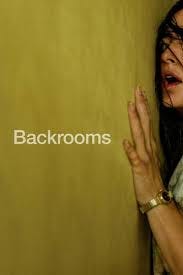
The horror film Backrooms (2026), by director Kane Parsons, is very interesting and clever. Clark (played by Chiwetel Ejiofor), is a furniture store owner who discovers an endless amount of additional rooms within his store. He shares his discovery with his therapist, Mary (played by Renate Reinsve), who is also thrusted into this world of mysteriously odd rooms which resemble reality, yet is far from it.
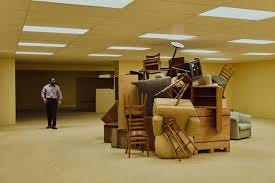
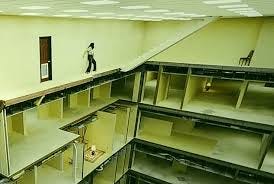
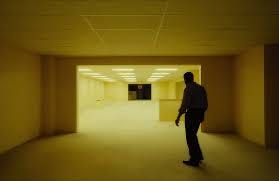
The backrooms in this film are a metaphor for the mind or the psyche. Clark first discovers these rooms which represent his mind. He can go in and out at any time through the invisible door. This is symbolic of the relationship between reality and irreality, one’s perception or interpretation of things versus what actually is. The backrooms are composed of items similar to what is in the furniture store, like 90’s style furniture and tacky decor, yet everything is distorted. The furniture is stacked up into piles, weird objects like stop signs where stop is spelled backwards are present, and some items are halfway stuck inside the floor. There are edible people of different shapes and sizes with more than two eyes each and a maze-like collection of rooms of different sizes that seem to continue to no end. These backrooms look very similar to the scenes created in Salvador Dali’s paintings. The bizareness of the rooms and the fact that they continue with no exit except for the invisible door in the wall reminds me of another film with a similar concept–Exit 8 (2025, dir. Genki Kawamura). The distortion of these backrooms represent Clark’s trauma. The random, odd objects are mental baggage and the endless backrooms, with their many awkward designs and sizes, are compartmentalization.
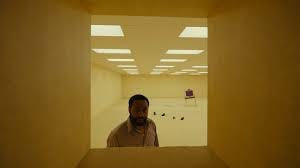
Clark invites his two employees, Bobby (played by Finn Bennett) and Kat (played by Lukita Maxwell), to embark upon the journey within the backrooms. Both Kat and Bobby do not escape the backrooms alive. They are killed by the monster that lurks within the backrooms. Eventually, Mary ventures into the backrooms and much is revealed about her relationship to this dark place.
What I find to be incredible about this film is how Parsons builds the fear which is the essence of this particular horror feature. The entire time there is the presence of a mysterious monster, yet we do not see it for the majority of the film. The evidence of its presence is made known through the sound of the loud stomping, growling and the movement of objects. It is the fear of the unknown and the wonder of what will pop up around the corner, through the door, or down the hall while exploring the backrooms. The use of home video footage, jarring camera shots, and jump cuts is another technique that aids in building the fear.
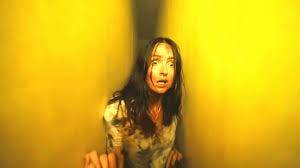
Once Mary entered the backrooms towards the end of the film, I had it all figured out. As Clark’s therapist, Mary takes on his baggage, which is how she can easily enter the realm, but she has unaddressed trauma of her own which explains the familiar things she sees from her childhood in the backrooms. The rooms even expand to more rooms specifically for her which represents what happens when trauma that has not been unpacked and addressed festers and grows into something worse within an individual.
Once the monster in the backrooms is revealed, we learn it is a large, goofy-looking, exaggerated version of Clark in his furniture store’s mascot’s costume. As I viewed this scene, I thought about two things. One is how great the fear factor is in leading up to the reveal, but once this monster appears, it becomes a little humorous. The other thing is how this relates to the mind/psyche. Sometimes human beings fear, worry, or develop anxiety over the unknown only to find out later that what they feared would happen did not actually happen and to realize that all the worrying was for nothing.
Since the backrooms monster is Clark, it is assumed that he is the “monster” who killed Bobby and Kat. The monster kills Clark which represents that Clark commits suicide. This is not far from reality where someone suffering decides to make others suffer and, in turn, inflicts that same pain upon themself.
Mary is left in the backrooms where she has a flashback to her mother who was in a mental health facility. By the end, Mary is in another provider’s care. All of this conveys the message that mental health issues can be hereditary and now Mary is in the same position as her client, Clark, where she must face her fears and address her childhood trauma. Parsons did a great job in creating Backrooms. This film is worth making a trip to the theater to see.
Leave a tip to support my writing
Thanks for reading Brandy’s Substack! Subscribe for free to receive new posts and support my work.
Comments
Nothing yet. Say the first thing.
Sign in to join the conversation.