
The Weekly Signals Brief gathers the most interesting articles that I have read over the past week. Each link below is a piece that piqued my interest (click the titles to go to the full articles).
The Weekly Signals Brief is part of a three-post weekly cadence—two original analyses and one curated intelligence sweep. Subscribe to receive it each Thursday.
I watched this interview with military historian Stephen Harding, conducted by Katie Sanders, about his new book on the FBI hunters who tracked down American traitors in Europe, and the central premise completely captivated me. We so often view that era through a lens of total national unity, so learning that a team of investigative agents had to imbed with combat units to find citizens actively collaborating with the Axis powers is a stunning revelation. It is a deeply compelling slice of history because it focuses on a side of the conflict we don’t often hear about. Beyond that little slice of espionage history, Harding also discusses a major classic by recommending Thirty Seconds Over Tokyo, which happens to be one of my all-time favorite memoirs. It is a brilliant pairing because both narratives masterfully trace how massive global events reshape the lives of small groups of ordinary people caught in the storm.
Reading about these contrasting wartime experiences made me think about the messy reality of loyalty, courage, and how individuals respond under immense pressure. On one hand, you have the sobering stories of American journalists turning out Nazi propaganda or socialites mixing with senior Gestapo officials. On the other hand, Lawson's memoir captures the ultimate peak of American grit and sacrifice during the famous Doolittle Raid. Exploring these forces us to confront uncomfortable questions about the human condition while simultaneously celebrating the incredible resilience that defines our finest moments.
I encourage you to watch this interview if you love discovering the hidden human dramas that occur in the shadow of massive historical turning points. Hearing Harding talk about Thirty Seconds Over Tokyo gave me a whole new appreciation for the book, especially since he shares a lovely personal memory of meeting Ted Lawson himself as a teenager. It is a quick and thoughtful read that will leave you eager to pick up a classic memoir and look at the complexities of the Greatest Generation with a fresh perspective.
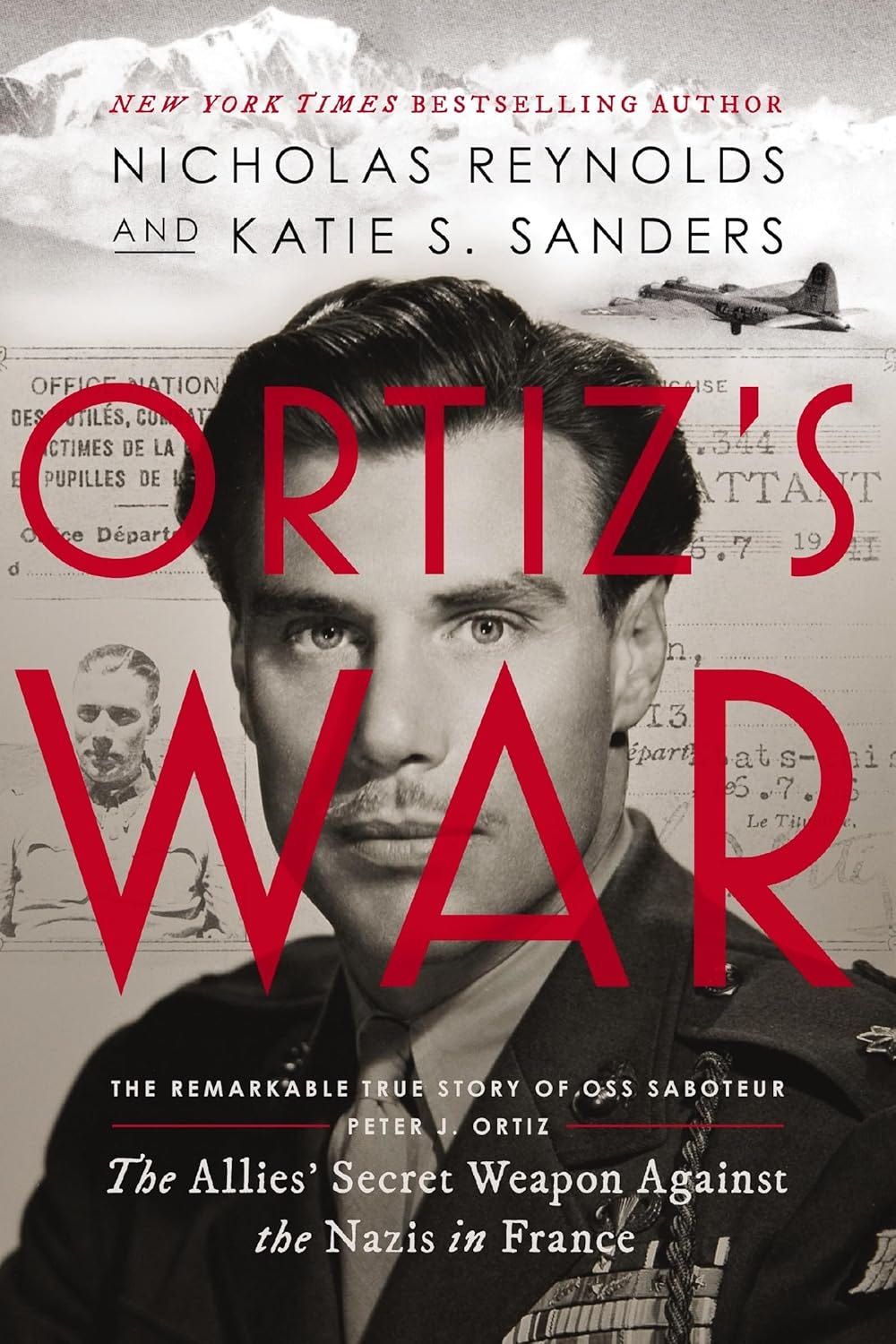
One last point, speaking of espionage; coming up on 25 August, Katie has co-authored a book with Marine Corps infantry officer and historian, Nicholas Reynolds. That book is Ortiz’s War: The Allies’ Secret Weapon Against the Nazis in France. I have been blessed to have been on the advanced copy list. I will be reading this, and publishing a review in the very near future to promote this book, which chronicles the mind-blowing journey of a rare Marine in the European Theater who became one of the most decorated heroes of the war. Peter (Pierre) Ortiz was a former French Foreign Legionnaire and OSS operative who parachuted behind enemy lines, donned his Marine uniform to defy the Gestapo, and led daring missions to supply the French resistance. It is also my understanding that Ortiz rescued Katie’s grandfather after his Liberator was downed on a mission over occupied Europe prior to D-Day. His story is an absolute masterclass in unconventional warfare and decisive leadership, and I am already planning to post a full review and recommendation the moment I finish reading it. Until then, I highly encourage you all to pre-order a copy on Amazon: Ortiz’s War. Not only would it go a long way to support an excellent author and journalist, but it would be supporting one of our very own here in the Substack history/military history community.
I came across this piece by Mark Lacy about why so many modern conspiracy theories fall apart under the slightest scrutiny, and his angle on the subject completely hooked me. Instead of just mocking wild claims like the staged Moon landings, he focuses on the breakdown of what he calls fundamental competencies, like photo and media literacy. What immediately caught my attention was how he used basic science and the mechanics of photography, such as the behavior of sunlight without an atmosphere, to easily poke holes in common myths. It is a refreshing approach because it shows that a lot of what people think is a massive cover-up is actually just a failure to understand basic optics and daylight exposure.
This discussion made me think a lot about his explanation of how the definition of literacy has expanded far beyond just reading words on a page. In an era where artificial intelligence and advanced editing can distort reality, having a working knowledge of history, economics, and science is our best defense against being deceived. His article demonstrates that a solid education is not about memorizing facts for a test, but about building the critical thinking skills needed to navigate a noisy world safely. When people lack these baseline competencies, they become incredibly vulnerable to spreading misinformation, making bad financial decisions, or losing trust in genuine human achievements.
I recommend this article because it acts as a great mental tune-up for anyone who values clear thinking. Lacy shares some fantastic insights from his own career as an educator, and his closing reminder that we need to actively pursue knowledge throughout our entire lives is always good advice. It is a light but impactful read that will leave you feeling a bit sharper and far better equipped to separate genuine mysteries from poorly constructed fiction. After all, the best way to keep from making embarrassing assertions is to never stop learning.
Speaking of never stopping education and book recommendations (are you noticing a theme here?), we now turn to a piece by Sam Rinko about his approach to structured self-education. Rinko shares the introduction of his new e-book, which examines the deep frustration that hits every independent learner who tries to study everything all at once, only to end up feeling spread thin across a dozen different subjects. What stuck was his argument that true intellectual growth requires us to consciously balance deep mastery in a specific craft with broad reading for pure enjoyment. It is a compelling perspective because it replaces the rigid, uninspiring reading lists of traditional schooling with a flexible framework built entirely around personal discipline and genuine curiosity.
This piece made me reflect on how the true challenge of adulthood is learning how to chart our own course once the guardrails of formal education are gone. When we are on our own, we have to become our own administrators, deciding which books merit our undivided attention and which ones we can simply skim. Rinko mentions historical figures like Teddy Roosevelt and Alexander Hamilton as inspirations, reminding us that the most decisive leaders and deepest thinkers were always remarkably broad in their reading habits. Looking into these ideas demonstrates that intentional self-education is not just an academic exercise, but a vital tool for sharpening our focus and building a full life. Eudaemonia, as the Greek philosophers called it.
I highly recommend spending some time with Sam’s work if you want to bring more purpose and structure to your own reading routine. It serves as a great reminder that having wide-ranging interests is a strength rather than a distraction, provided you have a strategy to navigate them. It is a thoughtful and refreshing perspective that will leave you eager to pick up your next physical book with a renewed sense of direction. True literacy takes a lifetime of deliberate effort to build, and this framework provides an excellent map for the journey. You can find his new e-book, The Lifelong Learning Compass, on his website: Knowledge Lust
I just finished reading a brief piece by Dennis Bodzash about the history behind the phrase we all use this time of year, and the cosmic origin of the expression was, admittedly, completely unknown to me before. We usually think of the dog days of summer as just a modern shorthand for the brutal months of July and August, without putting much thought into the idiom. I found it fascinating that the expression actually traces back to ancient Egypt and the astronomical alignment of the star Sirius, the Dog Star. It is a compelling bit of trivia because it reveals that our ancestors, who we know were tracking the skies to predict seasonal shifts, genuinely believing that the brilliant light of this distant star combined with the sun to create the peak heat of the year.
This reflection made me think about how deeply connected ancient civilizations were to the natural world and how they used mythology to make sense of the universe around them. Dennis explains that, for the Egyptians, the appearance of Sirius was a welcome signal for the annual flooding of the Nile, an event that brought fertile soil and life rather than destruction. It shows just how much our modern perspective has shifted, as we often view extreme summer heat as an inconvenience to be avoided with air conditioning rather than a vital marker of global cycles. There is a great lesson here about human observation, especially when you consider that the earth's natural wobble has actually shifted the alignment over the centuries, meaning the true astronomical dog days now occur much later than they did in antiquity.
You should definitely spend a few minutes noodling this article if you appreciate quick historical insights that change how you look at everyday language. It is a light, engaging read that ties astronomy, ancient agricultural survival, and classical history into a neat package. Reading it will give you a great story to share the next time someone complains about the July swelter. It is always rewarding to discover that a phrase we use casually at the backyard grill has roots that go back thousands of years to the pharaohs and the stars.
No posts
Comments
Nothing yet. Say the first thing.
Sign in to join the conversation.