
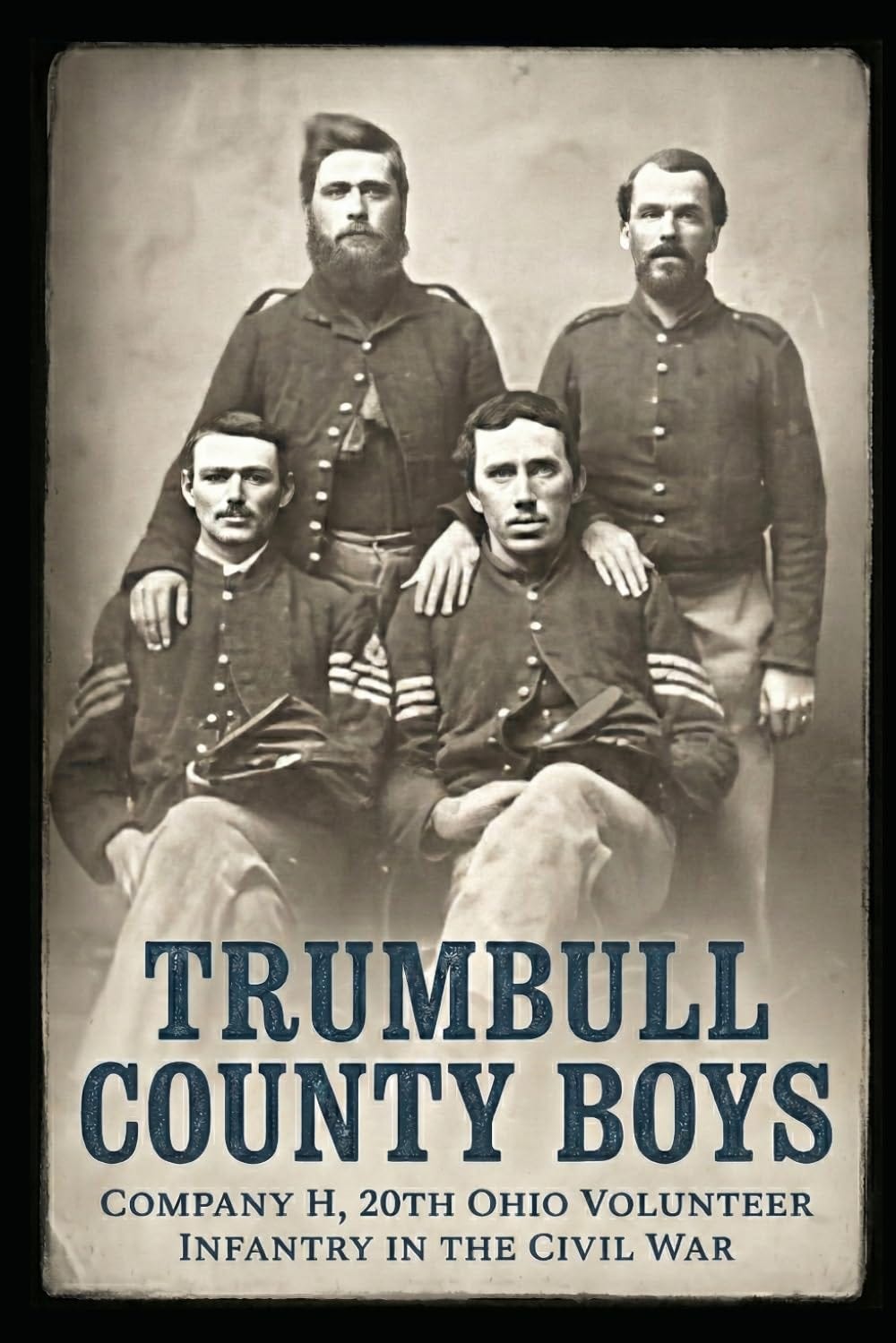
When studying war, it is easy to be drawn toward the grand strategies of general staffs, the sweeping lines of maneuver, and the high political dramas that dictate the mobilization of entire armies. Yet, as any man who has ever carried a rifle knows, war is not experienced in the abstract of a map room. It is lived, suffered, and survived in a space no larger than a few hundred square yards, bounded by the immediate presence of one’s comrades. It is the company, the section, the platoon that forms the true atom of military effectiveness.
In Trumbull County Boys: Company H, 20th Ohio Volunteer Infantry in the Civil War, Chris Mowery has given us an extraordinary glimpse into this atomic structure of combat during the American Civil War. By tracing the complete wartime odyssey of a single company raised from the soil of Ohio’s Western Reserve, Mowery doesn’t just recount their engagements, but dissects the very chemistry of their cohesion. His core thesis is that ordinary neighbors, bound by kinship, a distinct regional culture, and an unyielding anti-slavery conviction, were forged by the fires of combat, camp life, and disease into the ultimate of camaraderie. In doing so, he has produced a work that belongs on the shelf alongside the finest literature of the American Civil War.
Mowery begins his study not on the battlefield, but on the soil from which Company H grew. Following Abraham Lincoln’s call for 500,000 three-year volunteers after the disaster of First Bull Run in the summer of 1861, the response within Ohio’s Western Reserve was marked by patriotic fervor. Mowery identifies the source of this enthusiasm in the region’s distinct New England heritage. This was a landscape defined by an intense culture of education, deep-seated religious piety, and an uncompromising loyalty to one another, and the Union as a whole.
The men who gathered in Trumbull County in 1861 were not the rootless mercenaries or urban laborers who frequently populated the ranks of European armies of the period. They were farm boys, local craftsmen, and lifelong neighbors. They enlisted not merely as individuals, but as brothers, cousins, and friends. Mowery demonstrates with impressive clarity how this local identity was not shed when they donned the blue wool of the Union. The company was quite literally a community under arms, carrying the expectations, the morals, and the watchful eyes of Trumbull County across thousands of miles of hostile southern territory.
The narrative arc of the book is sweeping, tracking the 20th Ohio through the vast, muddy, and often neglected geography of the Western Theater. Unlike the concentrated bloodletting of the Army of the Potomac in Virginia, the Army of the Tennessee operated on a canvas of immense distance and fluid maneuvers. Mowery marches Company H through the entire grim litany of these western campaigns, from the freezing, slippery trenches of Fort Donelson and the chaotic, terrifying bloodbath in the peach orchards of Shiloh, to the grueling, mud-soaked operations of the Vicksburg Campaign. The narrative lingers with a visceral focus on the desperate clashes at Raymond and Champion Hill, before carrying the reader into the protracted, industrial-scale siege warfare around Atlanta, the psychological warfare of Sherman’s March to the Sea, and the subsequent, final campaign through the Carolinas.
Yet, Mowery’s greatest achievement is his refusal to limit his narrative to the action of battle. He understands that for the soldier, war is largely composed of an endless, exhausting prose, interrupted only occasionally by the violent poetry of combat. Trumbull County Boys gives proper weight to the unglamorous realities of garrison duty, the constant labor of fortification, and the terrifying omnipresence of disease. Mowery reminds us that the camp kettle and the polluted well-water were far more lethal than Confederate musketry. The book also dives in to the specialized corners of Civil War soldiering. We are introduced to the dangerous and lonely world of scout and intelligence operations through figures like Lorain Ruggles, whose exploits read with the tension of a Jack Ryan thriller.
Mowery has accomplished a feat that eludes the vast majority of Civil War history. So much of American Civil War literature falls into one of two categories. It either covers the grand overview found in most textbooks, or it becomes romanticized. Mowery avoids both. His prose is vivid and deeply immersive without drifting into the romantic. With the grit of Eugene Sledge in With the Old Breed, he puts the reader directly into the mud with the infantrymen. As you read his chapters on the Vicksburg campaign, you can almost smell the sulfur of the black powder smoke hanging heavy in the humid air, hear the wet squish of brogans in the Mississippi clay, and feel the terrifying rumble of artillery.
This is not achieved solely through creative writing, but through a meticulous, almost forensic exploitation of primary sources. Mowery has combed through diaries, official records, pension files, and pages of the Western Reserve Chronicle to bring the reader onto the field of battle and into the camps alongside the men of Company H. An added layer of intimacy is derived from Mowery’s personal ancestral connection to the unit in Private Samuel Hughes, his fifth great-grandfather. Hughes signed on as a fifty-two-year-old man, well past the prime age for grueling infantry service, which the army fudged to forty-four to secure his enlistment. This remarkable personal link grounds Mowery’s narrative in real, individual stories, lending an undercurrent of deep empathy that runs through the text without ever compromising his objective historical analysis.
In the broader context of military literature, Trumbull County Boys occupies an underrepresented niche. While the popular imagination has been captured by the small-unit histories of the Second World War, most notably Stephen Ambrose’s Band of Brothers or Alex Kershaw’s The Liberator, the American Civil War has lacked such granular, narrative-driven company studies. Mowery’s work fills this void. It is a book that demonstrates exactly how armies function at the point of impact, proving that the ultimate staying power of the volunteer soldier relies not on grand strategic comprehension, but on a deep loyalty to the man standing to his immediate left and right. For those interested in the American Civil War, and for anyone who wishes to understand the true, unvarnished nature of infantry combat in the nineteenth-century, Chris Mowery has delivered a masterful study. It is a work of deep respect, rigorous scholarship, and unforgettable narrative power, reminding us of the price paid among entire communities for the preservation of the American Republic. It is currently available on Amazon, with autographed hardcover editions available from Chris’s web page.
No posts
Comments
Nothing yet. Say the first thing.
Sign in to join the conversation.