
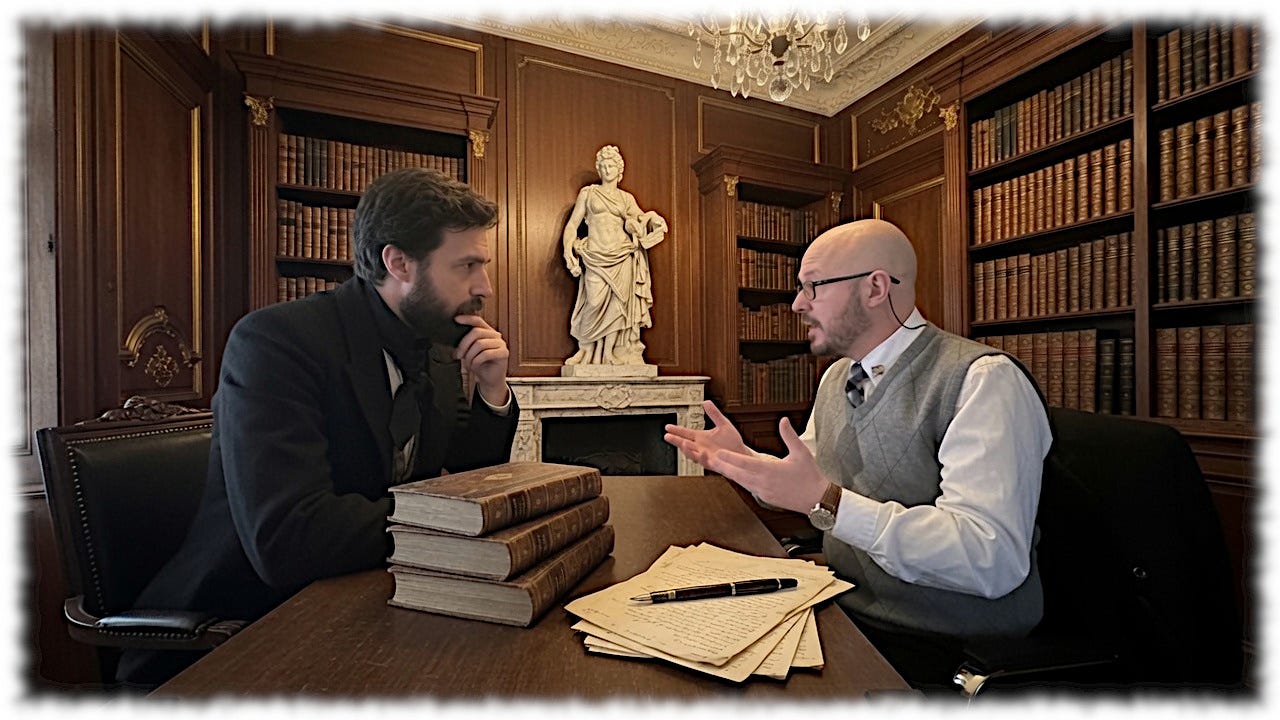
Context and acknowledgement: This essay is in response to an essay provided by Georgi V. Georgiev, in which he provides a rebuttal to my podcast episode A Warning From History: The Red Terror. I have provided his essay, and encourage my readers to not only read his excellent rebuttal essay, but also to subscribe to his Substack, Powers Old and New. I wish to add my thanks and gratitude to Georgi for engaging in this meaningful discussion. Too often, especially in today’s political climate, it is easy to dismiss opposing viewpoints and slip into an echo chamber that only reinforces, rather than tests, your own views. My most sincere appreciation goes to Georgi for not only testing, but challenging, my own viewpoints in the hopes of discovering a deeper truth.
When I began the Warning From History podcast series, I started with a narrow and deliberate purpose, setting aside the normal military campaigns and operational history, in order to examine what happens when a specific ideology seizes state power, and builds its core institutions according to that ideology. The first episode dealt with the early Soviet Union under Lenin, and the subsequent Red Terror. The episode explores how the machinery of the Cheka was not a radical improvisation brought about by civil war, but was constituted, from the October Revolution onward, as a mechanism of ideological enforcement. The Cheka had one, explicit instruction: that the individual was secondary to social class. The Cheka operated with extrajudicial authority on that principle. The Warning From History series exists because, unlike other repressive ideologies, such as Nazism or fascism, socialism did not die in 1991 with the collapse of the Soviet Union. Instead, socialism survived “the end of history” and has persisted beyond the twentieth-century into the present day, and is gaining support. The Marxist ideology that fuels the reduction of human beings to potential, frames property ownership as a form of class repression, and embraces destructive institutional reforms in favor of rebuilding society and (the unrealistic) re-engineering human nature remains culturally available.
Georgi Georgiev’s essay Debating the Warnings From History is the most serious public response the series has received. To summarize his key points, he does not dispute the historical record of atrocity. His pushback is against the fundamental ideologies of institutions of power and how ambition interacts to ideology. His argument is that ideology is downstream of power, and that ambitious men reach for whatever existing language provides legitimacy to their intentions. He further argues that cruelty exists across time, and the excesses of the twentieth-century were due to enormous industrial and bureaucratic capacity rather than any ideological underpinnings. Marxism, then, stands as just one ideology among the many available to those in pursuit of power, and that its force has mostly been blunted since the end of the Cold War. This is an excellent counterargument, which is why I am publishing this direct rebuttal.
While true that corruption, repression, and the suspension of certain liberties are not unique to Marxism, those arguments are not in dispute. The historical record supplies numerous examples that demonstrate Georgi’s case. The Egyptians enslaved the very Hebrews that had saved their civilization generations before (Now there arose up a new king over Egypt, which knew not Joseph) and the Seleucids attempted to stamp out their religious practice by force. The Nazis industrialized race-based slavery and murder on a scale never seen before in human history. And Napoleon shows us that Western, liberal ideologies, rooted in liberty, equality, and brotherhood can be corrupted into conquest. Even Christianity, which stands as the foundation of Western civilization, produced its own body counts through the crusades and the Inquisition. If the claim were that Marxist regimes are uniquely evil in the annals of history, that claim would be false on its face. However, that is not the claim being made, nor the reason for the Warning From History series. My focus on Marxism is intentional. Nazism was defeated in 1945. Bonapartism did not outlive its emperor. By contrast, socialism did not subsequently collapse with the Soviet Union and its Eastern Bloc satellites in 1991. Rather, the ideology that gave the world engineered famines through collectivization, scarcity through economic centralization, and political and class repression survived the twentieth-century and Cold War, and is gaining popularity in the West, and its revolutionary force is far from exhausted. That persistence is the reason the focus narrowed. It is not an argument that every other ideology is historically insulated.
The core of Georgi’s argument between instrumental adoption and institutional design is an important one, as in the case of secondary, or satellite states, power did often reach for the ideology out of usefulness. His example of Ho Chi Minh’s path from Woodrow Wilson to Karl Marx is a clear illustration of that fact. However, in the founding of the most powerful, and even some satellite states, the sequence runs in the opposite direction. The ideology, not the ambition, was the driver. Lenin wrote his April theses, which outlined the Marxist system that Russia would adopt once in power, more than a year before the Bolshevik revolution. That is not simply an institutional power adopting an ideology. The Cheka, the ideological enforcement arm of the ideology, under Felix Dzerzhinsky, was not the Okhrana that simply adopted Marx as its new governing ordinance. It was purpose-built from the earliest days of the October Revolution to enforce the perpetual revolution of the dictatorship of the proletariat. The Red Terror and Great Terror that followed, reorganized and rebranded into the GPU, and escalated as the NKVD, were guided by the ideology that supplied them with the moral cover to enact the horrors of Leninism and Stalinism. This is evident in Martin Latsiz’s directive to not focus on whether or not a person was guilty of an actual crime, but to instead focus on which class that person belongs. The organism put the ideology into execution as a foundational principle.
Georgi’s emphasis on agency is also not in dispute. Human beings act with agency, and use that agency to guide their personal ambitions. I think the earlier example of Ho Chi Minh is one of the most straightforward examples of that premise. My contention, though, is that people are not born radicals. Lenin was not born a Marxist, just as Hitler was not born a Nazi. Their worldviews were formed and shaped over the course of their lives through personal experience, reading, crisis, and the gradual internalization of particular concepts. Ideology, therefore, is not passive. It is not a mask that a man puts on in pursuit of his goals. It is acquired and internalized until it is inseparable from the individual himself. A framework that redefines individuals according to their utility reshapes what an ambitious agent is willing to consider necessary, permissible, or even virtuous, for that matter. The ideology doesn’t simply redecorate pre-existing apparati. As I have stated, it helps constitute the institutions and the moral logic those institutions enforce.
The core tenets of socialism; the abolition of private property, state seizure of the principle means of production, centralization of markets, and the reduction of individuals into class groups, produced a recurring pattern of results across different cultures, economies, whether agrarian or industrial, and varying degrees of external influence. Prolonged scarcity, prolonged economic stagnation, police states, labor camps, and category-based repression became hallmarks of socialist states. When the core ideology was relaxed, recovery followed, with Deng’s reforms in China and Doi Moi in Vietnam providing the clearest examples. It is this core ideological design that remains the primary variable of the pattern.
I do not argue that socialist regimes are constant terror at every step. Under these systems, people raised families, pursued education, lived in relative peace and harmony, and material development occurred. In certain circumstances, major achievements were made by these systems. The Soviet Union became a global superpower, put the first artificial satellite into orbit, and launched the first man, Yuri Gagarin, beyond the confines of the Earth. China aims to become the same (keep in mind they are no longer a purely Marxist state like they were under Mao). None of that, however, erases the fundamental principles in which these regimes operated. Individual liberty is subordinate to the collective good, which can be read as whatever the state determines the collective good to be. That remains true whether restrictions were relaxed or Glasnost was introduced. Those two categories do not rest in contention. The system could modernize and still treat persons as potential for the state, and the coexistence of the two does not stand as evidence against my argument.
Liberal and certain Judeo-Christian traditions have been repressive. There’s no argument there. However, this argument is about ideological foundations. The key difference is that liberal and Judeo-Christian philosophies have a tendency to force humanity upward. To elevate. Christianity outgrew the Inquisition, outgrew subjugation, slavery, segregation, and apartheid. The ideological foundations made the coexistence of equality, intrinsic value, and repression untenable. The ideological foundations of the West contain resources that treat humans as possessing inherent worth that precludes the state. Rights and intrinsic value predate the state itself. Marxist theory does not include that ideology. Where liberal foundations move upward, Marxism does not. Instead, it lowers man. Once human beings are sorted into categories, framed as necessary for the common good, the moral barrier dissolves. Does this mean every socialist state will build their own version of the Lubyanka? Of course not, and I have never made that claim. My specific, narrow claim is that the ideology itself makes institutional terror more likely. I do claim, however, that repression is baked into the socialist system, due to the very fact that individual liberty is incompatible with Marxism, and the reduction of liberty and human worth, by definition, is repression.
The claim that Marxist language is a spent force does not hold water in the face of present political movements. The national platform of the Democratic Socialists of America still speaks it, and uses the same egalitarian cover to justify it. It invites readers to imagine a day without capitalism in which work is performed according to ability and need (I’m certain I have heard that specific phrase prior to the 2020s), and which housing, food, education, energy, medicine, and transportation exist as collective goods rather than commodities. It frames the current system as organized by bosses and the billionaire class. It states that complete victory will require a revolutionary and fundamental transformation, including the drafting of a new constitution and the creation of a democratic socialist republic, as well as the abolition of the senate, and the replacement of the President and Supreme Court with an executive and judiciary subordinate to a monocameral legislative body. These proposals are far removed from other institutions labeled as ‘socialist,’ such as the Nordic model, which retains private capital, private industry, and private propery. LEGO and Ikea are not state-controlled. What the DSA proposes is a structural redesign that concentrates authority and places the principle means of production under political control. While it may not hold the majority now, that doesn’t equate to the movement being spent. The DSA is gaining in popularity and has multiple chapters across forty-seven states. Recall that Lenin and his acolytes were the minority at one point, too. The fact that the language and design remain embedded in political discourse, and that it finds an audience, is why the warning has not expired.
Cruelty is older than Marx. Concentrated power is dangerous under any banner. All true. The narrower claim is that when a theory that reduces humans to potential gains the levers of power, and constructs its institutions under that premise, the results are disastrous. Marxist ideology doesn’t simply exploit individuals after the fact. The underlying ideology shapes the institutions, which go on to shape the human beings that serve those institutions. That is the mechanism the Warning From History series is tracking. It is why I contend the Red Terror was not an improvisation, but a predictable, if radical, outcome of that ideology. It explains why, once you run out of billionaires, the millionaires are the next logical target, then those with hundreds of thousands, on down the line. Not every Marxist state produces the NKVD, but there is a clear through-line of repression, systematic starvation, and human misery that traverses decades and hemispheres. The moral and institutional language that survived its Cold War defeat continues to matter.
Thank you.
No posts
Comments
Nothing yet. Say the first thing.
Sign in to join the conversation.