
This episode examines the argument that foreign Western intervention is the primary driver of socialist state collapse. Through an analytical evaluation of twentieth-century economies and Cold War geopolitics, the episode explores whether centralized economic planning fails due to external pressure or internal failures. By contrasting the external-intervention thesis against historical case studies the episode demonstrates that political repression, market destruction, and economic stagnation are inherent outcomes of socialist governments rather than products of foreign containment.
The Fallacy of Unfalsifiability and Asymmetric Intervention: An analysis of the logical flaws within the Western-sabotage thesis, highlighting how it selectively ignores massive communist military interventions, such as the invasion of Afghanistan, the Brezhnev Doctrine in Eastern Europe, and regional proxy wars, while establishing an unfalsifiable framework that reassigns all internal economic decay to foreign pressure.
Capitalist Aid and Systemic Economic Weakness: An examination of early Soviet history, specifically the 1921 Volga famine and World War II Lend-Lease operations, demonstrating that the United States repeatedly provided critical material and logistical support to sustain the Soviet state during existential crises, directly contradicting the premise of continuous Western economic blockade in nascence.
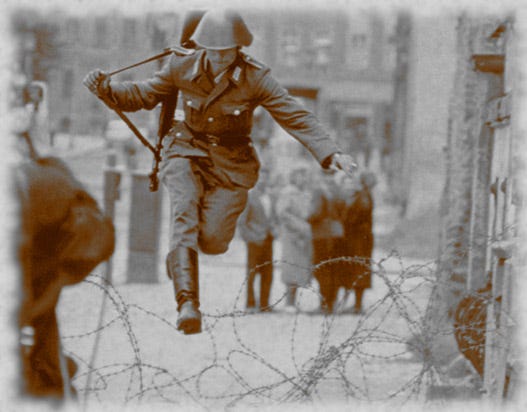
Structural Failure Across Varied Geopolitical Environments: A comparative study of socialist regimes operating under divergent levels of external pressure, ranging from the total isolation of Hoxhaist Albania and the internal horrors of the Maoist Great Leap Forward, to the comparative post-war divergence of East and West Germany, illustrating that central planning consistently yields supply collapse and authoritarian control regardless of Western involvement.
Within-Country Reform Mechanisms: An evaluation of post-1978 China and post-1986 Vietnam, proving that economic recovery occurred precisely when state-managed allocation and collectivization were dismantled, even while Western trade embargoes and diplomatic sanctions remained fully active or were actively tightening.
Ultimately, the historical record demonstrates that while Cold War containment strategies exerted real diplomatic and economic pressure on socialist states, external hostility was secondary to internal institutional failures. The abolition of private property, the suppression of price signals, and the centralized allocation of production inherently produce supply dislocation, economic stagnation, and political coercion. Foreign intervention neither created the structural flaws of central planning, nor does it explain why market-oriented shifts consistently produced growth under sustained diplomatic isolation. The collapse of twentieth-century socialist experiments stems from the economic and political unsustainability of the institutional model itself.
Comments
Nothing yet. Say the first thing.
Sign in to join the conversation.