
Over the last year, large consumer companies have been forced to make hard portfolio decisions and made some big moves:
Divestitures. Separations. Organizational resets. Capital pulled back to core brands and operating priorities. These moves were not about optimism, they were about discipline.
Across the consumer landscape, the environment demanded it.
Stock prices under pressure. Growth, volume in particular, was harder to find. Execution risk elevated. In that context, focus became non-negotiable. Integration, operating separation, portfolio clarity, and frontline execution quite rightly took precedence.
But taken together, these moves reveal something more structural — and more consequential for 2026. They point to a widening learning gap between how consumer demand is evolving and when large organizations act on it.
The pattern was consistent:
Reckitt sharpened its focus around 11 Powerbrands, divested Essential Home to Advent, and signaled intent to exit non-core assets.
Church & Dwight exited its vitamins and supplements business after years of fragmentation and rising competitive noise.
Edgewell divested its women’s health assets to Essity, narrowing its platform focus.
Kimberly-Clark undertook a transformational separation with Kenvue, a move that will command management attention for years.
Unilever announced the spin-off of its ice cream business, citing structurally different growth and capital profiles.
Nestlé, particularly within Health Science, has quietly re-scoped its ambitions, narrowing exposure where scale did not translate into durable advantage.
Individually, each decision makes sense. Collectively, they send a clear signal: Large portfolios are prioritizing “right-to-win” clarity and execution over breadth.
While this is rational, it has consequences.
What 2025 exposed is not a failure of strategy or leadership. It exposed a timing problem.
When portfolios retrench, three things happen simultaneously:
Capital concentrates downstream: Buyout and late-stage capital remains available. Early-stage consumer capital contracts materially as LPs and venture firms move upstream in search of scale, visibility, and nearer-term certainty.
Organizations turn inward: Integration, restructuring, and execution dominate leadership agendas — often for 12–36 months.
Demand continues to evolve anyway: Consumer behavior does not pause simply because portfolios do.
This creates a cycle: Learning shifts later → action gets more expensive → optionality narrows → acquisition risk increases.
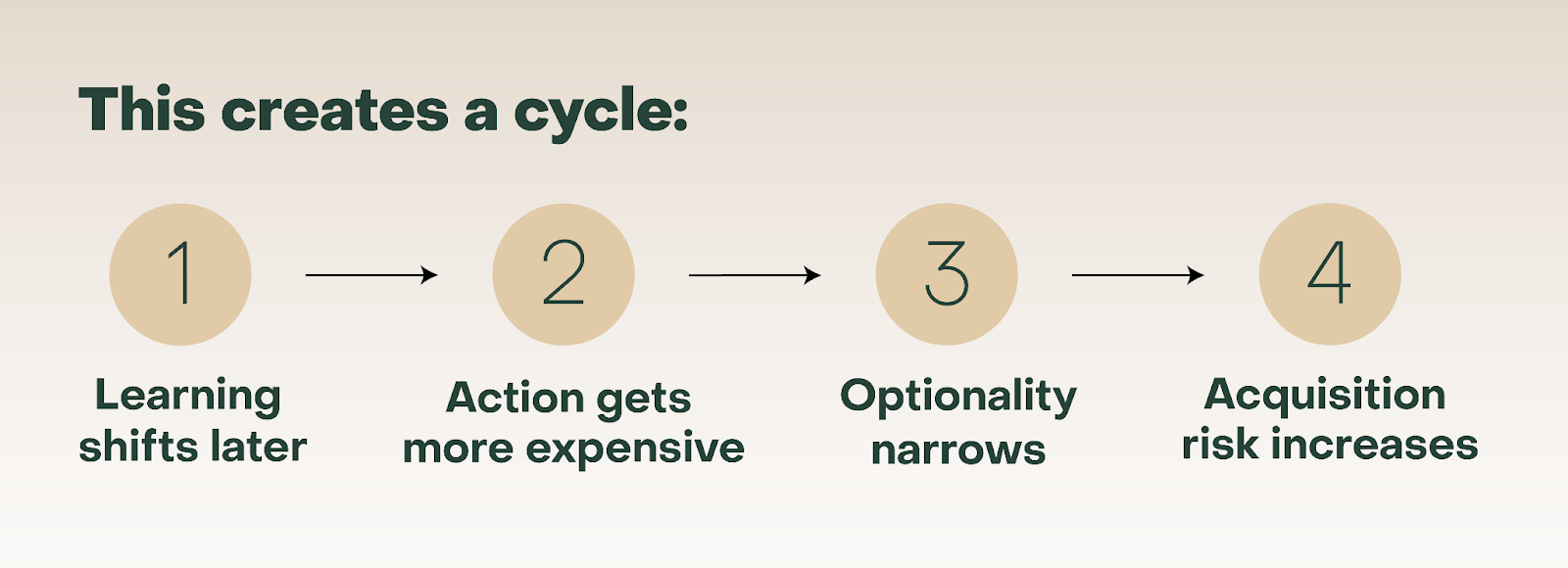
By the time new demand is in syndicated data or category reporting, competition intensifies and valuation expectations have moved.
This is the learning gap cycle.
Our upcoming Longevity Benchmark makes this dynamic clear.
Longevity is not forming as a new category to enter. It is emerging as a behavioral layer across everyday health, OTC, personal care, nutrition, and adjacent categories — it is reshaping usage, expectations, and perceived performance.
The data shows a consistent pattern:
Products shift from episodic (problem-solution) to habitual use (preventative).
Performance and felt outcomes replace claims as the basis of differentiation.
Category boundaries erode long before reporting structures change.
These signals appear well before their financial impact is at scale.
That matters because longevity-driven demand sits precisely at the intersection where many portfolios are currently least equipped to learn:
It is early.
It is fragmented.
It spans adjacencies rather than categories.
It requires behavior-level insight, not just financial confirmation.
The implication for 2026 is not that large companies should reverse course or abandon focus.
It is the opposite.
Focus on the core is necessary — but action cannot pause.
In Consumer Staples specifically, roughly 80% of the current stock price is based on the current terminal value, not near-term earnings. As Nik Modi, Managing Director at RBC Capital Markets, who covers Beverage and Household & Personal Care, has noted, the value is disproportionately shaped by growth in the outer years — not by short term gains in the next quarter.
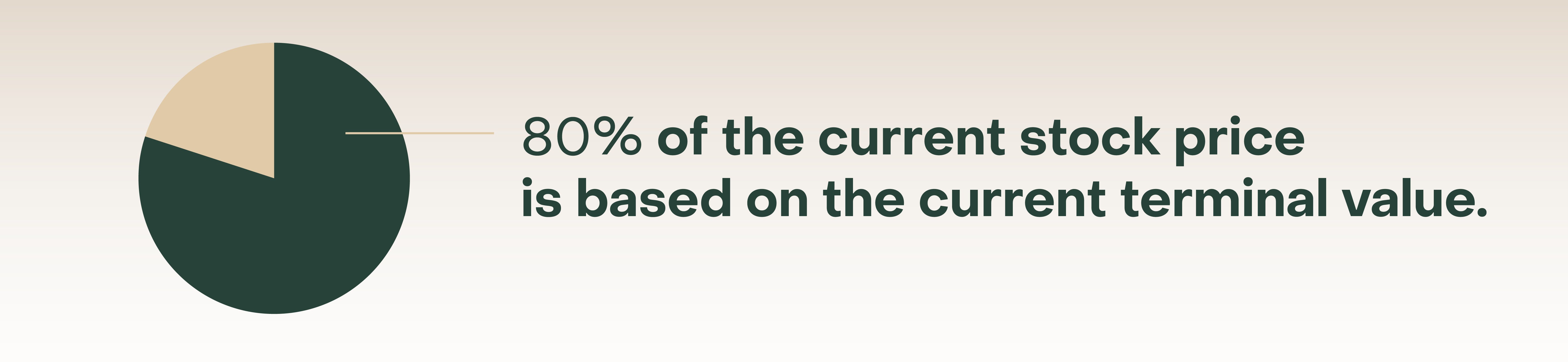
Most large organizations are wired to optimize for the near term. Quarterly earnings dominate attention, even though marginal gains today matter far less than sustained relevance over time.
The irony is obvious: companies manage what’s most visible now, even though the market ultimately prices what compounds years out.
We believe that winners in the next cycle won’t be the ones rushing back into headline M&A. They’ll be the ones that:
Stay disciplined on core execution, and
Get close to adjacencies early, at small scale
Build conviction before capital decisions become irreversible
This is where today’s funding gap matters.
Early-stage consumer capital has moved upstream. Fewer dollars are backing experimentation and demand formation, even as consumer behavior keeps shifting. Meanwhile, later-stage capital rewards proof—not emergence.
That leaves corporates with a simple choice:
Wait for certainty and overpay later, or
Stay close to where demand is forming before certainty shows up on a SIM slide
For corporates, this is where programmatic approaches matter. Not as substitutes for M&A — but as inputs to better M&A.
They allow organizations to:
Remain focused on core execution
Observe behavioral shifts before categories formalize
Reduce uncertainty ahead of larger capital commitments
Preserve optionality without public signaling
This is the work we increasingly do alongside corporates — helping translate early behavioral signals into structured learning while portfolios remain focused inward.
For venture-backed early-stage brands (or those with venture aspirations), the implications are just as important:
Capital is scarcer, and patience is thinner
Clear adjacency matters more than novelty
Products must earn habitual use, not just trial
M&A relevance now depends on how well a brand fits into a strategic’s future platform — not just its current growth rate
The lesson of 2025 is not that portfolios became smaller.
It is that the cost of learning late became impossible to ignore.
In a world where ~56% of M&A historically fails to create value, advantage no longer comes from moving first or moving big. It comes from sequencing learning ahead of capital.

2026 will reward the companies that treat learning not as an event — but as an operating discipline.
No posts
Comments
Nothing yet. Say the first thing.
Sign in to join the conversation.