
UPDATE: Young Lions Sometimes Roar is out now!
It’s available as an eBook, or a paperback, according to your preference, although the proof copies of the latter came out pretty well, and there are one or two footnotes knocking around, which always work better in print, I think.
I’ll be writing a little something extra about the book over the next few days. The very short version is: if you like cricket, and sport, from the 90s, and the following two videos stir something from deep inside of you, then you should enjoy Young Lions Sometimes Roar.
Thank you very much for your support: it means a lot. Apart from buying the book, if you could recommend it to anyone you know who might also enjoy it, that would be much appreciated.
As for reviews, Amazon apparently does not look kindly upon favourable critiques from friends or family (although how exactly they know of pre-existing relationships potentially leads down a troubling rabbit hole regarding the data privacy nightmare that is the modern world) and the consequences are potentially severe.
However, you can always leave me a review on Goodreads, if you have an account, or post something on social media – it all helps.
Right, I’m off to celebrate. There’ll be another profile this Sunday as usual, and plenty more to come over the rest of the summer. See you soon!
—
Hello all! I come with exciting news: my next book, Young Lions Sometimes Roar: Watching Bad Cricket (And Playing Cricket Badly) in the 90s, will be released on Friday 14 August 2026.
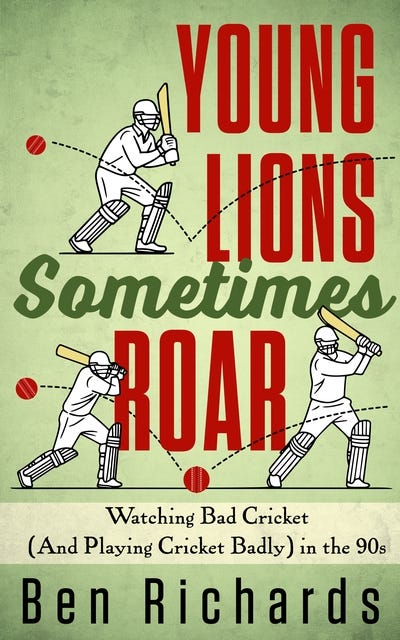
April 2022. In the icy stands of Headingley Cricket Ground sits writer Ben Richards, watching his home county of Yorkshire.
This isn’t the magical rekindling of a teenage romance with the sport that he had imagined. And England have been losing, just like they did in the 90s.
Back then, a team in disarray held a special and magical appeal. As the dawn of a new footballing age brought satellite television into the Richards household, coverage of England’s cricketers getting thrashed on their winter tour proved to be the unlikely origin story for a young Ben’s love of the game and a doomed quest to become the side’s next great all-rounder.
Young Lions Sometimes Roar is a look back at sport, and childhood, in the 90s: a tale of falling in love with Gooch’s hapless tourists on TV, following the travails of Atherton’s young lions via crackling long-wave radio coverage, and seeing the decade come crashing down on the captaincies of Stewart and Hussain.
Almost 30 years after watching his first match, Richards finds himself with time on his hands, watching county cricket in the cold, wondering if it was really that bad after all.
—
Young Lions Sometimes Roar: Watching Bad Cricket (And Playing Cricket Badly) in the 90s will be available via Amazon in paperback and eBook formats.
As I mentioned the last time I was here, over the last few months I’ve been running a separate Substack, also under the name Young Lions Sometimes Roar, delving into the careers of various characters in 90s cricket, via the pages of their dusty old books.
Some highlights of what’s been covered so far:
The Fading Warhorse – Graham Gooch
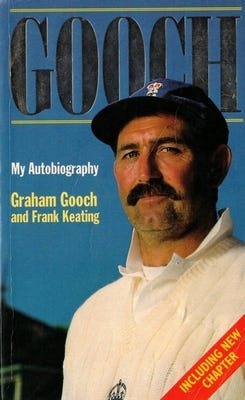
‘As with all captains, Gooch ultimately found that support for his methods only lasted for as long as they represented a break from the previous regime and produced an upturn in results, before ultimately being turned against him. The dropping of Gower and Botham in 1990 drew a line under the perceived indulgences and excesses of the 80s, but three years later, with the team struggling, public demand for the return of these ageing heroes quickly followed.’
The Young Lion as Captain – Mike Atherton
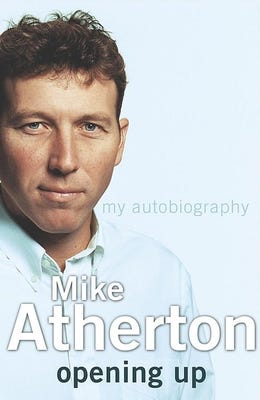
‘Waiting for Mike Atherton’s England side to be good was a quest that dominated my teenage years more than any other. It always lay tantalisingly out of reach, never so hopelessly dashed by the latest defeat that all seemed lost, with the occasional unlikely win or heroic performance rationed out in such a fashion that faith and optimism could still be maintained.”
“The man himself somehow never seemed entirely culpable, perhaps because he led from the front with the bat, or because a lot of the madness of English cricket at the time existed around him – was happening to him – and there was a sense that he was doing all he could to keep the team going.’
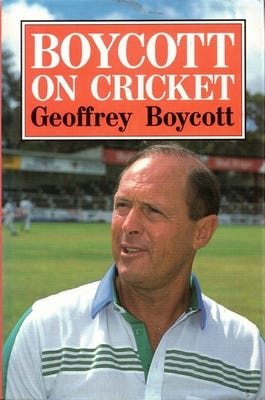
‘To the younger sports fan, older pundits are little more than TV characters, their playing careers a mere footnote predating the current generation’s interest in the game. In 2016, the BBC showed footage of Euro ‘96 to people born in 1996: during the memorable 4-1 group defeat of the Netherlands, one made a comment to the effect that she couldn’t believe that bald bloke off the telly – Alan Shearer – was once the premier striker in the land.’
‘And so for me, back in the 90s, Geoffrey Boycott was just a man with a booming Yorkshire voice, aged somewhere between 40 and 70, who appeared on television coverage of cricket to criticise poor batting technique and occasionally put his car keys into the pitch.’
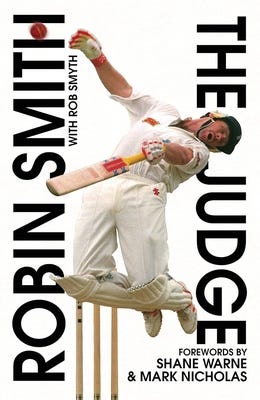
‘Robin Smith’s nickname may have started as a reference to his slightly static, wig-like curly hair, but surely stuck after it came to represent his aura at the crease: a strongman with big forearms, ready to pass judgement on wayward short-pitched bowling delivered by overexcited pacemen.’
‘And yet fans of Mike Atherton’s England rarely saw the best of Smith, who had made his batting reputation in the late 80s and sealed it during the early years of Gooch’s captaincy. Atherton later wrote that while the style and positive qualities of many contemporary batters reflected their personalities, the exact opposite was true of Smith, a seemingly battle-hardened warrior on the pitch, but a sensitive man in need of reassurance off it.’
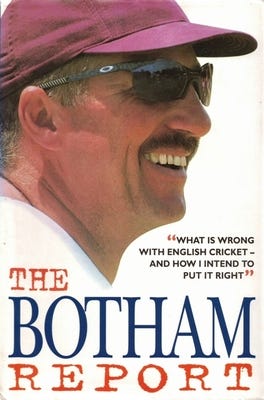
‘Ian Botham loomed uncertainly over 90s cricket. With his playing career over, and his best days gone long before that, Botham’s mammoth achievements in the late 70s and early 80s, along with a media presence that reflected an ongoing desire for the spotlight, ensured he remained in the public consciousness as a symbol of a better, bygone era, when England had a decent all-rounder and won the Ashes with some regularity.’
‘As the team continued to produce inconsistent performances, the media and public yearned for a player to reproduce his deeds and replace him in their affections, with the older Botham identified as a candidate to ‘sort out’ English cricket and become a new kind of saviour, off the field.’
—
There’s plenty more to come on the YLSR Substack over the rest of the summer. I’ve also set up a separate website to promote the book.
While the Substack and the book are both about English cricket in the 90s, the former is fairly relentlessly focused on the detail of individual players’ careers. The book is a little bit broader, albeit still written by a man mildly obsessed with those players and that particular subject. I’ll be writing a piece to introduce it properly before the release date.
If you know anyone who might be interested in Young Lions Sometimes Roar, I would be very grateful if you’d share this post or the YLSR Substack (or the book’s website, in case your friend who likes 90s cricket doesn’t know what a Substack is and finds the very notion of it off-putting).
All of the pieces on the YLSR Substack are (and will continue to be) completely free to access, so any potential readers can make up their minds whether my writing is their cup of tea or not before committing to the book.
I appreciate that everyone is now constantly inundated by automated messages from globo-mega-corps pestering you to leave a review, fill out a survey, or sign up to a mailing list before, during and after every interaction with them, but independent authors really do benefit from word-of-mouth recommendations, and while there are other ways to help get our work out there, we don’t exactly have agents, PR assistance or huge marketing budgets to rely on either.
All that aside, I’m so pleased to have finished the book and am excited to share it with the world. I’ll be back here soon in the build-up to release to share any updates.
Apologies if you’ve already seen a version of this message via the YLSR Substack. It is the price you pay for being Fans Of Richards (Ben), an elite group of tastemakers whose interest in my work extends beyond the niche world of 90s cricket. If I had a Patreon (which I don’t, and won’t), or paid posts on Substack (ditto), you would be my top tier fans (if all the tiers had no fee).
This brief period of crossposting will continue for the next couple of weeks or so, then cease forever. Thank you for your patience and support!
No posts
Comments
Nothing yet. Say the first thing.
Sign in to join the conversation.