
I wrote last time about a surfeit of opinions being available at election time, but chose not to mention the summer football tournament that was also taking place and generating a similar amount of internet-based hysteria.
Even if it is easy to be cynical about people constantly holding court on the serious topics of the day, those things do at least actually matter, unlike sport. I do like sport, though; apologies if you don’t, and I promise it won’t be a recurring subject here.
Although there’s no way for me to prove otherwise, I did write most of what follows prior to last Sunday’s Euro 2024 final, because I didn’t want to do a ‘man sad/team lost’ piece. Whatever feelings I had applied regardless of the result; although England did lose, and I was a bit sad.
–
I can’t really remember a time when I haven’t been excited about a summer football tournament.
While it feels like some of the magic may have been lost from the club game (tedious tribalism, dodgy owners, hefty TV subscription fees, constantly happening football massively mattering to someone, presumably), there’s something refreshingly stripped back about a short series of matches between international teams in the summer, at the end of which someone is declared ‘the best’ in a moment that genuinely seems to mean something, rather than immediately being erased by the next game and the next season.1
To follow England — the men’s team, at least — has always been to involve yourself, however unwillingly, in the psychodrama that goes along with it. It’s quite a position to hold, as many seem to do, that the England team is both good enough to win every game comfortably and also an absolutely terrible side who deserve a good hiding.
We’re the best; we’re the worst. We love ourselves; we hate ourselves.
Somehow, though, this summer has felt a little bit different. Even without venturing onto social media or voluntarily submitting yourself to too much additional #football #content, the negativity expressed towards the team quickly snowballed into something that threatened to overwhelm the whole experience.
On the field, England played ok; off it, the spectacle was bizarre, and the tenor of the feedback, whether through snarky highbrow smarty-pants think pieces or a booing crowd throwing beer — which are arguably just different ways of expressing the same emotion — consistently and aggressively downbeat.
I’ve long become used to the tyranny of the BBC live text update while following sport — usually cricket — which creates a particular kind of anxiety by punctuating descriptions of the action with comments from the public.
In such a context, and despite understanding on a rational level that it’s a filtered summary of multiple different pieces of correspondence from a variety of sources, the effect on the reader is to create a composite personality, Tommy Internet, who is working himself up into an unsustainable lather while generating multiple different knee-jerk opinions at once.
Tommy Internet doesn’t appear to be a very nice man, and certainly isn’t a happy one — in fact, he’s only able to maintain a tenuous link with reality, as the ability to hold and express so many thoughts at once is beyond the capacity of any human mind.
(It’s pretty hard to read them all, too: I’m fairly sure that following a Test match isn’t supposed to be like that scene in Robocop 2 where Robocop is reprogrammed to follow an unsustainable number of commands and ends up electrocuting himself in frustration).
With football, there’s a strange overlap now where not only do the fans think they’re pundits, because they’ve been so encouraged to offer their opinions that they’ve gone out and bought some microphones and cameras to publish their own hard-hitting truth bombs and tactical analyses to the web, but pundits have started acting like fans, with their reactions to goals not-so-secretly filmed and broadcast, along with their insistence that any intemperate comments about the team are made only because they care.
Does any of this achieve anything useful? Fans arguably best serve their team’s interest by cheering them on, while caring about England so much that you’re unable to prevent the emotion affecting your broadcasting is arguably the opposite of what you want from a professional. In a world where Roy Keane looks like the sanest man in the room, it’s a sure sign of a problem.
In the middle of it all has been Gareth Southgate. As a slightly gawky and well-spoken man, he's an uneasy fit with the angry England of Tommy Internet, which tends to demand either an underqualified tub-thumper who loves his country or a highly decorated foreign coach with superior tactical pedigree. (Both have been tried before, with no great success).
In many ways, Southgate was the perfect England manager, having played at the top level, including with the national side, and experiencing the full range of highs and lows that it entails, before serving an apprenticeship as an international manager with the U21s.
In the role, he was passionate and patriotic, but level-headed and articulate: a blend, in other words, of the two broadly different types of manager for which fans often call (and between which the FA has swung over the last 25 years).
Most significantly, he knew all about the fuss — the ‘noise’ — that comes along with being an England player.2
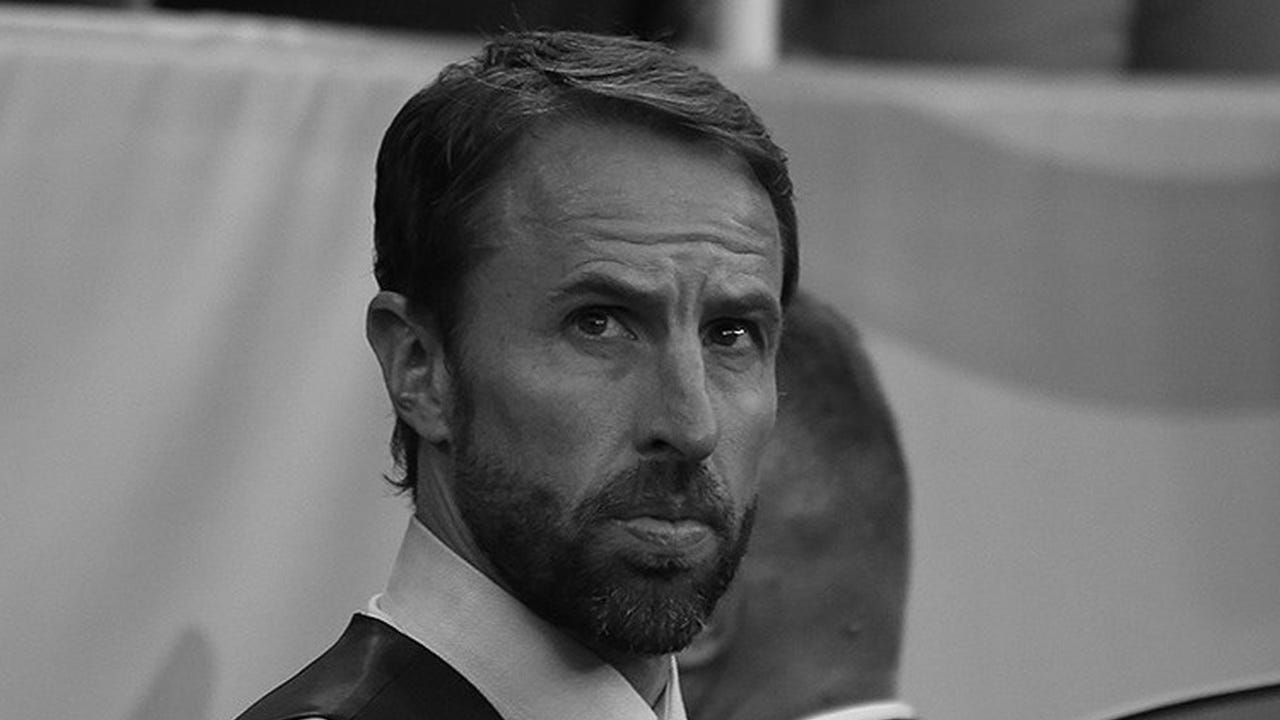
For a while, when results were improving, and better than they had been for some time, the noise subsided. But to match the near-success of the past was not enough.
During his tenure, the noise managed to turn a slightly melancholy pop song about no-one believing in the team into a nationalistic knees-up singalong. Meanwhile, former team-mates who continued to dine out on stories of their own nearlys and not-quites started to stick the boot in, while affecting a kind of faux-mateyness: ‘Gareth will be disappointed, of course he will.’
To have walked away after a slightly unfortunate defeat against France in Qatar 2022 would have pleased some fans and spared Southgate some abuse. But he wanted to win, not have yet more near-misses stored away in the archive to be romanticised and misremembered.
Now that he’s gone, a failure to secure that elusive victory may well be his legacy. Or maybe it will be the realisation that England getting to the latter stages of a tournament doesn’t necessarily mean that it’s the last chance for a set of uniquely gifted players — a golden generation — who absolutely must seize it now for the sake of king and country, but is a reasonable and achievable goal.
Because England have pretty much always had good players, as have many other international teams who didn't happen to win that particular year. Mostly, it’s about fine margins.
The teams that those of my generation endlessly look back on — 1990 and 1996 — were subject to pre-tournament ridicule, with their managers’ fates sealed in advance of the tournament, the noise forcing them from their posts before they’d even been eliminated.
Back then, the cliché was that today’s newspapers would be tomorrow’s fish and chip paper.3 These days, though, instead of it being thrown in the bin and forgotten about, you can access the digital equivalent with the click of a button.
You can, for example, to go back to when Gareth Southgate was appointed, and find Harry Redknapp, once passed over for the job, offering unfavourable comparisons with ‘experienced managers’ like Steve Bruce and Sam Allardyce.4
You can also find a clip, taken after England’s early exit from Euro 2000, of the BBC’s Alan Hansen decrying the technical abilities of the players available to the England manager.5
The team were poor in that tournament and their early exit was depressing, but look at the squad list and you’ll see Gary Neville, Sol Campbell, David Beckham, Alan Shearer, Steve McManaman, Paul Scholes, and Michael Owen, among others. Two years earlier, they were apparently destined to win the World Cup.
It’s easy to see why getting rid of the noise is essential for the players. A couple of years ago, a new coach and captain put it at the centre of the English Test cricket team philosophy: remember why you love the game, and why you played it as a kid. (It worked, too, at least until someone in the press gave the philosophy a silly name and the noise twisted its intentions, using it as a stick to beat the team with at every opportunity).
I’ve started to think that I need something similar as a fan: has sport, and the world around it, really gone uncontrollably, irretrievably mad? Or is there a way to experience a different feeling, and somehow go back to a time in your life when it was just something to be enjoyed; when you cheered on your team and wanted them to win?
Did that time ever exist? I like to think that it did, although the window of being old enough to understand a sport without having quite internalised the fact that you’re supposed to be quite cynical about it all — the manager, the players, the tactics — was actually pretty small.
By the time I’d reached my teens, maybe even before then, I had already started talking like a jaded middle-aged bloke who comes into work each Monday insisting that he’s wasted another weekend on that bloody team and is fed up with the lot of them.
Maybe it’s naïve, but if there’s room among England fans for podcasters, banter lads and the man who put a flare up his bum (and worse), there also has to be room for some gentle optimism and support.
The kinds of things that my Mum used to say to that cynical teen all those years ago — never mind, someone has to win, just enjoy the game — may have seemed ridiculous and embarrassing to me at the time, but I now realise they probably represented a deep and universal wisdom.
Even if that’s overstating the case somewhat, as guiding principles, they’re certainly much less ridiculous and embarrassing than the noise itself, or being subsumed by it.
I hereby acknowledge that corporate greed and ethical impropriety are also a core part of international football.
I’ve tried to avoid it, but evidently the post-final discourse has included the media talking about the ‘noise’ as if it was something separate and distinct from their own coverage — ‘nothing to do with us, guv’ — which adds a slightly meta element to the whole thing. But Alistair Campbell, himself a former journalist, provided a pretty decent description in the i this week: ‘Journalists create the noise, then write and broadcast on how the noise piles pressure on the England players. Players then in turn appear before the same journalists to explain how they are aware of the noise, but are determined to block it out.’
Did I ever actually eat fish and chips wrapped in newspaper? I thought I might have done, but the internet tells me that I can’t possibly be that old.
Southgate didn’t, of course, get the job ahead of Allardyce, but had to take over anyway shortly after the former Bolton manager was appointed and caught in an embarrassing newspaper sting which led to his sacking (and fevered online speculation as to whether the blurry footage captured the national team manager drinking a pint of wine).
This is not to pick on Hansen here, a fine former pundit from Scotland forced to endure years of being asked to explain England’s early tournament exits from the point of view of someone who cares. (Get well soon, Alan).
Comments
Nothing yet. Say the first thing.
Sign in to join the conversation.