
My partner and I love feeding people.
We always ask guests what they like to eat.
But what if we also asked: “How do you like to feel in a space?”
Hosting is more than logistics. It’s emotional design.
Do you prefer standing or sitting?
Is soft lighting or quiet space helpful?
Do you feel better with a blanket, or less clutter?
We’ve been curious this year if we could ask people for their sensory preferences and try to meet them. What if we invited people to open up about something that many neurodivergent people keep private.
And so we ran the experiment.
Did you know that we have more than 5 senses? They didn’t teach me this in elementary school!
Here are the 8 that show up most frequently.
Visual
Smell
Taste
Touch
Sound/Hearing
Interoception - Sense of what is going on inside our bodies
Proprioceptive - Sense of movement and balance
Vestibular - Sense of our body in a physical space
Not all senses are equally strong in everyone. Everyone has a different sensory profile, much like a fingerprint. One of the characteristics in many neurodivergent diagnoses is having a sensory profile with at least one sense that spikes outside of the norm.
It can play out in a person being restless and struggling to stay focused and seated, and benefiting from a fidget toys. It can be a person feeling distracted by the room being too cold or warm. Or too noisy. How many of your colleagues wear noise-canceling headphones because they like music, vs because they’re trying to survive the open floor plan?
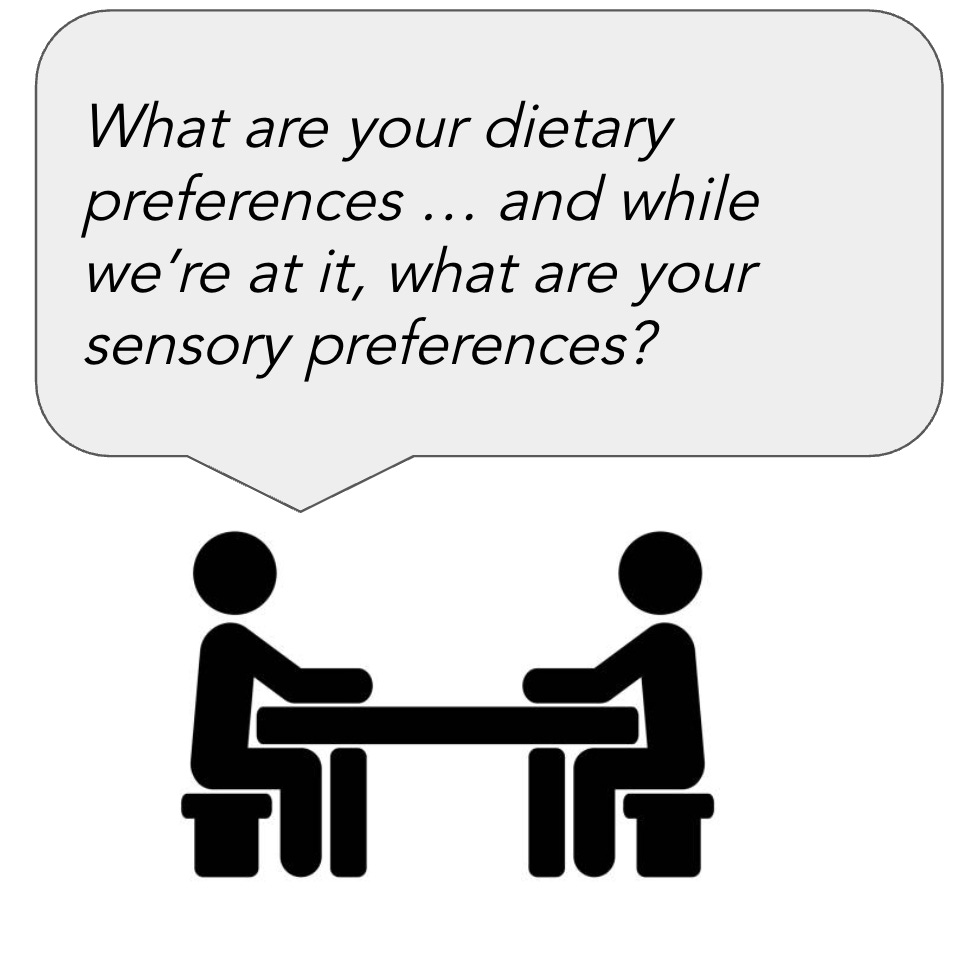
Given how parents of children seem to have more comfort around advocating for their children’s needs, we decided to run an experiment. For the three children’s birthday parties we recently hosted, we asked parents for their children’s dietary preferences as well as their sensory preferences.
Some were thrilled. One said: “My child prefers standing to eat.”
Perfect! We’d already ditched our dining table.
Some parents were eager to learn about sensory preferences and felt safe advocating for their children’s need.
The rough breakdown …
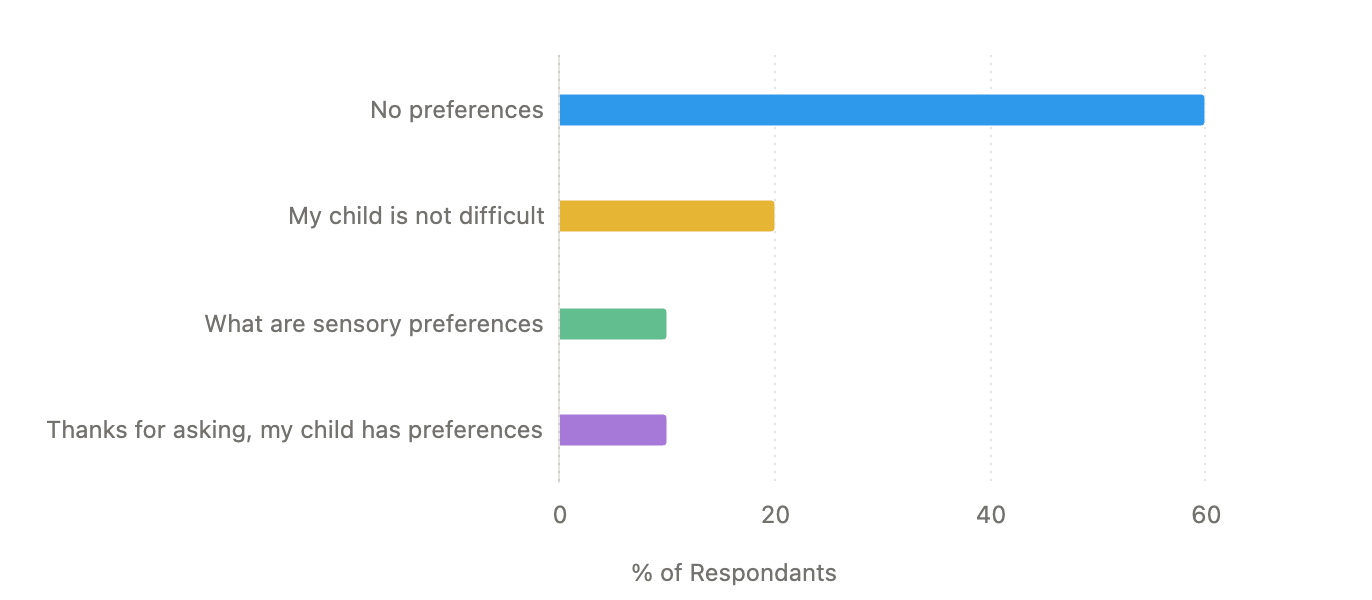
We were surprised that some parents hesitated. They were worried about being a burden, even though we explicitly invited their requests.
But it hit me: this is exactly how I feel as a vegetarian. I don’t want to inconvenience a host but I also don’t want to go hungry. I’ve felt appreciated when people ask because I never want to feel like a burden on the host but I also don’t want to show up and insult the host by not eating. Once at a restaurant, the staff asked if I had an special needs and I said no, assuming that the dish I ordered didn’t have meat in it because there was no meat in the description.
Why do we normalize asking about peanut allergies but flinch when it comes to light sensitivity, or noise tolerance?
Overcoming the stigma of sharing one’s preferences as a kid, adult, or caretaker is not easy. Yet we’ve normalized asking about peanut allergies. Why not normalize asking about noise sensitivity or lighting preferences? I am optimistic that by asking more often, we can begin to normalize these conversations.
What would happen if we made it easier for people to tell us how they want to be treated?
Everyone has preferences, regardless of if we voice them or not. Next time we host friends over, we’ll ask about their sensory presences. We want to feel seen in more spaces and treat others the way we wish to be treated. We ask, not hoping for an answer so much as hoping this question catches on.
Comments
Nothing yet. Say the first thing.
Sign in to join the conversation.