
Post by Anastasia Sares
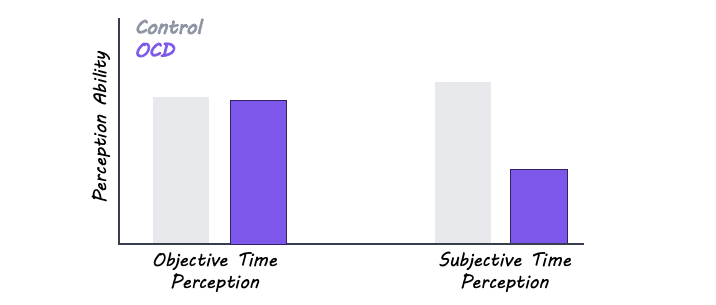
In a preliminary study designed to understand how people with obsessive-compulsive disorder may differ in time processing, the authors found that while objective time perception and movement ability were intact, subjective time perception (including time management, time knowledge, and time experience) was significantly impacted.
Obsessive Compulsive Disorder (OCD) is a condition in which a person experiences recurring worries (obsessions) and enacts certain behaviors (compulsions) to try and manage these worries. OCD shares some features with depression (for example, some depression medications that act on serotonin can also be used to treat OCD). It additionally shares features with movement disorders such as Tourette’s, where differences in brain function cause involuntary actions that are difficult for the person to control.
People with OCD can take longer to complete certain tasks and experience difficulties with time management. However, it is currently unclear what contributes to this. One possibility is that people with OCD have more difficulty controlling their movements, which means that doing things takes more time. Another possibility is that their objective time perception is altered—they might be less able to estimate time passing due to differences in time-keeping mechanisms in the brain. Finally, a third possibility is that people with OCD differ in their subjective experience of time, which could include difficulty making plans or realizing how much time they have spent on a task.
Recently, in an exploratory study published in European Archives of Psychiatry and Clinical Neuroscience, Mavrogiorgou and colleagues tested both objective and subjective time perception, along with movement ability and depression/anxiety symptoms, to better understand whether OCD uniquely contributes to altered time processing.
In this exploratory study, the authors recruited 20 participants with OCD and 20 healthy participants of similar ages and genders. They ran them through a battery of tests, including questionnaires to establish the severity of OCD symptoms, questionnaires for depression and anxiety symptoms, measures of movement ability, experimental tests to measure more concrete/objective aspects of time perception, and questionnaires about subjective aspects of time perception.
The objective time perception tasks included flicker fusion frequency, which presents a blinking light that flickers at faster and faster frequency until the participant indicates that they perceive it to be stable and not flickering anymore—this measures the timing resolution of their visual perception. Another was the Chronotest, where participants are presented with a light stimulus and asked to estimate how long it was on, in seconds. They are also asked to reproduce different time intervals by turning a light on for that amount of time.
Participants with OCD were not significantly different from the healthy controls in their objective time perception, and there was only a slight trend for a difference in movement ability. In contrast, subjective time measures such as time knowledge, time experience, and time management were significantly impaired in OCD, and were correlated with OCD symptoms—in other words, those with more severe OCD had poorer subjective time perception. Subjective time perception was also correlated with depression scores, both in people with OCD and in the healthy control group, but some influence of OCD symptoms remained even after controlling for depression, anxiety, and movement issues, specifically on time management. It’s worth noting that subjective time perception was measured using a questionnaire, while the objective time measures were done using experiments, so self-perception had more of a chance to influence the results.
Since this is an exploratory study, it should be treated as preliminary, but it has the potential to increase our knowledge of a lesser-known aspect of OCD. If these results hold, it means that there are time perception differences in OCD that are not related to movement difficulties or depression/anxiety symptoms.
No posts
Comments
Nothing yet. Say the first thing.
Sign in to join the conversation.