

Around May or June after senior year, your typical high school debater graduates from the trenches of competition into full-fledged judgehood. Around this time, she will sit down for an hour, think really hard, and write out a paradigm. Supposedly, her paradigm articulates a model for how a debate round should unfold. But paradigms are really some mix of autobiography, admonition, and legislation. Mine holds a few dozen opinions that span formats, topics, and arguments. If you’re debating in front of me, you’re playing my version of debate.
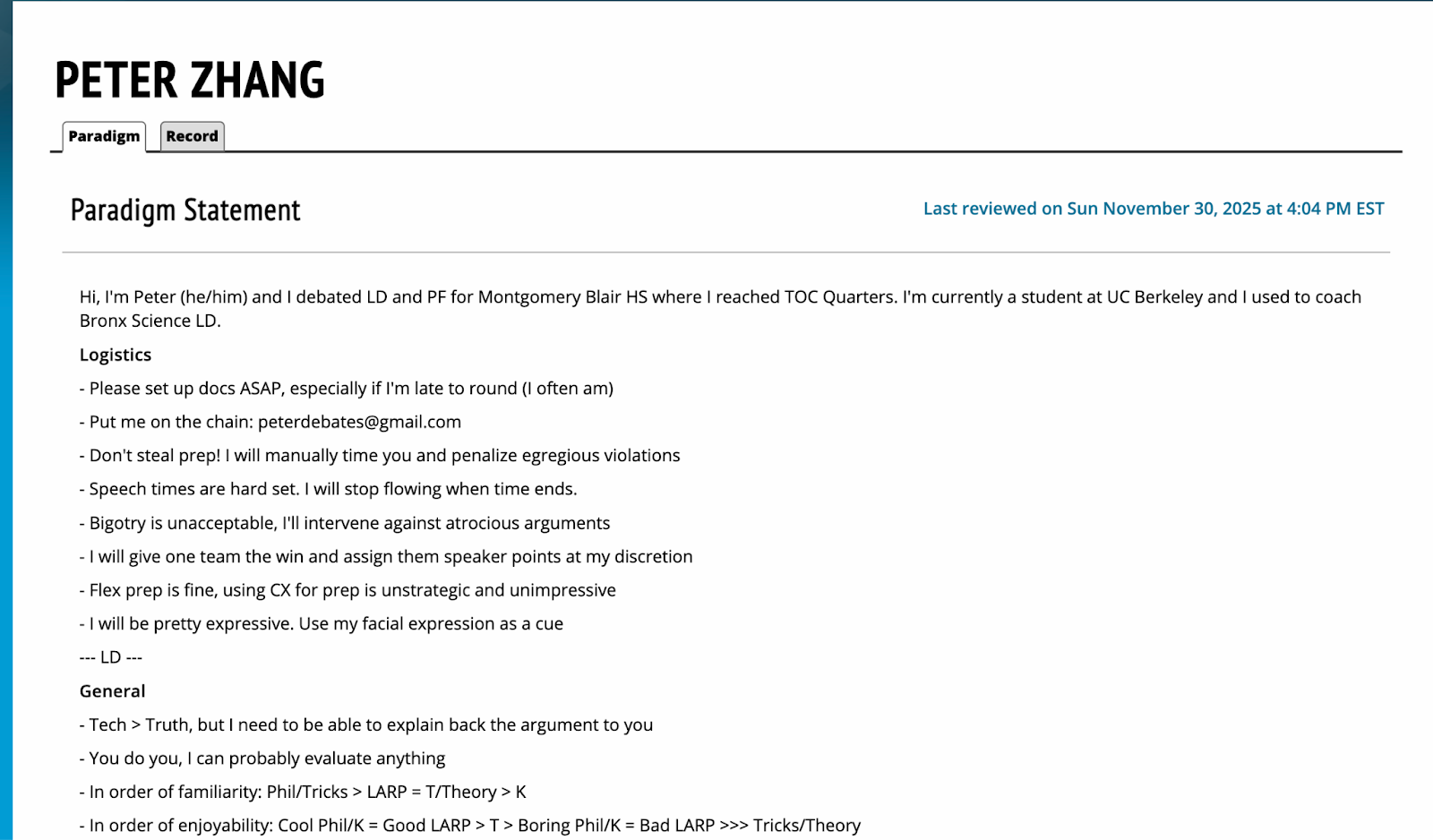
The paradigm statement is a compromise between judge and performer. Because the debate community failed to find a fair universal standard—it would require way too much consensus about values, belief formation, and so on—we settled on contracts. This judge-performer contract animates the activity’s evolution: judges set expectations of increasing excellence and particularity, and performers flourish under that creative constraint. While one can never make an objectively correct decision, one can make a decision with integrity. So too elsewhere: Dworkin’s Hercules strives to make the right decision by his own standards of law; your polished Hinge profile makes a promise to your future suitors.
So too for the 15 minute technical screen you have with me this evening.
Last reviewed on December 29th, 2025
1. I’m an engineer at Mercor. In March, I quit a great job at Jane Street, gave away my furniture, and joined a small startup creating a talent marketplace. Mercor painfully inched to a $10B valuation on the blood, sweat, and can-do attitudes of a few dozen 22-, 23-, and 24-year-olds. I’ve grown a lot. So much so that the company now entrusts me with your intro screen. The obviously great outcomes obscure my original motivations: I quit because I felt restless. I knew that trading wasn’t me at my best. I’m still figuring out how I feel about Mercor, but I like it so far.
2. My mission here is to automate vetting. I build systems that accurately and automatically assess human ability. I’ve watched hundreds of AI interviews.1 There are many fair nits to have with our interviewer, but the most pernicious and intractable problem is the bot’s politeness. I don’t think humans are ready for a rude robot that interrupts and asks hard follow-ups. Digital abrasion so deeply offends human preferences that this task must be left to humans for now.
3. My job is to decide if you can solve hard problems. Unlike a resume or take-home, a live screen affords me the opportunity to see you solve a problem in real time. I don’t want a recap of your background or a way to multiply 3 lists quickly. I want to find a problem that’s still alive in your head. It could be a gnarly problem at your current job or an extension of a personal project. A good discussion will feel like a problem-solving session with a colleague. I think that is basically what engineering is about.
4. Your time as a talented young engineer is extremely valuable. Great communicators conserve time. If you’re halfway through a paragraph that I can confidently autocomplete, I might cut you off. If you think you could speak faster, I dare you to do it. Engineering ability and conversational bitrate are distinct and maybe correlated axes. I’m impressed by people who excel in both dimensions. That’s part of my job.
5. Async reading is the fastest communication medium. We have obligatory “paperwork” questions that should be part of the written application, but aren’t yet. You can do me a massive favor by emailing me answers prior to the call.2
6. If you don’t know something, just say so. Humility is critical for all of our hires, young and old. It will count as a plus.
7. You absolutely may use AI during the interview. Please announce that you’ll be cheating at the outset and start screen-sharing. I’ll kick off a rapid-fire single-contestant jeopardy game. You’ll have 5 seconds to buzz. The board will be a weave of precise technical questions and totally made up joke topics. Your performance will be rated on buzz speed, pronunciation, and hallucination rate. It will be, like, the funniest thing.
8. I unabashedly prefer funny candidates.
9. I don’t expect you to know a thing about Mercor. If you’re anything like us, you want to get in on the AI boom and the corresponding career growth. You’re rightfully applying to a dozen other startups that promise the same thing. As an engineer, here’s all you need to know: you should consider Mercor if you can advocate for yourself and manage hard deadlines.
10. Take my AI interview. If you do well, I will reach out to schedule a phone screen and/or be much more inclined to pass you on. I will only review your submission if you tell me to, so it is effectively zero-risk. I promise it will be fun.
Does this sound fun to you? We’re hiring someone to work on the AI interviewer! Please reach out if you want to work on the world’s largest AI interviewer.
Email peter@mercor.com a topic you’d like to chat about! Can be anything from a problem you’re working on to a topic from school you felt like you knew really well.
No posts
Comments
Nothing yet. Say the first thing.
Sign in to join the conversation.