
Welcome back, brain-fit player.
This is Dr. Gordon Jones, your brain fitness and pickleball performance coach.
Today we talk about how the brain directs two skills that win more points, and saves more bodies from harm, than anything else in this sport. So, settle in, get comfortable, and let your hands rest naturally open and easy.
Remember, your access to this Substack series is freely given, so would you consider making a contribution to our non-profit mission of spreading the benefits of pickleball to the world?
Just go to
https://brainfit.gordonjones.org/
You can access the link in the written portion of this post.
Now for our discussion on Fast hands Smart feet.
Here is what most players never realize. The fastest hands at the kitchen line do not belong to the youngest players. They belong to the calmest ones.
Speed is not a muscle. Speed is a brain state. By training your brain properly, you’ll be able to handle anything that comes at you at the kitchenline.
And then there’s balance;
The thing that keeps you upright when the point gets wild is not in your legs, it is in your nervous system, actively reading the court and recognizing the patterns forming so you will naturally make decisions before you know you have made them.
Today we instill both.
Let’s begin with our breathing;
Breathe in deep through your nose, for 1, 2, 3, 4
And hold for 2, 3, 4, 5, 6
Breath out the mouth for 2, 3, 4, 5, 6, 7 ,8
And hold out for 1, 2
Listen as you breathe the pattern in and out again.
Breathe in deep through your nose, for 2, 3, 4
And hold for 2, 3, 4, 5, 6
Breath out the mouth for 2, 3, 4, 5, 6, 7 ,8
And hold out for 1, 2
Now, breathe naturally, letting each exhale take you a little deeper, a little quieter, a little closer to the theta state where real learning happens.
At the kitchen line, a ball can cross the net in under half a second. Your conscious mind cannot keep up with that. It was never supposed to. Fast hands belong to the other-than-conscious mind, and the other-than-conscious mind works best when the body is loose and the attention is soft and wide. A tight hand is a slow hand. A searching mind is a lost point. So the training is not to try harder. The training is to trust deeper. Learning at the speed of trust.
Think about your feet. Just like your hands, your feet are only as smart as the decisions your brain has rehearsed. The single most dangerous moment in pickleball is the moment a player backpedals, chasing a lob over their own head, eyes up, heels blind, balance gone.
Smart feet never backpedal.
Smart feet know a better answer, and tonight your brain learns it so completely that it becomes automatic.
You’re drifting deeper now. Deeper into the learning brain state of theta.
See yourself at the kitchen line playing doubles. Your partner is beside you. You know and trust each other to play in coordination together, not as two individuals, but instead, one team.
The ball is dinking, patient, quiet, and then it happens. Your opponent lifts a lob, high and deep, floating over your head. Watch what your body does not do. It does not backpedal. It does not reach and stumble backward. Instead, you hear your partner’s voice, immediate and certain. Mine. Your partner turns, naturally, the way you turn to walk, and runs back with the ball in view, balanced, smooth, arriving in position to return it.
And you, you stay forward. You hold the kitchen line, to shift to cover the open court behind you, your paddle up, ready to counter the very next shot. This is the pattern. The lob goes over one player, and the other player takes it. Turn and run. Never backpedal. Feel how right it feels. Feel the balance in it, the teamwork in it, the safety in it.
This one move not only offers a much more successful return or reset shot, but it reduces emergency room visits by half.
If you are listening to this podcast, make sure you read the notes to find the link to the most recent report on injuries due to pickleball in the United States. valuepenguin.com/pickleball-injuries-study
Now, back to our match;
Run that last point again, and this time reverse the roles. The lob sails over your partner’s head. Your eyes read it instantly, before it reaches its peak, and your voice is already out. Mine. You turn, hips first, and run naturally, the ball dropping into your vision, your feet under you the whole way. You return the lob with ease while your partner holds the line.
Turn and run. Never backpedal.
Turn and run. Never backpedal.
Your brain is recording this right now, wiring it as the automatic answer.
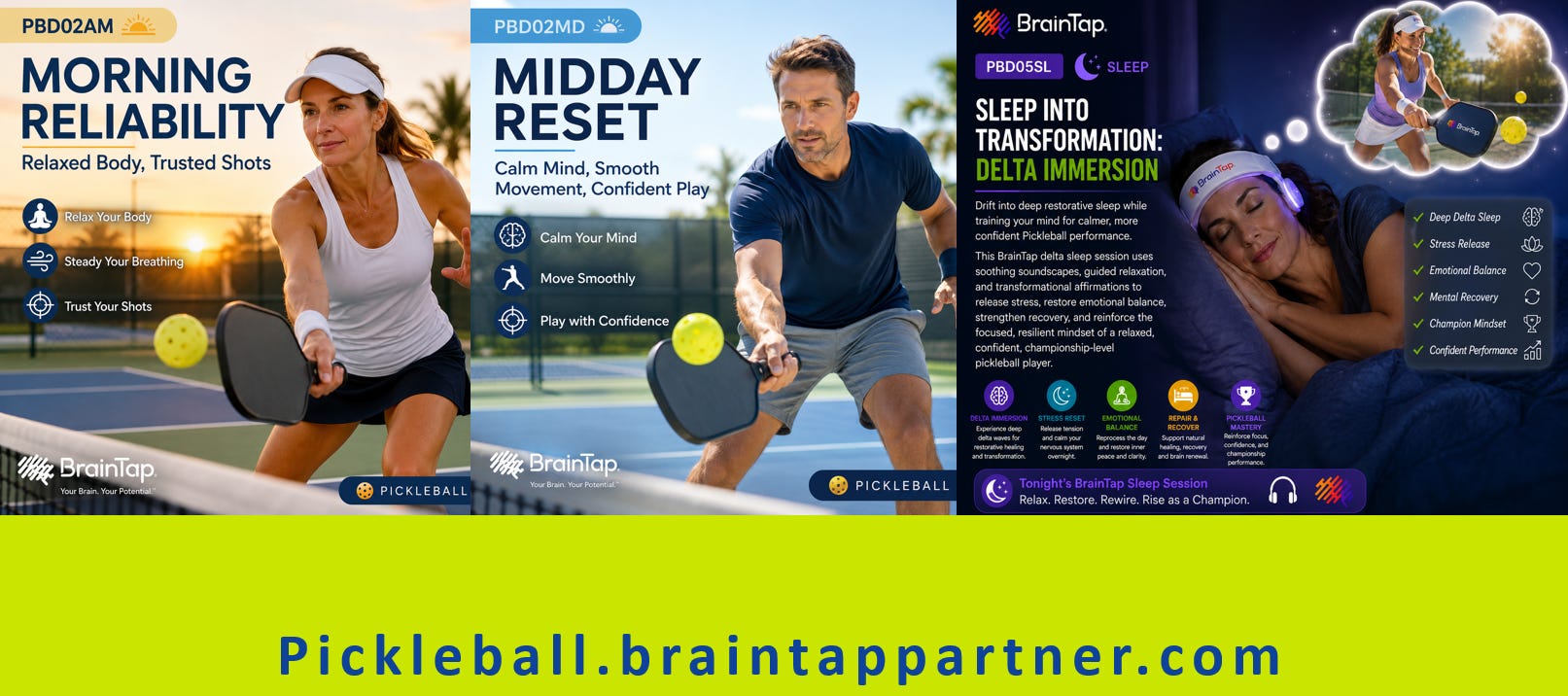
If you have been enjoying this brain fitness series for pickleball, you now have the opportunity to benefit from our more advanced brain fitness series for pickleball, sports, and for all aspects of your health and life with neuroscientist, Dr. Patrick Porter. Just click over to Pickleball on BrainTap
That’s pickleball.braintappartner.com/
Now back to the hands.
You returned the lob with a reset and you are back at the kitchen line with your partner. The ball is speeding up now and a drive comes at your body. Notice your hands, soft, quick, alive. Your paddle meets the ball out in front, a clean counter, no tension, no rush. Another attack, even faster. Your hands answer again, relaxed and instant, because your mind is quiet and quiet minds make fast hands.
Energy follows attention, and your attention is calm, wide, out in front of you, exactly where speed lives.
Remain here, in this theta state, while these patterns settle in.
Fast hands come from a calm mind. Smart feet come from rehearsed decisions.
As we rise, let’s build more capacity.
Breathe in deep through your nose, for 1, 2, 3, 4
And hold for 2, 3, 4, 5, 6
Breath out the mouth for 2, 3, 4, 5, 6, 7 ,8
This time hold out for as long as you can 1, 2, 3, 4, 6, 7, 8, 9, 10
Maybe more. Try it again.
Breathe in deep through your nose, for 1, 2, 3, 4
And hold for 2, 3, 4, 5, 6
Breath out the mouth for 2, 3, 4, 5, 6, 7 ,8
and hold out for as long as you can, 1, 2, 3, 4, 6, 7, 8, 9, 10
You’re coming back now, refreshed and sharp. Ready for the day and the play.
And here is your assignment,
because this session is not complete until it reaches the court. The very next time a lob goes up in your game, over your head or your partner’s, the call happens early and the coverage happens naturally. Mine. Turn and run. Return and reset.
At the kitchen, paddle up, hands soft, mind quiet.
Now, play several more points in your mind where you consciously notice how calm your hands feel, and how your feet make their turn and run. No, backpedaling!
Excellent, you are getting better at this.
For the rest of the day, remember…
Reset fast and Play free.
This is now the rhythm of your life.
Comments
Nothing yet. Say the first thing.
Sign in to join the conversation.